
Peptides
October 16, 2026
What thymosin beta-4 eye trials tell us—and why they don't validate TB-500 stacks
On this page
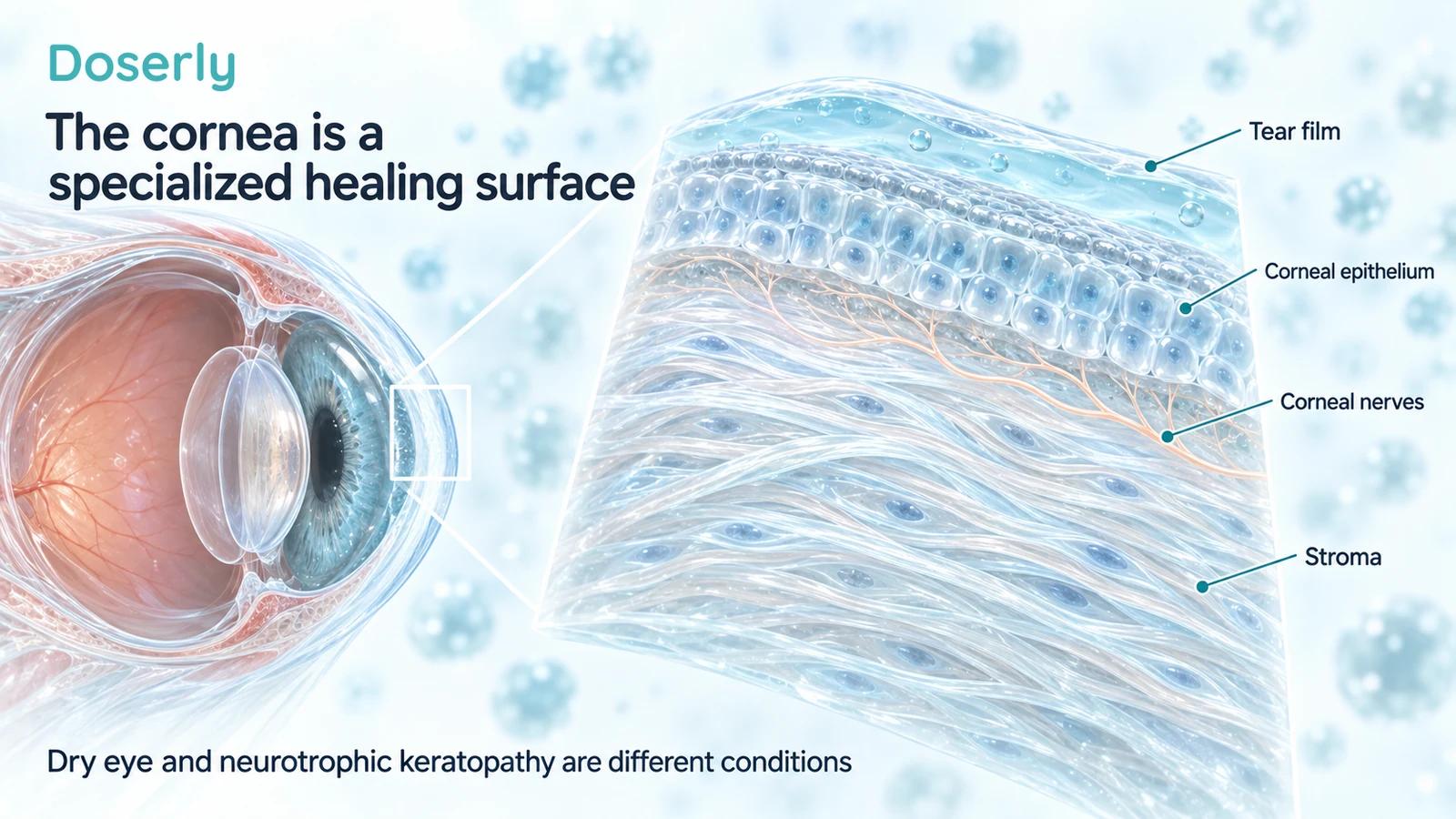
The cornea is the clear front surface of the eye. Its outer cells form a protective barrier, its nerves help regulate sensation and surface health, and the tear film keeps it moist. These features make corneal healing a specific clinical problem, with measurements that differ from those used to assess a painful tendon or injured muscle.
Thymosin beta-4 has been studied as an eye-drop treatment because researchers are interested in its effects on cell migration and surface repair. Those human studies are worth understanding. They do not validate a TB-500 injection stack for whole-body recovery. The molecule, formulation, route, patient population and outcome may all differ.
The eye evidence also deserves a more careful description than “successful phase 3 trials.” A large dry-eye trial missed its primary outcomes. A much smaller study in neurotrophic keratopathy had an encouraging numerical result, but its main comparison did not reach conventional statistical significance. Both facts belong in the discussion.
Dry eye and neurotrophic keratopathy are different problems
Dry eye can occur when too few tears are produced or when tears do not work adequately to keep the surface healthy. Symptoms may include burning, grittiness and fluctuating or blurred vision. Examination can assess tear production, tear stability and the surface itself. National Eye Institute: dry eye.
Neurotrophic keratopathy involves impaired corneal nerve function and can lead to persistent defects in the outer epithelial layer. A trial enrolling patients with such defects asks whether that surface closes and remains closed. That is not the same question as whether people with dry eye report less discomfort or show less staining on examination. The RGN-259 publication studied stages 2 and 3 neurotrophic keratopathy. Primary neurotrophic keratopathy trial.
The distinction matters because “eye healing” is too broad a summary. A treatment might help one condition without demonstrating benefit in another. Even within a condition, a change in a symptom and a change in an examination finding are related but separate results.
Which molecule was in the eye drops?
RGN-259 is an ophthalmic formulation containing thymosin beta-4. Full-length thymosin beta-4 has 43 amino acids. The substance FDA evaluated as TB-500 in its 2026 compounding briefing was the N-acetylated seven-amino-acid fragment Ac-LKKTETQ, considered in free-base and acetate forms. FDA TB-500 briefing.
A shared sequence does not establish that a fragment reproduces the longer peptide's clinical effects. Nor does a common marketing name establish the contents of a product. Before transferring an eye-trial result, the proposed recovery product would need an exact identity and evidence connecting its exposure to the intended tissue.
An ophthalmic preparation is also designed for application to the eye. Its concentration, accompanying ingredients and local exposure are part of the tested intervention. Injecting a different preparation does not recreate that experiment. Our TB-500 identity guide explains this distinction in more detail.
What happened in the large ARISE-3 dry-eye trial?
ARISE-3 enrolled 700 participants and compared RGN-259 with a placebo ophthalmic solution in a randomized, masked study. Treatment lasted 14 days, with primary assessments at day 15. The trial record describes both a corneal staining measurement and an ocular discomfort measurement. ARISE-3 registry and posted results.
The registry results, first posted in August 2026, show similar changes between groups. For the specified inferior corneal staining measure, the reported mean changes were −0.41 with RGN-259 and −0.46 with placebo. For ocular discomfort, both groups had a mean change of −0.4. These are changes in the trial's scoring systems, not percentages of people healed.
The sponsor's original March 2021 announcement said the trial did not meet its primary outcome measures. It reported improvement in ocular grittiness, a prespecified secondary symptom, and described additional exploratory analyses. Original sponsor announcement filed with the SEC.
The announcement is a primary source for what the sponsor reported, but it is not a peer-reviewed clinical paper. The later registry data provide more direct detail about the outcomes. Neither should be rewritten as a successful primary-endpoint trial merely because some secondary findings were favorable.
What the dry-eye measurements mean
Corneal staining is an examination finding. A dye helps reveal surface changes, which an assessor scores using a defined scale. Ocular discomfort is the participant's report of a symptom. In ARISE-3, the staining outcome also incorporated a controlled adverse environment, a standardized setting used to challenge the eye surface. That detail matters when interpreting the score: it is not a direct measurement of how many corneal cells regenerated. ARISE-3 record.
A negative change on these scales generally indicates improvement in the measured feature, but improvement in both groups does not establish an added drug benefit. The comparator contains the formulation's accompanying ingredients without thymosin beta-4. Comparing the groups therefore asks what the peptide adds to that control under the study conditions. It does not compare treatment with doing nothing, and it does not measure months of everyday functioning after treatment ends.
Why the primary and secondary findings matter differently
A primary outcome is the central measurement a trial is designed to test. Choosing it beforehand helps prevent researchers from looking across many measurements and promoting whichever looks best afterward. Secondary outcomes can still be useful, especially when they are prespecified, but they do not erase an unsuccessful primary comparison.
Here, ocular grittiness might be relevant to patients and worth studying further. That is a narrower statement than saying the trial conclusively demonstrated broad corneal repair. It also leaves open questions about reproducibility, size of benefit and which patients might benefit.
Post-hoc analyses, planned after examining the data, can suggest populations or measurements for future research. They are vulnerable to finding patterns that do not repeat. A promising subgroup should therefore be described as a hypothesis to confirm rather than treated as if it had been the trial's original success criterion.
For someone reading a treatment advertisement, the practical question is whether the claimed benefit matches the outcome that actually improved. “Less grittiness at a particular assessment” is not equivalent to “heals damaged tissue throughout the body.”
What the smaller corneal-defect trial found
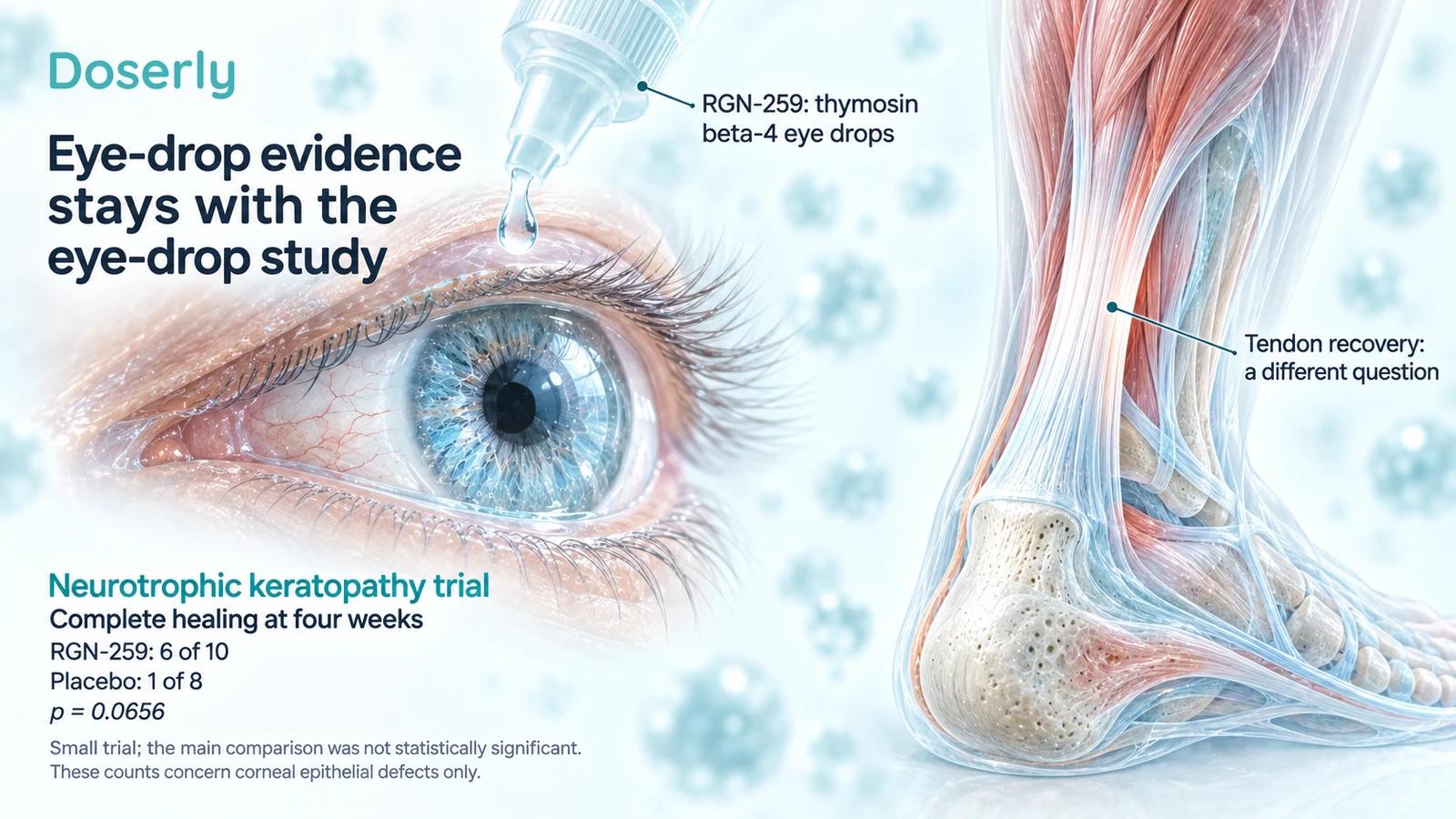
The neurotrophic keratopathy trial randomized 18 participants: ten received 0.1% RGN-259 and eight received placebo. At four weeks, complete healing occurred in six treated participants and one placebo participant. The reported p-value was 0.0656. Primary trial report.
That numerical difference is encouraging, but the main comparison did not cross the conventional 0.05 threshold. With such small groups, estimates are uncertain. The paper also reported favorable later and secondary findings, including healing at day 43, but those should remain distinguished from the main four-week comparison.
A result just above a statistical threshold is not proof that a treatment has no effect. It also isn't a confirmed benefit that becomes established by calling it a strong trend. The appropriate conclusion is that the small study offers a signal requiring more precise confirmation.
The outcome was closure of a persistent corneal epithelial defect. It was not tendon strength, muscle regeneration, reduced recovery time after training or the safety of combining two injected peptides. Keeping that outcome visible protects the value of the actual eye research.
What about the newer TB500 corneal hydrogel paper?
A 2025 materials study described an enzyme-responsive hydrogel incorporating the LKKTETQ sequence into a modified precursor called Nap-YpYY-TB500. The design uses an enzyme-triggered change to promote local assembly of a gel. In cultured human corneal cells, the investigators studied migration, proliferation and barrier-related behavior. Primary hydrogel paper.
This is a different preparation again. It is not RGN-259, and it is not a simple clinical injection of the seven-amino-acid N-acetylated fragment. The delivery material is central to the research question because retaining a substance at an injured eye surface is part of what the researchers are trying to solve.
Human-origin cells in culture do not make the experiment a human treatment trial. The accessible primary abstract did not provide a clinical patient comparison. Its findings should therefore be described as preclinical formulation research, without inventing a human dose or recovery rate.
The paper is a useful example of why the exact preparation matters. Changing delivery can be scientifically interesting, but a new engineered formulation needs its own development and clinical evidence. Its results cannot simply be assigned to every product using the TB500 name.
Eye-drop tolerability does not establish injection-stack safety
ARISE-3's sponsor reported no serious adverse events and mostly mild to moderate events in both groups. Its report included mild ocular pain on instillation. That information concerns a short ophthalmic exposure in a defined study population. Sponsor report.
A recovery stack introduces additional questions. Which substances are actually present? How are they formulated and administered? Does adding another peptide change exposure, tolerability or the ability to identify what caused an adverse event? An eye-drop trial answers none of those combination questions.
FDA's review found no human clinical evidence for the specific TB-500 substances it evaluated. The absence of those data cannot be repaired by transferring safety observations from a different molecule and route. FDA briefing.
This doesn't mean the eye results should be ignored. It means their safety scope should be stated accurately, just as their efficacy scope is. The same standard applies to both favorable and unfavorable findings.
What would connect this research to tendon recovery?
Researchers would first need to identify the recovery product and show how it behaves after the proposed route of administration. A clinical trial would then need a defined injury population, an appropriate control and outcomes such as function, strength or healing assessed in a way relevant to that injury.
For a combination, testing each ingredient separately would not be enough. The combination would need comparison with its components and appropriate background care. Otherwise, even a positive result would not tell us whether the second ingredient adds anything or simply adds exposure.
The biology of cell migration can provide a reason to develop such a program. It cannot determine its result in advance. Corneal epithelial closure, tendon load tolerance and a person's ability to return to work are distinct outcomes requiring their own measurements.
How to use the eye evidence in a clinical discussion
If your concern is dry eye, start with an eye examination and a diagnosis. The National Eye Institute describes treatments selected according to the underlying cause, including established lubricating and prescription options. A peptide-recovery discussion should not substitute for that assessment. NEI guidance.
If your concern is a tendon or muscle injury, ask why an eye trial is being cited. The answer may be a biological rationale for further research, which is different from evidence that the proposed treatment improves your injury. Ask for the completed study of the actual product, route and outcome being recommended.
Our TB-500 human-evidence guide provides the wider context. The eye studies contribute real information: a large dry-eye trial with unsuccessful primary outcomes, a small corneal-defect trial with an uncertain but encouraging signal, and specialized formulation research. None establishes a clinically validated TB-500 recovery stack.
Explore the research
- ARISE-3 registry and results: 700 participants; results first posted August 2026.
- RegeneRx's original ARISE-3 announcement: sponsor-reported failure of primary outcomes and secondary findings.
- RGN-259 neurotrophic keratopathy trial: 18 participants; four-week comparison p=0.0656.
- Enzyme-responsive corneal hydrogel study, 2025: modified preparation and preclinical cell research.
- FDA TB-500 briefing, 2026: evaluated fragment identity and human-evidence limitations.
- National Eye Institute: dry eye: clinical background and established care.