
TRT
October 16, 2026
Why “crash your estrogen” is bad hormone reasoning
On this page
Estradiol is a hormone men make and use throughout life. Some comes from converting testosterone through an enzyme called aromatase. When testosterone treatment changes the amount of testosterone available, estradiol can change too. That does not automatically mean treatment has gone wrong.
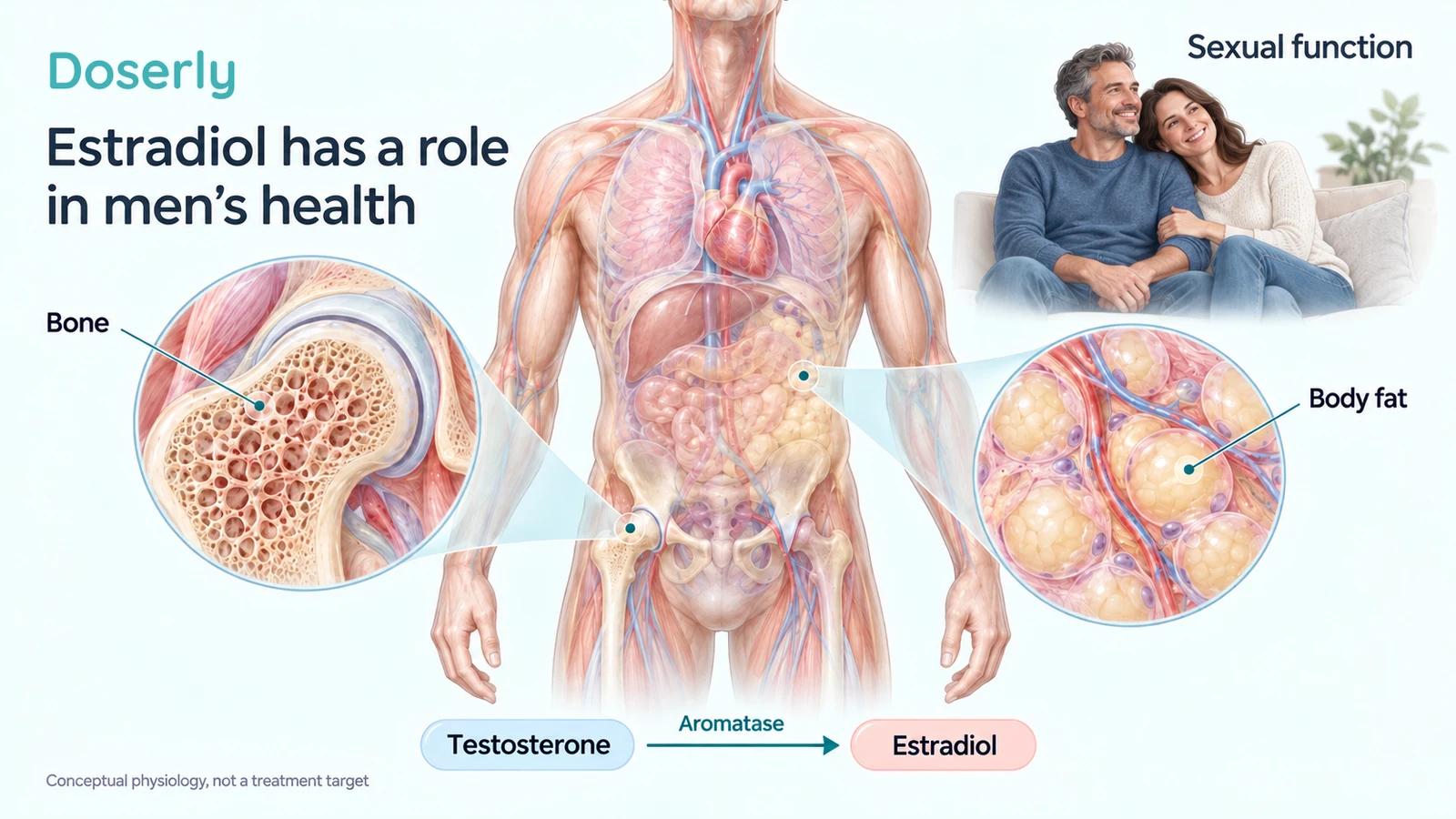
The practical question is what to do when a blood result rises, or when someone feels worse and wonders whether estrogen is responsible. Deliberately pushing estradiol as low as possible is a poor goal: the hormone contributes to bone health, body-fat regulation and sexual function. Those roles do not disappear when testosterone comes from a prescription. Human experiments help explain why. Hormone-suppression study.
This article looks at the biology behind that advice, the limits of a laboratory number and how to approach symptoms without assuming their cause. Our estrogen management guide provides a broader introduction to estradiol during testosterone replacement therapy, or TRT.
What does estrogen do in a male body?
“Estrogen” describes a family of hormones; estradiol, often abbreviated E2 on a laboratory report, is one member. Calling it a female hormone can obscure its importance in men. Testosterone and estradiol have overlapping but different effects, and having enough of one does not make the other unnecessary.
A useful clue comes from an unusual patient reported in 1994. A 28-year-old man with a disruptive estrogen-receptor mutation had normal testosterone but markedly impaired skeletal maturation and low bone density. His body could make estrogen, but could not respond to it normally. The case helped establish that androgen exposure alone was insufficient for normal male skeletal development. It was a rare genetic disorder, not a model of ordinary TRT, and cannot supply a target estradiol value for everyone. Original case report.
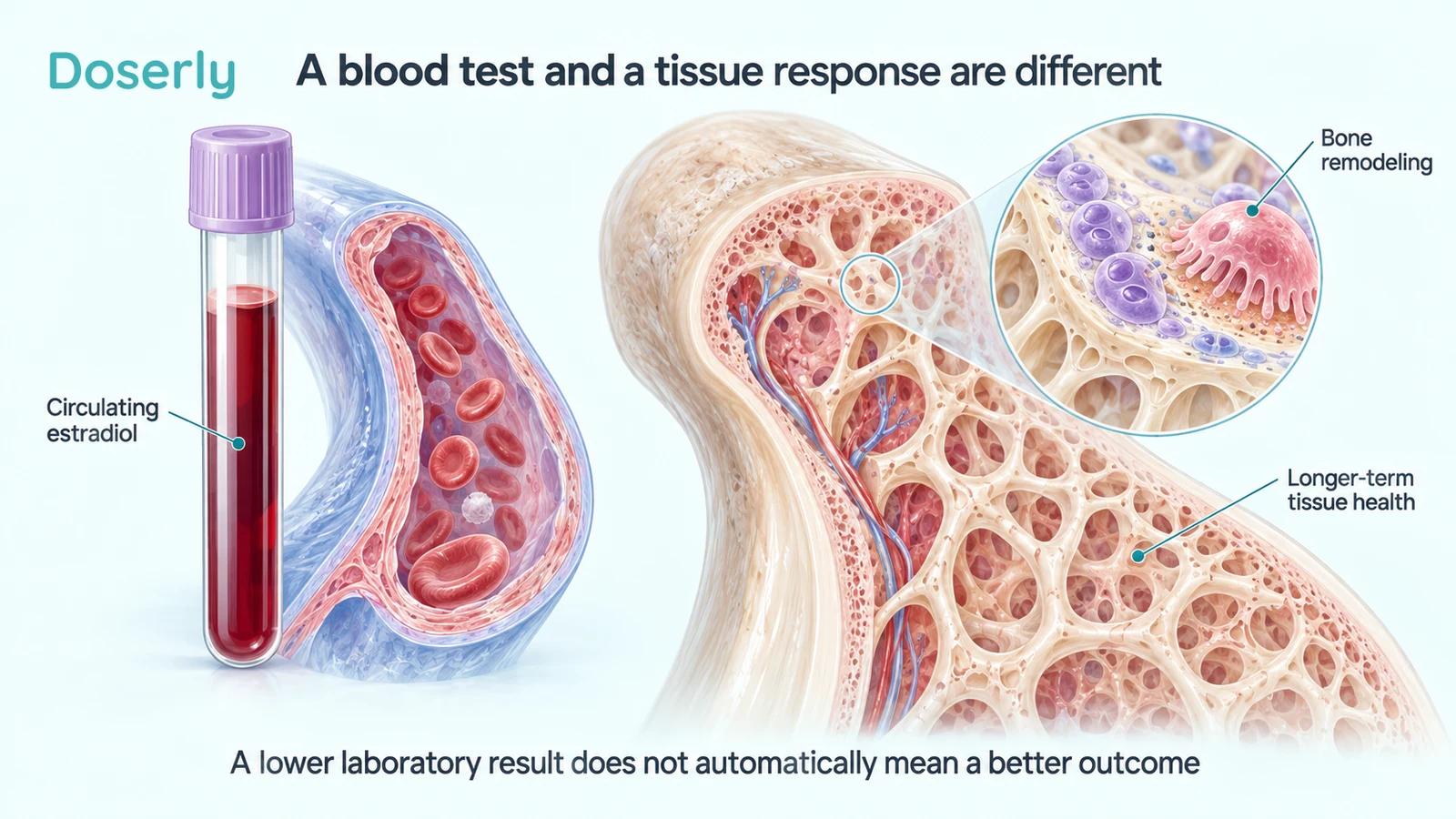
There is also a distinction between the hormone in circulating blood and hormone activity within tissues. A blood test samples one part of the system. It does not directly measure estrogen-receptor activity in bone, breast tissue or the brain. That is one reason a laboratory result needs interpretation rather than a reflex response.
The useful idea is physiological balance, but even that phrase can be misleading if it suggests a single ideal ratio. Different tissues respond differently, and the available clinical studies do not establish a universal testosterone-to-estradiol ratio that guarantees good symptoms. A ratio also changes numerically when laboratories report the hormones in different units. Before discussing any proposed ratio, identify exactly what it is supposed to predict.
What happens when researchers suppress estradiol?
In a 2013 experiment, researchers temporarily suppressed the participants’ own testosterone production and assigned different testosterone-gel exposures. One cohort included 198 healthy men aged 20–50. Another 202 men underwent the same general intervention with anastrozole, which inhibits aromatase and limits conversion to estradiol. Follow-up lasted 16 weeks.
The investigators measured body composition, muscle size, strength and sexual function. Testosterone deficiency accounted for reductions in lean mass, muscle size and strength; estrogen deficiency primarily accounted for increases in body fat. Both hormones contributed to sexual function. These findings show why a higher testosterone result cannot be assumed to compensate for very low estradiol. Finkelstein and colleagues.
The experiment involved deliberate short-term hormone manipulation in healthy volunteers. It was not a trial comparing two long-term treatment strategies in men already receiving TRT. Its value here is explaining physiology, not establishing an anastrozole schedule or a personal threshold below which symptoms must occur.
For a reader worried about libido, that distinction is useful. The study makes low estrogen a biologically plausible contributor to sexual difficulties. It does not let someone diagnose low estradiol from libido alone. The same symptom can arise through several pathways.
Bone health makes “lower is better” especially questionable
Bone is living tissue that is continually renewed. Bone mineral density describes the mineral content measured by a scan; it is related to skeletal strength, although it is not itself a count of fractures.
A one-year randomized trial studied 69 men aged at least 60 with low or borderline testosterone and symptoms. Anastrozole increased testosterone and reduced estradiol, but spine bone mineral density fell relative to placebo. The study did not show that every man taking anastrozole will develop osteoporosis, and it was not a trial of intermittent add-on treatment during TRT. It did show that an apparently favorable testosterone change can accompany an unfavorable skeletal measurement. Burnett-Bowie and colleagues.
That is a concrete reason to ask about duration and monitoring when estrogen suppression is proposed. The treatment goal cannot be assessed only by whether the next blood result is lower. Relevant questions include why the drug is being used, whether the original complaint improves, and whether the exposure introduces other concerns over time.
Bone health also helps explain why feeling fine today cannot establish long-term safety. A symptom diary and a bone-density scan answer different questions. Neither replaces the other.
Does an elevated estradiol result always need treatment?
No single result can answer that without the clinical setting. A reference interval describes a laboratory’s comparison population and method; it is not automatically a treatment threshold. A flagged value may deserve investigation, but a flag alone does not establish that suppressing the hormone will help.
The American Urological Association discusses estradiol testing particularly in men with breast symptoms or gynecomastia, meaning enlargement of glandular breast tissue. It also notes that some breast symptoms appearing during testosterone therapy can settle with clinical monitoring. This is a more specific approach than treating every higher estradiol value. AUA guideline.
Consider two hypothetical consultations. One person feels well, has no breast changes and brings an unexpected isolated result. Another reports a new tender lump. They may have the same laboratory value, but they do not have the same clinical question. The first discussion may focus on confirming and contextualizing the measurement; the second also requires examination of a symptom.
These examples are not instructions to ignore abnormalities. They show why the reason for ordering a test matters. A result used to investigate a new symptom is different from a result being chased without a defined problem.
How reliable is the estradiol test?
Estradiol concentrations in men can be challenging to measure accurately. An Endocrine Society position statement described problems with sensitivity, specificity and agreement between methods, particularly at low concentrations. Mass-spectrometry methods can address some limitations, but the laboratory’s validation and performance matter too. A test name containing “sensitive” does not, by itself, explain how dependable a particular result is. Measurement position statement.
Ask which method was used, what units appear on the report and whether comparison tests used the same method. If treatment decisions hinge on a surprising value, the clinician may want confirmation before changing medicines. Old numerical claims about assay limitations should not be assumed to describe every laboratory in use today.
A practical record includes the collection date, time, testosterone product and recent medication changes. Keep the original report when possible. A remembered number without its units or laboratory method is harder to interpret, especially if care is shared between clinicians.
Measurement uncertainty does not mean symptoms are imaginary or testing is pointless. It means that a result should be good enough for the decision being made. The more consequential the treatment change, the more useful it is to resolve a questionable measurement first.
Why symptoms cannot identify estrogen on their own
Low libido, fatigue or a change in mood can be distressing. They can also have multiple causes. In its July 2026 statement, the Endocrine Society emphasized that these symptoms are not specific even for testosterone deficiency and that reversible contributors need attention. The same caution applies when symptoms are used to declare estradiol too high or too low. Endocrine Society statement.
Start with a description instead of a hormone label. “My desire declined after this medication change” preserves useful information. “My estrogen is high because my desire declined” adds a conclusion that has not yet been established.
Timing can narrow a discussion without settling causation. Note whether the problem began before TRT, after a formulation change, after another medication was added or during a period of disrupted sleep. If several things changed together, say so. A clinician can work with an imperfect timeline; an overconfident explanation may obscure it.
The point of recording symptoms is to make follow-up more informative. Choose the complaint that matters most, describe its severity and its effect on daily life, and identify when it changes. Checking every hour or repeatedly adjusting treatment to a passing sensation can make the pattern harder to understand.
Breast symptoms deserve an examination
Breast tenderness is not interchangeable with gynecomastia, and gynecomastia is not the only possible explanation for a breast lump. The European Academy of Andrology recommends assessing underlying conditions, medication or substance exposures, and other breast lesions. The evaluation can include examination and selected laboratory tests; imaging or biopsy depends on what is found. EAA guideline.
This matters because lowering estradiol cannot substitute for identifying a lump. A persistent or changing breast abnormality should be brought to a clinician even if it appeared soon after starting TRT. Giving the timing is helpful; assuming the timing proves the diagnosis is not.
The guideline does not recommend aromatase inhibitors as a general treatment for gynecomastia. That is different from claiming that no specialist could ever justify one in a selected situation. Individual treatment decisions need a defined indication and a plan for assessing benefit.
What should a treatment discussion actually establish?
If an estrogen-lowering medicine is being considered, ask what problem it is intended to solve. The answer should be more specific than “balance your hormones.” Is the concern an examined breast symptom, a reproducibly abnormal result with a clinical explanation, or something else?
Next, ask what would count as success. A laboratory response may confirm that a drug is affecting its target, but it does not automatically show that the original complaint improved. The plan should allow both observations to be considered. If the number changes and the symptom does not, that is useful information rather than a reason to keep intensifying the same approach indefinitely.
A reasonable discussion also includes when to review the plan and what would lead to changing or stopping it. These are questions for the prescribing clinician, particularly if you already take anastrozole or another hormone-active medicine. This article does not supply a dose, a taper or a self-directed experiment.
You can prepare a short medication list that includes testosterone formulation, all prescribed add-ons, nonprescription supplements and recent changes. Bring relevant laboratory reports and a concise symptom timeline. This makes it easier to discuss the entire treatment picture rather than treating estradiol as an isolated problem.
The goal is useful treatment, not the lowest estradiol
The human evidence makes one point clear: estradiol has meaningful functions in men. It does not establish that more is always better, and it does not validate a universal target for people using testosterone. Both overconfident reassurance and aggressive suppression can bypass the actual clinical question.
If you are feeling worse on TRT, that deserves attention. Start with what changed, confirm the measurements that matter and investigate the symptom. If you feel well but a result is flagged, ask what that result means in your particular treatment context before assuming another medicine is required.
Our estrogen management guide explains the wider physiology and monitoring discussion. The most useful endpoint is a treatment plan with a clear purpose, an assessable benefit and appropriate follow-up—not a contest to produce the smallest number.
Sources
- Gonadal Steroids and Body Composition, Strength, and Sexual Function in Men
- Effects of Aromatase Inhibition on Bone Mineral Density and Bone Turnover in Older Men with Low Testosterone Levels
- Challenges to the Measurement of Estradiol: An Endocrine Society Position Statement
- Evaluation and Management of Testosterone Deficiency: AUA Guideline
- EAA Clinical Practice Guidelines—Gynecomastia Evaluation and Management
- Estrogen Resistance Caused by a Mutation in the Estrogen-Receptor Gene in a Man
- Statement on Testosterone Replacement Therapy