
Peptides
October 16, 2026
Why IGF-1 LR3 cell studies cannot establish a bodybuilding protocol
On this page
A photograph of developing muscle cells can make a growth-factor claim feel tangible. Cells exposed to IGF-1 LR3 may show changes in differentiation or protein-related processes, and an animal experiment may report heavier muscle. Those observations deserve attention. They do not tell a person how to use LR3 safely or whether it will improve strength.
The gap is more specific than “animals are different from humans.” The substance, delivery method, exposure, tissue environment and outcome can all change between a dish and a training program. A protocol would need evidence across those steps, including unwanted effects.
Recent primary studies illustrate the problem well: LR3 can affect muscle-cell development, yet preserving or increasing muscle mass has not consistently meant preserving or increasing measured force. Cell and mouse experiments, 2026 rat muscle-injury study
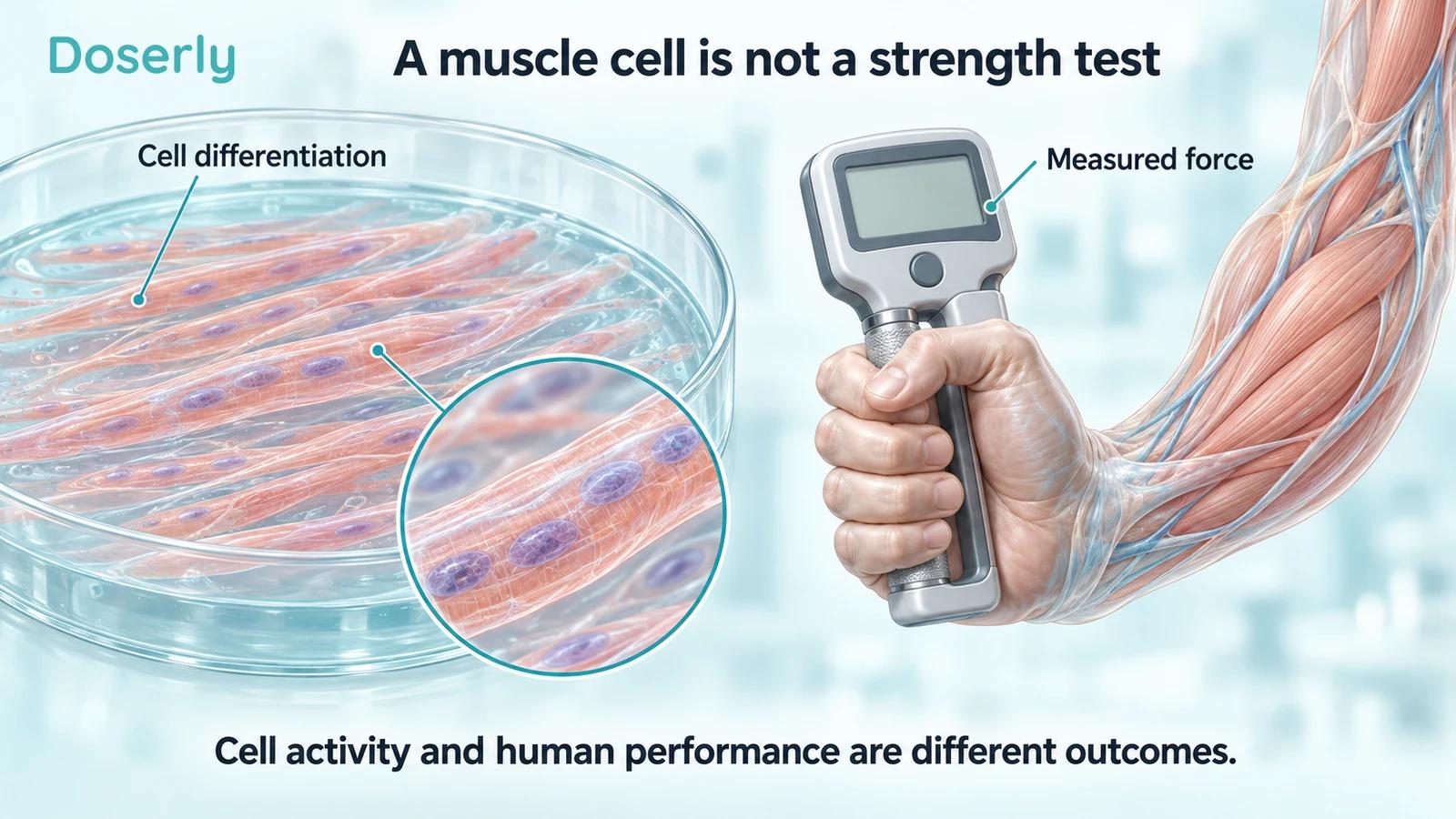
What LR3 contributes to a cell-culture experiment
Long R3 IGF-I is an altered IGF-I analogue developed for research applications. Its reduced affinity for IGF-binding proteins helps explain its activity in cell culture. Repligen supplies it as a cell-culture supplement and describes specific molecular changes, including an extension and an amino-acid substitution. Manufacturer documentation
A culture experiment deliberately simplifies biology. Investigators choose a cell type, medium, concentration and observation period. They can compare treated cells with controls under conditions that would be difficult to isolate in a person.
That control is a scientific strength. It allows a narrower question to be answered: does the intervention alter this response in this model? The problem begins when that answer is rewritten as a broader claim that the experiment never tested.
For example, a culture condition that encourages muscle precursors to fuse into myotubes can help explain muscle development. It does not establish how much useful contractile tissue an adult will gain, how long it will last or what happens elsewhere in the body.
A concrete example: myoblasts becoming myotubes
A 2019 study used C2C12 mouse skeletal-muscle cells to investigate muscle wasting pathways. Researchers tested LR3 alongside compounds that inhibit activin-like kinases. They evaluated a fusion index, based on the proportion of nuclei found in multinucleated myotubes, and counted nuclei within cells. LR3 enhanced differentiation under the studied culture conditions. Levolger and colleagues
The terminology matters. A myoblast is a muscle precursor cell; a myotube is an elongated, developing muscle structure formed through cell fusion. Counting nuclei in those structures is a way to study differentiation. It is not a miniature strength test.
Nor does a higher fusion index mean that a person's muscle mass will increase by the same percentage. The denominator is a cell-culture measurement, not the participant's body composition. Converting one percentage into the other changes the meaning of the result.
The paper is useful evidence that LR3 can influence a biological process in a defined setting. It does not provide an adult training outcome simply because the cells are described as skeletal muscle.
Concentration in a dish is not an administered human amount
Cell papers commonly describe exposure as an amount per volume of culture medium. That tells you what was added around the cells. It does not describe an injection amount, a blood concentration after administration or a concentration reached within a person's muscle.
Several steps would need to be measured before those quantities could be connected. How much reaches the circulation? How does it distribute? How much binds other proteins? How quickly does it disappear from blood, and does it remain active in tissue? How variable are those answers between people?
Multiplying a dish concentration by estimated blood volume does not solve these questions. It assumes away distribution, clearance and tissue access. Scaling an animal amount by body weight alone has the same problem: arithmetic does not supply missing pharmacokinetic evidence.
A genuine clinical development program investigates those relationships rather than treating them as known. Without them, a detailed schedule can look scientific while resting on untested assumptions.
The same muscle-wasting paper shows why function matters
The 2019 investigators also studied mice bearing C26 tumours, a model of cancer-associated muscle wasting. LR3-treated animals retained more of certain muscle weights than untreated tumour-bearing animals, but they still developed loss of grip strength. The study also raised concern about tumour growth. Its detailed results describe higher tumour weights that did not reach statistical significance in the LR3 comparisons. Full study
These findings do not establish an effect in healthy adults. They do show why selecting only the muscle-mass outcome can distort the study's message.
A person interested in performance wants more than tissue weight. The tissue needs to generate force and work within an intact neuromuscular system. If an intervention changes mass while function worsens or remains unchanged, the mass result cannot stand in for an overall benefit.
The adverse-outcome observations also belong in the interpretation. A growth-related intervention cannot be judged only by the tissue a user hopes it will affect.
A newer experiment separates muscle weight from torque
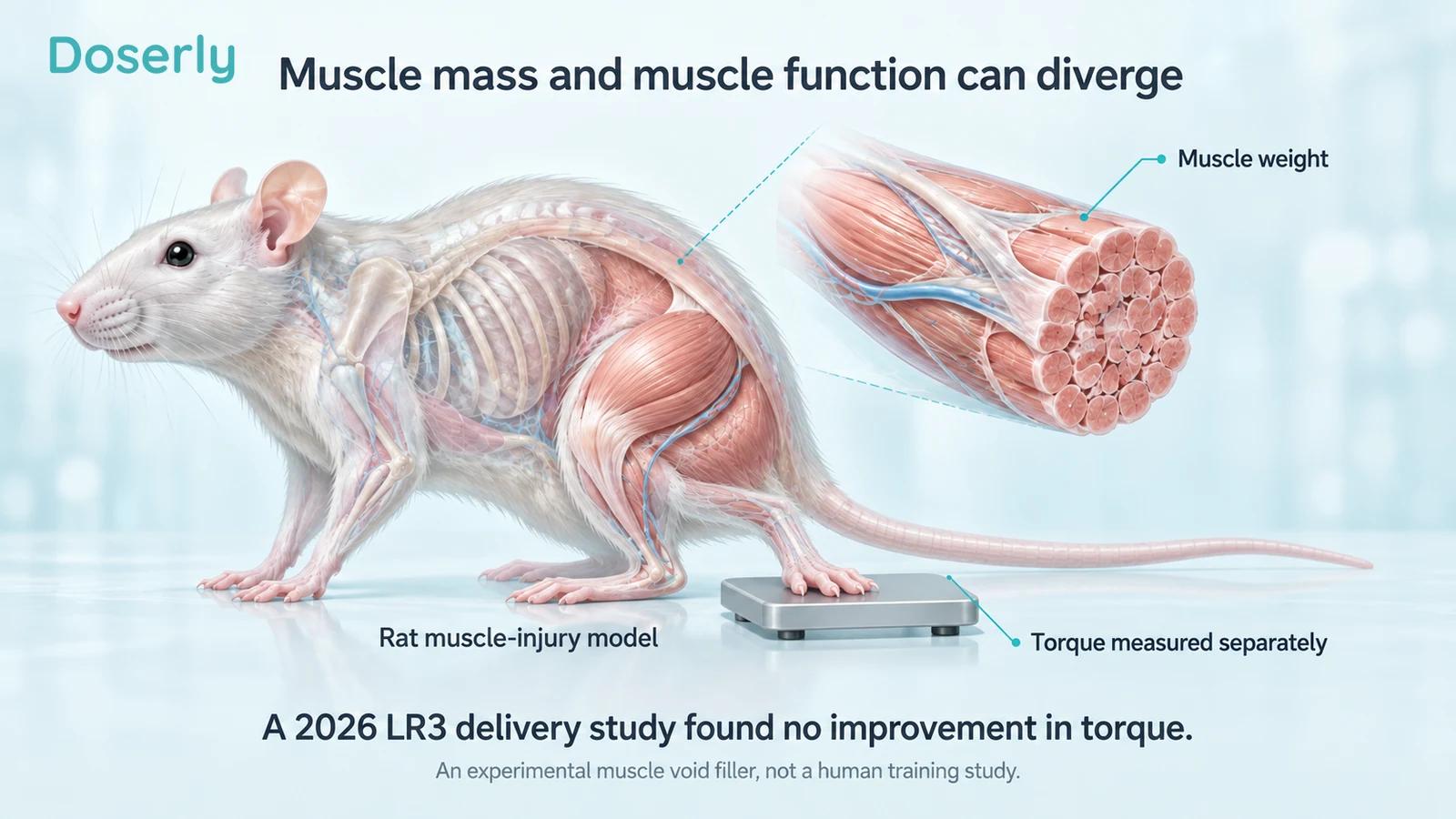
A study published in the January 2026 issue of the Journal of Surgical Research investigated LR3 in a muscle void filler after surgically created volumetric muscle loss in adult male rats. The intervention used a synthetic hydrogel, with soluble or encapsulated LR3, rather than a consumer injection routine. Researchers measured muscle tissue and isometric torque. Clark and colleagues
One encapsulated treatment group had higher muscle weight at 28 days. However, the investigators found no differences in maximum or specific torque between experimental groups, and no improvement in muscle-fibre size or count.
This is not proof that every possible LR3 intervention must fail. It is direct evidence that a plausible growth-factor delivery strategy did not achieve the desired functional result in that experiment.
The delivery system is also part of the intervention. A material placed into a muscle defect is not equivalent to circulating LR3 in a person with intact muscle. Removing that detail turns a tissue-engineering experiment into a claim about something else.
Fetal growth research answers another distinct question
A 2021 study infused LR3 into late-gestation fetal sheep for one week. Among the evaluated fetuses, several organs were heavier, while total fetal weight was not statistically different between groups. The researchers also found changes in nutrient measures and muscle-cell proliferation, without a corresponding difference in fetal protein kinetic rates. Stremming and colleagues
That study concerns fetal development and placental nutrient supply. A fetal muscle precursor's response is not evidence for a training protocol in an adult. It is especially misleading to summarize selective organ growth as a general demonstration of desirable muscle gain.
The broader lesson is that “growth” needs an object. Growth of which cells or organs, at which stage of development, and with which functional consequences? A paper's title may be broad; its measurements are more specific.
This distinction also prevents a safety mistake. An intervention that affects growth in several tissues is not automatically targeted to skeletal muscle just because that is the intended goal.
Older anabolic studies have their own boundaries
In 1992, investigators compared IGF-I variants in dexamethasone-treated rats. LR3 and another modified IGF form showed greater anabolic potency than native IGF-I on some measures in that induced catabolic state. Tomas and colleagues
That experiment helps explain why researchers were interested in the analogues. It does not establish that healthy adults would reproduce the same balance of muscle, organ and metabolic changes.
A study designed to counter a drug-induced breakdown state starts from a different baseline than resistance training. Restoring a disrupted process and pushing an already functioning process further are different therapeutic hypotheses. Both require testing.
The historical results should therefore remain attached to their model. They can support further research without supporting a consumer instruction to copy an animal schedule.
Binding proteins complicate the translation further
The biological activity of IGF compounds depends partly on binding proteins. In a 1993 study, LR3 interacted much less strongly with several binding proteins and had greater activity in a muscle-cell assay. In rats, it also cleared from blood faster than native IGF-I. Ballard and colleagues
That combination is a warning against treating cell potency as a direct measure of duration in the body. More activity under one laboratory condition does not mean a longer human half-life or predictable exposure at the desired tissue.
The result also explains why “long” in a name should not be treated as a dosing instruction. The relevant measurements must be made for the actual molecule, route and population. A commercial description cannot fill that evidence gap.
What would support a bodybuilding claim?
The study would first need to use the actual intervention being discussed. It would need an appropriate adult population, a comparison group and enough follow-up to distinguish a sustained benefit from an early measurement change.
For a muscle-building claim, useful outcomes would include reliable body-composition measurements and direct assessments of strength or function. Researchers would also need to account for training, nutrition and other substances, because those can change the same outcomes.
Safety assessment would need to extend beyond the desired tissue and beyond participants saying they felt fine. The study should define adverse events in advance and explain how they were detected. Product identity and exposure would have to be sufficiently controlled for the results to be interpretable.
These are criteria for evaluating a claim, not a proposed self-experiment. A person cannot recreate a controlled trial by logging measurements while using an uncertain product.
Why an anecdotal transformation cannot close the gap
Someone may report gaining weight, looking fuller or lifting more after starting LR3. That observation can be sincerely described without identifying its cause.
Changes in training, food intake, hydration, other hormones and measurement methods can accompany the same period. If several things changed together, attributing the result to one substance requires more than the timing.
Before-and-after photographs add further uncertainty because lighting, posture and selection influence what is visible. They cannot establish product identity or detect a silent adverse effect. A persuasive story and a causal comparison are different forms of evidence.
A useful discussion separates what happened from what caused it. That preserves the person's experience without treating it as a validated protocol.
Reading the next LR3 paper
Look first for the exact molecule and how it was delivered. Then locate the model: cell line, animal species, disease state or human population. Identify the primary outcome before looking at the most impressive number.
Read the results that did not improve, and check whether unwanted effects were measured. In particular, distinguish protein signalling, cell differentiation, tissue weight, body composition and force production. Each can matter, but none automatically proves the next.
The Doserly IGF-1 LR3 guide provides broader context for the analogue. For this question, the central finding is narrower: the available cell and animal observations explain why LR3 is biologically interesting, while leaving the human performance and safe-use questions unresolved.
Sources
- Repligen Long R3 IGF-I documentation
- Cell differentiation and cancer-cachexia mouse experiments
- LR3-releasing muscle void fillers in rats
- LR3 infusion in fetal sheep
- IGF variants in dexamethasone-treated rats
- Binding proteins, biological activity and clearance