
Peptides
October 16, 2026
Epitalon and cancer cells: what the findings can—and cannot—tell us
On this page
Epitalon attracts interest because laboratory experiments suggest it can change how cells maintain their telomeres, the protective structures at chromosome ends. That makes the cancer question unavoidable. A process that helps a cell keep dividing can have different implications in healthy tissue and in a cell that has already become malignant.
The most useful answer is not a simple “causes cancer” or “prevents cancer.” A 2025 study found telomere-related responses in breast cancer cell lines as well as normal cell models. It did not expose people to Epitalon or measure cancer diagnoses. Its findings identify biology that deserves investigation; they do not calculate a person's cancer risk. Original cell study.
Here we look at why those cells were studied, how the results fit with older animal experiments, and what remains unknown for someone considering Epitalon—particularly someone with a cancer history. Our Epithalon guide covers the wider compound background.
Why telomeres matter in cancer biology
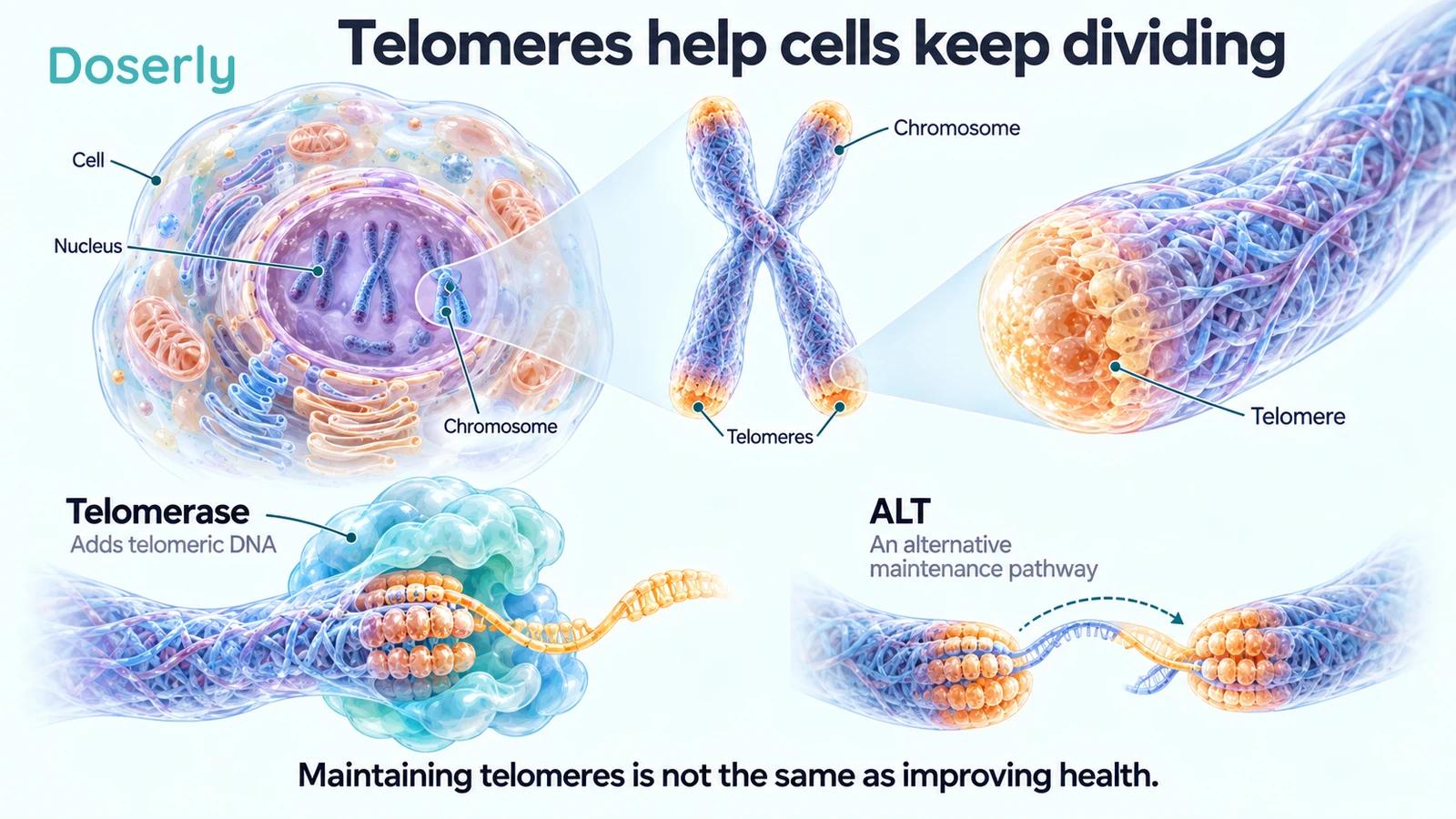
Chromosomes contain DNA, and their ends need specialized protection. Telomeres contain repeated DNA sequences together with associated proteins. In many dividing cells, telomeres shorten over time. When chromosome ends become critically dysfunctional, cells can stop dividing or die. That response can limit the expansion of a damaged cell population.
Telomerase is an enzyme that helps maintain telomeres by adding telomeric DNA. Another route is alternative lengthening of telomeres, usually abbreviated ALT, which involves a different maintenance process. These are cellular mechanisms, not clinical diagnoses. A change in either pathway does not mean that a normal cell has necessarily become cancerous.
Cancer develops through multiple changes. Telomere maintenance can help an abnormal cell population persist, but it is not the only requirement for malignancy. The relevant question is therefore not whether telomeres are simply “good” or “bad.” It is which cells are affected, what other changes those cells carry, and what happens in the surrounding tissue.
Human genetics illustrates why longer telomeres cannot automatically be treated as healthier. A 2023 study of families carrying variants in POT1, a telomere-related gene, identified a syndrome involving unusually long telomeres, expansion of particular blood-cell populations and various tumors. This was research on an inherited condition, not on Epitalon. Its relevance is biological: more cellular replicative capacity is not universally beneficial. DeBoy and colleagues.
What the 2025 Epitalon experiment actually compared
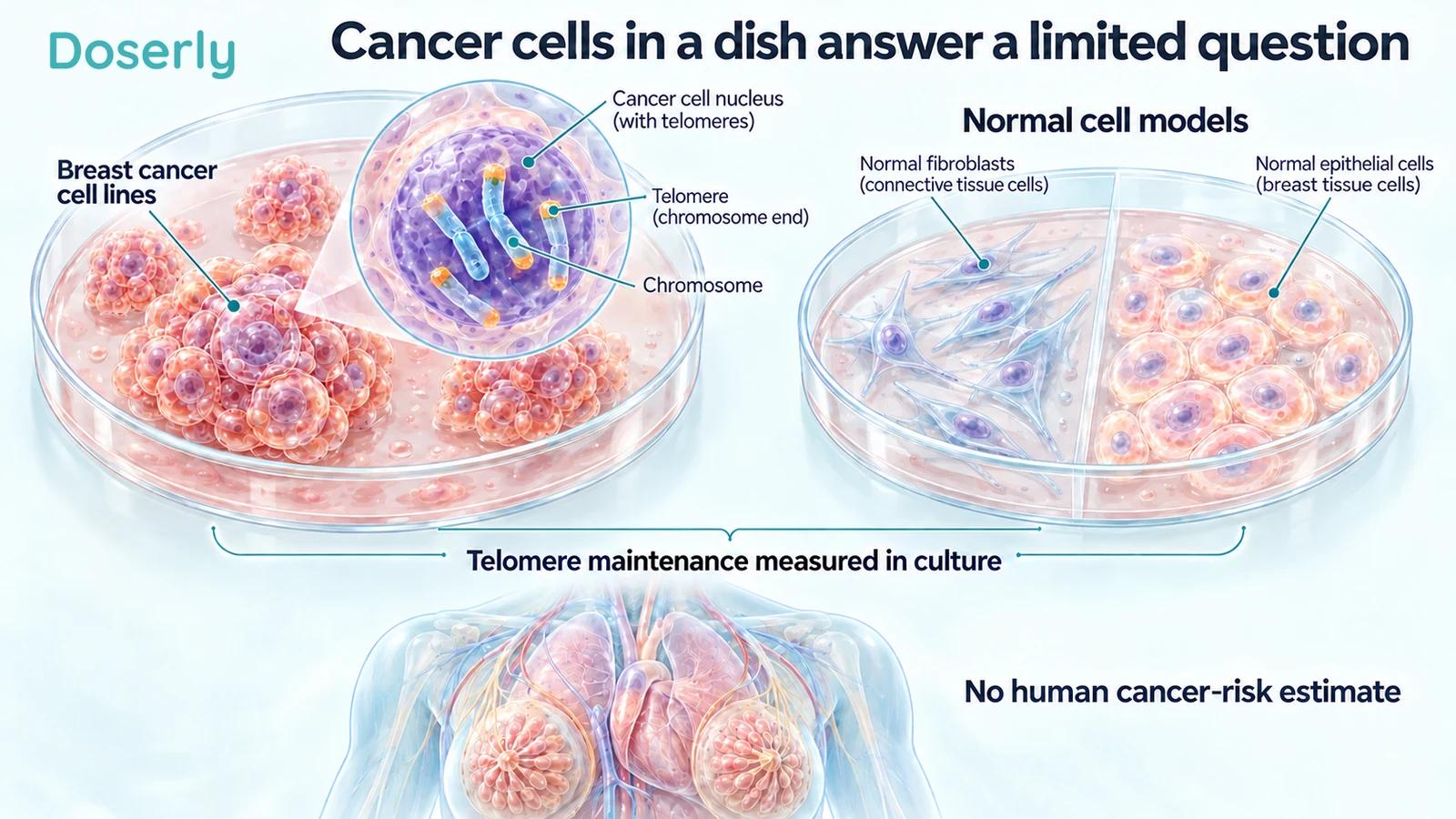
The researchers studied two breast cancer cell lines, 21NT and BT474, alongside normal fibroblast and mammary epithelial cell models. A cell line is a population maintained under laboratory conditions. It lets researchers make repeated measurements in a controlled environment, but it lacks much of the complexity of living tissue.
The cancer cells received Epitalon for four days at several concentrations. The normal-cell experiments used a longer exposure, three weeks. Researchers measured telomere length, expression of hTERT—a gene encoding a component of telomerase—telomerase activity, and indicators of ALT. Untreated cultures provided comparison measurements. These were exposure concentrations in culture medium, not doses administered to patients. Methods and results.
The paper reported telomere lengthening in both normal and cancer cell models, with different maintenance-pathway patterns. The normal-cell findings involved increased hTERT expression and telomerase activity; the cancer-cell findings implicated ALT. It would be inaccurate to summarize the whole paper as showing only a favorable response in healthy cells.
The different exposure durations also matter. They prevent a simple claim that one cell type was “more responsive” or “safer” than another under identical conditions. The experiment compared several biological settings; it was not a clinical safety competition between healthy and malignant tissue.
Read the correction with the original paper
A correction published in November 2025 replaced Figures 1, 2 and 3. Those figures concern telomere length, hTERT/telomerase measurements and ALT-related findings. The corrected material belongs with the original article when interpreting its results. Published correction.
A correction is not an independent replication. It also should not automatically be treated as evidence that every conclusion is false. The appropriate response is to examine the corrected version and avoid copying numerical claims from an older screenshot or an uncorrected summary.
For this article, the useful conclusion is qualitative: the investigators reported different responses in different cell models, including cancer cells. We have not converted their laboratory fold changes into a predicted increase or decrease in human cancer risk.
Why the result does not prove Epitalon causes cancer
A breast cancer cell line is already malignant. Changing telomere maintenance in those cells does not show that Epitalon transforms a normal human cell into a tumor. It also does not tell us whether a tumor would grow faster in a person, invade surrounding tissue, respond differently to treatment or recur after remission.
Those are different questions with different measurements. A study could examine cell proliferation, cell death, chromosome stability or tumor growth in an animal. Each would add information, but none is interchangeable with long-term cancer incidence in treated patients.
In the body, exposure depends on absorption, distribution, metabolism and elimination. Immune cells, blood supply, neighboring cells and other medicines can alter the response. A dish experiment controls some of that complexity precisely because it is trying to isolate a biological process.
That is useful science. Its limits become a problem only when a laboratory finding is presented as a completed clinical answer. The cancer-cell result supports further safety investigation; it cannot supply a numerical personal risk estimate.
Why it does not establish safety either
The opposite argument is also too strong: “Epitalon improved normal cells, so it must be safe.” Normal-cell experiments are not designed to capture every potential harm. They do not reproduce years of exposure across many organs, interactions with other treatments, or the behavior of small abnormal cell populations that have not yet caused symptoms.
Similarly, an absence of obvious short-term toxicity in a culture is a different outcome from an absence of cancer over a long follow-up period. Researchers need both immediate safety measurements and observation appropriate to the concern under investigation.
FDA's 2026 review identified gaps in the safety evidence for the Epitalon substances it evaluated. That assessment should be described as a regulatory review with defined scope, rather than a clinical trial proving harm. It does, however, reinforce that long-term safety cannot be inferred from a proposed anti-aging mechanism. FDA briefing.
If someone offers reassurance, it is reasonable to ask what outcome was actually monitored and for how long. “No problem was noticed” is less informative than a documented study with a defined population, complete follow-up and a clear method for detecting adverse events.
What about the mouse studies reporting fewer tumors?
A 2002 experiment used female mice genetically engineered to express HER-2/neu, making them a particular mammary-tumor model. Epitalon was compared with saline and another peptide, Vilon. The investigators reported favorable changes in several tumor measures with Epitalon, including cumulative tumor number and maximum tumor size. They reported smaller lung metastases, but not fewer lung metastases. Original animal-study abstract.
Those distinctions matter. Smaller tumors and fewer tumors are related but different outcomes; neither can be substituted for a measured reduction in human cancer deaths. The mice also had a specific genetic susceptibility, so the results cannot be assumed to apply to every tumor type.
The Vilon comparison is another reminder to identify the actual molecule. Its findings differed from Epitalon's, despite both being short peptides. “Peptide treatment” is not one uniform biological intervention.
An animal result can legitimately point researchers toward a mechanism or a future therapy. It cannot establish that an untested use prevents cancer in a healthy person or is safe after cancer treatment.
Other tumor models did not give the same answer
In a rat experiment involving chemically induced bladder tumors, the abstract reported an inhibitory effect for Vilon but no inhibitory effect for Epitalon. Original rat-study abstract.
A separate study of senescence-accelerated mice also did not show a reduction in tumor frequency with Epitalon, although the investigators reported some survival-related findings. Original accelerated-aging mouse report.
These are not necessarily contradictions. Different species, strains, tissues, causes of cancer and exposure patterns can produce different responses. The studies ask narrower questions than “Does this peptide prevent cancer?” Their results should stay attached to those questions.
Taken together, the animal literature does not support a universal anticancer claim. It also cannot be used to cancel the uncertainty raised by the cell findings. A favorable result in one model and a concerning biological possibility in another need further investigation, not an average reassurance score.
If you have had cancer, what is the useful clinical conversation?
For a person with a cancer history, the decision involves more than whether a peptide has ever been studied in tumor cells. Cancer type, current disease status, treatment history, ongoing medicines and the reason for considering the peptide all matter.
Bring the exact compound and proposed product to the clinician responsible for your cancer care. Explain the hoped-for benefit—sleep, fatigue, recovery or something else—so that the discussion can address that goal directly. The evidence reviewed here does not establish a cancer-safe Epitalon regimen or a waiting period after treatment.
It would be inappropriate to infer a contraindication for every individual from this cell study alone. It would be equally inappropriate to promise that a remote cancer history makes the uncertainty irrelevant. The responsible conclusion is that these experiments cannot settle the individual decision.
A normal screening result or a favorable telomere test would not fill that gap. Screening answers a particular diagnostic question at a particular time; it does not validate the long-term safety of an experimental exposure. Likewise, no schedule can be declared safe merely because it is brief or popular online.
A proposed “protective” companion treatment does not resolve this uncertainty either. If the argument is that another supplement, peptide, or screening schedule offsets a theoretical risk, that combination needs evidence of its own. None of the experiments discussed here tested a strategy for making repeated Epitalon use safe by adding something else.
The same principle applies to a reassuring personal account. Someone feeling well during a short course can describe their experience accurately, but that experience does not measure latent cancer outcomes. It is useful information for their clinician, with a different evidentiary role from a long-term controlled safety study.
What evidence would answer the safety question better?
A stronger program would characterize the product and its exposure in humans, examine relevant nonclinical safety endpoints, and then follow appropriately selected participants with systematic adverse-event reporting. For cancer concerns, the design would need to consider latency: some outcomes may take much longer to appear than immediate tolerability problems.
Researchers would also need to distinguish prevention of a new cancer from progression or recurrence of an existing one. Those outcomes involve different populations and cannot all be answered by the same small study.
For now, the cancer-cell findings belong in Epitalon discussions because they prevent an overly simple story about telomere lengthening. They do not prove clinical harm, and the older animal findings do not prove protection. The Epithalon guide can help you keep those research categories separate when preparing questions about a proposed use.
Sources
- Al-Dulaimi and colleagues, 2025: normal and breast cancer cell models; no human treatment outcomes.
- Correction, November 2025: corrected figures for the same study, not an independent replication.
- DeBoy and colleagues, 2023: inherited POT1 long-telomere syndrome; no Epitalon exposure.
- Anisimov and colleagues, 2002: HER-2/neu mammary-tumor mouse model; abstract reviewed.
- Bladder-neoplasm experiment, 2001: rat findings differed by peptide; abstract reviewed.
- Senescence-accelerated mouse report, 2005: tumor frequency and survival are separate outcomes; abstract reviewed.
- FDA, 2026 Epitalon briefing: safety evidence assessment for the substances evaluated.