
Peptides
October 16, 2026
Why athletes need a different TB-500 risk conversation
On this page
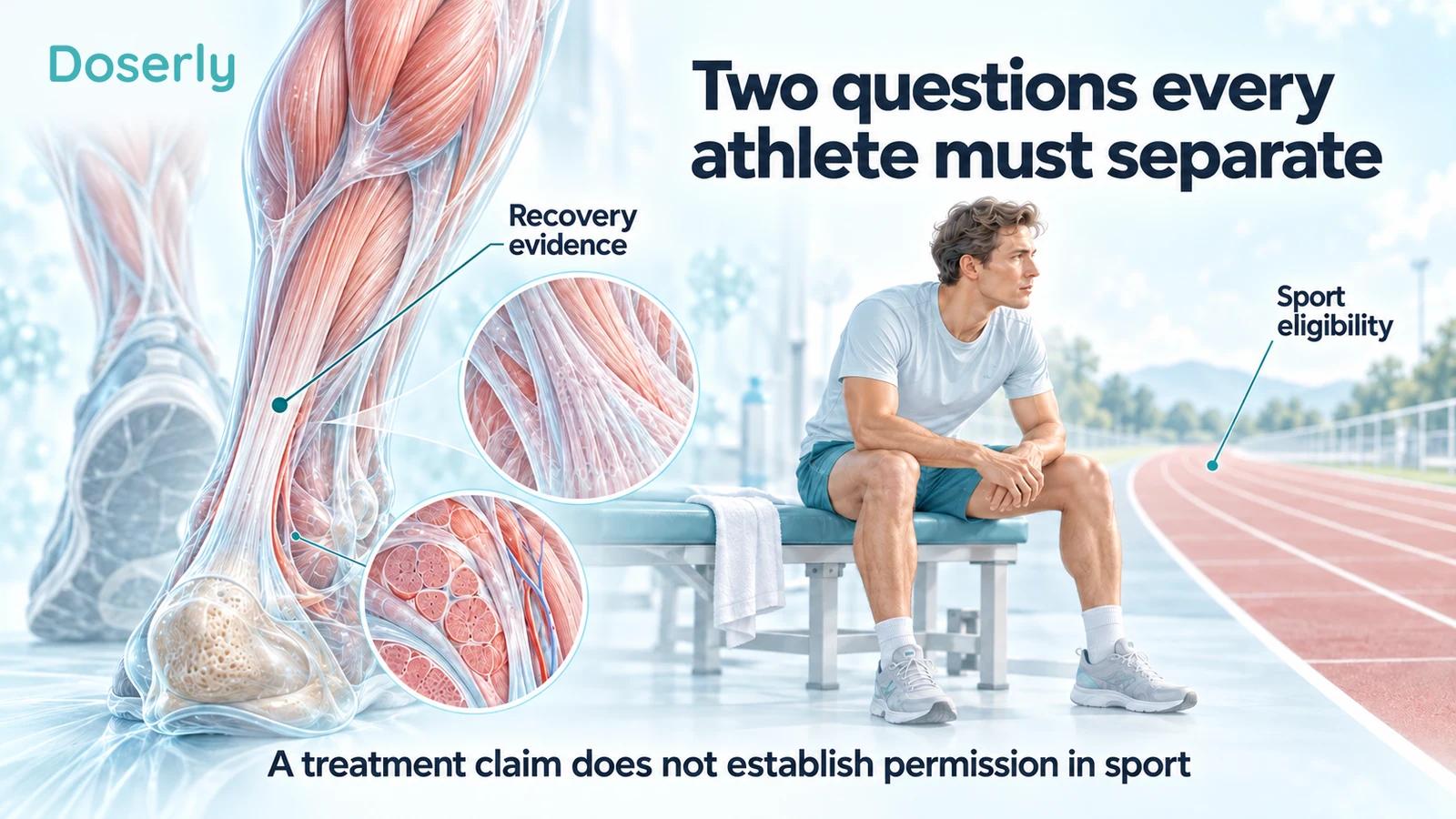
For an athlete subject to anti-doping rules, TB-500 raises two separate questions: what is known about its effects on health and recovery, and whether its use is permitted in sport. Uncertainty about the first does not create uncertainty about the second.
The 2026 WADA Prohibited List includes thymosin beta-4 and its derivatives, with TB-500 named as an example, under S2.3. That category is prohibited at all times, including outside competition. The rule does not depend on an athlete proving that the product improved performance, or on a clinician describing the purpose as injury recovery.
This article checks the rules and research as of October 15, 2026. It focuses on athletes covered by WADA-based rules; leagues and organizations with different systems require their own current rule check. The practical goal is to separate clinical evidence, product identity, eligibility, and laboratory detection before they become mixed into a single reassuring claim.
“For recovery” does not answer the eligibility question
An injured athlete may have a clear, understandable goal: returning to training without persistent pain or another injury. A treatment promoted for that goal can feel categorically different from a product promoted for muscle growth. Anti-doping classification does not follow that marketing distinction.
The current WADA list places thymosin beta-4 derivatives in the growth-factor and growth-factor-modulator section of S2. “At all times” covers both in-competition and out-of-competition periods. Taking a break from competition, rehabilitating an injury, or using a product during a training block does not itself create permission.
The list also includes BPC-157 under S0, the category for non-approved substances. Combining it with TB-500 does not remove either ingredient's status. Athletes evaluating a blend need to identify every ingredient rather than checking only the name printed most prominently on its label.
These are classification statements, not predictions about the outcome of an individual case. The relevant anti-doping organization is the appropriate source for advice about a person's rules, medical circumstances, and responsibilities. A seller's description of a product as “recovery,” “research,” or “wellness” is not that advice.
Prohibition is not proof of clinical effectiveness
A prohibited listing is sometimes presented as indirect evidence that a peptide must work. That reverses the purpose of the rule. The USADA explanation of the list describes consideration of potential performance enhancement, actual or potential health risk, and the spirit of sport. The listing process is not a clinical trial demonstrating benefit for an injured athlete.
This matters in both directions. Weak human recovery evidence does not make a prohibited substance permissible. Prohibited status does not transform animal repair findings into proven human benefit. An athlete can face a clear eligibility restriction while the clinical benefit remains uncertain.
The same USADA page distinguishes the 2026 list from the already published 2027 list, which takes effect on January 1, 2027. Checking the document's effective date is part of checking the rule. A future list or an old screenshot should not silently replace the version governing the period in question.
A sensible clinical discussion therefore continues independently of the anti-doping discussion. What is the injury? What outcomes have actually been studied? What standard care is appropriate? What uncertainty remains about the proposed intervention? None of those questions is answered by the fact that a substance appears in a prohibited category.
Personal responsibility is broader than intent to enhance performance
Under Article 2.1 of the World Anti-Doping Code, athletes are responsible for prohibited substances or their metabolites or markers found in their samples. Establishing a presence violation does not require proving intent, fault, negligence, or knowing use. Fault can matter when consequences are determined; strict liability does not mean every case has an identical sanction.
Article 2.2 also makes the success or failure of use immaterial to whether a use violation can occur. “It did not help me” is therefore not equivalent to “it could not create an anti-doping problem.” The Code also recognizes evidence of use beyond a positive test, so the entire issue cannot be reduced to whether one particular sample detects a substance.
The practical implication is to verify before relying on reassurance. A coach, clinic, teammate, or product vendor may be confident without having checked the applicable rule. Their confidence does not change the substance's classification or automatically resolve the athlete's responsibilities.
If a problem has already arisen, the facts and documents matter. Keep the product information, medical records, and relevant communications intact and obtain advice from the responsible organization and qualified professionals. A general article cannot determine an individual's violation or sanction from a product name alone.
A prescription and a TUE are different documents
Medical treatment and anti-doping authorization have related but distinct processes. A prescription records a clinician's treatment decision. A therapeutic use exemption, or TUE, is an anti-doping decision made under the applicable rules. One should not be assumed to supply the other.
USADA's TUE resources direct athletes to check medication status and use its pre-check process when requirements are uncertain. Applications require medical documentation and are reviewed by a TUE committee. Approval is not guaranteed, and responsibilities vary with the athlete's level and circumstances. This does not imply that TB-500 is eligible for a TUE in a particular case.
An athlete considering a treatment should make their sport participation visible to the treating clinician and identify which organization governs the exemption process. The conversation needs the exact proposed substance, formulation, route, diagnosis, and relevant medical history. A general assurance that a clinic “treats athletes” leaves too much unspecified.
Emergency care is different from an elective recovery experiment. USADA advises seeking necessary emergency medical care first, retaining documentation, and then addressing the applicable process. Athletes should not delay urgent treatment while trying to resolve an online rules question.
The name TB-500 does not fully identify the substance
Scientific uncertainty begins even before the body receives a product. FDA's 2026 TB-500 briefing evaluated the N-acetylated seven-amino-acid fragment Ac-LKKTETQ. Full-length thymosin beta-4 is a different molecule, although the names are frequently mixed in discussions of recovery research.
That distinction matters for interpreting studies. Human research on a specific full-length or recombinant thymosin beta-4 product does not establish the benefit–risk profile of the fragment. The FDA review identified no human clinical studies of the particular fragment it evaluated. The Doserly evidence guide explains why related findings should remain attached to their actual investigational products.
For eligibility, however, resolving that naming problem does not offer an easy workaround. WADA's entry explicitly includes thymosin beta-4 and its derivatives. A claim that a vial contains “the full version” instead of “the fragment” must be assessed under the actual rule, not treated as permission by default.
Product uncertainty adds another layer. A 2023 laboratory analysis reported composition differences in products sold as TB500 and TB1000 compared with earlier descriptions. It does not establish the contents of every product. It does explain why a label, a confident sales explanation, or an unrelated certificate cannot settle what a particular athlete received.
Detection research answers a different question from recovery research
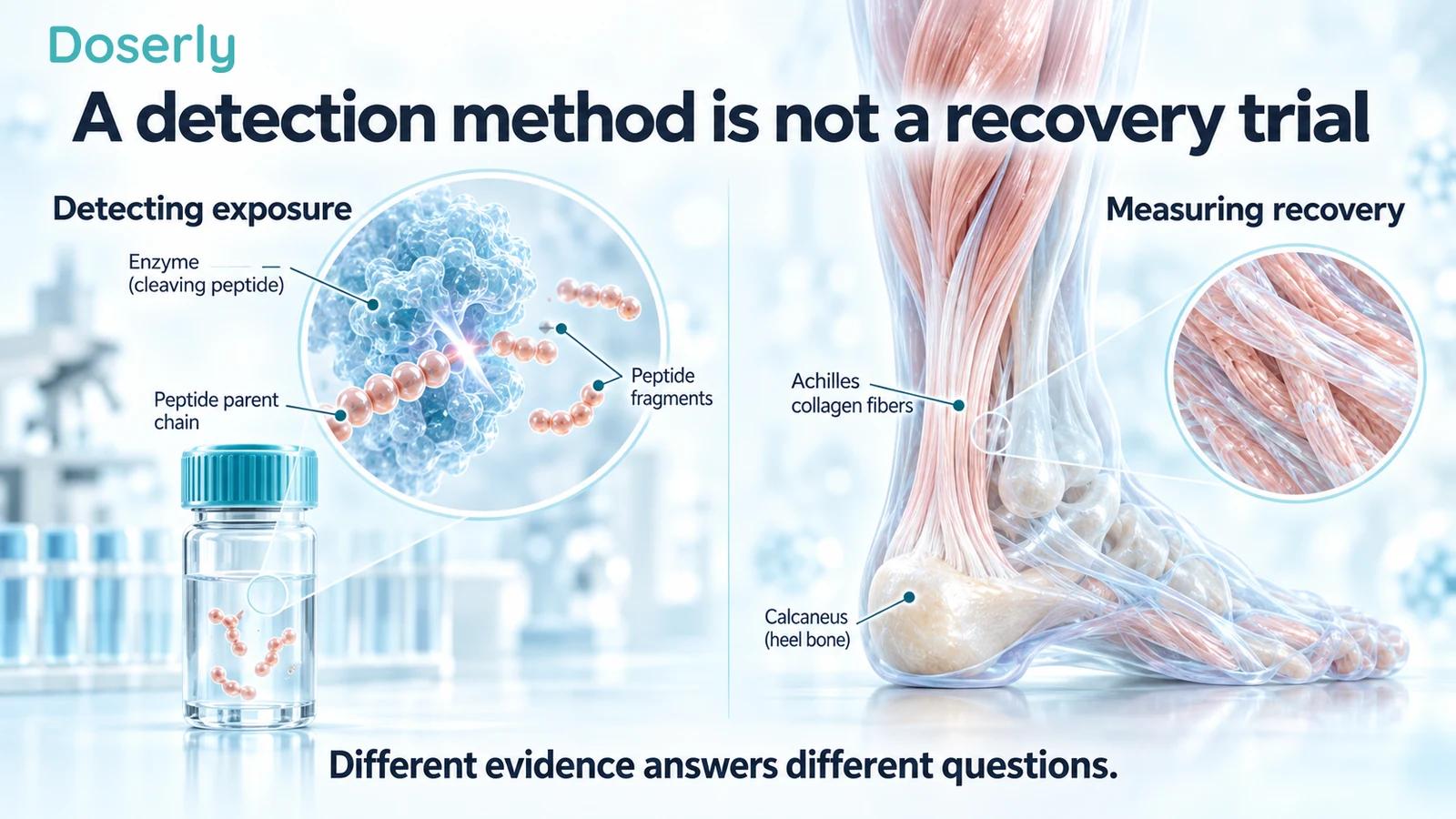
Analytical scientists may investigate TB-500 to identify exposure. That work can be rigorous and useful without testing whether the substance heals an injury. A paper about a sensitive assay should not become a clinical efficacy citation merely because it contains the peptide's name.
A 2016 urine-screening paper included TB-500 among the peptides targeted by its laboratory method. Its proof-of-concept samples after human administration concerned other peptides, not a human TB-500 administration study. That distinction is easy to miss when a long analyte list is summarized as “tested in people.”
A 2026 analytical workflow study examined prohibited substances in dried and liquid blood samples and investigated sample stability. It included TB500 among the analytes discussed. Stability in a stored specimen is not persistence in a living person, and validation of an analytical workflow does not establish a recovery benefit.
These studies also should not be turned into claims that every laboratory uses the same method or that a particular athlete will receive a particular test. Their contribution is evidence about analytical capability under specified conditions. Operational testing decisions and an individual's case require the relevant anti-doping authority's assessment.
A detection interval is not a safe-use guarantee
The 2024 TB-500 metabolism study investigated laboratory systems and rats, including metabolites in rat urine. It adds information about what compounds may be measured after exposure in that experimental setting. It does not establish a human timetable for clearance, eligibility, or a negative test.
Several distinctions prevent overinterpretation. A parent peptide and its metabolites are different analytes. Urine and blood are different sample types. A result depends on assay sensitivity and sampling times. Laboratory stability concerns what happens after collection, whereas pharmacokinetics concerns what happens in the body.
Even a well-conducted human pharmacokinetic study would not create permission to use a substance prohibited at all times. The relevant question is compliance with the rule, not finding a plausible interval between use and testing. No washout interval is supplied by this article because the cited research does not establish one for that purpose.
The Doserly TB-500 risk guide covers broader uncertainties about the substance. For an athlete, those uncertainties coexist with the sports rule; they do not replace it.
Make the next conversation specific
A useful discussion with a sports clinician and the responsible anti-doping organization starts with the actual situation. Identify the sport and competition level, the organization whose rules apply, the diagnosed injury, and the exact treatment being proposed. If a product has several ingredients or ambiguous names, bring the original label and documentation rather than a shortened nickname.
Ask the clinician to explain the evidence for the intended outcome and the available standard-care options. Ask the anti-doping organization to clarify the substance's status and any required process. Those are complementary requests directed to people with different responsibilities. Neither is replaced by a testimonial from another athlete.
Keep a dated record of the information used to make the decision. That is useful for continuity of medical care and for understanding what advice was actually obtained. It is not a guarantee against an adverse medical event or an anti-doping finding, and it should not be treated as one.
For TB-500, the present distinction is clear: uncertain human recovery benefit does not soften an explicit prohibition under WADA-based rules. Athletes need both a sound clinical plan and an accurate eligibility assessment. Treating either one as a substitute for the other leaves an important part of the decision unanswered.
Explore the research
- WADA Prohibited List 2026 — Primary anti-doping rule.
- USADA: WADA Prohibited List — Anti-doping authority guidance.
- World Anti-Doping Code — Primary anti-doping rules.
- USADA Therapeutic Use Exemptions — Primary anti-doping procedural guidance.
- FDA Evaluation of TB-500-Related Bulk Drug Substances (TB-500 free base and TB-500 acetate) — regulatory-briefing.
- TB500/TB1000 and SGF1000: A scientific approach for a better understanding of misbranded and adulterated drugs — analytical-product-study.
- Simplifying and expanding screening for peptides under2kDa — Primary analytical study.
- Rapid and harmonized workflow for doping agents in dried and liquid blood — Primary analytical study.
- Simultaneous quantification of TB-500 and its metabolites in in-vitro experiments and rats by UHPLC-Q-Exactive orbitrap MS/MS and their screening by wound healing activities in-vitro — rat-invitro-analytical.