
Peptides
October 16, 2026
Mazdutide approval: what an overseas decision means where you live
On this page
Mazdutide's approval in China was an important step in its development as a medicine. It followed human research on a drug that activates GLP-1 and glucagon receptors and can reduce body weight. For readers elsewhere, though, the news raises a practical question: does approval abroad mean the product is approved, available or appropriate for them at home?
Those are separate questions. A regulatory decision applies within a legal jurisdiction and concerns a particular product and use. It is not a worldwide permission attached to every vial carrying the molecule's name. It also doesn't settle whether a competing athlete may use the substance under their sport's rules.
This article uses mazdutide to explain those distinctions, with US access rules and WADA documents checked on October 15, 2026. It isn't a survey of every country's law. For the medicine's biology and clinical evidence, see our mazdutide guide.
What was approved in China?
In June 2025, Innovent announced that China's National Medical Products Administration, or NMPA, had approved mazdutide for chronic weight management. The described use was alongside reduced-calorie eating and increased physical activity in adults with BMI at least 28, or at least 24 with a weight-related condition. The announcement tied the approval to the GLORY-1 development program. Innovent's original approval announcement.
That is more precise than saying “mazdutide is approved.” It identifies the regulator, jurisdiction, purpose and population described in the announcement. It doesn't mean every possible dose, preparation or health claim was approved. Nor should a June 2025 announcement be treated as a continuously updated list of every later indication.
The underlying GLORY-1 trial randomized 610 Chinese adults to two mazdutide regimens or placebo and found greater weight reduction with active treatment. A human clinical trial can provide relevant evidence beyond the country where it was conducted. Legal authorization is a separate matter: readers in another country can learn from the science without assuming the foreign decision authorizes local supply. GLORY-1 primary report.
Why doesn't another country's approval become FDA approval?
FDA explains that medicines marketed in the United States generally need to meet the applicable US approval requirements. A drug approved by another regulator doesn't become FDA-approved simply because the scientific evidence is promising or the overseas regulator is respected. FDA drug questions and answers.
This isn't a claim that research conducted abroad is inferior. The distinction concerns the decision being made and the product being supplied. Regulators assess evidence within their own legal frameworks, and an authorization has a defined scope. The presence of clinical studies and the presence of a local marketing authorization are related facts, but one is not a substitute for the other.
For a reader, the practical step is to name the regulator and product rather than rely on a seller's phrase such as “internationally approved.” Ask what exact authorization the phrase refers to, for which formulation and indication, and whether it applies in your location. A country name attached to a sales claim isn't itself documentation.
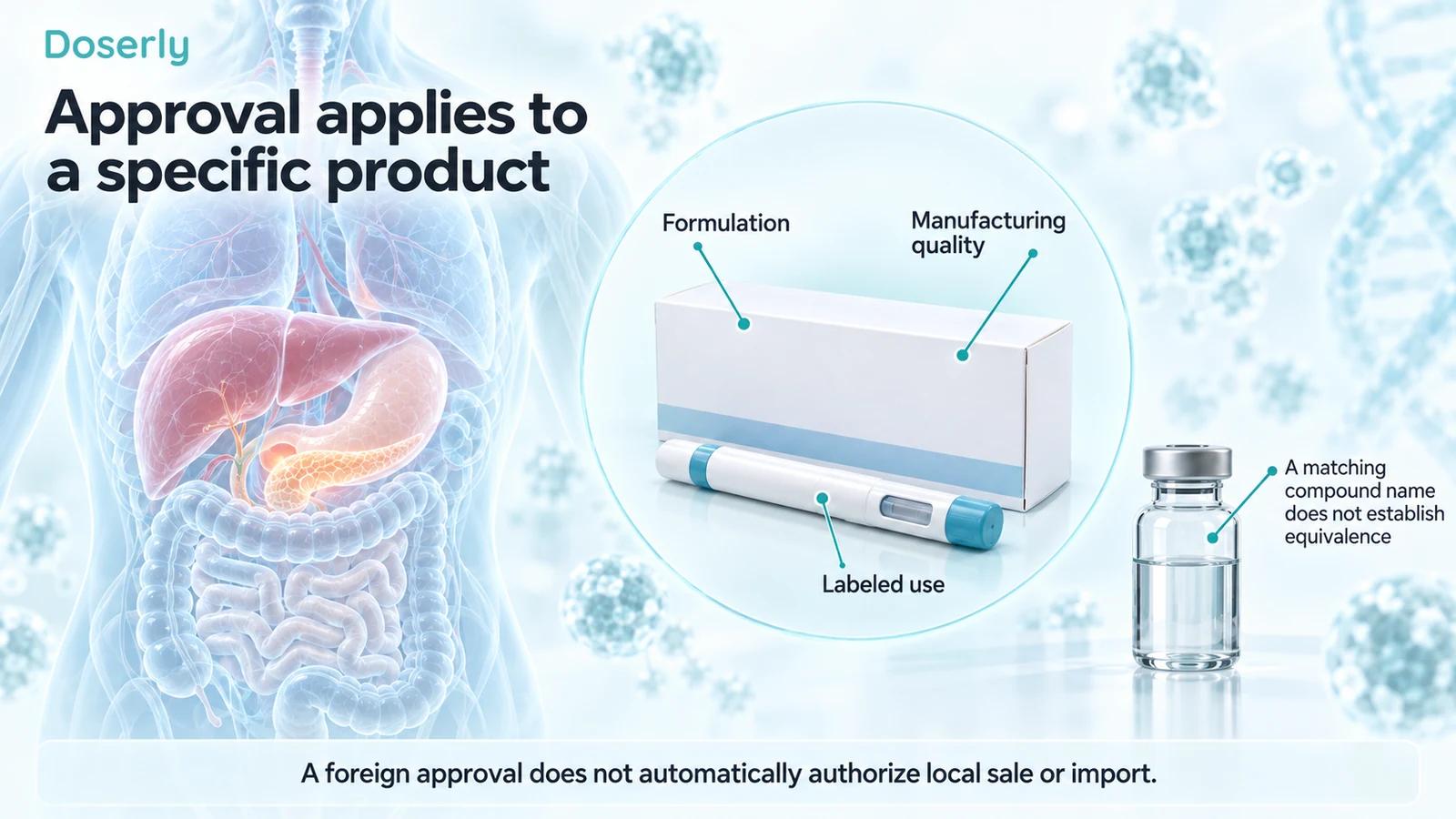
The product is more than the active ingredient's name
A prescription product includes an active ingredient, formulation, strength, container, manufacturing process and labeling. Those features affect how it is used and the assurance attached to its quality. The word “mazdutide” alone doesn't describe all of them.
Consider a seller offering a powder under the same name as a prescription medicine. Even if the intended peptide sequence matches, that doesn't establish the supplied material's identity, strength, purity or suitability for injection. Nor does an overseas approval certify that seller's manufacturing or handling. FDA distinguishes products in the legitimate regulated supply chain from medicines obtained outside it. FDA human drug imports information.
A certificate or assay can address a particular laboratory question. It doesn't automatically replace a complete product authorization or prove equivalence to the clinical-trial preparation. The scope of what was tested matters: a result about one sample cannot establish every property of every vial offered under a name.
That distinction also explains why trial results shouldn't be used as direct proof of an online product's benefits. A study evaluates what participants actually received under the protocol. Changing the source, formulation or handling creates additional uncertainties that the trial did not evaluate.
Does “research use only” change the situation?
The phrase is common on websites selling peptides, but a disclaimer doesn't automatically determine a product's legal status. FDA examines the context, including claims and the apparent intended use.
In a March 31, 2026 warning letter to Prime Sciences, FDA discussed products including mazdutide. The agency stated that the products were being offered as unapproved new drugs and described why website claims established intended human use despite research-related disclaimers. FDA warning letter.
This is a specific enforcement document, not an individual medical assessment and not a laboratory report testing every seller's material. Its relevance is narrower and concrete: a “research” label does not automatically override how a product is promoted or intended to be used.
A consumer should therefore avoid treating the disclaimer as a quality designation. It doesn't mean “approved for cautious self-experimentation,” and it doesn't establish that the product matches the medicine used in a published study. The scientific and regulatory questions still need their own answers.
Can a prescription or personal-use claim make importation automatic?
No. FDA's personal-importation guidance says that importing an unapproved drug for personal use is generally unlawful in the United States. The agency describes circumstances in which it may exercise enforcement discretion, but that is not a blanket entitlement to bring in any foreign-approved medicine. FDA personal-importation guidance.
This distinction matters when a website promises that a small quantity, a personal prescription or “not for resale” wording guarantees entry. The existence of a policy allowing case-specific discretion doesn't establish that a particular shipment qualifies. A foreign approval doesn't answer the import question by itself.
FDA's drug FAQ likewise explains that the possibility of personal importation in certain circumstances does not create a right or expectation of importing unapproved drugs. FDA questions and answers.
For someone already receiving treatment abroad, the useful discussion is about continuity of care and the exact applicable requirements before travel or shipment. A clinician and the relevant authorities can address the actual product and circumstances. A general blog article or seller's shipping history cannot provide a guarantee.
These US statements should not be copied into advice about Canada, the UK, the EU or another jurisdiction. Each location requires its own current official check. “Not FDA-approved” describes a US regulatory fact; it is not a complete worldwide legal classification.
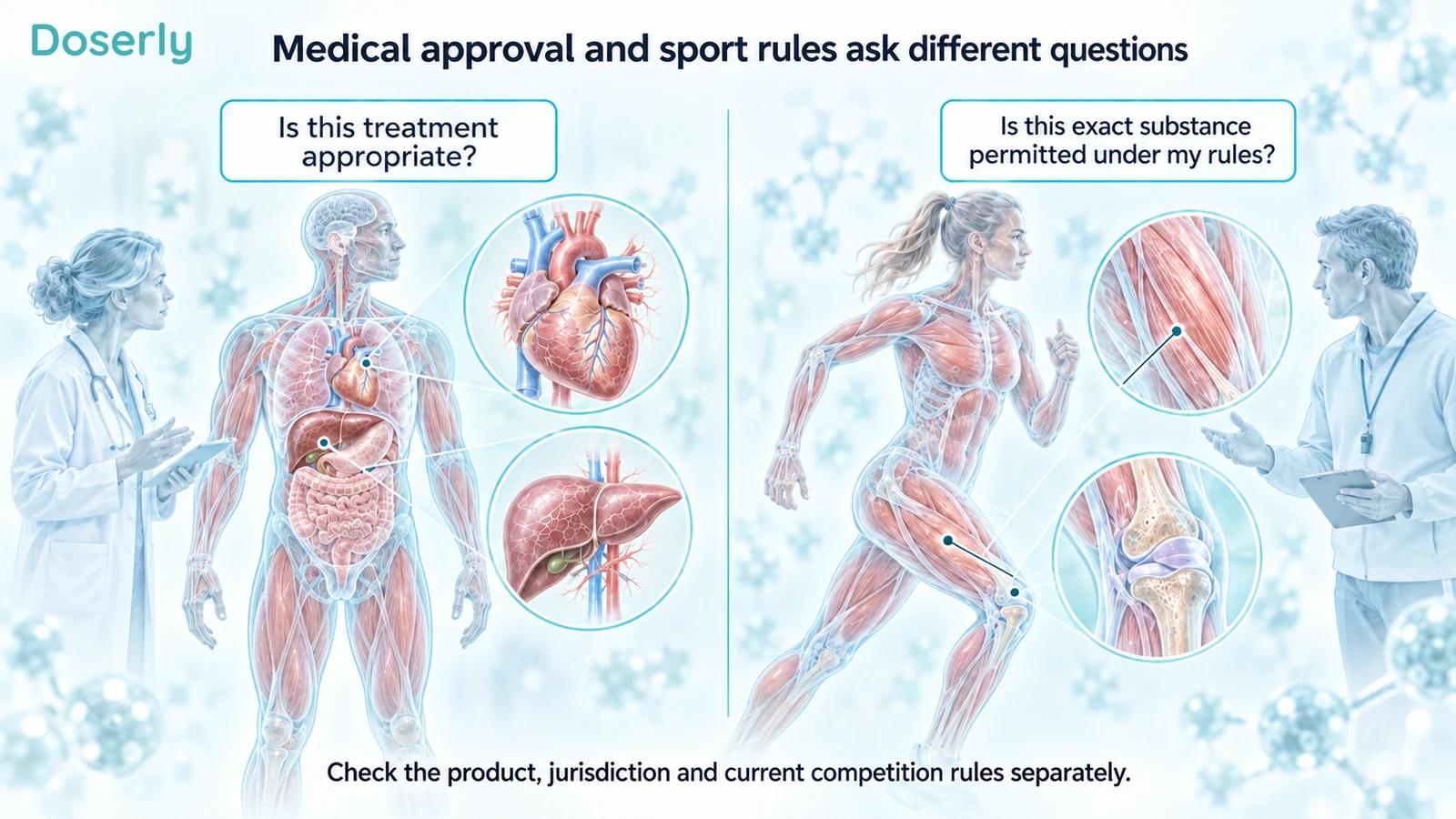
Medical approval and sport eligibility are separate
Athletes face an additional set of rules. A medicine can have a legitimate medical use and still be prohibited in sport. Conversely, a substance's absence from a named list doesn't establish that a particular product is medically appropriate or locally authorized.
WADA's 2026 Prohibited List includes an S0 category concerning certain pharmacological substances without current approval by any governmental regulatory health authority for human therapeutic use. The wording concerns approval by any such authority, not only FDA. That means “not FDA-approved” is not enough, by itself, to apply that definition. Other prohibited categories and the exact substance still require consideration. WADA 2026 Prohibited List.
This article does not issue a mazdutide eligibility verdict. An athlete should obtain an answer for the exact substance and relevant rules from their anti-doping organization. The overseas approval makes the reasoning more specific; it does not replace that check.
Monitoring is not the same as prohibition
WADA's 2026 Monitoring Program includes markers of semaglutide and tirzepatide. The document explains that monitoring concerns substances outside the Prohibited List that WADA wishes to observe for patterns of misuse. Being monitored is therefore not the same as being prohibited. 2026 Monitoring Program.
Those two named substances are not mazdutide. Their status shouldn't be transferred to another peptide merely because the drugs share GLP-1 activity. Anti-doping classifications need the actual substance, rather than an informal label such as “weight-loss peptide.”
USADA's athlete guidance discusses GLP-1 medicines and directs athletes to verify medication status. That is a more appropriate route than relying on a clinic advertisement or a receptor diagram. USADA guidance.
WADA has also published its 2027 documents, which must be distinguished from the rules in force during 2026. The 2027 Monitoring Program names semaglutide and tirzepatide under GLP-1 agonists. Publication in advance doesn't make the following year's list the current list for an event held in October 2026. 2027 Monitoring Program, 2027 Prohibited List.
A useful way to check an approval claim
Start with the exact product name and active ingredient. Then identify the regulator, jurisdiction, approval date and labeled indication. Check whether the source is an official authorization, a manufacturer announcement reporting it, or a seller repeating it. Those sources do not all have the same role.
Next, separate the clinical question from access. A medicine may have evidence relevant to your condition while lacking a local authorized route of supply. Or a locally available medicine may be inappropriate for your medical history. Approval doesn't mean risk-free, and lack of local approval doesn't erase a genuine clinical study.
If sport rules apply, make that a separate dated check. Retain the exact response from the relevant organization rather than trying to infer eligibility from a drug class. Future rule changes, product ingredients and the circumstances of competition can matter.
For mazdutide, the accurate starting point is that China's approval is a real jurisdiction-specific development. It doesn't authorize every preparation or confer worldwide access. Keeping the product, location, use and date visible makes the news useful without turning it into a promise it cannot support.
Explore the research
- Innovent's June 2025 NMPA approval announcement.
- GLORY-1 primary trial.
- FDA drug questions and answers.
- FDA human drug imports and personal-importation guidance.
- FDA Prime Sciences warning letter, March 2026.
- WADA 2026 Prohibited List and 2026 Monitoring Program.
- WADA 2027 Prohibited List and 2027 Monitoring Program.
- USADA's GLP-1 guidance for athletes.