
Peptides
October 16, 2026
Why an eloralintide dose-ranging trial isn't a dosing guide
On this page
Eloralintide's clinical trials tested several amounts and schedules because researchers were still learning how to balance weight reduction with unwanted effects. That is the purpose of a dose-ranging study: to compare candidate approaches and decide which deserve further evaluation.
It is different from a prescribing guide. A list of experimental groups doesn't establish where an individual should start, how quickly they should change treatment or what to combine with another medicine. Those decisions depend on evidence about the final product, intended population and treatment strategy.
The distinction is especially important for eloralintide because early papers use similar-sounding terms for different study designs. “Ascending dose” can describe separate groups receiving progressively higher amounts, rather than each participant increasing their own dose. We'll unpack those designs and what the actual findings contribute. Our eloralintide guide offers broader background.
What are researchers trying to find?
A useful dose isn't necessarily the largest amount that produces weight loss. Researchers need to understand how benefit changes with exposure and what happens to tolerability at the same time.
Imagine two hypothetical groups with similar weight reduction but substantially different symptom burdens. The group with more unwanted effects might offer little additional value. Alternatively, a higher-exposure group might achieve additional benefit that some patients consider worthwhile. Those are clinical tradeoffs that have to be measured.
Dose-ranging studies help reveal this relationship. They also identify whether a response appears to level off, whether certain symptoms become more frequent and whether participants can remain on treatment.
The outcome is a set of candidates and questions for further research. It isn't a universal rule that every person should move through all the tested groups.
“Single ascending dose” doesn't mean repeated self-escalation
Eloralintide's first-in-human study enrolled 48 generally healthy adults in six cohorts. Within each cohort, participants were randomized to eloralintide or placebo. Each participant received a single administration, followed by observation.
The cohorts were studied sequentially, with safety and other available information informing progression to a higher-dose cohort. The individual participant wasn't moving through every dose listed in the paper. Discovery and single-dose report
This design asks an early question: what happens after an initial exposure at these levels? It provides information about safety, drug concentrations and preliminary effects. It cannot establish the experience of repeating the same treatment for months.
A dose table removed from this context can therefore be misunderstood in two ways: as a schedule for one person, or as evidence that repeated treatment at each listed amount has already been evaluated. Neither follows from a single-dose cohort study.
“Multiple ascending dose” can still mean fixed doses within a cohort
The subsequent phase 1 study gave weekly eloralintide or placebo for 12 weeks. Participants were grouped into cohorts receiving different dose levels, without routine within-person escalation.
One later cohort had a planned opportunity for dose adjustment after four weeks. After reviewing available safety and tolerability data, investigators and the sponsor continued the same dose to characterize it further. This was a protocol-governed research decision, not a general rule for future use. Multiple-dose methods
The study also involved screening, lead-in procedures, inpatient and outpatient assessments, and follow-up after treatment. The administered amount was only one part of that system.
When a paper says an amount was “studied,” the statement includes those surrounding conditions. Reproducing the number alone doesn't reproduce the study.
Dose and drug exposure aren't identical
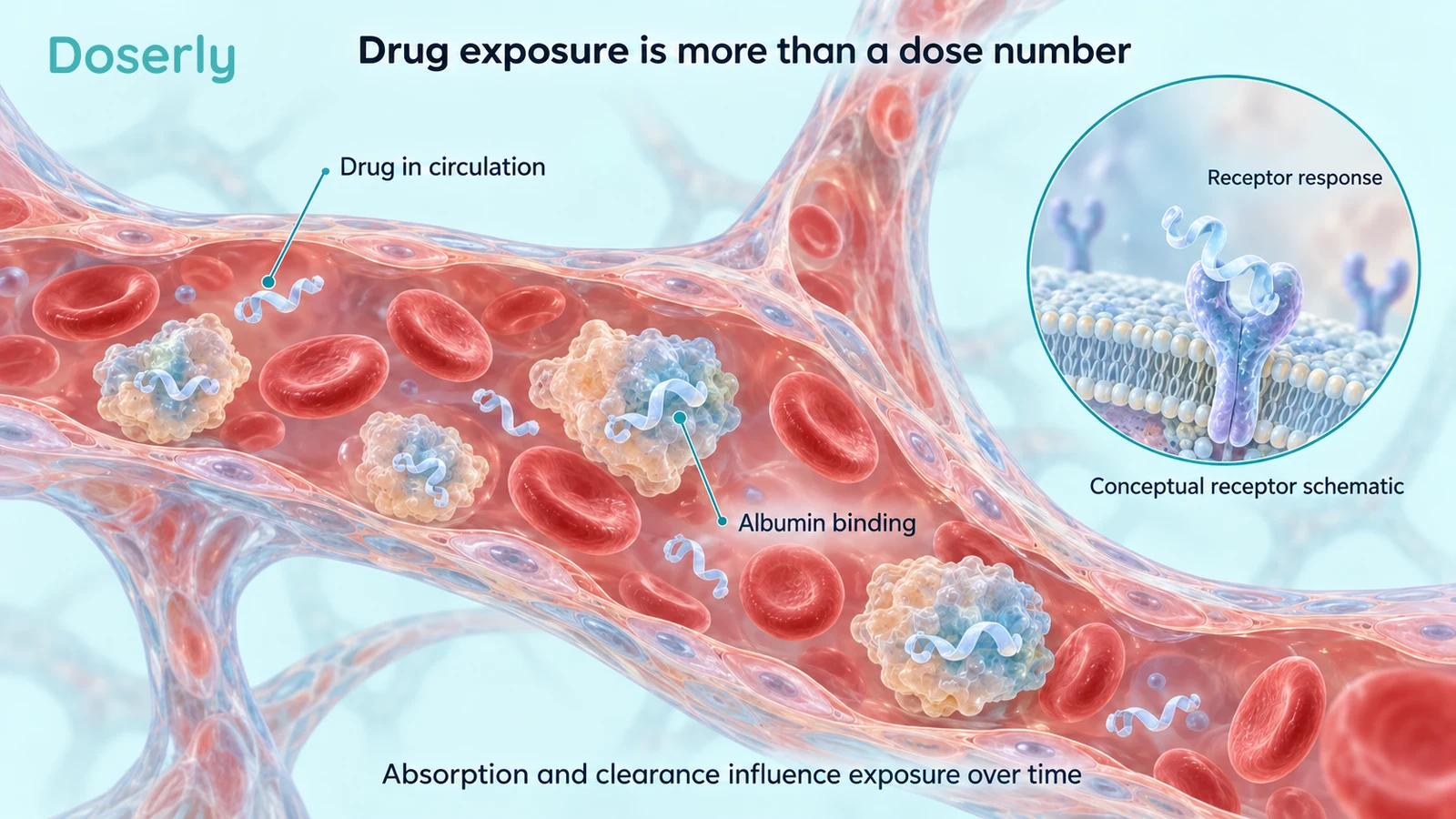
A dose is the amount administered. Exposure describes how much drug is present in the body over time. Absorption, distribution, binding to proteins and clearance all influence that exposure.
Eloralintide's design includes features that support binding to albumin, a blood protein, and prolonged persistence. The repeated-dose study measured concentrations and described slow absorption and a long half-life. Pharmacokinetic findings
Pharmacokinetics is the study of those concentration changes. A drug doesn't necessarily disappear before the next administration, and repeating doses can produce accumulation until a more stable pattern is reached.
This explains why changing an interval isn't merely moving the same total amount around a calendar. The peaks, troughs and cumulative exposure may change. A study of one schedule doesn't automatically validate a split schedule or a shorter interval.
Follow-up continued after the 12-week treatment period. The phase 1 protocol included another 10 weeks with five outpatient visits, for an overall study duration of approximately 22 weeks. The distinction matters when a description calls it a “22-week study”: that is not 22 weeks of active dosing. Study design
Post-treatment observation helps characterize what happens after exposure changes, including the course of reported events. It is part of the research design, not an optional addition to an extracted dose schedule. Copying only the administration amounts from a publication omits the assessments, eligibility decisions and follow-up that accompanied them.
Why milligrams don't convert between peptides
Milligrams measure mass. They don't describe receptor activity, the number of molecules, absorption or persistence. Two different peptides given at the same mass can have very different effects.
That is why eloralintide's trial amounts can't be converted to cagrilintide, semaglutide or another medicine by matching the numerical dose. A smaller number doesn't necessarily mean a weaker exposure, and a larger one doesn't automatically mean a more aggressive treatment.
Unit conversion and clinical dose conversion are also different tasks. Converting between units of mass is arithmetic. Establishing an equivalent clinical effect requires pharmacological and human evidence.
The discovery studies explain how eloralintide was modified and characterized as its own molecule. Those properties are part of why it needs its own development program. Molecular and receptor characterization
What did phase 2 add?
The 48-week phase 2 trial randomized 263 adults across placebo and several eloralintide groups, including fixed-dose and escalation approaches. Group sizes ranged from 24 to 54 in the active-treatment arms.
The primary outcome was percentage weight change. Reported efficacy-estimand averages ranged from approximately 9% to 20% weight loss, versus 0.4% with placebo. The different schedules also produced different frequencies of nausea and fatigue. Phase 2 report
This provided information for choosing later research strategies. It didn't establish that the schedule with the largest average weight change is best for every individual, or that a person should increase treatment until they match that group.
Small groups also leave uncertainty around differences between active schedules. A study designed to compare each group with placebo may not be equally well equipped to establish every active-versus-active difference.
Why the starting schedule can matter
Two groups can reach the same eventual dose after different earlier exposures. They may differ in cumulative exposure, time at the target amount and the way symptoms develop.
If their outcomes differ, several explanations are possible. The final dose is only one feature of treatment. The path used to reach it, the time available for weight change and the participants' tolerance all belong in the interpretation.
Eloralintide's phase 2 study included escalation groups precisely because schedule was a research question. The results should be used to evaluate those tested strategies, rather than to invent an untested series of intermediate steps. Primary trial
The clinical goal is an appropriate balance of outcomes over time. It isn't simply reaching the highest amount mentioned in a paper.
Weight loss and tolerability have to be considered together
In the phase 2 report, nausea ranged widely across groups, and fatigue was also common in some arms. A treatment could produce meaningful weight loss while still being difficult for some participants to sustain.
The earlier multiple-dose study additionally observed changes in pulse and mood-related events. Those findings are relevant to dose development even when the main public discussion concerns appetite. Phase 1 safety findings
A useful dose-selection process therefore examines several outcomes together: weight, symptoms, persistence, physiological measurements and patient experience. It doesn't reduce safety to whether a small group had a serious event.

The people studied are part of the protocol
The phase 2 trial excluded diabetes and several medical histories, including recent major cardiovascular events, pancreatitis and certain slow-heart-rate conditions. Participants also met specified weight and stability criteria. Registered eligibility
Those rules constrain the meaning of a studied dose. The findings don't automatically describe someone with an excluded illness, different concurrent medicines or a very different starting weight.
This doesn't imply that every excluded person would experience harm. It means the trial doesn't provide the necessary answer. Further studies may expand the evidence, often with different monitoring or eligibility.
A dosing guide based on an approved product would need to address such clinical situations. An early trial table usually has a narrower purpose.
Why combining treatments creates another question
Adding eloralintide to another medicine changes the treatment being evaluated. Even if each has been studied separately, their combined effects on appetite, exposure, tolerability and nutrition need direct assessment.
The registered tirzepatide–eloralintide combination study had its own population, safety objectives and follow-up. Its existence demonstrates that combination development is a separate research task. A completed registry status doesn't, by itself, establish a particular combination benefit or validate other pairings. Combination study record
The same reasoning applies to online schedules that use smaller amounts as add-ons. “Lower than a monotherapy trial dose” isn't evidence of safety or efficacy when another active treatment is present.
A combination also can't be reduced to adding weight-loss percentages. The effects may overlap, and unwanted effects can change. Those relationships have to be measured.
What does an efficacy estimate leave out?
An estimand specifies the treatment question an analysis is intended to answer. Some estimates address outcomes under continued treatment; others include outcomes regardless of specified discontinuations or changes.
A continued-treatment question can be scientifically useful, but it doesn't tell us that everyone who starts will remain on that schedule. Persistence and the reasons for stopping need to be considered alongside the efficacy result. FDA estimand guidance
This matters when selecting a dose for further study. A large effect among sustained users may have a different practical value if many people cannot continue. Conversely, a somewhat smaller effect may be useful if the overall strategy is easier to maintain.
The appropriate interpretation preserves both parts instead of presenting the largest estimate as a personal target.
Reading a dose-ranging paper usefully
Start by identifying the design. Were participants given one dose, repeated fixed doses or an actual escalation schedule? Were dose changes allowed, and what follow-up occurred after treatment?
Next, identify the population and main outcome. A schedule tested in selected adults without diabetes isn't automatically established for people with diabetes, significant illness or ongoing weight-management treatment.
Then read benefit and unwanted effects together. The amount associated with the largest numerical change is only one piece of information. Group size, uncertainty, persistence and the analysis all affect the conclusion.
Finally, distinguish the clinical product used in research from any other product carrying the same compound name. The study evaluates its specified intervention under controlled conditions; the name alone doesn't establish equivalence.
Eloralintide's dose-ranging studies are valuable because they reveal what should be tested next. They don't establish a personal protocol, a conversion between drugs or a stacking strategy. Our eloralintide guide explains the broader evidence while preserving those boundaries.
Sources
- Eloralintide (LY3841136): from discovery to clinical proof of concept — translational and human phase1, 2025.
- Eloralintide: Phase 1 proof of concept — human rct, 2026.
- Eloralintide for obesity: a 48-week phase 2 randomized trial — human rct, 2025.
- Eloralintide phase 2 trial, NCT06230523 — trial registry results, 2026.
- Multiple-dose combination study of tirzepatide and LY3841136 — trial registry, 2025.
- ICH E9(R1): Estimands and Sensitivity Analysis in Clinical Trials — regulatory guidance, 2021.