
Peptides
October 16, 2026
Why a host-defense peptide is not automatically safe to inject
On this page
“The body already makes it” sounds reassuring. For LL-37, it is also incomplete. The body’s use of a molecule in a particular tissue does not establish the safety of administering a manufactured preparation by injection.
LL-37 is a host-defense peptide with antimicrobial and immune-signaling activities. Those activities are part of the reason it attracts research interest—and part of the reason its clinical safety needs careful investigation. A biologically active molecule can affect human cells as well as microbes.
The relevant question is specific: what evidence supports this formulation, route, exposure and patient population? For LL-37, topical wound studies, a very small intratumoral melanoma study and laboratory experiments provide pieces of information. They do not combine into an established safety profile for routine self-injection.
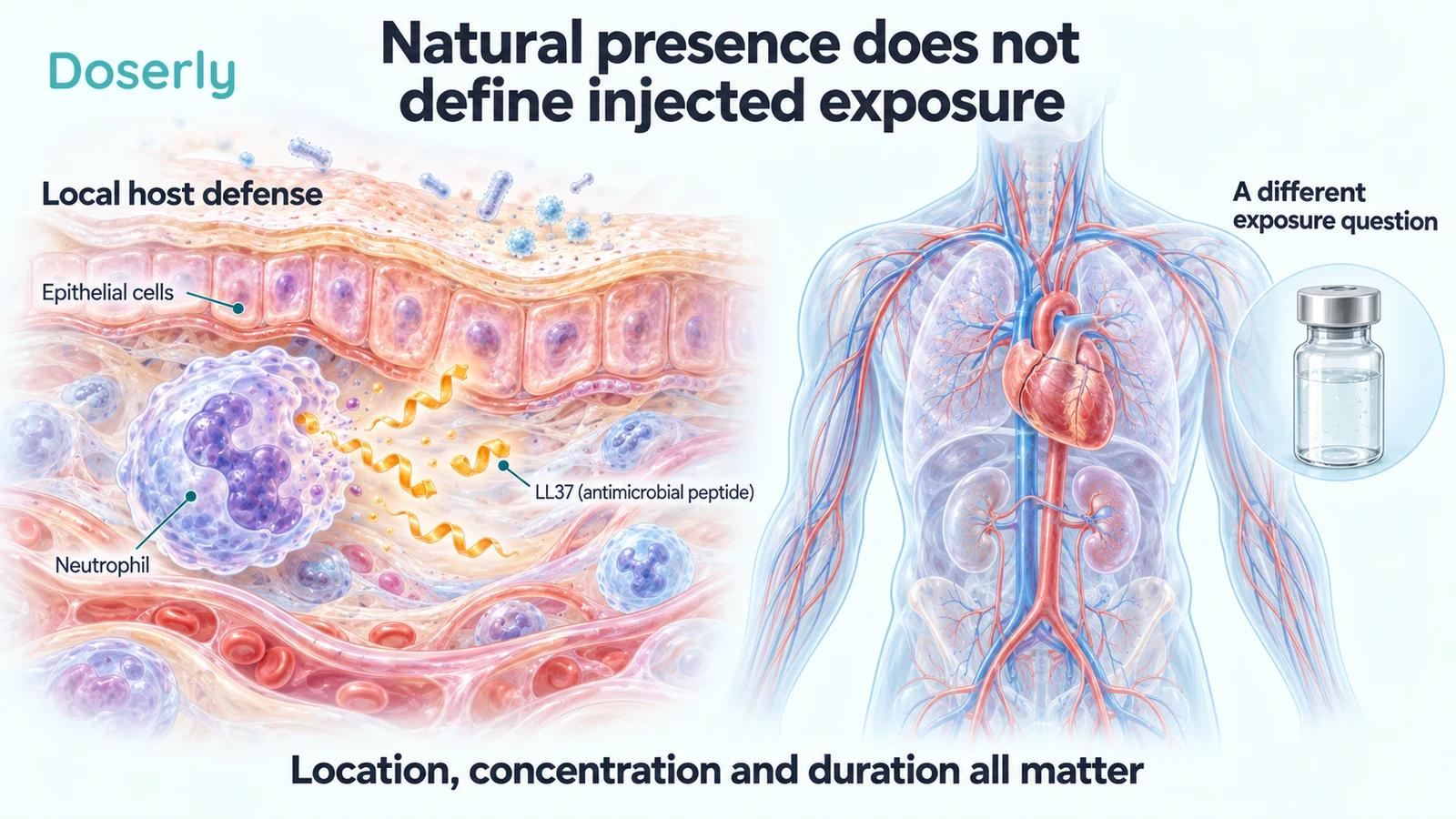
Natural production and administered exposure are different situations
A molecule produced by cells is encountered in a biological context. Where it is released, what it binds to and how long it remains available influence its effects. Administering a preparation can change those conditions.
That distinction applies even when the manufactured molecule has the intended amino-acid sequence. Identity answers what the substance is. Exposure asks where it goes, how much active material is present and for how long. Safety depends on both, along with the person receiving it.
The early LL-37 structure-and-activity study found that its behavior changed with the surrounding solution and that it could affect eukaryotic cells under experimental conditions. Human serum inhibited both antibacterial and cytotoxic activities in that study. The surrounding environment was part of the result.
This does not mean natural LL-37 is inherently harmful. It means natural presence is not a substitute for studying an administered product. A physiological role and a medical use are different claims, and each needs evidence appropriate to its scope.
Membrane activity can involve host cells too
LL-37’s interactions with membranes are relevant to both antimicrobial action and safety. A 1999 study of model phospholipid membranes examined why the peptide was not completely selective for bacterial cells in laboratory systems. It compared membrane types and assessed structural behavior, including the relationship between individual molecules and larger assemblies.
A model membrane is a simplified experimental system. It helps researchers isolate an interaction that would be difficult to study inside a person. It does not directly predict an adverse-event rate after a particular clinical dose.
Nevertheless, the finding matters because it shows why antimicrobial activity cannot be evaluated alone. A candidate treatment needs an exposure range that affects its intended target while remaining tolerable for human tissue. Discovering that a peptide can damage bacteria does not establish that separation.
The same caution applies to attempts to calculate an injection amount from a laboratory concentration. An assay concentration is not a clinical prescription. It does not account for distribution, binding, clearance, formulation or the concentration experienced by different tissues.
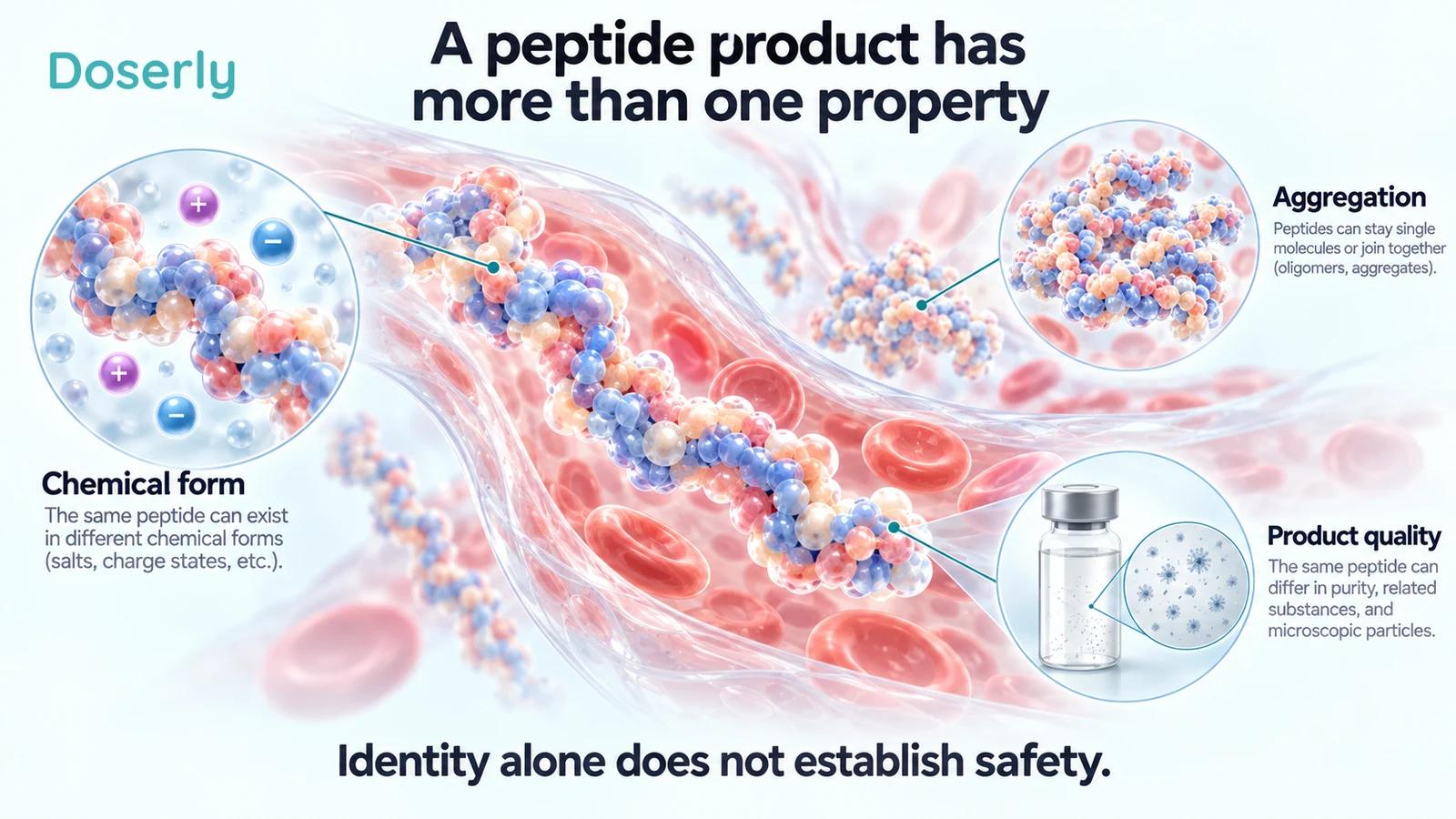
Chemical form is part of the product
The letters “LL-37” do not describe every property of a preparation. Peptide materials may be associated with different counter-ions, and the finished formulation adds further variables. These details can affect experimental behavior.
A 2018 primary study of counter-ion effects compared several antimicrobial peptides, including LL-37, in different salt forms. The investigators measured activity against staphylococci, effects on human red blood cells and toxicity in cultured skin cells. Differences depended on the peptide and form; there was no universal ranking that made one salt the best choice for every molecule.
The study is a reason to characterize the material carefully, not a consumer guide to selecting an injectable salt. An in-vitro comparison does not establish the safety of a finished product, and changing a counter-ion does not supply missing human evidence.
This is also why results for modified LL-37 fragments or related peptides should stay attached to those specific molecules. Development work may deliberately alter a sequence to change its properties. A favorable result for the modified compound cannot be assumed to apply to the original peptide.
Purity, sterility and clinical safety answer different questions
A chemical identity test can help establish what a sample contains. A purity measurement describes the sample under the method used. Neither, by itself, establishes that a finished preparation is sterile, stable or clinically safe for an intended route.
These are different layers of evidence. Product-quality controls address whether the preparation meets relevant specifications. Human studies address what happens when that preparation is administered. A well-characterized product can still lack evidence of benefit or have pharmacological adverse effects.
The FDA’s explanation of compounded drugs states that compounded drugs are not FDA-approved and are not individually reviewed by the agency for safety, effectiveness and quality before reaching patients. Compounding can serve individual medical needs, but it is not equivalent to approval of a finished medicine.
A research-use label is even less informative about human administration. It does not turn a laboratory material into a clinical product. The presence of a batch number, a purity percentage or a familiar peptide name cannot fill the gap between an analytical document and a demonstrated safe medical use.
Topical wound studies cannot establish every injection route
LL-37 has been evaluated in topical wound formulations. The larger venous-ulcer trial reported tolerability findings within that setting, alongside an overall efficacy result that did not show significant improvement over placebo.
Those observations are relevant to the tested topical product and the selected participants. They do not establish what happens after subcutaneous, intravenous or intratumoral administration. Each route creates a different exposure question.
Even within one route, safety findings depend on the number of people studied and the length of observation. A trial can identify common short-term reactions more readily than uncommon or delayed problems. “No serious treatment-related event was observed” should therefore be read with its denominator and follow-up period, rather than as a permanent property of the molecule.
This does not invalidate topical research. It keeps its contribution precise. A wound trial can inform subsequent topical development while leaving systemic or injected use unresolved.
There has been human intratumoral research—but very little
It would be inaccurate to say that LL-37 has never been injected into a human research participant. The ClinicalTrials.gov melanoma record describes injections directly into tumors in a small, single-group study. The registry lists four enrolled participants; its posted participant-flow and safety results describe three treated participants across two cohorts.
That distinction matters. Intratumoral administration in selected cancer patients is not the same intervention as repeated subcutaneous use for general wellness or infection prevention. The indication, anatomical target, monitoring and background illness differ.
The posted safety tables report no serious adverse events among those three participants, while recording other adverse events. With such a small group, an absence of reported serious events cannot rule out uncommon harms or establish a broadly applicable safety profile. The registry also cannot show that every recorded event was caused by LL-37.
The study demonstrates that a narrowly defined clinical investigation occurred. It does not validate every product or route sold under the same name, and it does not provide a general self-administration protocol.
A published skin reaction adds a human safety signal
A 2018 case report described a woman with advanced melanoma who developed multiple skin lesions during a course of intratumoral LL-37 injections. Biopsies showed inflammatory and atypical squamous changes. The lesions resolved within two months after LL-37 was stopped.
The report deserves attention because it describes an observed human event with clinical and pathological detail. It also has limits: it concerns one patient with cancer and prior systemic treatments. It cannot estimate how often a similar reaction occurs, prove every causal step or predict the outcome of another route.
A case report and a small trial answer different safety questions. The case can alert researchers to an unexpected pattern. A sufficiently large, well-monitored study is needed to estimate frequency and identify risk factors. Neither should be flattened into “perfectly safe” or “certain to cause this reaction.”
For patients, the practical implication is that unexpected symptoms during experimental treatment should be assessed and documented. Assuming that a reaction is harmless because the substance is endogenous can delay a useful clinical evaluation.
What the FDA currently says about the evidence gap
The FDA’s LL-37 bulk-substance safety entry identifies potential immunogenicity for certain routes and challenges involving peptide-related impurities and active-ingredient characterization. It states that there is insufficient safety information to determine whether administration would cause harm.
The entry also mentions nonclinical findings involving male reproduction and possible tumor-promoting effects in some tissues. “Nonclinical” is essential here: these observations should not be converted into a quantified human infertility or cancer risk. They are concerns requiring evaluation, not measured probabilities for an individual.
The regulatory page is not proof that every exposure produces an adverse event. It is equally not compatible with a claim that safety has been established merely because the peptide is naturally occurring. The uncertainty is substantive.
When reading a product claim, distinguish absence of evidence from evidence of absence. A small number of exposures without a particular event may be reassuring within that small sample, but it cannot exclude events the study was too small or short to observe.
What a more informative safety program would establish
A useful development program would characterize the finished product and measure exposure through the intended route. It would specify the patient population, duration and monitoring plan. It would also define which adverse events require stopping treatment or further investigation.
Human data would need enough participants and follow-up to support the intended claim. A short early-phase study can explore tolerability and help plan later work. It cannot by itself establish safety for prolonged use in a much broader population.
Benefit matters too. Acceptable risk is evaluated against a demonstrated or plausible clinical need. A closely supervised experimental cancer intervention and an unproven wellness use do not have the same benefit-risk context. The existence of the first does not justify the second.
A detailed protocol is therefore more than an injection schedule. It includes eligibility, product controls, assessments and rules for responding to problems. Removing those parts and copying the administration details does not reproduce the study.
A useful conversation begins with the exact product and purpose
If LL-37 is being proposed, ask what condition it is intended to treat and what human evidence supports that particular use. The answer should identify the route and formulation, explain what remains unknown and describe how outcomes and adverse effects would be assessed.
If it has already been used, keep the product label, dispensing information where available, route, dates and symptom history accessible to the treating clinician. A tracking record can help reconstruct exposure and timing. It cannot certify product quality or determine whether a symptom was caused by the peptide.
The Doserly LL-37 guide provides the broader evidence map. The safety conclusion is narrower than a blanket judgment about the molecule: LL-37’s endogenous role does not establish that a manufactured preparation is safe to inject, and the available human evidence does not supply a general self-injection regimen.
Explore the research
- LL-37 conformation and cell effects, 1998.
- Membrane interactions and selectivity, 1999.
- Counter-ion effects on antimicrobial peptides, 2018.
- Topical venous-ulcer trial, 2021.
- Intratumoral melanoma trial and posted results.
- Dermatologic toxicity case report, 2018.
- FDA LL-37 safety entry.
- FDA compounding questions and answers.