
Peptides
October 16, 2026
Why a gonadorelin stimulation test is not a treatment trial
On this page
A hormone level rises after an injection. It is an understandable result to find reassuring: something responded. But a gonadorelin stimulation test asks a narrow diagnostic question. It does not establish that repeated treatment will improve testosterone symptoms, produce sperm, restore ovulation or lead to a pregnancy.
The distinction is more than a technicality. A short test measures a response under specified conditions. A treatment trial follows people long enough to determine whether an intervention changes a meaningful outcome, with an appropriate comparison when possible. Using the same molecule in both settings does not make the evidence interchangeable.
This article explains what the stimulation test can show, why diagnostic results can overlap and what must be added before making a therapeutic claim. The Doserly gonadorelin guide introduces its diagnostic and pulsatile treatment uses.
What is being stimulated?
Gonadorelin is manufactured gonadotropin-releasing hormone, or GnRH. Its immediate target is the pituitary gland, which releases luteinizing hormone (LH) and follicle-stimulating hormone (FSH). The diagnostic challenge observes the pituitary's response after an administered signal.
The UK product information describes a single-injection test for assessing gonadotrope function. A normal response indicates functioning pituitary gonadotropes. The label also explicitly says that the test does not establish the cause of a subnormal response or measure pituitary gonadotropic reserve. Gonadorelin product information.
That wording draws an important boundary. A gland that can release LH when challenged is not necessarily receiving an appropriate natural pattern of signals throughout everyday life. Nor does its response tell us everything about the testes or ovaries downstream. The test is one observation within an endocrine assessment, not a comprehensive certificate of reproductive function.
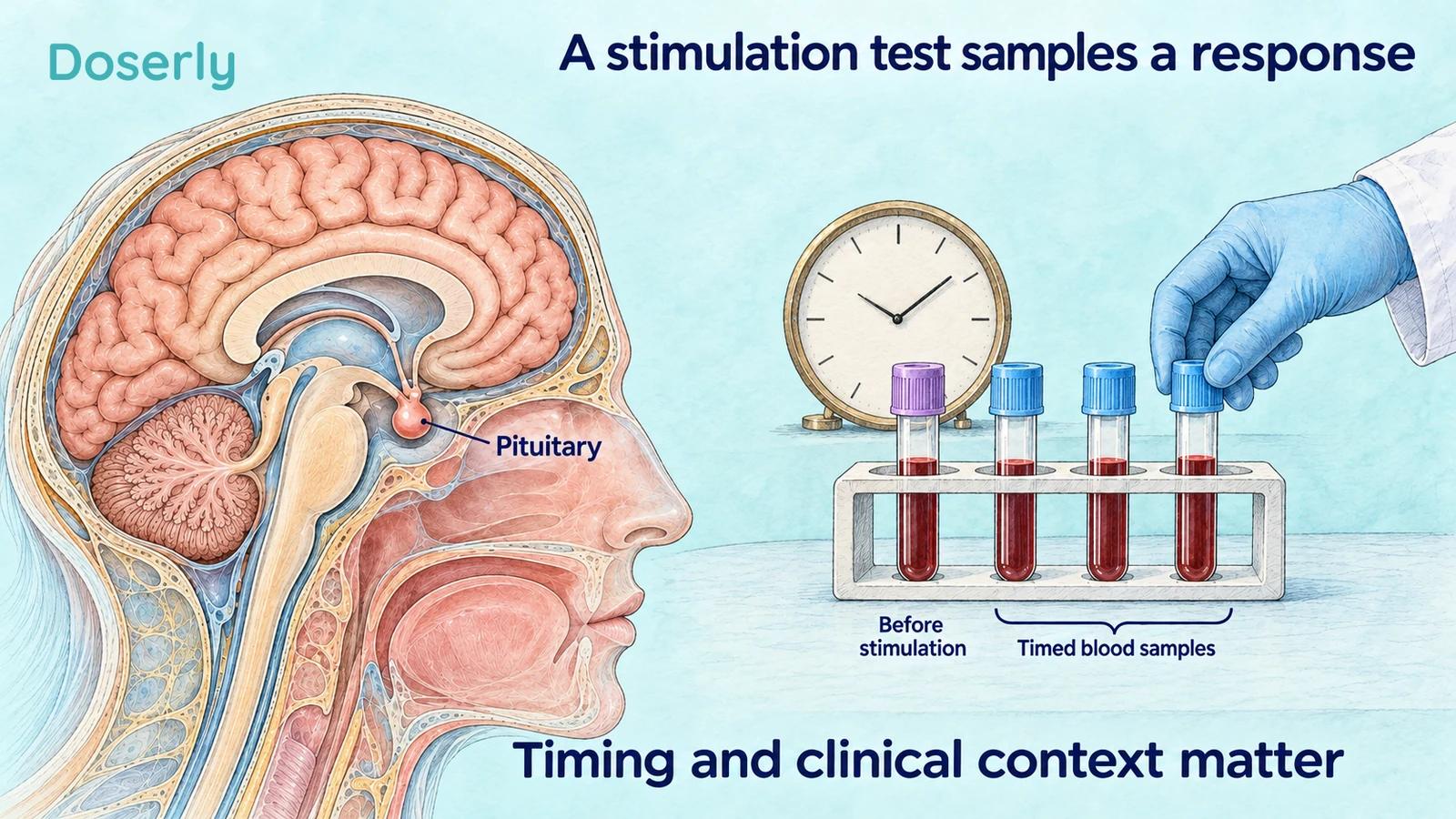
A test result includes its timing
A stimulation response changes over time. A sample collected before administration and one collected afterward do not represent the same physiological condition. A later value may also differ from an earlier post-stimulation value without indicating a lasting change in health.
The product information uses multiple timed samples and emphasizes laboratory assay reliability and clinical context. For women with an identifiable menstrual phase, it specifies early-follicular testing. It also identifies medicines, including sex-steroid preparations, that can affect interpretation. Gonadorelin product information.
These requirements explain why a screenshot containing only “before” and “after” values is incomplete. The reader needs to know what was administered, when samples were taken, which laboratory method was used and why the test was ordered. Without that information, even a correctly measured result can be used to answer the wrong question.
For a patient, the practical step is to keep the clinic's report and timing information together. Medication changes before testing should be directed by the clinical team; a general article cannot determine which prescribed medicines should be withheld or for how long.
Diagnostic accuracy is different from biological activity
A test can reliably provoke a hormone response and still be imperfect at separating two diagnoses. Biological activity asks whether the intervention changed a measurable process. Diagnostic accuracy asks how well the result distinguishes the conditions under consideration.
Delayed puberty provides an instructive example. Constitutional delay of growth and puberty can resemble congenital hypogonadotropic hypogonadism, especially early in evaluation. The long-term implications differ, so investigators have examined whether the LH response to GnRH can distinguish them.
In a 2015 study, researchers assessed 91 patients with idiopathic hypogonadotropic hypogonadism, 27 with constitutional delay and additional reference participants. Proposed LH measures achieved only moderate sensitivity and specificity in males. Results in females also had limitations. This was research into classification, not a trial showing that a test response predicted fertility treatment success. Sun and colleagues, 2015.
Sensitivity describes how often a test identifies people who have the condition in the studied group. Specificity describes how often it correctly excludes the condition among those without it. Neither measure tells a patient whether taking the test substance repeatedly will improve an outcome. The same numerical response can have different implications depending on the population and the question being asked.
A larger study showed substantial overlap
A 2020 study assessed 232 males: 127 with congenital hypogonadotropic hypogonadism, 74 with constitutional delay and 31 healthy controls. The investigators deliberately included a wider spectrum of congenital disease than studies dominated by severe cases. They found that 47% of the congenital hypogonadism group had peak LH responses overlapping with the constitutional-delay group. Mosbah and colleagues, 2020.
That overlap matters more than the existence of a statistically different group average. A group can have a lower average response while many individuals still fall in the other group's range. The average difference does not supply a clean dividing line for every patient.
The authors also found overlap in inhibin B, another proposed marker. Very low responses could be informative in that cohort, but a more reassuring response could not reliably rule out congenital deficiency. These results support interpreting the test alongside clinical history and examination rather than letting a single cutoff decide the diagnosis.
The study does not mean every GnRH test in every endocrine setting is useless. It addresses a particular differential diagnosis. It does mean that “the pituitary responded, therefore the diagnosis is excluded” is too strong a conclusion for that setting.
An established test is not automatically a routine recommendation
Product information and clinical guidelines answer related but different questions. A label can describe how a diagnostic product is used. A guideline considers whether that test adds useful information within a modern clinical assessment for a particular disorder.
The Endocrine Society's adult hypopituitarism guideline recommends measuring relevant basal reproductive hormones and includes a recommendation against dynamic GnRH testing in its assessment of central hypogonadism in females, stating that it adds no useful diagnostic information there. This is context-specific guidance, not a prohibition on every pediatric or research use of GnRH testing. Endocrine Society hypopituitarism guideline.
The apparent tension disappears once the questions are separated. “Can this product provoke a measurable response?” differs from “Will that response change the diagnostic decision in this patient?” A clinician may decide that history, examination, basal hormones and other targeted evaluation already answer the relevant question better.
That is why more testing is not necessarily more information. A result is most useful when its possible outcomes are linked to a clinical decision before the test is performed.
Treatment studies have to follow the downstream outcome
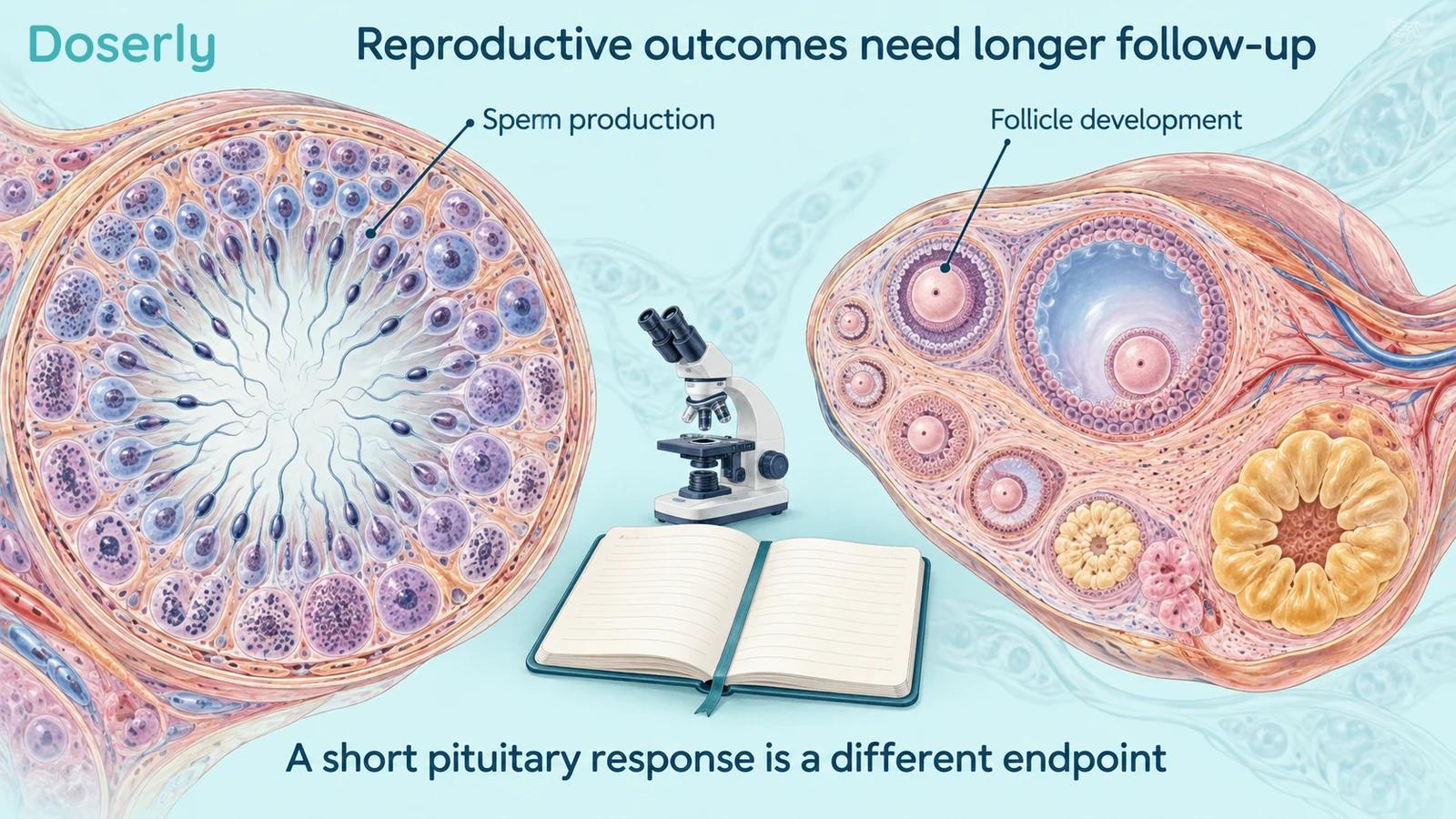
A fertility treatment study needs to measure what happens beyond the pituitary response. In men, this can include sperm production and semen characteristics. In women undergoing ovulation induction, it can include follicular development, ovulation and pregnancy outcomes. A hormone response may help explain how treatment acts, but it does not replace those endpoints.
For example, a cohort of 76 men with idiopathic hypogonadotropic hypogonadism received GnRH therapy for 12–24 months. Most achieved normalized LH and testosterone, but some men in the absent-puberty subgroup remained azoospermic. The study connected treatment to reproductive outcomes over time and showed that hormone normalization did not ensure sperm production in every participant. Pitteloud and colleagues, 2002.
A short diagnostic test cannot reproduce that follow-up. It also cannot show whether someone can use the delivery system consistently, whether the treatment remains tolerable or whether another fertility factor becomes important. Those are properties of a treatment course, not of a single challenge.
Delivery makes the two interventions different
The word gonadorelin can conceal a major difference in exposure. A diagnostic bolus is designed to test responsiveness. Pulsatile treatment repeatedly supplies GnRH signals through a pump over an extended period. An occasional injection schedule is another intervention again.
A small historical comparison in men with idiopathic hypogonadotropic hypogonadism found better endocrine and fertility responses with pulsatile pump administration than with twice-daily injections. It is not a modern definitive comparison, but it directly supports treating delivery pattern as part of the intervention. Shargil, 1987.
This prevents a common evidence shortcut: taking a diagnostic response from one schedule and fertility outcomes from another, then combining them into a claim about a third. Each piece may be real, while the combined claim remains untested.
When reading a study, look for the complete description of administration rather than only the compound name. A treatment claim should identify the population, delivery pattern, duration and outcome together. Omitting one of those details can make evidence sound more applicable than it is.
What would establish predictive value?
If a clinic wanted to claim that a stimulation test predicts later treatment benefit, that prediction would need to be evaluated directly. Patients would undergo a defined test, receive a defined treatment and be followed for a prespecified outcome. Investigators would then examine whether the test meaningfully separated likely responders from nonresponders.
That design would need to account for factors already associated with treatment outcome, such as prior pubertal development in male GnRH deficiency. Otherwise, a test might appear predictive simply because it tracks a clinical feature that was already known. Validation in a separate group would strengthen confidence that the rule was not tailored to the original sample.
These are methodological requirements for a future predictive claim, not an established clinical algorithm. The diagnostic studies discussed here evaluated classification, while the longer fertility studies evaluated treatment outcomes. They should not be described as if they had validated a universal “respond now, benefit later” rule.
How to discuss the result without overreading it
A useful explanation of a stimulation test should make three things clear: the question it was ordered to answer, what the observed response supports and what remains unresolved. An LH rise may support functioning gonadotropes under the test conditions. It does not alone establish the cause of symptoms, sustained hormone production or fertility.
If treatment is proposed afterward, ask what additional evidence links that treatment to the intended goal. For fertility, ask which reproductive outcome will be monitored. For another endocrine goal, ask how improvement and adverse effects will be assessed over time. The plan should explain why the treatment fits the diagnosis rather than treating the diagnostic injection as a successful rehearsal.
Keep the actual report, sample times and current medication list available for the clinician interpreting the result. Those details make the observation more useful without turning it into a promise it cannot support. The gonadorelin evidence overview offers a broader map of where diagnostic physiology ends and treatment evidence begins.
Explore the research
- Gonadorelin product information
- GnRH testing in delayed puberty, 2015
- Diagnostic overlap in male GnRH testing, 2020
- Endocrine Society adult hypopituitarism guideline
- Long-term male GnRH treatment outcomes, 2002
- Pulsatile pump versus injections, 1987