
TRT
October 16, 2026
Why a better DEXA scan is not proof of a better TRT outcome
On this page
A scan feels persuasive in a way that a symptom description sometimes does not. The report shows less fat, more lean tissue, and numbers printed to a decimal place. If those changes appeared after starting testosterone, it is tempting to regard them as proof that treatment worked—and that the lean-mass increase represents newly built, useful muscle.
The report can be valuable without supporting every part of that conclusion. Body composition, muscle strength, walking ability, and treatment safety answer different questions. A measurement can change without establishing what caused the change, whether it exceeds measurement variability, or whether it made everyday life easier.
DXA, commonly written as DEXA, means dual-energy X-ray absorptiometry. It is used for bone measurements and body-composition assessment, but those are distinct applications. This article concerns body composition: what lean-tissue and fat measurements can tell someone reviewing TRT, and what needs to be assessed separately. The International Society for Clinical Densitometry uses the abbreviation DXA. ISCD official positions
What the lean-mass number means
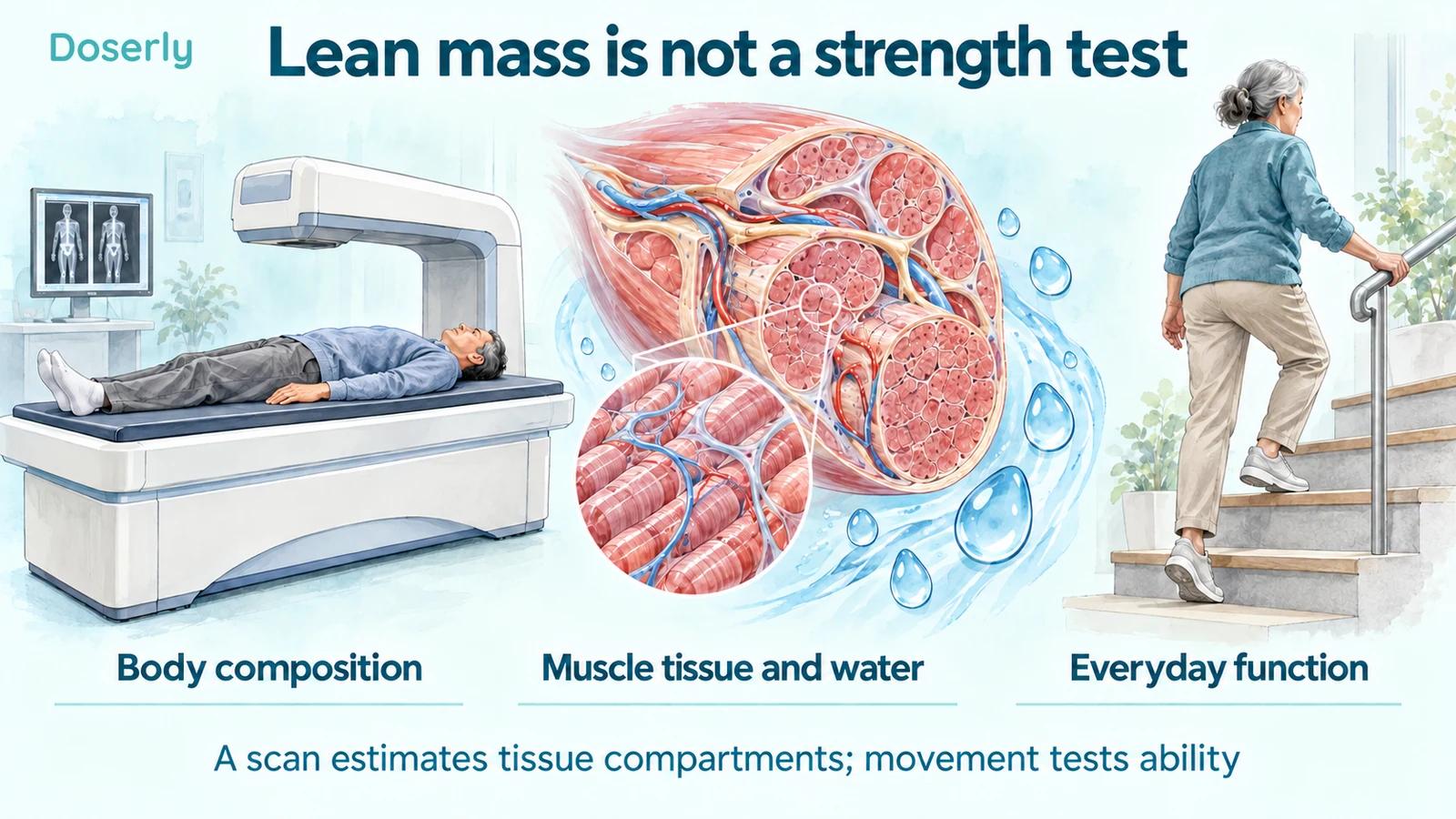
A body-composition report separates estimated tissue compartments, including fat, lean tissue, and bone mineral. Lean soft tissue is not a direct count of contractile muscle fibers. It includes water and nonfat soft tissues, so a change in that category cannot be read simply as kilograms of new muscle protein. Nor does the scanner measure how much force a muscle produces.
This is easiest to see by separating three statements: “the lean-tissue estimate increased,” “muscle size increased,” and “strength improved.” They may all be true in a particular situation, but the first statement does not prove the other two. A scan, an anatomical measurement, and a performance test provide different pieces of evidence.
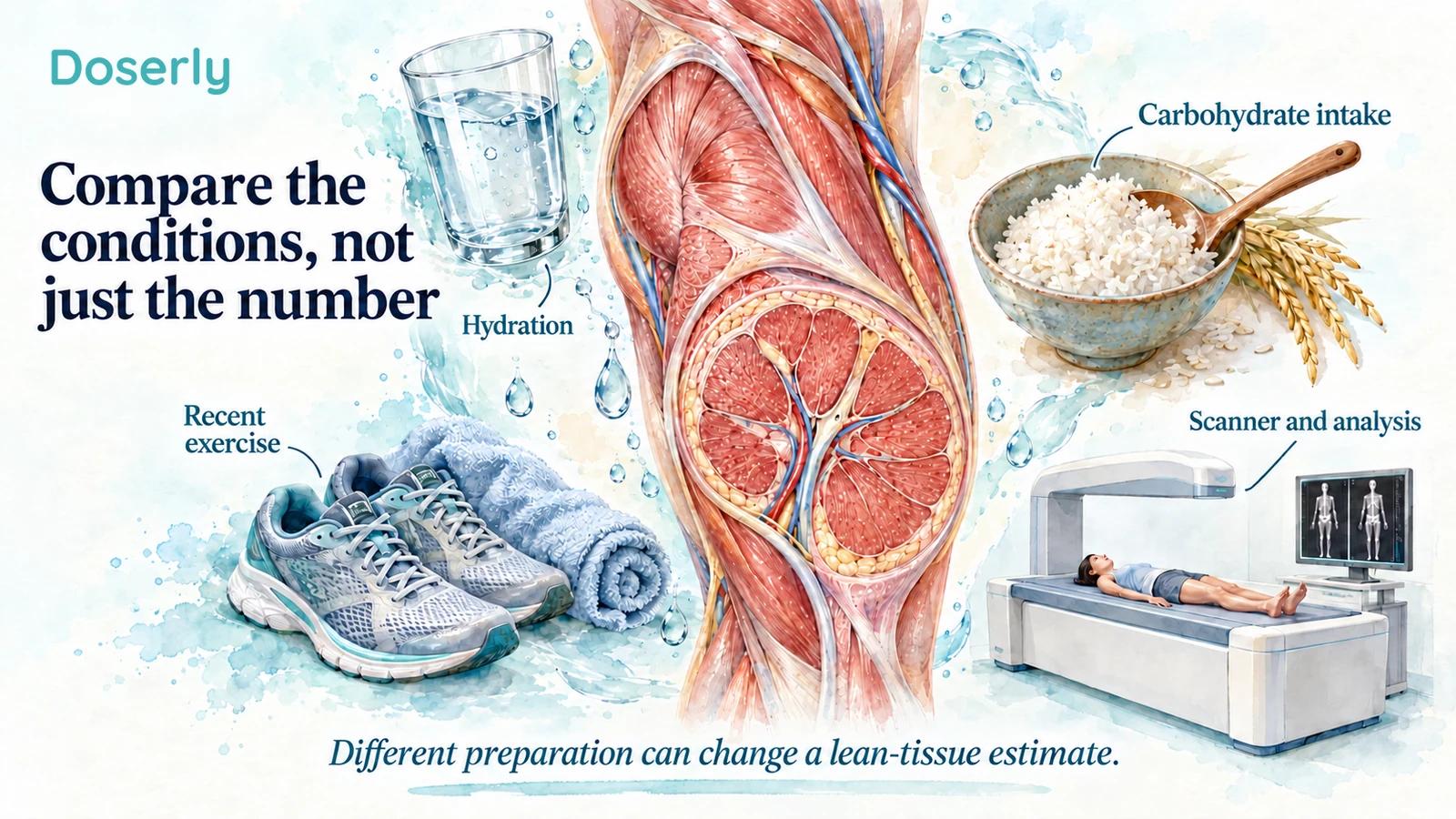
Researchers have demonstrated how quickly the scan estimate can move when body water and carbohydrate stores change. In a study of 12 active young men, exercise in heat followed by carbohydrate loading and recovery produced substantial changes in measured lean tissue over a short interval. Lean tissue fell by an average of 1.69 kg after exercise and rose by 2.36 kg during the subsequent supercompensation phase. These were measurement responses under an experimental protocol, not evidence of rapid muscle destruction and rebuilding. Hydration and DXA study
That small study does not establish how much of your particular result is water. It explains why a scan should be interpreted under comparable conditions. Dismissing every improvement as fluid would be just as unjustified as calling every increase new muscle. The useful question is what the measurement can distinguish—and what it cannot.
Testosterone can change composition, but context matters
In a randomized trial by Ng Tang Fui and colleagues, 100 men with obesity and testosterone at or below 12 nmol/L entered a structured weight-loss program. They received testosterone undecanoate injections or placebo for 56 weeks. Both groups followed a very-low-energy diet initially, then a maintenance program. The testosterone group had more favorable changes in fat and lean mass than the placebo group; the authors described its weight loss as almost entirely fat loss. Weight-loss and testosterone trial
This is evidence about adding testosterone to a particular program in a selected population. The comparison was not TRT versus doing nothing, and it was not a trial of normal-testosterone athletes seeking a different physique. The diet is part of the finding, not an inconvenient detail that can be removed from the headline.
Randomization helps estimate the additional effect of the assigned treatment when the background program is shared. By contrast, if someone starts TRT, changes food intake, begins resistance training, and then posts a scan, the personal before-and-after comparison cannot separate those contributions. It may accurately document progress while remaining weak evidence about which component caused it.
A later observational follow-up of participants from the weight-loss trial found that the former between-group body-composition differences were no longer apparent after treatment cessation and a follow-up period of about 82 weeks. This does not mean everyone lost all progress, or that every individual will follow the same course. It does mean that a treatment-period scan should not be turned into a promise of permanent changes after treatment ends. Post-treatment follow-up
Mechanistic research is not a physique prescription
Another influential study experimentally suppressed natural hormone production in healthy men aged 20–50, then assigned different testosterone-gel amounts. A second cohort also received an aromatase inhibitor to suppress conversion to estradiol. Over 16 weeks, the results helped distinguish androgen and estrogen contributions: androgen deficiency accounted for reductions in lean mass, muscle size, and strength, while estrogen deficiency was a major contributor to fat increases. Finkelstein and colleagues' experiment
The experiment shows why hormone physiology is more complex than “testosterone builds muscle and estrogen causes fat.” It does not establish a safe self-directed hormone target, a reason to suppress estradiol, or a dosing strategy for improving a scan. Deliberately creating deficiency and studying its consequences is a different question from deciding whether a symptomatic patient should start long-term replacement.
It also illustrates why outcomes can diverge. The amount of hormone associated with maintaining one physiological outcome need not be identical to the amount associated with another. A person should not infer that a satisfactory scan proves sexual symptoms, mood, or strength have been adequately addressed. Those outcomes require their own evidence.
For diagnosis and treatment context, the TRT beginner guide is a useful companion. The purpose of replacement is considered within a clinical assessment of hypogonadism and symptoms; a body-composition image does not provide that assessment by itself. Endocrine Society guideline
More lean tissue does not automatically mean better mobility
The Testosterone Trials provide a practical example of why function must be measured directly. The physical-function component tested whether more participants improved their six-minute walking distance by at least 50 meters. That primary comparison was not significant in the Physical Function Trial itself, although analyses across all Testosterone Trials participants showed a benefit. Testosterone Trials main report
A later analysis found improvements in self-reported walking ability and modest walking-distance changes across the wider trial population. Falls did not decrease: 103 of 380 analyzed participants in each treatment group reported at least one fall during the intervention period. The authors described benefits as modest and noted that results varied with baseline characteristics and the outcome examined. Testosterone Trials mobility analysis
A statement that treatment improved one walking measure should therefore not become “TRT prevents falls,” “TRT restores independence,” or “every increase in lean mass improves mobility.” Those are separate claims. A person may value a modest functional improvement, but it should be identified and measured rather than inferred from body composition.
This distinction can make follow-up more useful. If climbing stairs was the original difficulty, describe whether stairs are easier. If carrying groceries was the priority, discuss that task. A scanner cannot report whether you still avoid an activity because of pain, breathlessness, balance, or fatigue. An apparently favorable composition result and an unresolved functional problem can coexist without either observation being false.
Read a repeat scan as a comparison, not a verdict
ISCD recommends consistent positioning and preparation for body-composition measurements, including factors such as clothing, time of day, activity, and bladder status. It also addresses cross-calibration when comparing scanners and requires assessment of measurement precision. Two reports from different machines are not automatically interchangeable merely because both say DXA. ISCD official positions
Ask the facility how the scans were standardized and whether the observed change is large enough to interpret confidently. Do not take a precision percentage from an unrelated clinic or a bone-density example and apply it to your own lean-mass result. The relevant question is how the particular measurement was obtained and compared.
Keep absolute and relative changes separate as well. A lower body-fat percentage can arise from changes in the numerator, denominator, or both. For a simple hypothetical example, 20 kg of fat in a 100 kg body is 20%. If body weight changes, interpreting the percentage without the compartment masses can conceal what actually moved. This arithmetic example is not a desired body-fat target.
A useful comparison therefore includes dates, equipment or facility, relevant preparation differences, body weight, and the specific compartment being discussed. It also includes the treatment and activity history during that interval. These details do not make a scan less objective; they make its objective information easier to interpret correctly.
Work through a before-and-after claim
Imagine a hypothetical report showing less fat and more lean tissue after six months. During that period, the person also began a supervised exercise program and changed their eating pattern. Start with the narrow observation: the scanner estimated a different composition at the second visit. Then ask whether preparation and equipment were comparable. If they were, confidence in a real tissue-compartment change increases.
The next question is causal: which intervention produced it? The scan cannot divide the change between testosterone, exercise, food intake, or their combination. Finally, ask whether strength, symptoms, and everyday tasks improved. Even a convincing composition change leaves that question open if nobody measured or described function.
Now consider the reverse pattern: little scan change, but easier stair climbing and better tolerance of ordinary activity. That does not prove TRT caused the improvement either, but it is information worth retaining. A scan-centered account could miss a benefit the person actually values. These examples are reasoning exercises, not patient testimonials. They show why the most useful progress record keeps measurement, attribution, and lived benefit visible separately.
Put function and safety beside the scan
Strengthening activity, aerobic activity, and balance work address different aspects of physical ability. NIA describes muscle-strengthening exercise as a way to support everyday tasks such as getting up from a chair, climbing stairs, and carrying groceries. The appropriate activity plan depends on the person, including any limitations that need professional assessment. A favorable scan does not replace the work of building and maintaining those abilities. NIA exercise guidance
The same separation applies to treatment safety. A change in lean mass does not tell you whether treatment is causing an adverse effect or whether the original indication remains appropriate. The Endocrine Society recommends assessing response, adverse effects, and adherence during treatment. Doserly's TRT blood-work guide can help organize the monitoring discussion. Endocrine Society guideline
At review, keep four questions visible: what changed in composition, what changed in symptoms, what changed in ability, and what the safety assessment shows. These are not competing definitions of success. They help prevent a single favorable number from silencing an important concern elsewhere.
Before paying for another scan, it is reasonable to ask what decision it would change. Would it help clarify an unexpected weight change, support a clinician's assessment, or simply repeat information that is already available? The answer may differ by situation. More measurements are useful when they answer a question; they are less useful when the only goal is to obtain a more reassuring score.
A better DXA result can be encouraging. The strongest interpretation is precise: the measured compartment changed under the conditions of that assessment. To judge TRT as a whole, add the outcomes the scan cannot supply—how you feel, what you can do, whether the comparison is reliable, and whether treatment remains appropriate and tolerable.
Sources
- ISCD official adult positions
- Hydration, glycogen and DXA lean-tissue measurement
- Testosterone during a structured weight-loss program
- Body composition after testosterone cessation
- Gonadal steroids, body composition and strength
- Testosterone Trials main report
- Testosterone Trials mobility analysis
- NIA exercise guidance
- Endocrine Society testosterone guideline