
HRT
October 16, 2026
WHI was not one universal HRT experiment
On this page
Hormone therapy can relieve menopausal symptoms, but its effects extend beyond the symptoms a person notices. Estrogen acts in tissues including bone, the reproductive tract and blood vessels. A treatment that helps one outcome can affect another differently. The Women's Health Initiative, usually called WHI, was designed to investigate that wider balance in postmenopausal women.
WHI is often described as a single study proving that hormone therapy is either dangerous or beneficial. Its hormone research actually included two separate randomized trials, later analyses and long-term follow-up. They studied particular oral medicines in women aged 50–79. Understanding those details helps explain why different WHI headlines can sound contradictory without either being fabricated.
For a reader considering treatment today, the aim is to identify which findings are relevant to your proposed regimen and goal. WHI remains important evidence. It is also possible to take its findings seriously while recognizing the questions it did not test. Our WHI guide provides a broader reference for the study's history and clinical implications.
First separate the two trials
In the combined-therapy trial, 16,608 women with a uterus were assigned an oral tablet containing conjugated equine estrogens, abbreviated CEE, plus medroxyprogesterone acetate, or an inactive placebo. Medroxyprogesterone acetate is a progestin, a medicine with progesterone-like activity. The daily trial formulation contained 0.625 mg CEE and 2.5 mg medroxyprogesterone acetate. These amounts identify the intervention studied; they are not instructions for a contemporary prescription. Combined-trial primary report.
In the estrogen-alone trial, 10,739 women who had undergone hysterectomy, surgery removing the uterus, were assigned oral CEE 0.625 mg daily or placebo. They were a different population, with their own randomized comparison. Estrogen-alone primary report.
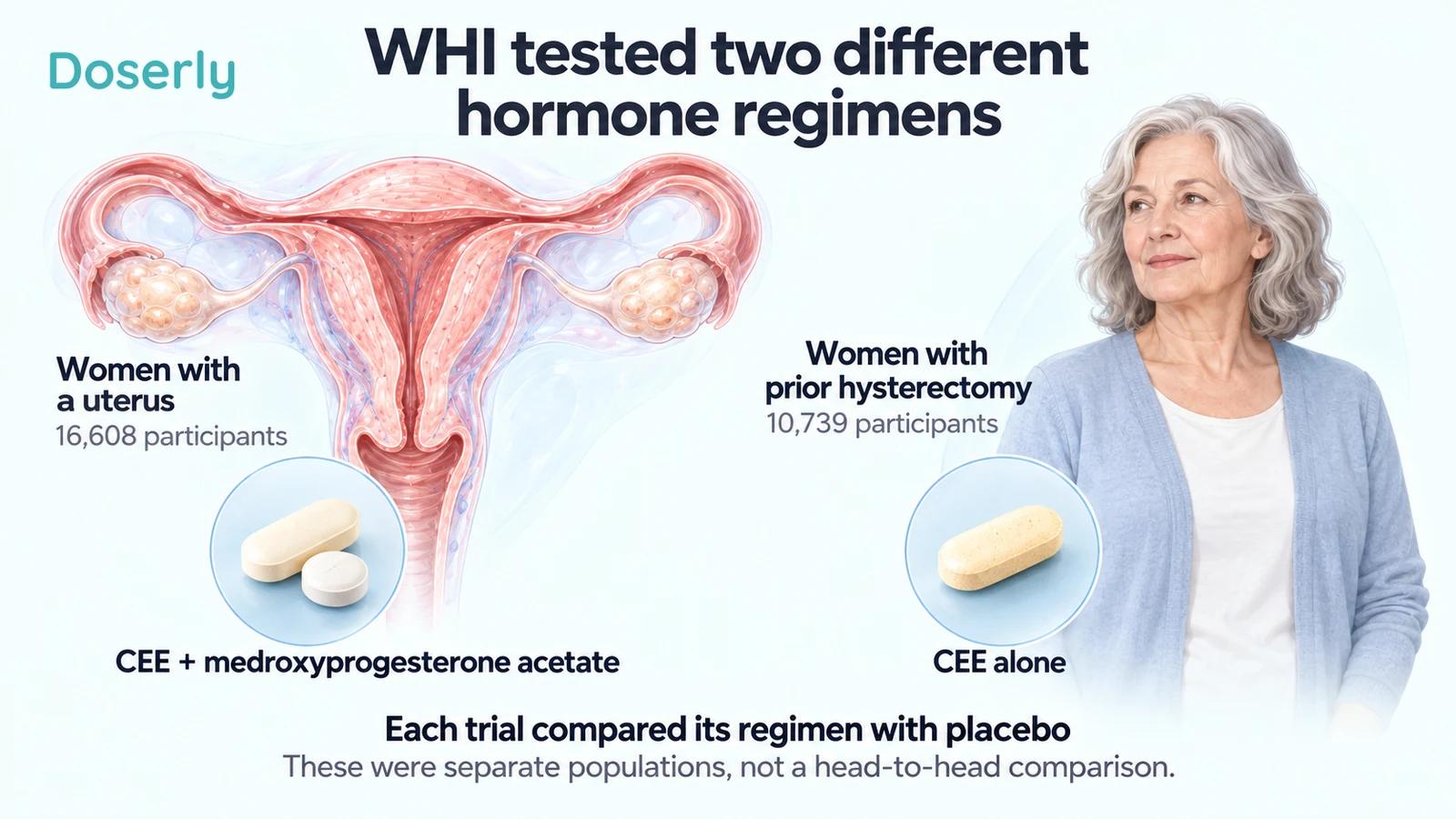
This design is important when comparing results. WHI did not randomly assign otherwise identical women to have or not have a uterus, nor did it directly randomize one population between estrogen alone and combined therapy. Differences between the two trials cannot be attributed solely to adding a progestin without considering differences between their participants.
What was WHI trying to prevent?
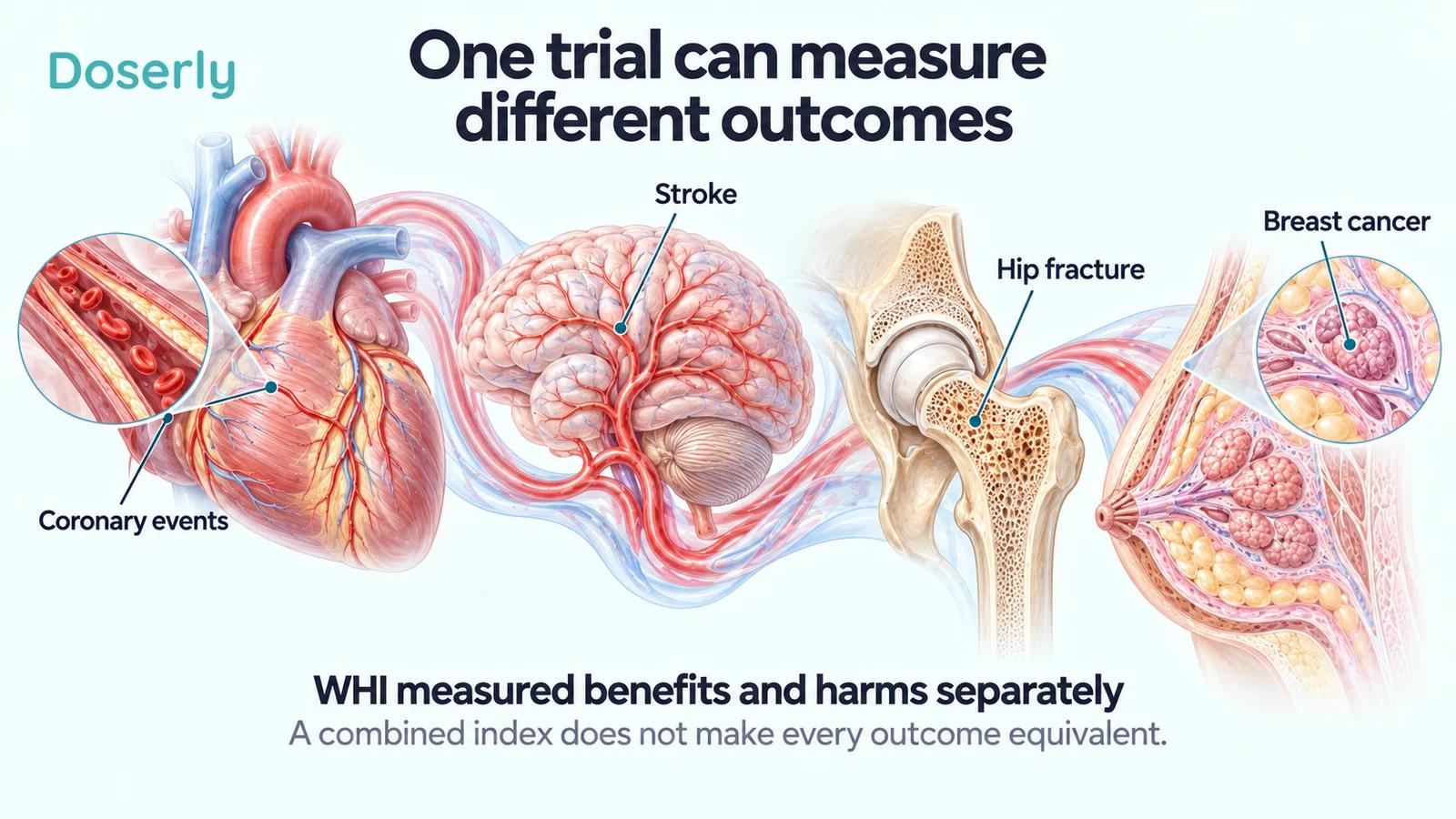
The central question was whether hormone therapy could prevent chronic disease. Coronary heart disease was a principal outcome, and invasive breast cancer was a major safety outcome. Researchers also tracked stroke, blood clots, fractures and other events. This was a much broader question than whether a treatment reduced hot flashes over a few months.
NHLBI, the institute that supported WHI, emphasizes that its prevention trials were not designed as the original tests of whether approved hormones treat menopausal symptoms; symptom benefits were already established. Its 2024 review of the research continued to distinguish chronic-disease prevention from individualized symptom treatment. NHLBI clinical interpretation.
That distinction changes the benefit side of a decision. Someone with severe night sweats may value relief that improves sleep and daily function. Someone without symptoms, taking a medicine solely to prevent a future heart attack, needs evidence of that preventive benefit. The same adverse effect can be weighed differently when the expected benefit differs.
Why was combined treatment stopped early?
The initial combined-trial report described a mean follow-up of 5.2 years. Treatment was stopped because the breast-cancer monitoring threshold had been crossed and the overall balance supported more harms than benefits. The original report estimated, per 10,000 person-years, eight additional invasive breast cancers and five fewer hip fractures with combined therapy than placebo. Other cardiovascular harms contributed to the overall assessment. Combined-trial primary report.
A person-year is a unit of observation time. Ten thousand people followed for one year contribute approximately 10,000 person-years, as would a smaller group followed for longer. These numbers are annualized differences between study groups; they do not mean eight in every 100 women developed breast cancer because of treatment.
They also show why a treatment cannot be summarized by one favorable or unfavorable event. Fewer fractures are clinically valuable. Additional cancers or vascular events matter too. A person considering treatment needs the relevant outcomes presented together, with enough context to understand their scale.
Was estrogen alone simply safer in every respect?
The estrogen-alone trial produced a different pattern. In its 2004 report, with average follow-up of 6.8 years, the coronary-heart-disease estimate was not significantly different from placebo: hazard ratio 0.91, with a 95% confidence interval of 0.75–1.12. Stroke risk was higher, with a hazard ratio of 1.39, interval 1.10–1.77, while hip fractures were less frequent, hazard ratio 0.61, interval 0.41–0.91. Estrogen-alone primary report.
A hazard ratio compares how quickly events occur over follow-up. A value above 1 indicates a higher estimated event rate in the treatment group; below 1 indicates a lower rate. The confidence interval describes uncertainty around that estimate. When it crosses 1, the study has not established a clear difference at the conventional statistical threshold.
The estrogen-alone results therefore cannot be compressed into “estrogen was protective.” The outcome matters. They also cannot justify omitting a prescribed progestogen in someone with a uterus: the estrogen-alone trial enrolled women whose uterus had been removed.
What did longer follow-up add about breast cancer?
The 2020 breast-cancer analysis followed the two randomized populations for more than 20 years cumulatively. In the estrogen-alone trial, 238 breast cancers occurred in the CEE group and 296 in the placebo group; the hazard ratio was 0.78, interval 0.65–0.93. In the combined trial, there were 584 cases with CEE plus medroxyprogesterone acetate and 447 with placebo; the hazard ratio was 1.28, interval 1.13–1.45. Long-term breast-cancer report.
These are outcomes after initial randomized treatment and subsequent follow-up, not a trial in which everyone remained on treatment for 20 years. The study also distinguished developing breast cancer from dying of it. Combined therapy was associated with increased incidence, while its breast-cancer mortality estimate did not establish a statistically clear difference.
The findings help explain why estrogen alone and combined treatment need separate discussions. They do not establish that every estrogen-only formulation lowers breast-cancer risk, or that replacing medroxyprogesterone acetate with another progestogen guarantees the same result. Those are additional clinical questions requiring their own evidence.
Why do different WHI reports use different numbers?
A research program can publish an initial analysis, update adjudicated events, extend follow-up and examine particular outcomes in more detail. “The WHI result” is therefore incomplete without the publication and period being discussed.
The 2013 integrated analysis reported median intervention durations of 5.6 years for combined therapy and 7.2 years for estrogen alone, with approximately 13 years of cumulative follow-up. It found that many effects diminished after treatment stopped, while some differences persisted. It also described a more favorable pattern for several outcomes in younger estrogen-alone participants. Integrated intervention and postintervention report.
This is why the 5.2-year mean in the first combined report and the later 5.6-year median are not interchangeable labels. They refer to different analyses and summary measures. Quoting one paper's event count with another paper's follow-up duration can create an apparently precise statement that no publication actually reported.
When reading a risk estimate, look for the words “during treatment,” “after stopping” or “cumulative follow-up.” They tell you what period the estimate covers and whether it describes the immediate treatment experience or a longer observation window.
Did age and time since menopause matter?
WHI included women in their 50s, 60s and 70s, with an average age around 63. Averages are useful, but they do not mean every participant was elderly or that nobody near menopause was studied.
A 2007 secondary analysis examined cardiovascular results by time since menopause. For participants less than 10 years from menopause, the pooled estimate across both WHI hormone trials for coronary heart disease was 0.76, with a confidence interval of 0.50–1.16. The point estimate favored hormone therapy, but the interval included both benefit and no benefit. Results were less favorable farther from menopause. Age and timing analysis.
This supports taking timing seriously without treating an early-start subgroup as a guaranteed heart-protection strategy. It is a secondary analysis with fewer events within each subgroup, and pooling regimens does not make them biologically identical. Your age and cardiovascular history help determine relevance, but they cannot convert an uncertain estimate into a personal promise.
What about the dementia findings?
The Women's Health Initiative Memory Study, or WHIMS, addressed a narrower population than the main hormone trials. Its combined-treatment study enrolled 4,532 women aged 65 or older who did not have probable dementia at entry. Over about four years, probable dementia was diagnosed in 40 combined-treatment participants and 21 placebo participants. The hazard ratio was 2.05, interval 1.21–3.48. WHIMS combined-treatment report.
That result is relevant to starting the studied treatment in older women. It does not directly measure what happens when a person starts a different regimen at 50 for hot flashes, nor does it test relief of subjective “brain fog.” Cognitive symptoms, formal cognitive-test performance and diagnosed dementia are different outcomes.
Recognizing the age restriction should sharpen interpretation, not erase the result. Similarly, absence of a corresponding prevention trial in younger women does not establish that earlier hormone use prevents dementia. It leaves that particular question unresolved by WHIMS.
Did hormone therapy change overall survival?
The 2017 mortality analysis followed 27,347 originally randomized participants for approximately 18 years cumulatively. Death from any cause occurred in 27.1% of the hormone-therapy groups and 27.6% of placebo groups. The pooled hazard ratio was 0.99, interval 0.94–1.03, showing no statistically clear overall difference. Long-term mortality report.
This is valuable reassurance against a simplistic claim of a large overall mortality penalty from the trial regimens. It also does not mean the treatments had no meaningful harms or benefits. Nonfatal stroke, cancer treatment and a hip fracture can profoundly affect someone's life even when a trial's all-cause mortality result is neutral.
The outcome you care about therefore remains important. Survival is one essential measure; it does not replace symptom relief, disability, treatment burden or the individual disease outcomes that contributed to the trial's assessment.
How should WHI inform a decision now?
Start with the proposed treatment: the estrogen molecule, route, dose and whether a progestogen is included. Then identify the purpose, such as treating disruptive hot flashes, and the relevant personal history. Ask which WHI comparison is informative and which questions require evidence from other studies.
WHI did not directly compare a modern estradiol patch plus micronized progesterone against its oral combined regimen. That limitation is a reason to examine additional evidence, not proof that a different regimen has no risks. Conversely, using an old oral-trial estimate as the exact risk of every modern formulation overstates what was measured.
The Menopause Society's 2022 statement reflects this individualized approach: benefits and risks depend on formulation, dose, route, duration, timing and progestogen use. It describes a favorable balance for suitable symptomatic patients younger than 60 or within 10 years of menopause, with ongoing review. Position statement.
A useful consultation can hold both ideas at once: WHI identified real effects that should shape care, and its findings need to be applied to the right population and treatment question. That is a stronger basis for a decision than accepting or rejecting “WHI” as a single verdict.
Sources
- Combined WHI trial primary results, 2002.
- Estrogen-alone WHI primary results, 2004.
- NHLBI review of WHI clinical messages, 2024.
- WHI integrated intervention and postintervention analysis, 2013.
- WHI age and time-since-menopause analysis, 2007.
- WHIMS combined-treatment dementia trial, 2003.
- WHI breast-cancer long-term follow-up, 2020.
- WHI mortality follow-up, 2017.
- The Menopause Society hormone-therapy position statement, 2022.