
Peptides
October 16, 2026
Tirzepatide and food noise: what did researchers actually measure?
On this page
People often use “food noise” to describe repeated thoughts about eating: thinking about the next meal, feeling pulled toward available food or finding cravings difficult to set aside. For someone who experiences that as intrusive, a change can matter independently of the number on the scale.
Tirzepatide research has examined appetite, cravings, food intake and responses to food cues. These findings help explain why some people describe less preoccupation with food. But those measurements aren't all the same, and a study showing a smaller lunch does not by itself prove that every participant's food thoughts disappeared.
The useful question is what changed, how it was measured and how long it was observed. Our tirzepatide guide explains the broader medicine; this article focuses on the human research behind the food-noise discussion.
Hunger, cravings and food thoughts can overlap without being identical
Hunger can describe the desire or physical readiness to eat. A craving is often a desire for a particular food or type of food. Food preoccupation concerns how much attention food occupies and whether those thoughts feel persistent or intrusive.
A person could feel less physically hungry but still think frequently about food. Someone else might enjoy meals and experience ordinary hunger while feeling less driven to seek snacks between them. Asking only whether appetite decreased can miss those differences.
Researchers have developed a Food Noise Questionnaire to study this broader experience. Developing and validating a questionnaire tests whether its questions behave as a useful measurement tool. It doesn't establish that a particular treatment improves the score, identify a diagnosis in every person with a high score, or show that food thoughts should be absent. Questionnaire development study
This matters when reading older trials. A study might use established hunger or craving scales before a food-noise instrument was available. Those results can be relevant to the same experience without being interchangeable with a direct food-noise score.
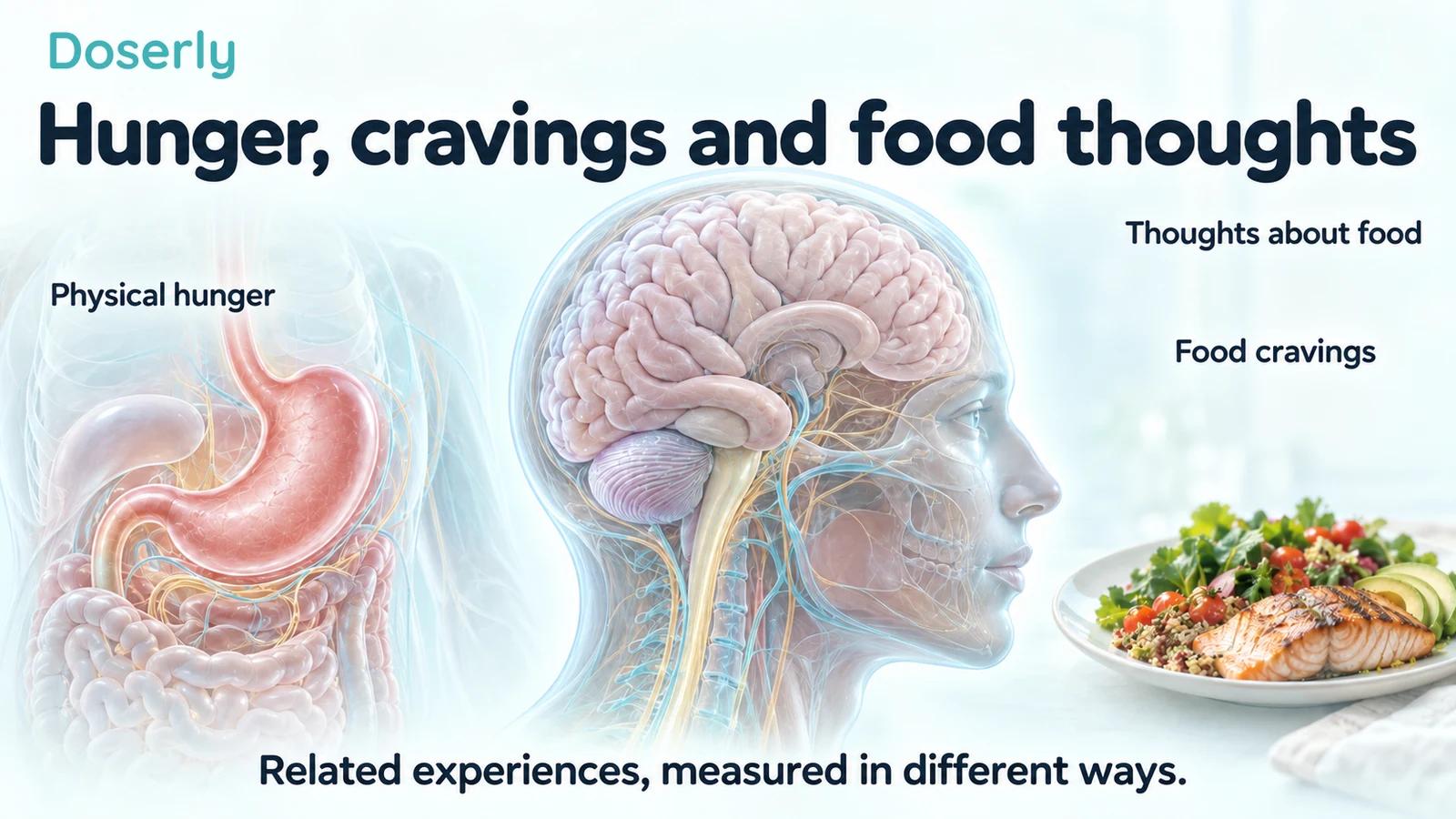
The concepts can overlap. The illustration does not assign each experience to a single brain location or show a drug changing brain activity.
What did the six-week trial actually test?
A randomized phase 1 trial published in 2025 enrolled 114 adults without diabetes, with BMI between 27 and 50. It compared blinded tirzepatide or placebo with an additional open-label liraglutide group. The primary question was the change in energy eaten during an unrestricted lunch test at week three. Treatment continued for six weeks. Primary trial PDF
An ad libitum meal means participants can eat according to appetite within the test setting. Researchers measure the food consumed. This provides a behavioral outcome rather than relying only on memory of what someone ate.
In the prespecified primary analysis, the between-group difference favored tirzepatide by approximately 534 kcal at that lunch. The paper's abstract reports about 525 kcal from a different model. Both estimates describe a test-meal comparison, not a prescribed daily calorie deficit. Primary analysis
Do not multiply that number by every meal or every day to predict weight loss. People can eat differently later, and the clinical setting is not their entire food environment. The trial answers whether intake changed under its test conditions.
What did the questionnaires add?
The study also assessed reported appetite, cravings, responsiveness to available food and eating behavior. Several measures improved relative to placebo, while cognitive dietary restraint did not show a significant difference at week three. These were secondary outcomes, distinct from the primary meal measurement. Trial measures and results
Dietary restraint concerns deliberate efforts to limit intake. It differs from feeling less hungry or less drawn to food. A person doesn't need to report greater conscious restriction to report a change in appetite.
That distinction is useful in conversation. “I can leave food on the plate without thinking about it” is different from “I am working harder to resist eating.” Either description can be explored without treating it as a moral judgment about self-control.
Questionnaires also depend on what people are asked and the time period they recall. A fasting rating that morning, a report about the previous week and a description of the hardest moment are different observations. If they differ, that needn't mean someone is reporting incorrectly.
Why a meal test and a questionnaire are both useful
Food intake is observable; an intrusive thought is an experience only the person can report directly. Measuring one doesn't make the other unnecessary. Together they can help distinguish feeling less driven to eat from simply eating less under observation.
Imagine two hypothetical participants eating the same smaller lunch. One feels comfortably satisfied. The other wants to eat but feels nauseated. The measured intake is similar, but the experience and clinical meaning differ. Neither example is a claim about an actual trial participant.
This is why tolerability belongs beside appetite findings. A medication that changes hunger can also cause gastrointestinal symptoms. Those possibilities should be discussed separately rather than treating every reduction in eating as the desired effect.
The label for tirzepatide includes nausea, vomiting, diarrhea and other gastrointestinal adverse effects. Persistent symptoms, difficulty maintaining fluids or inability to eat adequately deserve review rather than being counted as evidence that treatment is working especially well. Zepbound prescribing information
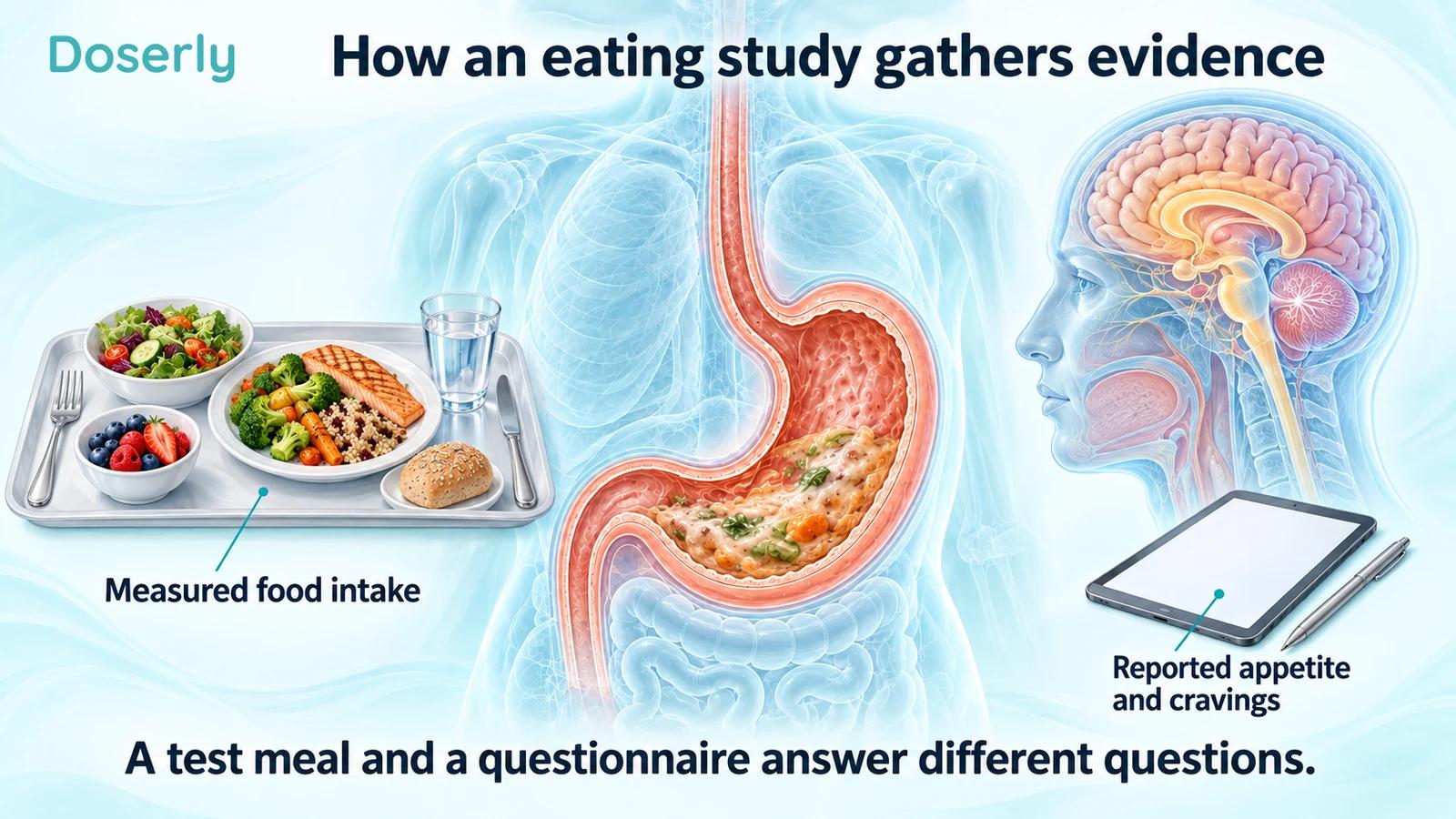
The food consumed and the experience reported are separate measurements. These are illustrative scenes, not photographs of study participants.
Did brain imaging prove that food noise was switched off?
No. The six-week study used functional MRI while participants viewed food images. For the aggregated highly palatable food category, the week-three difference in brain response was not statistically significant. Findings for selected food categories were more specific and should not replace that broader result. Trial imaging results
Functional MRI measures changes related to blood oxygenation as an indirect indicator of activity. It doesn't directly read a thought, identify a unique food-noise switch or diagnose why a particular person wants a snack.
A headline about reduced activation in selected regions may sound more conclusive than the underlying comparison. The useful interpretation is that imaging can help investigate how food cues are processed, while the relationship to everyday experience requires careful testing.
The different measurements also need not move together. A person may report a meaningful change without a clear group-level imaging result. Conversely, an imaging difference doesn't automatically establish a benefit someone notices.
What about the direct brain-recording study?
A later report examined one person with severe food preoccupation using implanted electrodes that allowed recording within the nucleus accumbens, a brain region involved in reward-related processing. Low-frequency activity preceded breakthrough episodes of severe preoccupation despite tirzepatide treatment. Single-case report
This was an unusual opportunity to observe brain physiology directly. It was also a single uncontrolled case, not a randomized trial of whether tirzepatide quiets food noise. The investigators could not compare recordings during a treatment-free period, and other changes could have contributed.
The report doesn't establish that a brain measurement can currently select a dose or determine when another injection is needed. Nor does it show that all people with obesity share the same pattern. Its value lies in suggesting questions for future research.
The case also makes the story less simplistic: preoccupation can return or break through while someone remains on treatment. That observation should not become a claim that the medicine inevitably stops working, but it does argue against promising permanent silence.
What does the longer diabetes study contribute?
A separate analysis examined 28 weeks of tirzepatide, semaglutide or placebo in adults with type 2 diabetes. The groups included 45, 44 and 28 participants, respectively. Researchers assessed body composition, appetite and energy intake, providing evidence over a longer period in a different population. Diabetes study
The appetite comparison favored tirzepatide over placebo, but did not establish a clear difference from semaglutide on that reported measure. That is a useful reminder that a greater change in weight doesn't require every appetite questionnaire to show a correspondingly larger difference.
This was a secondary analysis of a mechanistic trial, not an independent large trial designed around food noise. People with diabetes also aren't interchangeable with the adults without diabetes in the six-week study.
Taken together, these studies support measurable effects on eating-related outcomes. They don't provide a single percentage by which food noise falls for every patient. Different tools, populations and durations are part of the reason.
What would make future food-noise research more useful?
A treatment study could specify a validated food-preoccupation measure in advance, follow it over a meaningful period and assess whether changes correspond to improvements people value. That could include less distress, easier meal planning or improved daily functioning, alongside nutrition and adverse effects.
It would also help to know who benefits and who doesn't. Baseline preoccupation, eating-disorder symptoms, diabetes, other medicines and the broader food environment may matter. These are research questions, not established rules for predicting an individual's response.
Repeated measurement would be more informative than asking once whether treatment made thoughts quieter. It could show whether early changes persist, fluctuate during treatment or differ from changes in hunger. A useful study would also account for people who stop because of adverse effects.
Those design needs don't invalidate personal reports. They explain what is required to turn a common description into a reliable estimate of treatment benefit.
How can someone describe their own experience?
Start with what changed in ordinary life. Are thoughts less frequent, less distressing or easier to set aside? Do you feel comfortably full sooner? Are cravings different, or are you avoiding food because of nausea? Concrete descriptions help a clinician understand the effect without assuming that every experience fits one label.
A brief dated record can include meal patterns, symptoms and medication changes. It doesn't need to become constant surveillance of every thought or calorie. The purpose is to support a useful discussion, particularly if appetite changes interfere with adequate eating.
Persistent distress, loss-of-control eating, severe restriction or compensatory behaviors deserve assessment in their own right. Eating disorders are serious conditions, and a change in weight doesn't determine whether someone needs support. NIMH eating-disorder information
Tirzepatide's human studies provide a credible basis for discussing changes in appetite and eating behavior. The most helpful account keeps the measurements specific and the person's experience central: quieter food thoughts may be meaningful, but they are one part of a treatment response, not a universal requirement or a reason to ignore adverse effects.
Sources
- Six-week ingestive-behavior trial, 2025.
- Appetite, intake and body composition in diabetes, 2023.
- Food Noise Questionnaire development, 2025.
- Single-participant brain-recording report, 2025.
- NIMH eating-disorder information.
- Zepbound prescribing information.