
Peptides
October 16, 2026
What would make petrelintide useful in everyday care?
On this page
An early weight-loss result answers an important question: does a treatment appear to do something worth studying? It does not answer all the questions a person and clinician face when deciding whether a medicine belongs in long-term care.
Petrelintide has now moved beyond its smallest early trials. ZUPREME-1 was published in September 2026, and the sponsor announced results from ZUPREME-2 in people with type 2 diabetes in October. That changes the evidence discussion. It is no longer accurate to describe the entire program as a handful of volunteers and a promising press release.
The next question is how much the growing evidence tells us about sustained, usable benefit. That requires looking at participants, symptoms, treatment continuation and outcomes beyond a single mean percentage. The petrelintide guide provides background on the investigational amylin analogue; this article examines what would make its evidence useful in ordinary clinical decisions.
Start with what has actually been established
The published ZUPREME-1 phase 2 trial randomized 493 adults with overweight or obesity without type 2 diabetes; 485 received treatment. It compared several weekly petrelintide doses with placebo.
The primary weight outcome was measured at week 28. Estimated mean weight change ranged from −7.9% to −9.8% across active groups, compared with −1.7% with placebo, under the efficacy analysis. That analysis addresses the specified continued-treatment scenario rather than simply averaging every observed experience regardless of treatment changes. ZUPREME-1 primary publication
This is evidence of a clinical effect in the studied population. It is stronger than a laboratory mechanism or a small uncontrolled report. It is also a dose-finding phase 2 study, with a limited duration and no active-drug comparator.
The sponsor's later summary describes follow-up to week 42 and distinguishes efficacy from treatment-policy estimates. That distinction is useful because the treatment-policy question includes events such as treatment discontinuation rather than treating continued adherence as the only scenario of interest. Publication and follow-up announcement
For everyday care, both questions matter. A clinician wants to know the medicine's potential when continued and the outcome of choosing the treatment strategy when some people stop or change treatment.
The participants should resemble the people making the decision
Early studies often select relatively homogeneous participants to characterize initial safety and exposure. Petrelintide's phase 1 program illustrates that stage: its small cohorts were mostly male, and the 16-week portion was conducted in a selected population at a single center. Phase 1 primary report
ZUPREME-1 broadened that evidence. Among treated participants, 53% were women, the mean age was 47 years and mean BMI was 36.7. However, 86% were White, and people with type 2 diabetes were excluded.
These characteristics do not invalidate the result. They define its most direct application and show where additional evidence would improve confidence.
A useful clinical program should report enough detail to assess older adults, different racial and ethnic groups, people with multiple conditions and people taking common concomitant medicines. Subgroup analyses need adequate numbers and careful interpretation; a small subgroup estimate with a wide uncertainty interval cannot establish that treatment behaves differently.
It also matters who was excluded. A trial that excludes certain gastrointestinal conditions or prior therapies may provide limited information for people with those histories. The published eligibility criteria and trial registration help reveal these boundaries.
Diabetes evidence is an expansion, not a duplicate
The sponsor's October 7 ZUPREME-2 announcement reported results in 220 adults with overweight or obesity and type 2 diabetes receiving metformin, with or without an SGLT2 inhibitor.
At week 28, the announcement reported weight reduction of up to 9.2% with petrelintide compared with 2.0% with placebo under the efficacy estimand, alongside improvements in HbA1c. These are sponsor topline findings, not a substitute for the full peer-reviewed report and detailed safety tables. ZUPREME-2 announcement
The new population matters. Diabetes, background treatment and baseline metabolic characteristics can affect both the clinical question and the treatment context. The result should not be casually compared with ZUPREME-1 to conclude that diabetes either enhances or reduces petrelintide's effect.
A full report would allow readers to examine the dose groups, missing observations, glucose outcomes, discontinuations and safety events together. That is the level of detail needed before translating a promising topline number into an informed expectation.
Durability requires more than a falling curve
A treatment can produce an early reduction in weight without establishing the durability of that effect over years. Continued benefit, the timing of a plateau and outcomes after interruption are separate questions.
For chronic treatment, a study needs enough time at the maintenance regimen to evaluate sustained response. Time spent escalating is not equivalent to time spent at a stable dose.
The FDA's January 2025 draft guidance on developing weight-reduction drugs emphasizes sustained reduction and long-term maintenance. It is a draft, non-binding document, not a petrelintide approval standard already satisfied by phase 2 results. Its broader point is useful: initial change is only one part of a long-term treatment claim. FDA draft guidance
A useful maintenance study would also explain what happened to participants who paused, stopped or changed treatment. Simply removing those experiences from the analysis can make the result less representative of the decision to begin a medicine.
Treatment continuation is a clinical outcome
A medicine can have substantial biological activity and still be difficult for some people to continue. That does not make the efficacy result false. It means efficacy and persistence need to be interpreted together.
Trial reports should distinguish stopping the study drug from withdrawing from follow-up. Someone who stops treatment may still provide valuable outcome data. Losing that follow-up creates a different problem from stopping the medicine itself.
The reasons for stopping also matter. Symptoms, lack of benefit, personal circumstances and other reasons should not be collapsed into a single unexplained dropout number. At the same time, excluding personal reasons does not make missing outcomes disappear.
The statistical framework known as an estimand makes these choices explicit: what treatment question is being asked, in which population and how events during follow-up are handled. The FDA's E9(R1) guidance explains this framework. For readers, the practical test is whether the headline number matches the question they care about.
Safety should describe experience, not only incidence
In ZUPREME-1, nausea was reported in about 20% of petrelintide-treated participants and 6% of placebo participants. Other gastrointestinal events were reported separately. That detail is more useful than saying the drug had a “good gastrointestinal profile.”
An event percentage tells us how many participants had at least one recorded event. It does not by itself describe how often symptoms recurred, how long they lasted, whether they interfered with work or eating, or whether a participant needed a treatment change.
Larger and longer studies are also needed to characterize uncommon events. A study of several hundred people can identify common tolerability patterns while remaining unable to estimate rare risks precisely.
For routine care, the useful safety account combines symptom type, severity, duration, serious events, discontinuation and the relevant patient context. A treatment does not become appropriate for every patient because most participants completed a trial.
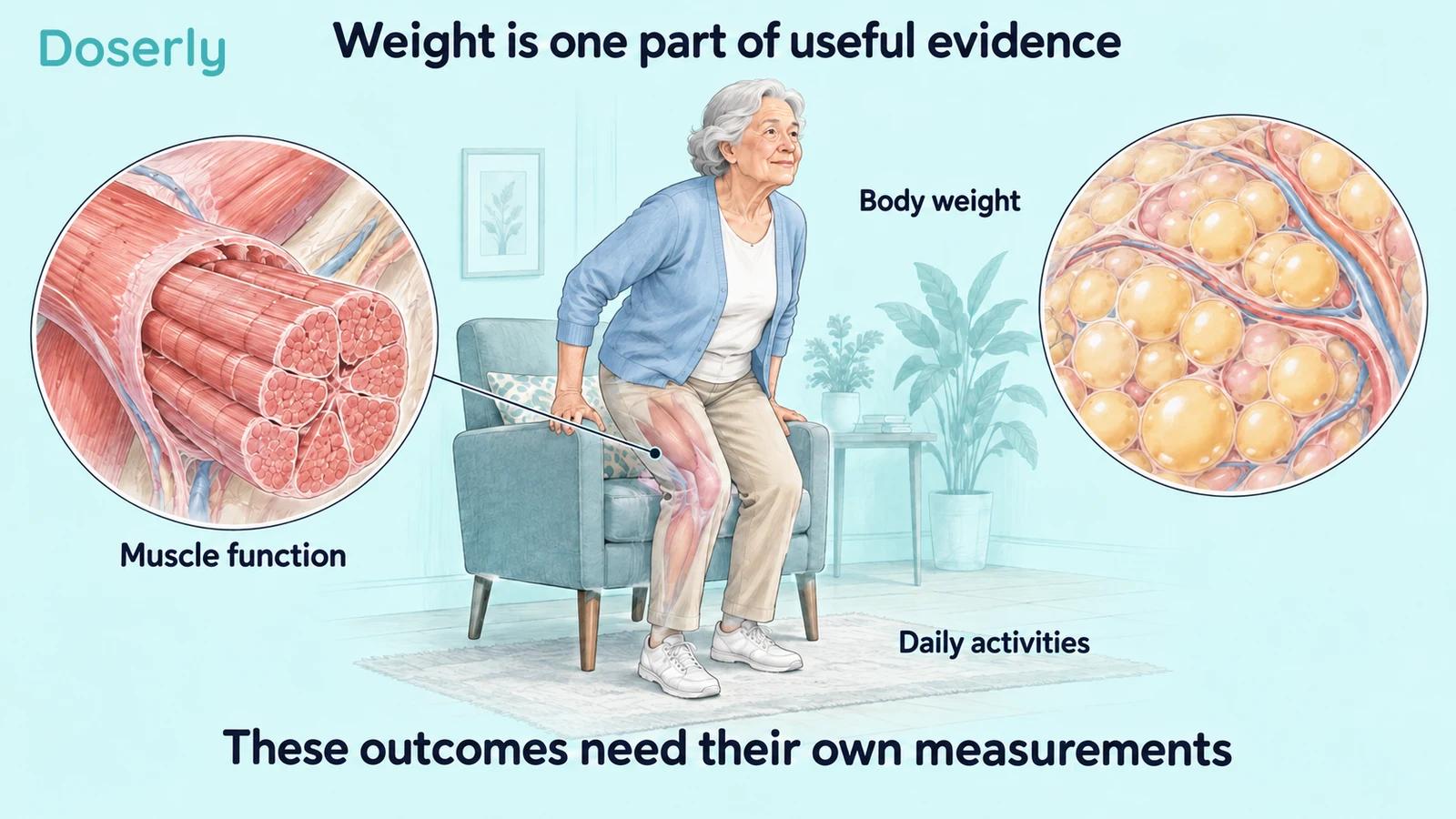
Weight should be connected to function and health
A scale measures total mass. It does not separate fat, lean tissue, water and other components, and it does not measure strength or the ability to carry out daily activities.
Body-composition methods can add information, but a lean-mass estimate is still not the same as a direct measurement of muscle function. A trial that claims preserved function should assess function rather than relying entirely on a body-composition label.
For people, useful outcomes may include mobility, comfort during daily activities, the burden of obesity-related conditions and quality of life. Which outcomes matter most will differ across patients.
These are questions for the petrelintide program to address. The weight findings reviewed here should not be presented as proof that petrelintide preserves muscle, improves physical performance or prevents cardiovascular events. Each of those claims requires its own appropriately designed evidence.
Comparison should reflect a real treatment choice
Placebo-controlled trials establish whether a treatment has an effect beyond the trial's background care. They do not necessarily establish how it compares with an established active treatment.
An active-comparator study could help answer whether petrelintide offers a useful tradeoff in weight outcomes, tolerability, persistence or patient preference. Such a study should use fair treatment schedules and report both benefits and burdens.
Cross-trial comparisons are less secure. Differences in duration, diabetes status, baseline weight, dose escalation and statistical analysis can produce apparent rankings that do not represent a direct comparison.
A medicine also need not be the largest weight reducer to be useful. A smaller average effect might still matter if the treatment is suitable for a particular population or offers a demonstrated advantage in tolerability or use. That advantage must be measured rather than inferred from mechanism or marketing language.
The practical treatment matters too
The final device, storage conditions, administration steps and access arrangements affect whether a treatment can fit into someone's life. These features may evolve during development and cannot be assumed from an early research vial.
Clinical support also changes outcomes. Regular trial visits, structured follow-up and ready access to a study team can differ from routine care. Later evidence should describe the support that accompanied treatment so readers can understand what the results depended on.
After any future approval, observational evidence could help examine use in broader populations and over longer periods. Such evidence has its own limitations, including differences between people who receive different treatments. It complements randomized evidence rather than replacing it.

What to look for in the next report
The most informative next report will make the treatment decision clearer. It should identify who was studied, how long they remained at the intended regimen, what happened when treatment changed and how benefits related to symptoms and daily life.
Petrelintide already has a meaningful clinical signal supported by published phase 2 evidence. The remaining work is to establish how durable, broadly applicable and usable that benefit is.
For someone following the research, the goal is not to dismiss promising percentages. It is to connect them to a fuller question: what can a person reasonably expect from starting and continuing this treatment, and how confidently does the evidence support that expectation?
Sources
- ZUPREME-1 primary report.
- Petrelintide phase 1 publication.
- ZUPREME-1 registry.
- ZUPREME-1 publication and follow-up announcement.
- ZUPREME-2 sponsor topline.
- FDA weight-reduction drug development draft guidance.
- FDA estimand guidance.