
Peptides
October 16, 2026
GHRP-6 tolerance: what repeated-response studies actually measured
On this page
When people ask whether GHRP-6 “stops working,” they may mean that hunger feels less noticeable, a hormone measurement changes, or a hoped-for benefit never appears. Those are different observations. The human studies of repeated GHRP-6 exposure mainly examined growth-hormone secretion, not long-term appetite, injury recovery or muscle gain.
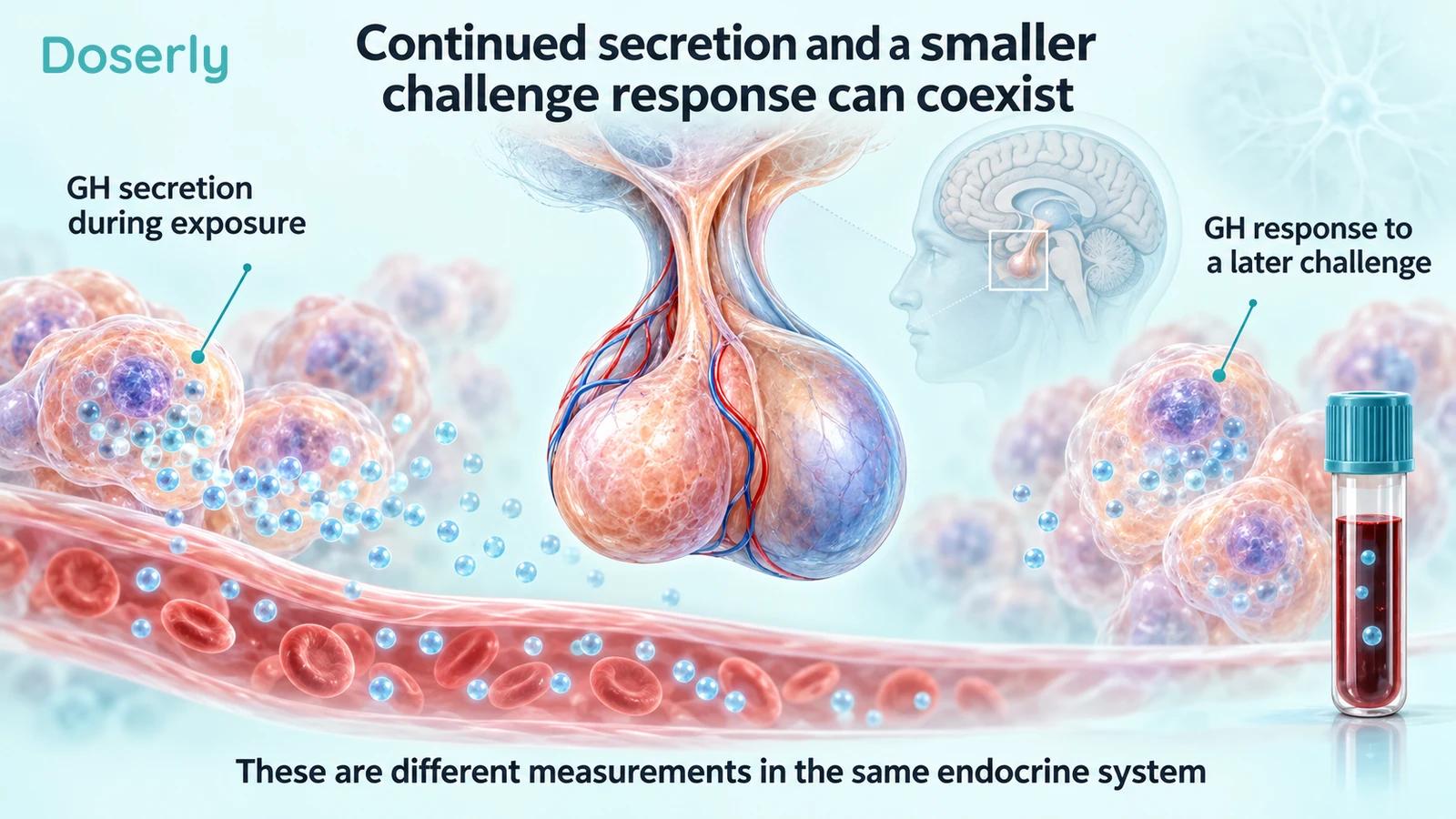
Their most useful lesson is more specific than a yes-or-no answer about tolerance: growth-hormone secretion can remain elevated while the response to an additional GHRP-6 challenge becomes smaller. Both findings occurred within the same controlled experiment. That does not establish a cycling schedule, but it helps explain why apparently conflicting summaries can describe different measurements. Twenty-four-hour infusion study.
First, define the response that changed
Tolerance generally describes a diminished effect after repeated exposure. Desensitization is often used when responsiveness within a biological signaling system decreases. In these studies, the observable result was a hormone response; researchers did not directly photograph receptors becoming inactive.
An endocrine experiment can measure several things: average GH concentration, the size and frequency of natural pulses, an integrated concentration over time, or the response to an extra test dose. IGF-1, a signaling protein influenced by GH, is another measurement. These quantities are related, but they need not move together.
GH is normally released in pulses under interacting hypothalamic and pituitary signals. Food, sleep, age and body composition can influence those patterns. Frequent sampling is therefore much more informative about secretion than one isolated sample. Endotext physiology.
The GHRP-6 guide gives a wider introduction. Here, the important detail is how investigators tested continued responsiveness and what that means for claims about repeated use.
What did the 24-hour infusion experiment find?
Eight healthy young men took part in an experiment comparing saline and continuous GHRP infusion. Blood was sampled every ten minutes across the study period. After the 24-hour infusion, investigators administered a challenge with GHRP or GHRH, the brain hormone that stimulates pituitary GH release. Primary report.
GH secretion stayed pulsatile and was higher during GHRP exposure than during saline. Yet a subsequent GHRP challenge produced a smaller response: mean peak GH was 7.9 micrograms per litre after GHRP infusion versus 25 after saline. In contrast, the response to GHRH was greater after GHRP exposure.
The different challenge responses mattered. If the gland had simply run out of releasable GH, an enhanced response to another stimulus would be difficult to explain. The investigators therefore argued that depletion of pituitary GH did not account for the attenuated GHRP response.
The study does not mean that tolerance is imaginary. It shows a real attenuation of a specified challenge response alongside continued endocrine activity. “No effect remains” would misstate the findings, just as “no attenuation occurred” would.
It also doesn't identify what someone would experience during repeated injections at home. A continuous infusion maintains an exposure pattern that differs from separated injections, and healthy research volunteers are not every potential user. The observed challenge response belongs to this experimental design.
Did a longer infusion tell the same story?
A separate study examined a 34-hour intravenous infusion in nine healthy young men. Compared with saline, GHRP-6 increased integrated GH concentration and pulse amplitude. IGF-1 rose from an average 252 to 312 micrograms per litre. Pulse frequency and the GH concentration between pulses did not change. Jaffe and colleagues, 1993.
Responses to additional GHRH challenges were augmented, while the response to a GHRP challenge was smaller. The researchers concluded that the pituitary remained responsive during prolonged exposure, while acknowledging uncertainty about the precise mechanism.
This experiment adds detail to the first: “more GH” did not mean every feature of secretion increased. Larger pulses, unchanged pulse frequency and a smaller extra challenge response can occur together. A description that selects just one of those features may give a misleading impression of the whole experiment.
The duration is another important limit. Thirty-four hours is prolonged for intensive laboratory sampling, but it is not long-term treatment. It cannot establish the effectiveness or safety of exposure over many weeks, and it does not tell us when an untested regimen should be interrupted.
What happened with repeated nasal administration?
A 1991 study investigated GHRP-6 in six healthy men. During seven intranasal administrations, GH responsiveness was not attenuated, and mean IGF-1 increased from 94.5 to 125.8 micrograms per litre. Hayashi and colleagues.
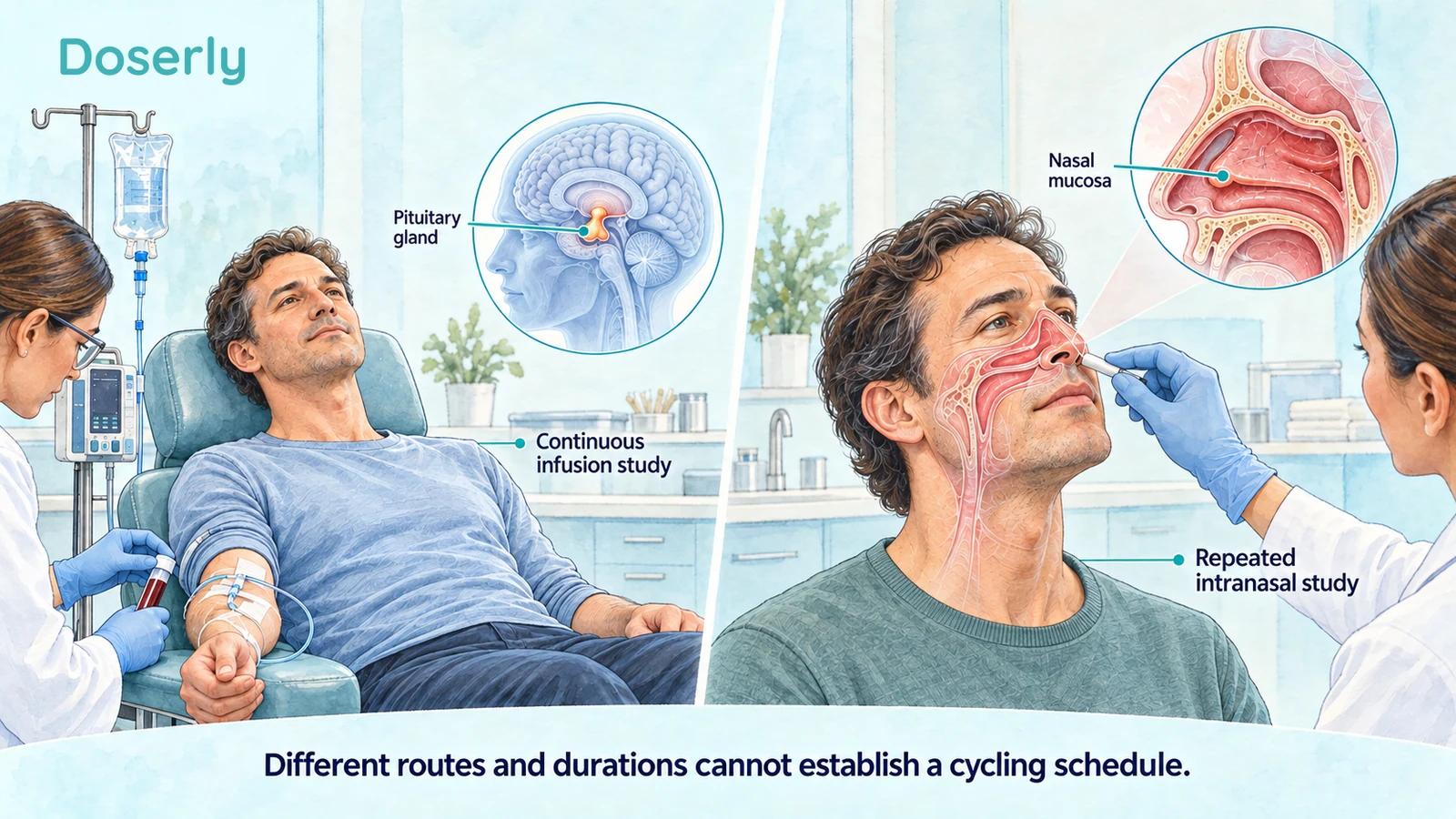
This result is compatible with the infusion findings because the experiment asked a different question. Separate nasal administrations create a different exposure pattern from a continuous intravenous infusion. The studies also used different participants, procedures and measurement schedules.
The absence of detected attenuation during a brief course doesn't prove that attenuation could never develop. Nor does attenuation after an infusion prove that every other route must behave identically. The appropriate conclusion is that responsiveness depends on the conditions being tested.
A four-day oral study in seven older women adds another distinction. The GH response was maintained, but IGF-1 did not rise significantly. Ghigo and colleagues. Continued GH responsiveness is therefore not synonymous with a sustained change in every downstream measurement.
Why GHRP-2 findings cannot settle GHRP-6 tolerance
A five-day study of the related peptide GHRP-2 is frequently relevant to discussions of this family. Nine healthy participants received daily subcutaneous exposure. Mean GH peaks declined from 83 to 59 to 51 micrograms per litre on days one, three and five; IGF-1 did not increase. Nijland and colleagues.
The study illustrates a measurable attenuation during repeated exposure, but the administered peptide was GHRP-2. It isn't a direct comparison showing that GHRP-6 is more resistant to tolerance. Differences in route and study duration further prevent a simple ranking against the small intranasal GHRP-6 experiment.
A familiar family name can make such substitution easy. When a protocol claims that “GHRPs need a break after a certain number of days,” the supporting experiment should be checked for the exact molecule, exposure pattern and outcome. A class-wide schedule needs evidence beyond an endocrine observation in one small study.
Does fading hunger show that the hormone response has faded?
Not necessarily. Hunger is a subjective experience, while the infusion experiments measured secretion through repeated blood samples. The studies did not validate hunger intensity as a marker of GH exposure or receptor responsiveness.
Someone may describe a strong initial sensation that later becomes less noticeable. That observation is worth recording, but several questions remain: did food intake change, did the circumstances change, and was any relevant physiological measurement made? Without those details, the cause of the change remains uncertain.
The same applies to an unchanged IGF-1 result. It could be informative in a clinical evaluation, but it doesn't by itself prove that GHRP-6 has stopped stimulating GH. The older-women study showed maintained GH responsiveness without a significant IGF-1 rise. Different endpoints need their own interpretations.
This is why increasing exposure to recreate a subjective sensation is not an evidence-based way to manage tolerance. The studies offer no validated relationship between how strongly someone feels an effect and the safest or most useful endocrine response.
Do the experiments support cycling or a receptor reset?
They do not establish a safe and effective GHRP-6 cycle. To do that, investigators would need to compare clearly defined continuous and interrupted regimens, include an appropriate control, and measure a clinically meaningful benefit as well as adverse effects.
A smaller challenge response after an infusion does not tell us the minimum break needed for recovery. Even observing a return toward baseline after stopping would answer only the measured endpoint under that study's conditions. It would not automatically establish that repeated cycles improve long-term outcomes or reduce harm.
“Receptor reset” is particularly imprecise when the experiment measures blood hormones rather than receptor number or function. Hormone feedback, changes elsewhere in the signaling system and the timing of measurements may contribute. The human studies provide constraints on explanations, not a complete molecular account.
The claim that a pituitary is “exhausted” is also too strong. The enhanced GHRH response after GHRP infusion directly argues against simple depletion as the explanation in that experiment. It doesn't mean every possible long-term endocrine effect has been excluded.
What should matter more than preserving a peak?
The reason for considering an intervention matters more than maintaining a large laboratory response. If the goal is recovery, nutrition or function, those outcomes need direct assessment. Preserving GH responsiveness without a worthwhile benefit would not establish that a treatment is useful.
Safety cannot be inferred from whether the effect fades. A person could develop a smaller response to one endpoint while remaining exposed to other effects. FDA identifies GHRP-6 concerns involving cortisol, insulin sensitivity, blood glucose and potential immune reactions associated with peptide impurities or aggregation. The limited safety information does not provide a validated chronic cycling strategy. FDA safety information.
If you're discussing an observed change with a clinician, describe the exact symptom or measurement, when it occurred and what else changed. Distinguish the administered substance and route from the name of a broader peptide family. That is more useful than treating every change as proof of tolerance.
The human GHRP-6 literature supports a nuanced answer: some challenge responses attenuate, ongoing GH secretion can remain elevated, and short repeated-dose studies sometimes show maintained responsiveness. None of those findings supplies a proven schedule for long-term use. The guide's human research section places these experiments in their wider context.
Explore the research
- Twenty-four-hour infusion, 1993: ongoing secretion and attenuated GHRP challenge.
- Thirty-four-hour infusion, 1993: pulse amplitude, IGF-1 and different challenge responses.
- Intranasal study, 1991: brief repeated exposure in six men.
- Oral study, 1994: seven older women and unchanged IGF-1.
- GHRP-2 study, 1998: related peptide, not a GHRP-6 comparison.
- Endotext physiology: normal secretion and feedback.
- FDA safety information.