
TRT
October 16, 2026
TRT and prostate safety: what TRAVERSE can—and cannot—tell us
On this page
The prostate sits below the bladder and surrounds the first part of the urethra, the tube carrying urine out of the body. That location helps explain why prostate problems can affect urination. It also explains why a conversation about testosterone and the prostate should distinguish urinary symptoms, a PSA blood test and cancer: they are related concerns, but they are not the same outcome. NIDDK prostate anatomy
TRAVERSE provides useful reassurance for a specific group of men considering testosterone replacement therapy. Serious prostate events were uncommon and did not differ significantly between testosterone and placebo in participants carefully screened before enrollment. The screening and the limited number of events are essential to understanding the result. Primary prostate-safety report
For a patient, the question is how closely that experience fits their own history—and what follow-up still makes sense.
Three prostate questions that should stay separate
Benign prostatic hyperplasia, or BPH, is noncancerous enlargement of the prostate. It can contribute to a weak stream, difficulty starting urination, urgency or repeated nighttime trips to the bathroom. The size of the gland does not perfectly predict symptom severity, and similar symptoms can arise from other urinary problems. NIDDK BPH guidance
Prostate-specific antigen, or PSA, is a protein produced by prostate cells. A blood test measures how much is circulating. Both cancer and benign conditions, including inflammation and enlargement, can raise it. A PSA result is information used in assessment; it is not a cancer diagnosis. National Cancer Institute PSA explanation
Prostate cancer requires its own diagnostic evaluation. A person may have an elevated PSA without cancer, urinary symptoms without cancer, or cancer without the particular symptoms they associate with an enlarged prostate. Treating these as a single category of “prostate problems” can make a study sound more conclusive than it is.
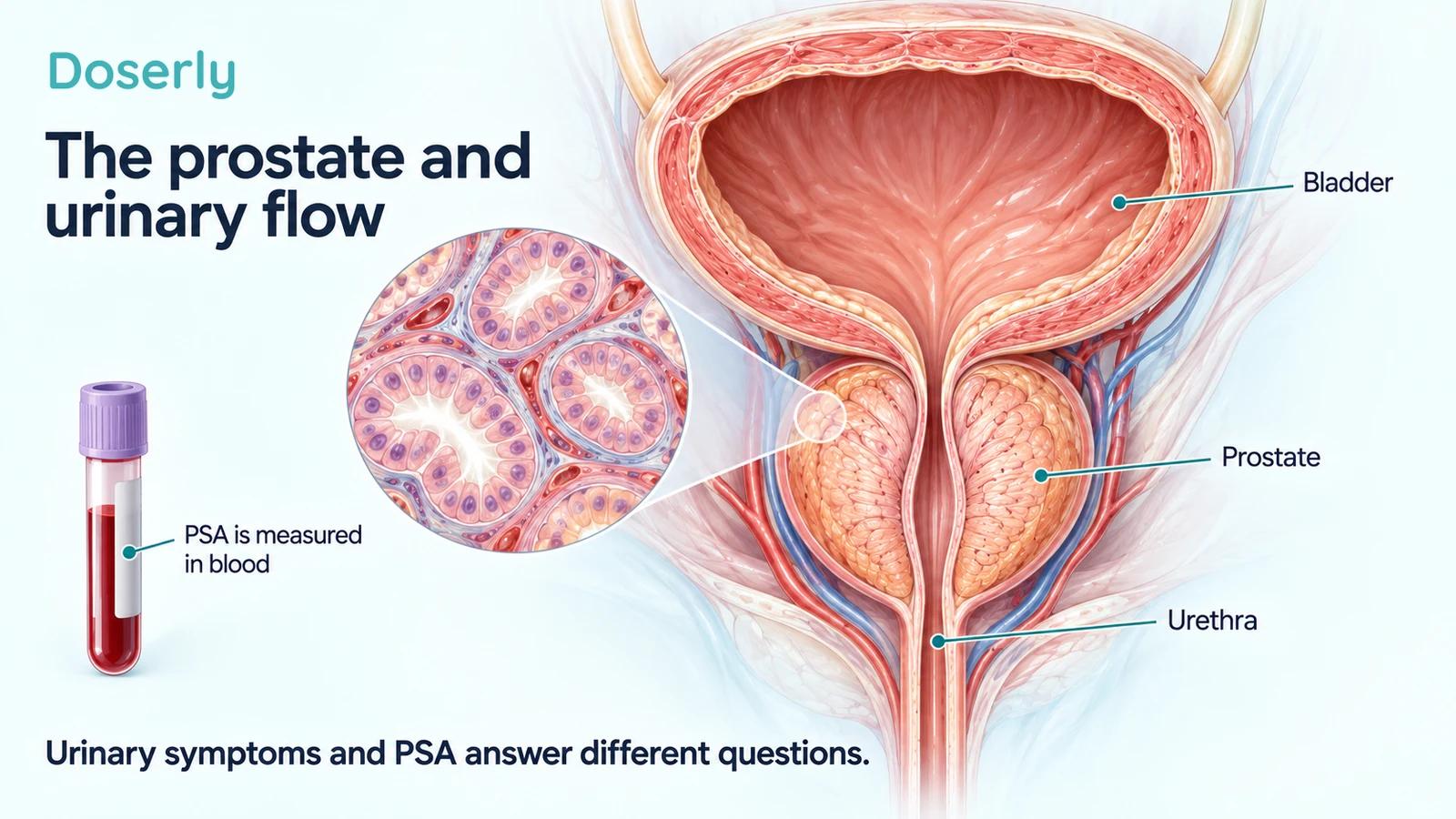
Before interpreting a headline, ask which of these questions it answers. A study finding no average worsening in urinary symptoms does not by itself prove that cancer risk is unchanged over decades.
Who entered the TRAVERSE prostate study?
TRAVERSE enrolled men aged 45–80 who had symptoms of hypogonadism, two testosterone concentrations below 300 ng/dL, and cardiovascular disease or increased cardiovascular risk. Participants received daily 1.62% testosterone gel or placebo gel under blinded conditions. The prostate analysis involved approximately 5,200 men, selected after evaluation intended to exclude those at high prostate-cancer risk. Trial report
Men with PSA above 3.0 ng/mL or an International Prostate Symptom Score above 19 were excluded. That symptom questionnaire, usually abbreviated IPSS, helps describe the severity of lower urinary tract symptoms. The exclusions mean that the findings do not directly answer the question for a man presenting with an unexplained high PSA or severe symptoms. Eligibility criteria
This is an important feature of a safety trial, not an inconvenience to ignore. Investigators were studying a screened treatment strategy. Removing the screening step when applying the result changes the situation being evaluated.
Imagine two prospective patients: one has a reassuring evaluation and mild stable urinary symptoms; the other has a rising PSA that has not been investigated. The trial is more directly informative for the first situation. That does not diagnose either person or decide their treatment, but it explains why a clinician may reasonably recommend different next steps.
What happened during follow-up?
High-grade prostate cancer occurred in five of 2,596 testosterone participants (0.19%) and three of 2,602 placebo participants (0.12%) in the reported comparison. The hazard ratio was 1.62, with a 95% confidence interval of 0.39–6.77. There was no statistically significant difference. Rates of other assessed prostate events, including urinary retention and invasive procedures, also did not differ significantly. Primary results
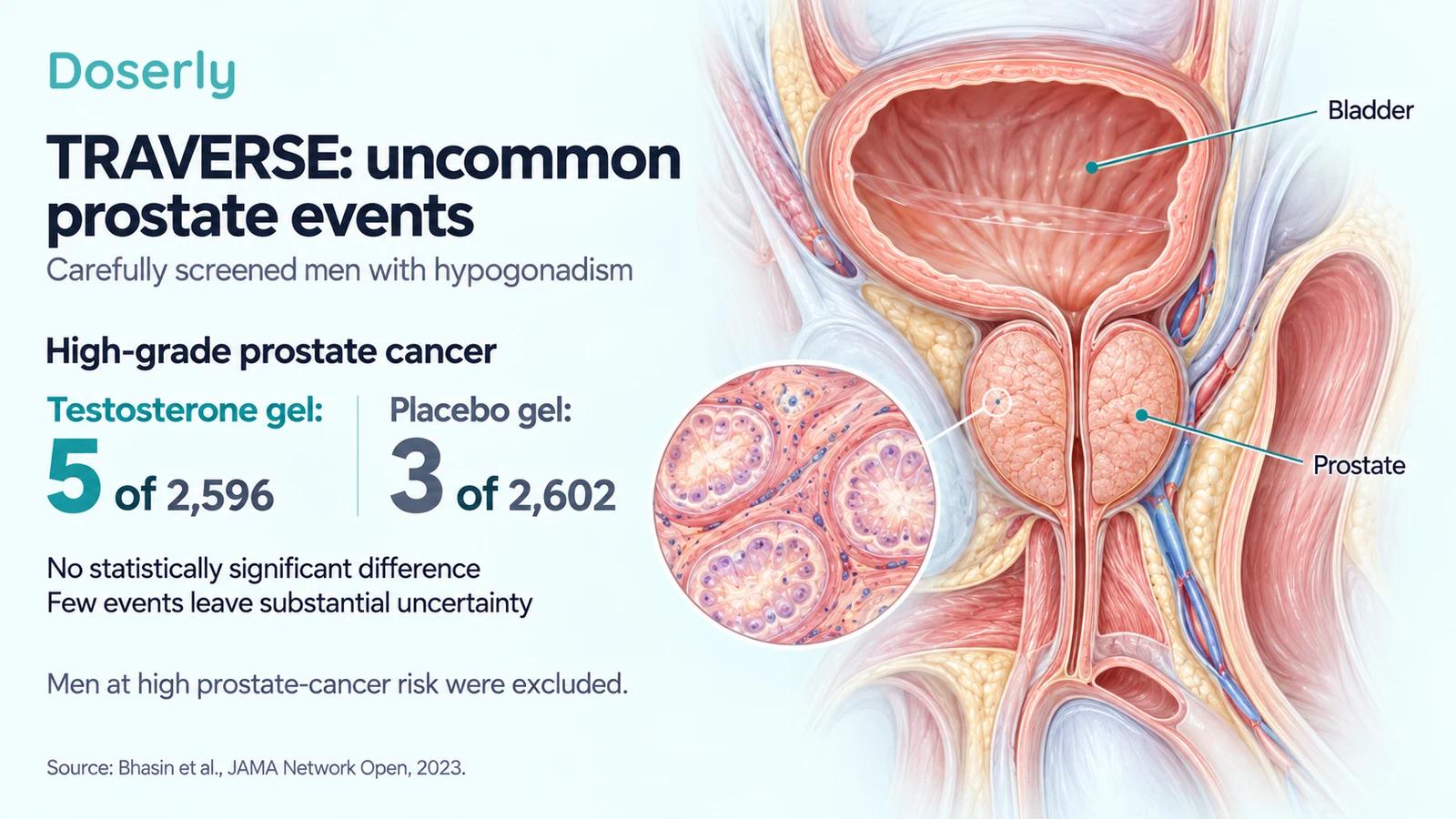
Image sources: TRAVERSE prostate study
The counts are reassuring in one sense: serious events were infrequent during the study. They are also a reason for precision. With only eight high-grade cancers across the two groups, the estimate is too uncertain to establish that the risks are exactly identical.
A hazard ratio above one does not, on its own, prove an increase. Here the interval includes values below and above one and is wide. Equally, the absence of statistical significance does not prove the absence of any possible effect. Both statements follow from the same uncertainty, rather than representing opposing interpretations.
Why duration matters for prostate cancer
A cancer may develop over a longer period than the active treatment and observation available in a trial. TRAVERSE's prostate report describes average treatment exposure of about 22 months. That provides useful monitored experience, but it is not a lifetime study. Prostate report
This matters particularly when someone intends to use TRT for many years. The evidence can reduce some uncertainty today while leaving questions about prolonged exposure. It would be misleading to turn a few years of observation into a promise that no future prostate issue can occur.
It would also be wrong to assume that a prostate diagnosis appearing later must have been caused by treatment. Establishing cause requires more than temporal order, especially for a common age-associated disease. A patient needs evaluation of the new finding, not an automatic conclusion in either direction.
The practical response is continued appropriate surveillance, with the plan tailored to age, risk factors, previous results and preferences. “The trial was reassuring” and “we should still follow changes” belong in the same conversation.
What if PSA rises after starting testosterone?
The prostate analysis reported a greater PSA increase with testosterone than placebo, despite no significant difference in the clinical prostate outcomes assessed. That shows why a laboratory marker and a diagnosed event should not be collapsed into one claim. TRAVERSE prostate findings
A rise should be interpreted, not ignored and not immediately equated with cancer. NCI explains that temporary influences such as inflammation or recent procedures can affect PSA, while some medicines used for BPH lower it. The relevant history and medication list therefore matter when comparing results. NCI PSA fact sheet
The Endocrine Society guideline recommends urological consultation during the first treatment year for specified confirmed PSA changes, a sufficiently elevated confirmed PSA, or an abnormal prostate examination. Its thresholds are referral guidance for clinicians, not instructions to diagnose yourself or change a testosterone dose. Clinical guideline
A useful record includes the date, value, laboratory and any events the clinician considers relevant. If you take finasteride or dutasteride, make sure that information accompanies the result. Comparing an untreated baseline with a value obtained after starting a PSA-lowering medicine without accounting for it can mislead.
Our TRT blood-work guide provides context for how PSA fits into follow-up alongside other measurements. The reason to monitor is to support decisions, not to label each fluctuation as a treatment failure.
What about urinary symptoms?
A weak stream or waking repeatedly at night can affect quality of life even when no cancer is present. TRAVERSE's reassuring average symptom findings should not discourage a patient from reporting a new problem. Men with severe symptoms were not the population the study was designed to reassure.
Describe what has changed: difficulty starting, a sense of incomplete emptying, urgency, frequency, pain or nighttime waking. Note when it began and how much it affects daily life. A clinician can then consider BPH, bladder problems, infection, medicines and other possible contributors rather than attributing everything to testosterone. NIDDK BPH assessment
Being unable to urinate, or having painful urinary symptoms with fever and chills, needs prompt medical attention. Blood in the urine or marked lower-abdominal discomfort also warrants assessment. These are practical reasons to contact a clinician, regardless of whether a study found low average event rates. NIDDK symptoms requiring attention
For less urgent changes, a brief symptom record can help. It is more useful to say that nighttime waking increased from an occasional event to several nights each week than simply to report that the prostate “feels worse.” The location of the symptom does not identify the underlying cause.
How the 2026 labeling request fits
In June 2026, HHS announced requested changes to testosterone labeling concerning prostate cancer and BPH. The proposed contraindication would be narrowed to metastatic prostate cancer, while risk assessment and monitoring would remain. The announcement also acknowledged limited evidence about long-term cancer effects and severe urinary symptoms. HHS requested revisions
A regulatory request is not the same as a completed change in every product's label. The current information for the exact product should be checked when making a prescribing decision. More fundamentally, a proposed change does not convert TRAVERSE into a trial of men with active prostate cancer.
For someone with a previous cancer diagnosis, the relevant questions are more specific: what treatment was given, what is the current disease status, what follow-up results show, and what symptoms are motivating consideration of TRT? These require a discussion with the treating clinicians. A broad news summary cannot supply those missing details.
The article is about what this particular trial contributes to that discussion. It is not evidence that all men with a cancer history have equivalent risks or that specialist evaluation has become unnecessary.
Screening itself involves choices
PSA testing can identify findings that deserve attention, but it can also lead to false alarms and further procedures. NCI describes potential harms including unnecessary biopsy and overdiagnosis of cancers that might never have caused symptoms. Screening decisions should account for those tradeoffs rather than treating more testing as automatically better. NCI explanation of PSA benefits and harms
The question before TRT is therefore not simply “Was a PSA ordered?” It is whether prostate risk was considered appropriately and whether the patient understands what a result might lead to. A follow-up plan should make clear who reviews results, when additional assessment is needed and how concerns are communicated.
For example, receiving an abnormal result through a patient portal without an agreed contact plan can leave someone choosing between alarm and avoidance. Asking beforehand how results will be handled makes the monitoring process more useful.
What to take from the study
TRAVERSE offers evidence that monitored testosterone gel treatment did not produce a statistically significant excess of the assessed prostate events in carefully screened men during the study. That is more informative than assuming all prostate concerns are established harms. It is also narrower than a guarantee of lifetime safety.
Before treatment, ask whether your history resembles the studied population and whether any finding needs investigation first. During treatment, report new urinary symptoms and review PSA changes with a clinician. If you have a prostate-cancer history or severe symptoms, ask how the evidence relevant to your situation differs from TRAVERSE.
Our TRT introduction explains the broader diagnosis and treatment process. The prostate findings belong within that process: they can inform a decision without replacing the individual assessment that made the trial's reassuring experience possible.
Keep the original screening context available when care changes hands. A new clinician should be able to see earlier PSA results, relevant medicines, urinary symptoms, and previous investigations alongside the current result. A reassuring measurement is most useful when it is interpreted as part of that history, rather than as a stand-alone certificate of prostate safety.
Sources
- Bhasin and colleagues, TRAVERSE prostate-safety trial, 2023.
- NIDDK, prostate anatomy and problems.
- NIDDK, benign prostatic hyperplasia.
- NCI, Prostate-Specific Antigen Test.
- Endocrine Society, testosterone clinical guideline.
- HHS, June 2026 requested label revisions.