
Peptides
October 16, 2026
What TB-500 half-life claims need to show
On this page
A half-life claim sounds like a small technical detail. In TB-500 discussions, it often does much more work: it is used to justify a schedule, explain why an effect supposedly lasts, or reassure someone that a substance will soon be gone. Each of those conclusions requires evidence beyond a number followed by “hours” or “days.”
The central problem is that human pharmacokinetic evidence for the specific TB-500 fragment is missing from the sources reviewed here. Studies of metabolites in rats, detection in horses, and a different thymosin beta-4 product in volunteers are informative. They are not interchangeable measurements of how long injected TB-500 remains in a person's circulation.
A credible claim needs to identify the molecule, specimen, species, route, assay, and measured time course. Without that information, a precise-looking half-life can be an unsupported estimate with a scientific unit attached.
First identify what is supposedly disappearing
TB-500 is not a consistently used molecular name. FDA's 2026 review evaluated the N-acetylated seven-amino-acid fragment Ac-LKKTETQ. Full-length thymosin beta-4 and recombinant thymosin beta-4 preparations belong to related research, but they are different substances.
This matters before any arithmetic begins. A half-life measured for one peptide cannot be assigned to another solely because both are described as “thymosin.” The chemical modification, formulation, and route also need to match the claim being made. A number detached from its experimental substance has lost essential meaning.
The Doserly guide to TB-500 and thymosin beta-4 explains this identity problem in more detail. For half-life claims, the key distinction is between the parent molecule that was administered and any smaller products formed after it was broken down. An assay detecting a metabolite may be answering a different question from an assay measuring the intact parent peptide.
That distinction becomes especially important when a paper's most memorable result is its latest positive sample. A fragment detected late in urine does not mean that the original peptide remained at a therapeutic concentration in blood for the same interval.
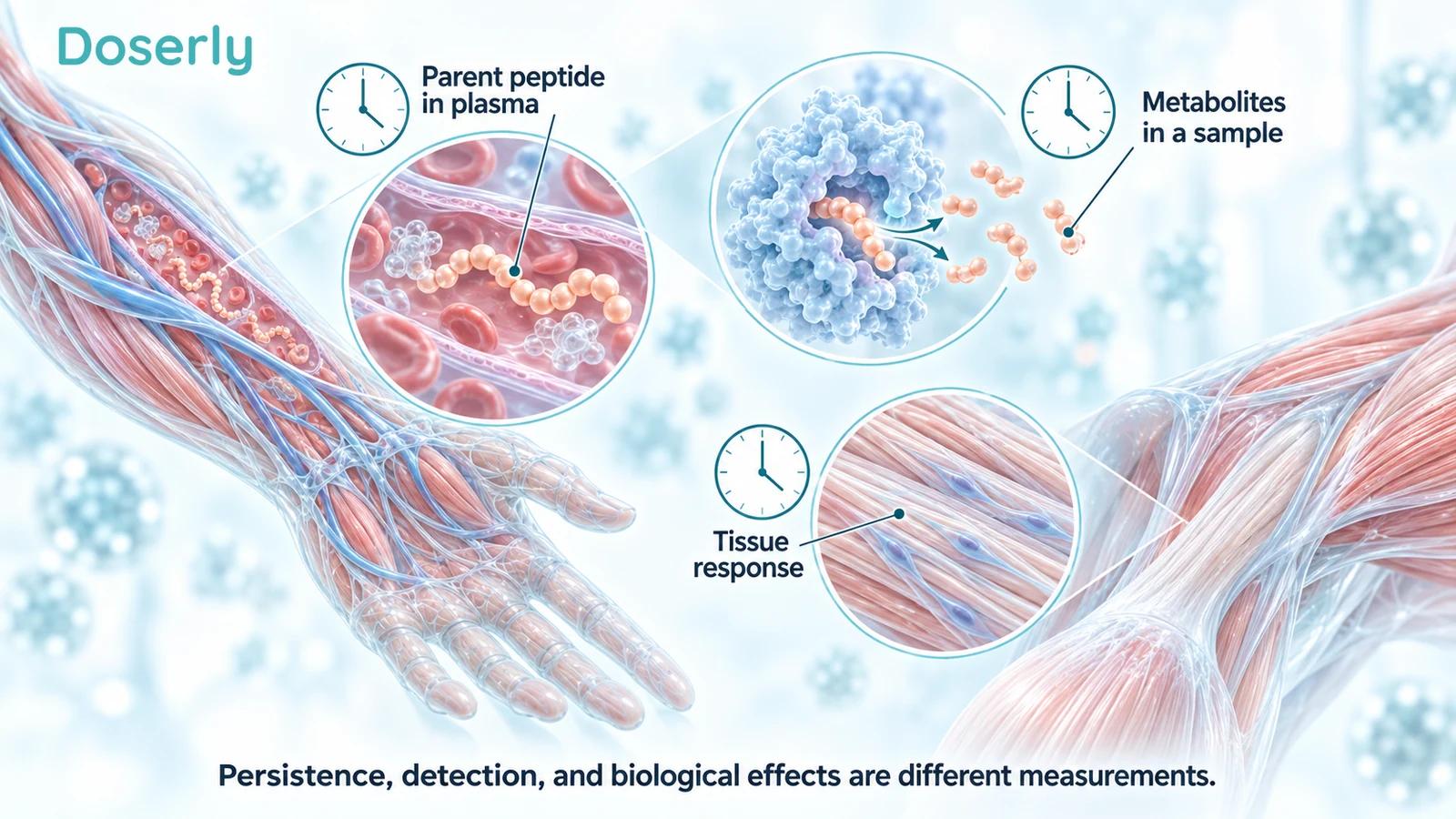
Half-life, detection, and effect are different clocks
A concentration half-life describes the time associated with a halving of the measured concentration during a specified phase of a concentration–time profile. In a suitable simple model, repeated half-lives describe repeated proportional decreases. Real concentration profiles can have multiple phases, and the interpretation depends on the model and the available samples.
A detection interval is different. It depends on which substance the assay looks for, the sample type, how sensitive the method is, and when samples were collected. A more sensitive assay can detect a smaller remaining amount without changing the underlying biology. A negative result can mean that the measured analyte fell below the method's threshold; it is not a direct observation that every molecule has disappeared.
Duration of effect is a third question. A biological process could persist after plasma concentrations decline, or an analytical signal could persist without a meaningful clinical effect. Either possibility needs evidence in the relevant setting. Neither can be assumed simply because a peptide is described as a signaling molecule.
FDA's clinical pharmacology labeling guidance separates pharmacokinetic information about absorption, distribution, and elimination from other aspects of drug action. Applying that distinction here means asking what was measured before asking what it implies for recovery.
What the 2024 rat metabolism study found
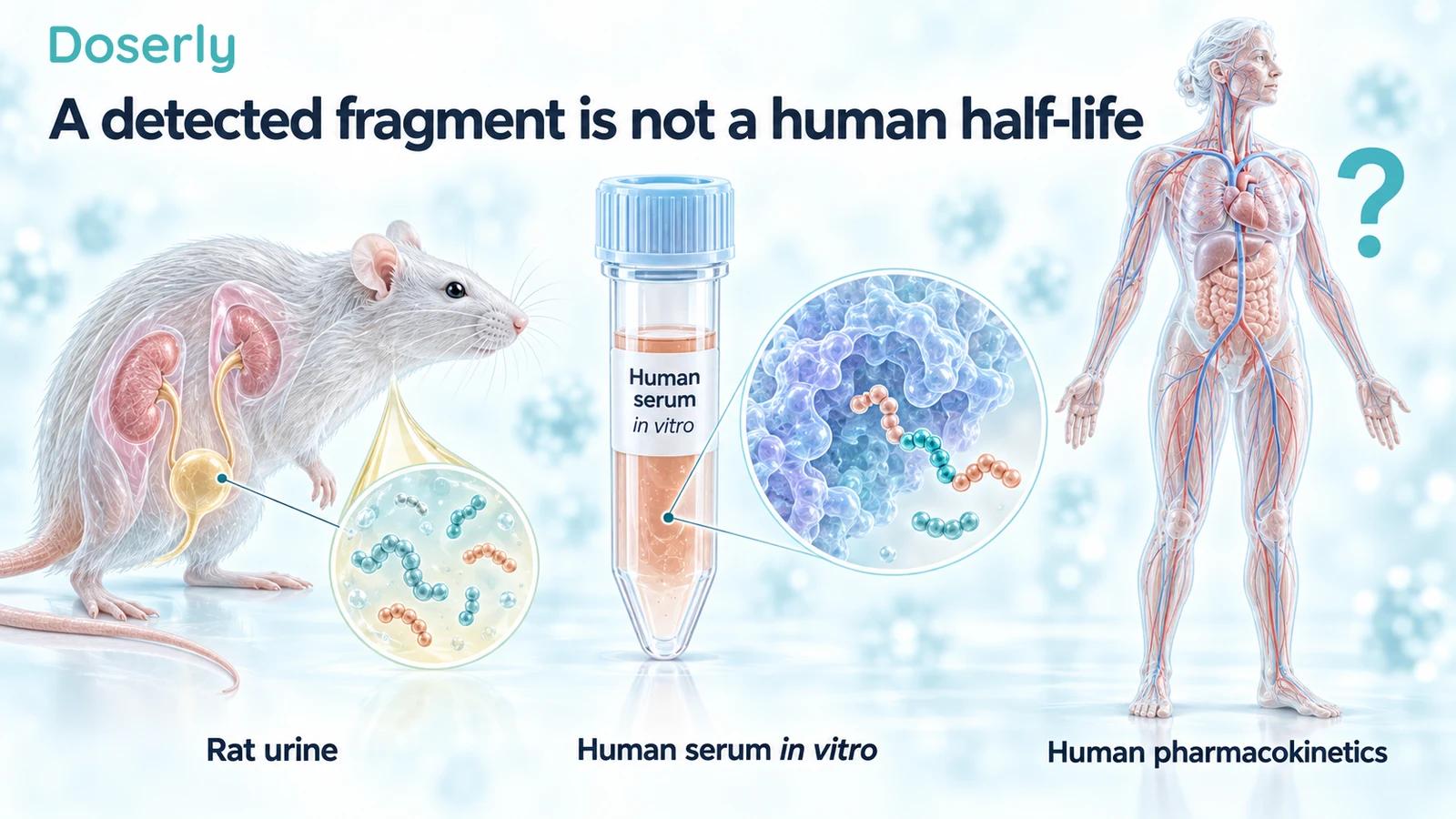
A 2024 analytical study examined TB-500 and its metabolites using laboratory enzyme systems, human serum in vitro, and urine from rats given TB-500. The investigators developed a method to measure the parent and metabolites together. The abstract reports that Ac-LK was the most abundant metabolite in the early 0–6-hour interval and that another metabolite, Ac-LKK, remained detectable up to 72 hours.
Those findings describe metabolite measurements in the studied setting. The 72-hour observation is not a 72-hour plasma half-life, and it is not a measurement in people. The study's use of human serum also does not make it a human administration trial: serum in a laboratory system cannot reproduce the intact person's absorption, distribution, metabolism, and excretion.
The same paper tested biological activity in fibroblast experiments. Of the compounds tested, only Ac-LKKTE showed a significant wound-healing assay result compared with control. That is a reason to investigate which molecule may contribute to a laboratory effect. It does not establish that this metabolite repairs human tendon, reaches an effective tissue concentration after TB-500 administration, or determines a dosing interval.
A useful way to preserve the study's contribution is to describe both parts accurately: it improves analytical understanding of metabolism and raises a mechanistic question. Turning either result into a human schedule would add an answer the experiment did not supply.
What the horse studies can establish
The 2012 equine study developed liquid chromatography–mass spectrometry methods for detecting the acetylated fragment and its metabolites in horse plasma and urine. It confirmed their presence in samples collected after administration. The study was designed for doping-control analysis, which makes reliable identification a central objective.
This is direct evidence that the defined fragment and related analytes can be investigated after exposure in horses. It is not a clinical comparison of recovery in people, and the animal's species remains part of the result. A detection method that performs well in horse urine does not automatically become a validated measurement of human plasma clearance.
The distinction also prevents overreading the last sample in an experiment. If an analyte was found at the final collection, that collection time is not necessarily its biological endpoint. If it was not found, the finding depends on the assay and the sampling design. Neither situation can be converted into a universal “out of the system” deadline.
For an athlete, a published detection observation therefore cannot establish a safe interval before testing. That is a separate rules and testing question, not a scheduling conclusion available from this pharmacology literature.
Human thymosin beta-4 research is relevant but different
A 2021 phase I trial studied intravenous recombinant human thymosin beta-4, designated NL005, in healthy volunteers. It included single- and multiple-dose cohorts and measured pharmacokinetic and safety outcomes. The abstract reports increasing exposure with increasing dose and no obvious accumulation during the repeated-administration portion.
This is genuine human research, and it should not be erased when describing the wider field. Its relevance is bounded by its investigational product and intravenous route. It does not supply the half-life of Ac-LKKTETQ given under the skin or into muscle.
Even borrowing a result from a chemically identical product would require checking route and formulation. With a related but different peptide, the transfer is more problematic. An intravenous study starts with direct access to the circulation; an extravascular route also involves absorption. A time course can therefore reflect more than the body's removal of a molecule once it reaches blood.
For the specific fragment considered in its briefing, FDA identified no human pharmacokinetic studies. That is the appropriate evidence boundary for this article. It is not a claim that no related thymosin research exists, or a prediction that a future study will find either a short or a long half-life.
What a convincing human measurement would require
The first requirement would be a fully characterized investigational product. The report would need to specify whether it studied the acetylated fragment, full-length thymosin beta-4, or another preparation. Otherwise, even an excellent concentration–time analysis could be attached to the wrong product claim.
Next comes a suitable assay. It should distinguish the parent from relevant metabolites, work reliably in the chosen biological sample, and document the concentration range over which measurements are dependable. FDA's ICH M10 bioanalytical guidance addresses validation and study-sample analysis, including selectivity, accuracy, precision, and stability. Those are the foundations beneath a trustworthy pharmacokinetic curve.
Sampling also needs to be informative. A handful of early samples may characterize an initial decline while missing a later phase. Samples collected only late may miss the peak and much of the overall exposure. A published half-life estimate should therefore be accompanied by the study's sampling design and explanation of which part of the profile was used.
Participants matter as well. A result from healthy adults under controlled conditions would first describe that population. Claims about people with a particular injury, different organ function, or repeated exposure would need justification. The report should show variability rather than presenting one average as if it described every individual.
Finally, a human pharmacokinetic study would still need appropriate clinical and ethical oversight. Listing its necessary measurements is an explanation of evidence quality, not a proposal for people to experiment with products and collect their own samples.
Why a half-life would still not validate a schedule
Imagine a future study reliably establishes the concentration profile of a defined TB-500 product. That would answer an important missing question. It would not automatically identify the exposure that improves a particular injury or the exposure associated with unacceptable harm.
A schedule requires connecting exposure to outcomes. For tendon recovery, relevant outcomes might include function, strength, symptoms, and reinjury over a clinically meaningful follow-up period. Investigators would need to determine whether the product changes those outcomes relative to a suitable comparison, not merely whether a laboratory can still detect it.
The same limitation applies to claims about “loading” or prolonged effects. A concentration profile may help researchers design a trial, but a trial design is not an established treatment regimen. A proposed mechanism can motivate measurements without supplying the result of those measurements in advance.
The most useful response to a half-life claim is therefore specific: show the study, identify the molecule and route, and explain which analyte and specimen were measured. If the source is a rat metabolite experiment or a different thymosin product, preserve that finding under its correct name. Current evidence does not justify filling the human TB-500 gap with a confident timetable.
Explore the research
- FDA Evaluation of TB-500-Related Bulk Drug Substances (TB-500 free base and TB-500 acetate) — regulatory-briefing.
- Simultaneous quantification of TB-500 and its metabolites in in-vitro experiments and rats by UHPLC-Q-Exactive orbitrap MS/MS and their screening by wound healing activities in-vitro — rat-invitro-analytical.
- Doping control analysis of TB-500, a synthetic version of an active region of thymosin β₄, in equine urine and plasma by liquid chromatography-mass spectrometry — equine-analytical.
- A first-in-human, randomized, double-blind, single- and multiple-dose, phase I study of recombinant human thymosin β4 in healthy Chinese volunteers — human-phase1.
- Clinical Pharmacology Section of Labeling for Human Prescription Drug and Biological Products — FDA guidance.
- M10 Bioanalytical Method Validation and Study Sample Analysis — FDA/ICH guidance.