
Peptides
October 16, 2026
What SURMOUNT-4 reveals about staying on treatment
On this page
Reaching a lower weight changes the question. Early in treatment, people often want to know how much weight a medication might help them lose. Later, the more practical question is what will preserve that change without making treatment unnecessarily burdensome.
SURMOUNT-4 tested that transition. Adults who had completed an initial course of tirzepatide were randomly assigned either to continue it or to switch to placebo. Continuing treatment generally maintained and extended weight reduction; switching generally led to regain. That is strong evidence that the benefit can depend on ongoing treatment, but it is not a prescription for every person to remain on the same dose indefinitely. Read the original trial.
Understanding the study requires keeping three things separate: the people who reached randomization, the starting weight used for each percentage, and the maintenance strategies the researchers actually compared.
A trial with two starting lines
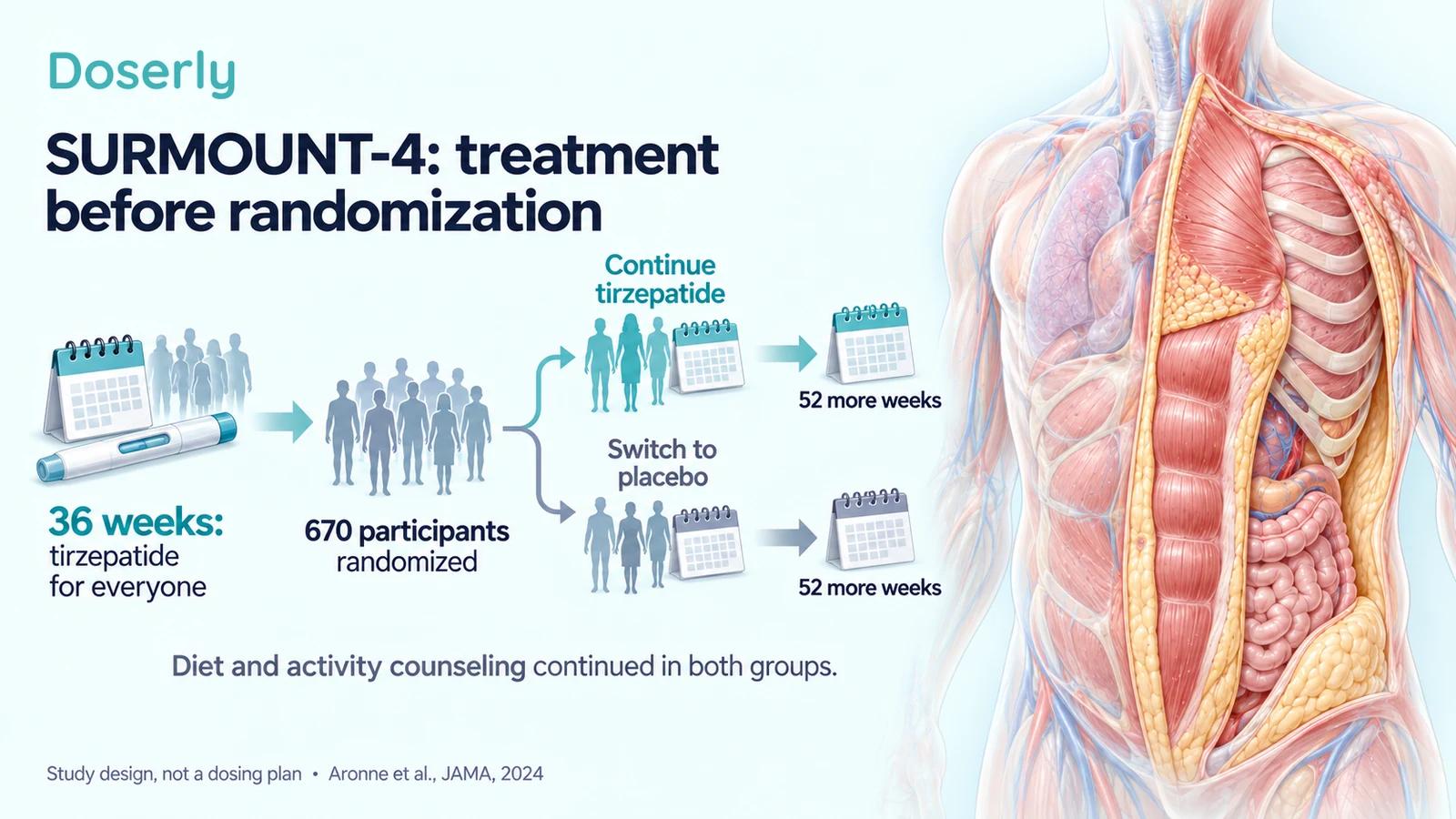
SURMOUNT-4 enrolled 783 adults with obesity, or overweight plus a weight-related complication, without diabetes. Everyone initially received tirzepatide for 36 weeks. The 670 participants who reached randomization had lost an average of 20.9% of their starting weight. They then continued their tolerated 10- or 15-mg regimen or switched to placebo for another 52 weeks. Diet and activity counseling continued in both groups.
The primary comparison began at week 36, after the initial loss. During the randomized period, mean weight changed by −5.5% with continued tirzepatide and +14.0% with placebo. Across the full 88 weeks, losses from the original starting weight averaged 25.3% and 9.9%, respectively. Trial methods and results.
This is a randomized withdrawal design: it asks what happens when an established treatment is continued or removed. It should not be read as a trial in which one group started medication while another had never received it. Both groups brought substantial previous treatment experience to the comparison.
Why the denominator matters
The phrase “regained 14%” is incomplete unless it tells you 14% of what. Here, that percentage describes change from the weight at randomization. It is not the percentage of all the previously lost weight that returned.
Consider an imaginary person who starts at 100 units of weight and reaches 80 units. A subsequent 10% increase from 80 adds eight units, bringing the person to 88. The person has regained 40% of the original 20-unit loss while remaining 12% below the initial weight. All three descriptions are mathematically correct; they answer different questions.
That example is deliberately separate from the trial averages. It explains the arithmetic without pretending that a single fictional person reproduces an adjusted group result. When a headline combines percentages calculated from different starting points, ordinary subtraction can give a misleading answer.
The same distinction helps with personal records. A weight history can preserve the original starting measurement, the measurement when a treatment change occurred, and the dates of follow-up. Without those reference points, two apparently conflicting percentages may simply be describing the same trajectory differently.
Maintaining a loss is an outcome of its own
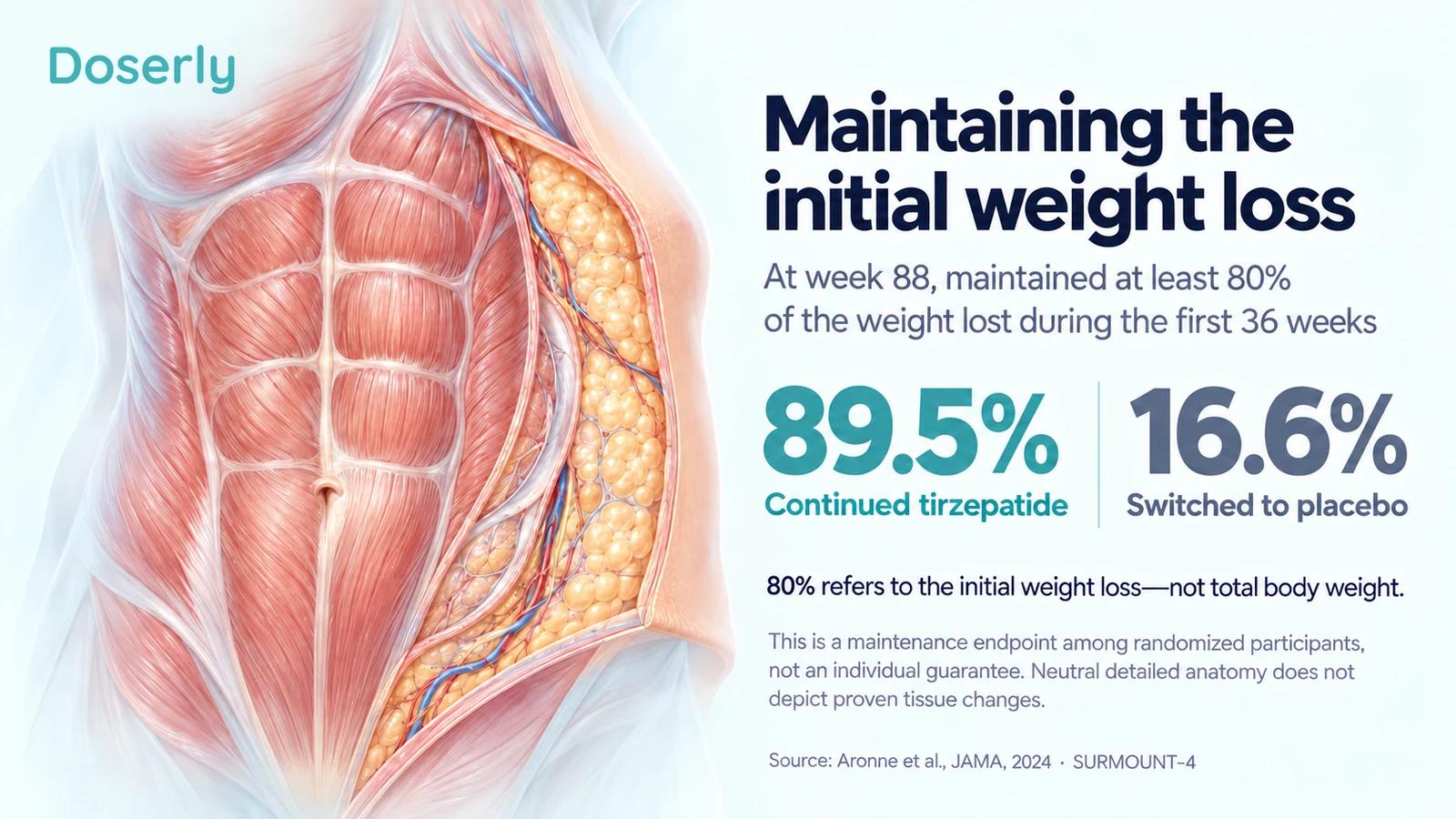
A second trial endpoint asked whether participants retained at least 80% of the weight they had lost during the initial treatment period. At week 88, 89.5% of those continuing tirzepatide met that threshold, compared with 16.6% of those switched to placebo. The endpoint and results also appear in the current Zepbound prescribing information.
Again, the denominator is the earlier weight loss. If an imaginary person lost 20 units, maintaining at least 80% of that loss means retaining a reduction of at least 16 units. It does not mean losing 80% of body weight. A participant could regain a modest amount and still meet this maintenance definition.
A threshold also compresses a continuous experience into a yes-or-no result. People just above and just below a cutoff can have similar experiences, even though they fall into different reporting categories. The average change and the maintenance threshold are therefore complementary views of the trial.
For an individual, a useful maintenance target needs a clinical purpose. Keeping a weight reduction may matter because of mobility, metabolic health or another treatment goal. The target should be discussed in that context rather than chosen solely to match a research cutoff.
The randomized group was already selected by experience
Not everyone who starts a medication reaches a long-term comparison. People may stop because of adverse effects, practical difficulties or a change in preference. Randomization after an initial treatment period makes a study particularly useful for a person who has reached a similar point, while limiting what it tells a new starter.
The SURMOUNT-4 authors explicitly identify tolerance of the initial regimen as a limitation. Gastrointestinal events were the most common adverse effects, and the randomized phase did not permit dose adjustments. The trial therefore cannot establish that continuing an unchanged regimen is appropriate for someone who cannot tolerate it. Study discussion.
This selection issue is easy to miss when a headline begins with a large average loss. A person deciding whether to begin treatment has to consider the whole pathway, including whether treatment is acceptable and sustainable. Someone already benefiting from it has a different decision: what is likely to happen if a component of the current plan changes?
Neither decision should be reduced to a comparison with the average participant. The evidence supplies a useful expectation, while the person's experience determines how closely that expectation applies.
What happened to health markers after withdrawal?
A later exploratory analysis examined 308 placebo-group participants who had achieved at least a 10% initial weight reduction and had follow-up weight data. Greater regain was associated with greater reversal of improvements in several cardiometabolic measures, including waist circumference, blood pressure and glycemic measures. The analysis was published online in November 2025. Read the post hoc analysis.
This was not a new randomization to different amounts of regain. Participants were grouped according to what happened after withdrawal, so the comparison describes an association. It cannot prove that weight change alone caused every change in a health marker. It also did not establish how withdrawal changes the risk of a future heart attack or stroke.
The practical implication is to define what is being maintained beyond the scale. If a clinician is following a particular metabolic condition, a weight-only review may leave out part of the clinical picture. Conversely, a changing laboratory value should not be converted into an event-risk claim that the study never tested.
Does this mean everyone needs the maximum dose forever?
No. SURMOUNT-4 compared continuation of the established regimen with placebo. It did not compare individualized lower-dose maintenance, dose spacing, tapering or a switch to another medication. Those approaches cannot be declared equivalent to continued treatment—or ineffective—using this trial alone.
The current US label lists 5, 10 and 15 mg once weekly as maintenance options for weight reduction and long-term maintenance, with selection based on response and tolerability. That is prescribing context, not a suggestion to change a dose independently. The Doserly tirzepatide guide provides broader background for understanding the medication and preparing questions for a prescriber.
There are also reasons a treatment plan must change despite a benefit. Current labeling includes contraindications, serious gastrointestinal risks and pregnancy precautions, among other considerations. Maintaining weight loss does not override those individual safety decisions. Current prescribing information.
The 2026 obesity pharmacotherapy standards from the American Diabetes Association's Obesity Association recommend continuing medication after goals are reached to sustain benefits, while individualizing the maintenance dose around effectiveness, health benefit and tolerability. The guidance specifically allows that the appropriate maintenance dose may differ from the maximum approved dose. Read the guideline.
That distinction makes the conversation more useful: “ongoing treatment may matter” and “this exact regimen is right indefinitely” are separate claims.
How the finding fits with other maintenance evidence
The semaglutide STEP 4 trial used a related withdrawal design. After a 20-week initial period, 803 participants were randomized to continue semaglutide or switch to placebo while lifestyle intervention continued. Over the next 48 weeks, weight changed by −7.9% and +6.9%, respectively. STEP 4 primary report.
The similar direction strengthens the broader observation that withdrawing an effective obesity medication can be followed by regain. It does not turn the two trials into a head-to-head comparison. Their initial treatment periods, regimens and participants differed. Ranking drugs by subtracting one withdrawal-trial average from another would answer a question neither study randomized.
Longer follow-up also addresses a different uncertainty. A SURMOUNT-1 analysis followed participants with both obesity and prediabetes through 176 weeks of assigned tirzepatide or placebo, then a 17-week off-treatment period. It found sustained weight reduction during treatment and less progression to diabetes with tirzepatide. Long-term primary report.
That evidence extends observation beyond the duration of SURMOUNT-4, but its prediabetes population and study design still matter. Three years of data do not establish a lifetime optimum, and a brief off-treatment period does not tell us what every participant would experience years after stopping.
What a maintenance review can make concrete
A useful review begins with the outcome that justified treatment. Has the plan improved the problem it was intended to address? Is that benefit still present? What burden is treatment adding? These questions allow maintenance to be evaluated as an active phase of care rather than an automatic continuation of the weight-loss phase.
A concise record can help organize that discussion:
- The prescribed regimen and dates of any clinician-directed changes or interruptions.
- Weight measurements with consistent reference dates, without treating a single reading as the whole trend.
- Symptoms, treatment burden and any practical barriers to continuing the plan.
- The health outcomes the clinician has agreed to follow, with the relevant measurements or appointments.
This is a way to make the consultation more informative, not a self-directed treatment algorithm. Recording a pattern does not determine whether medication should be increased, reduced, replaced or stopped. It gives the clinician better context for that decision.
A stable weight can also prompt a different conversation from continued weight loss. If maintaining an earlier reduction is the agreed objective, stability may be consistent with that objective. It is therefore helpful to write down whether the next phase aims for additional loss, preservation of a benefit, improved tolerability or a change in another health measure. Without an explicit goal, the same weight trend can be interpreted in contradictory ways.
Access deserves a direct place in the plan. A recommendation that cannot be sustained financially or practically may not be usable. The 2026 guideline includes cost, access and individual preferences in medication selection, alongside health considerations. Raising these constraints early gives the care team something concrete to address. Guideline discussion.
If treatment must end or change, the unanswered question is not whether a person has “failed.” It is how follow-up will recognize a change in the outcomes that matter and what options can be discussed then. SURMOUNT-4 makes that planning important: achieving a lower weight and preserving its benefits are related, but they are different stages of treatment.
Sources
- SURMOUNT-4 randomized clinical trial: continued tirzepatide versus withdrawal.
- Cardiometabolic changes by weight regain after tirzepatide withdrawal: post hoc analysis.
- Zepbound US prescribing information, revised August 2026.
- STEP 4 randomized semaglutide maintenance trial.
- Tirzepatide for obesity treatment and diabetes prevention: long-term SURMOUNT-1 analysis.
- Pharmacologic Treatment of Obesity in Adults: 2026 Standards of Care.