
Peptides
October 16, 2026
What patient-reported outcomes add to afamelanotide trials
On this page
A treatment can change daily life in ways that a skin photograph or laboratory result cannot show. For someone with erythropoietic protoporphyria, or EPP, meaningful improvement might include getting through a commute with less fear of pain, joining an outdoor conversation or needing fewer changes to an ordinary day.
Those experiences are part of treatment evidence. They also need careful measurement. A patient-reported outcome is not automatically a testimonial, and a questionnaire score is not automatically a reliable measure of everything that matters.
Afamelanotide research illustrates both points. Patient reports help explain the value of increased light tolerance, while the history of the questionnaires shows why readers should ask which questions were used, how the score was developed and what an observed change can support.
The patient knows things an observer cannot see
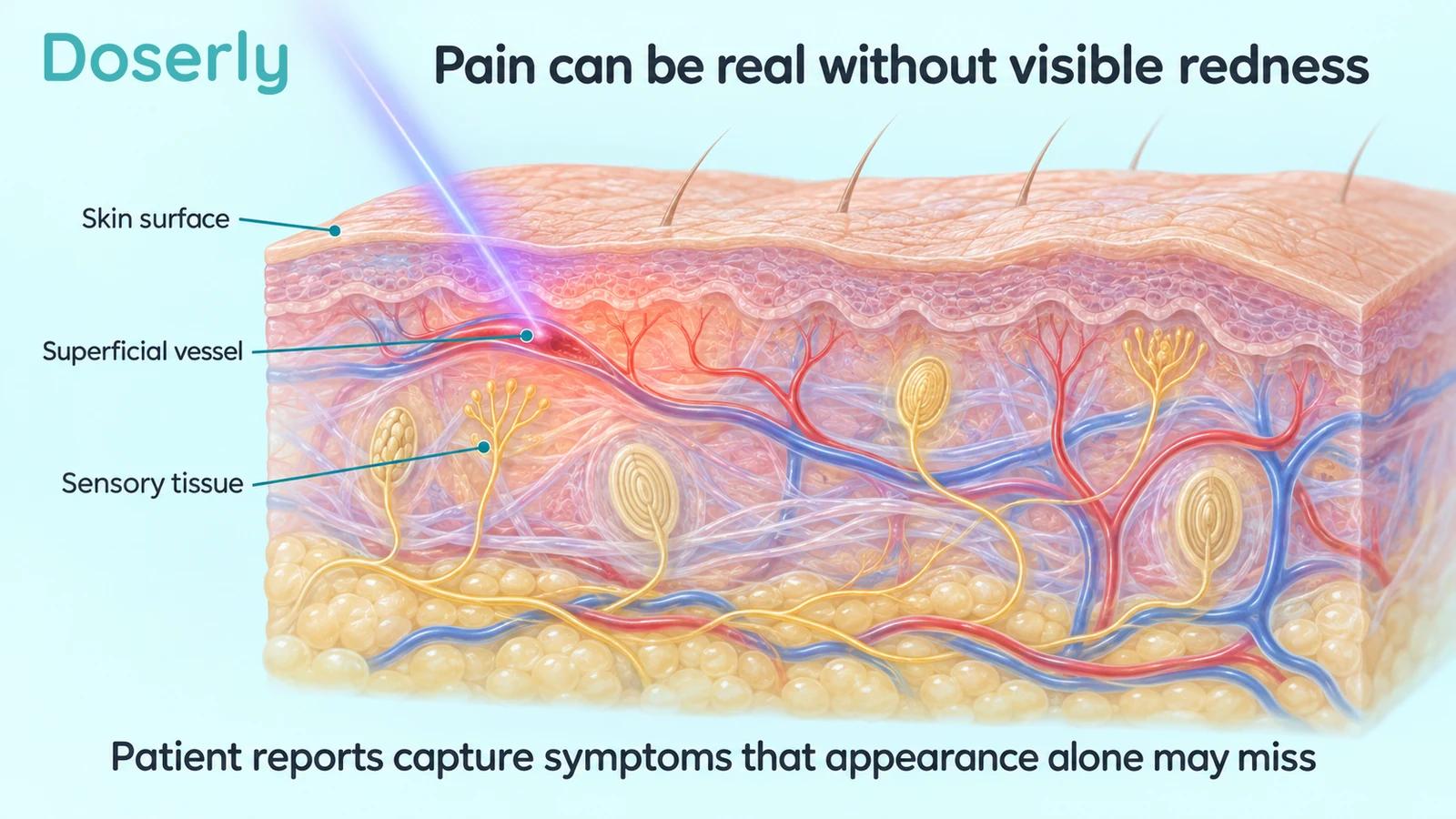
EPP can cause severe light-triggered pain with few visible skin changes. In a study of 35 people with EPP, investigators examined reported cutaneous symptoms and their relationship to light-sensitivity measurements; 24 participants also completed light dosimetry. The study was observational and all participants were White, limiting its representativeness. Original symptom study.
A photograph cannot establish that an apparently uninflamed hand was comfortable. Nor can a clinician watching a brief examination reconstruct all the activities someone avoided during the preceding week.
This is why the source of an outcome matters. Pain, fear of a reaction and interference with a personally important activity often require the person's own report. That report provides information unavailable from another observer, even when other measures are collected alongside it.
What makes a patient report a research measure?
FDA's guidance describes patient-reported outcomes as reports coming directly from the patient without another person's interpretation of the response. In research, the instrument includes more than its questions: instructions, response choices, recall period and scoring are part of the measure. FDA patient-reported outcome guidance.
A caregiver's observation may add useful context, but it should remain identified as a caregiver report. Substituting an observer's judgment for the person's own response changes the source of the outcome, particularly for experiences such as pain that another person cannot directly feel.
That distinction separates a planned measure from a favorable comment selected after treatment. A study can ask every participant the same question at prespecified times, including people who did not improve. It can also explain how missing responses were handled.
Consider the difference between “Did the treatment help?” and “How much did light-related symptoms limit a specified activity during a defined period?” The first question may capture an overall impression. The second narrows what the answer means. Neither wording should be treated as interchangeable with a laboratory endpoint.
Different outcomes answer different questions
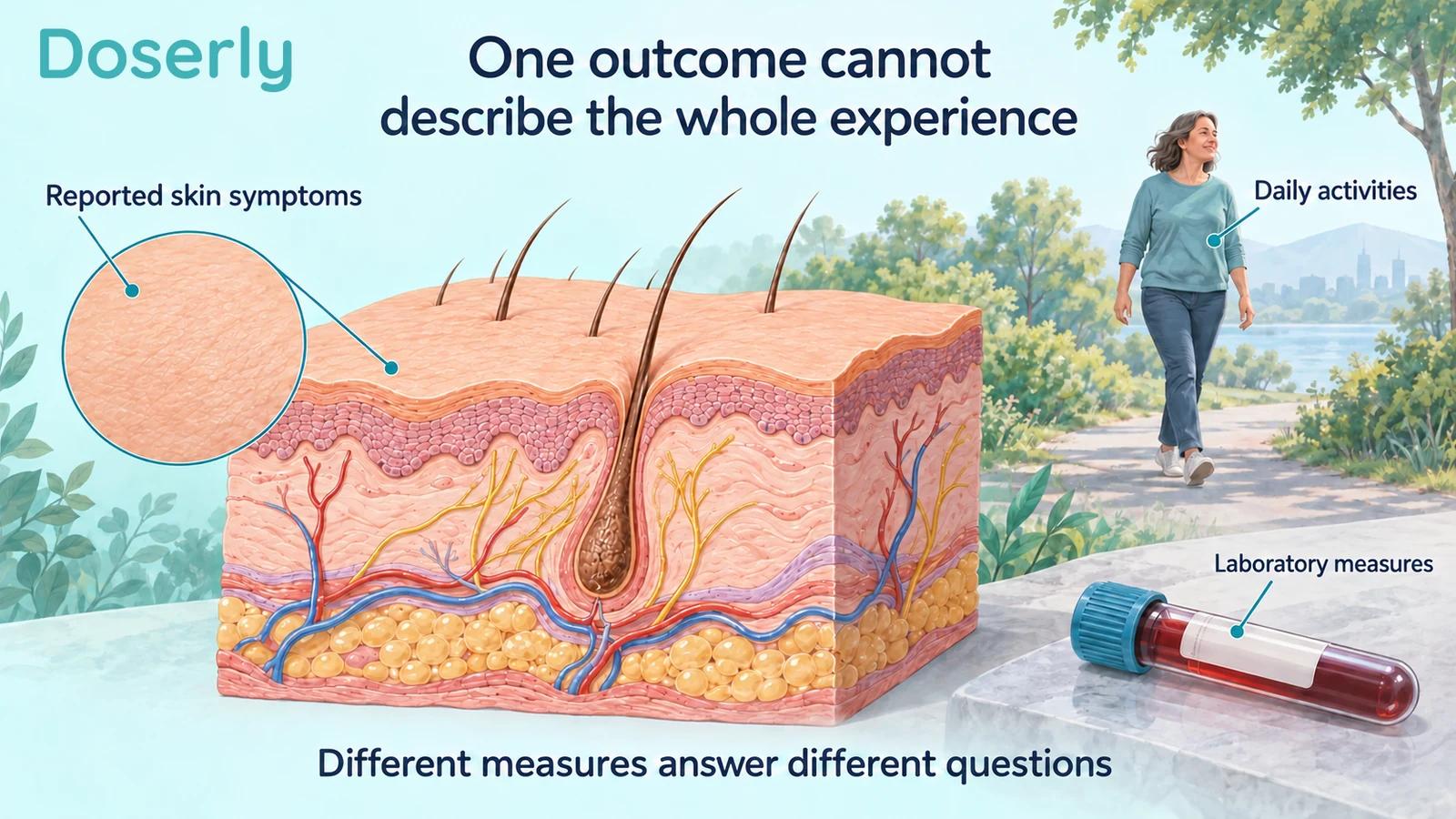
An exposure diary, a symptom scale and a quality-of-life questionnaire can all involve patient reporting, but they are not measuring the same thing.
Measure
Pain-free light-exposure diary
- Main question
- How much qualifying exposure occurred without pain?
- What it cannot establish alone
- Whether every important activity became easier
Measure
Symptom rating
- Main question
- How severe or frequent was a defined experience?
- What it cannot establish alone
- How much exposure or avoidance produced that experience
Measure
Activity-impact question
- Main question
- How did symptoms affect an activity?
- What it cannot establish alone
- Whether underlying disease biology changed
Measure
Broad quality-of-life measure
- Main question
- How was health affecting several areas of life?
- What it cannot establish alone
- Which change was caused by the treatment
Measure
Laboratory test
- Main question
- What happened to a measured biological variable?
- What it cannot establish alone
- How the person felt or functioned
The distinction is practical. Someone may report fewer symptoms because treatment helped, because they stayed indoors more, or because the weather reduced exposure. An activity measure supplies context that symptom frequency alone may miss.
Conversely, a person may accept some symptoms while doing much more outside. Whether that tradeoff represents a worthwhile improvement should not be decided from the pain count alone.
What the randomized trials contributed
The 2015 afamelanotide publication reported placebo-controlled trials in people with EPP. Alongside their light-exposure endpoints, the trials collected quality-of-life information. Disease-specific scores improved with afamelanotide. The questionnaires therefore added a patient perspective to the exposure findings. Original trial publication.
A randomized comparison helps distinguish treatment effects from changes that would occur over time in both groups. It does not remove every measurement problem. Pigmentation may make participants suspect which treatment they received, potentially changing expectations or behavior.
The EMA's 2014 assessment discussed imperfect blinding, diary reliability and uncertainty about the then-unvalidated EPP-specific questionnaire. Those concerns explain why patient-reported findings require methodological scrutiny; they do not mean that the experiences themselves are unimportant. EMA assessment report.
The EPP-QoL questionnaire has a development history
The original EPP-QoL instrument was developed through clinical-expert consultation with informal feedback from patients. It was used in the trial program before formal evidence of its measurement properties was available.
A 2021 study subsequently analyzed data from two trials to examine how its questions grouped together and how the resulting scales performed. The EPP Symptoms domain had evidence supporting reliability and validity. The EPP Wellbeing domain performed poorly, and the authors recommended dropping it and its associated items. Original validation study.
This history rules out two shortcuts. It is inaccurate to describe every version and domain as equally established. It is also inaccurate to repeat the early concern about absent validation as though no later work occurred.
The relevant question is which version, domain and scoring approach a particular study used. A familiar questionnaire name does not guarantee that two papers measured precisely the same construct.
Reliability is not the same as relevance
A measure can produce consistent scores while asking about the wrong aspect of a condition. It can also ask important questions but need further work to show that score changes can be interpreted reliably.
For example, a question about difficulty wearing short sleeves might be meaningful for one person's light avoidance. A question focused mainly on visible skin lesions might miss another person's severe pain without redness. These are examples of how content can fit a disease more or less well, not proposed replacement questionnaires.
In practical terms, readers need evidence that the questions cover relevant experiences, that responses are reasonably dependable, and that change in the score corresponds to change in the intended concept. “Validated” is a description of supporting work in a context, not a permanent seal covering every population and use.
FDA's guidance treats these measurement properties as part of evaluating an instrument for a particular purpose. FDA guidance.
What newer patient interviews add
The EPP Impact Questionnaire, or EPIQ, was developed using interviews with 23 people: 17 adults and six adolescents. The work explored symptoms and impacts and tested whether the proposed questions were understandable and relevant. EPIQ development study.
That is evidence about content validity. It is not, by itself, evidence that afamelanotide works or that every score change has an established clinical meaning. Larger quantitative studies are needed to examine additional measurement properties.
The study also had limits, including a small and demographically restricted sample, incomplete debriefing of every item and industry involvement. Its contribution is still valuable: asking people directly can reveal concerns that clinicians or developers might otherwise overlook.
A newer instrument therefore does not automatically replace every older one. The choice depends on the study question, population and evidence supporting its intended use.
A quality-of-life improvement can coexist with another unchanged outcome
A 2024 US observational cohort included 29 adults with protoporphyria. Afamelanotide treatment was associated with improved EPP-specific quality of life and several broader PROMIS domains. Pain-related scores did not show the same favorable pattern, and liver biochemical measures did not improve. Original US cohort.
The investigators discussed season and increased willingness to test light-exposure limits as possible explanations for the pain findings. Those are interpretations, not randomized demonstrations of why the scores differed.
The study shows why one overall improvement should not be expanded into a claim that every symptom or biological measure improved. It also shows why an unchanged laboratory result does not invalidate a meaningful change in daily life. The outcomes address different parts of the condition.
Observational follow-up adds experience, with limits
A Dutch clinical-practice study followed 117 people receiving afamelanotide. It found increased outdoor time and improved quality of life, with reduced pain severity but no significant change in reaction frequency or duration. Original Dutch cohort.
These findings add information about treatment outside the original trials. Without a randomized concurrent comparator, however, they cannot separate the medicine's contribution from all changes in behavior, season or reporting.
Continuing treatment can also indicate that people value the experience, but continuation is not a standardized effect size. Access, convenience, expectations, alternatives and individual preferences may influence that decision. It should be read alongside measured benefits and harms, rather than used as a substitute for them.
Read the missing responses as well as the average
Imagine a hypothetical study in which the average activity score improves among people who complete follow-up. If people who found treatment ineffective or burdensome are less likely to return the questionnaire, the remaining responses may tell an incomplete story.
That possibility does not prove that a particular result is biased. It explains why the number invited, the number responding and the reasons for missing assessments matter. A complete report should make those counts understandable.
Recall period matters too. A question about the last day, the last week and the last two months may capture different seasons or reaction patterns. Changing the recall period can change the question being answered, even when the words about pain or activity remain similar.
Ask whether the change is meaningful, not just detectable
Statistical significance concerns the compatibility of data with a statistical model. It does not specify whether a difference lets someone do something they value.
A score change is easier to interpret when the study explains its relationship to an understandable improvement: less interference, fewer curtailed activities or a patient-rated change in condition. The threshold used should be justified for the instrument and setting.
Avoid treating a percentage rise on one questionnaire as equivalent to the same percentage rise on another. Different scales have different ranges, directions and scoring rules. A number becomes useful only when its meaning is clear.
For an individual appointment, a concrete example can complement formal scores: “I could finish a familiar activity with fewer symptoms” is more informative when paired with its light conditions and duration. It remains a personal observation, not a controlled estimate of treatment effect.
What to look for when reading the next study
Identify the instrument and version, the people who completed it, the recall period and the schedule of assessments. Then look for the comparator, missing responses, domain-level results and adverse events.
Ask whether the authors separate patient experience from biological claims. Better quality of life does not establish correction of protoporphyrin metabolism, prevention of liver complications or protection against skin cancer. Those require their own evidence.
The Doserly afamelanotide and Melanotan I guide provides the broader product and disease context. Patient-reported outcomes make that evidence more useful when they show what changed in a person's life and when their interpretation stays as precise as the questions that were asked.
Sources
- FDA: patient-reported outcome measures guidance.
- Light-related cutaneous symptoms in EPP.
- Langendonk et al.: randomized afamelanotide trials.
- EMA: 2014 assessment report.
- Biolcati et al.: EPP-QoL validation.
- Mathias et al.: EPIQ development and content validation.
- US cohort: quality of life and laboratory parameters.
- Wensink et al.: clinical-practice cohort.