
Peptides
October 16, 2026
What the older Epitalon longevity reports leave unresolved
On this page
The most striking claims in Epitalon discussions often concern older people followed for many years. Unlike a cell experiment, a study reporting illness and deaths can address outcomes that matter directly to patients. These papers therefore deserve a careful reading.
They also deserve accurate names. The human reports discussed here studied epithalamin, a pineal peptide extract, sometimes combined with thymalin, a thymus-derived preparation. They were not trials of synthetic Epitalon alone. FDA explicitly distinguishes the extract from the four-amino-acid synthetic peptide. FDA identity discussion.
Even after correcting that name, questions remain about the participants, treatment periods, numerical reporting and independent confirmation. One original paper contains a particularly important inconsistency between its survival counts and its headline mortality wording. We will examine that directly rather than repeat the percentage as settled fact.
The Epithalon guide explains the compound's wider research history. This article focuses on what the older longevity reports can support and what they leave unanswered.
Which people were actually studied?
“Older adults” is a broad category. A healthy person in their sixties, someone with coronary disease, and a frail person needing daily assistance have different baseline risks and different reasons for considering treatment.
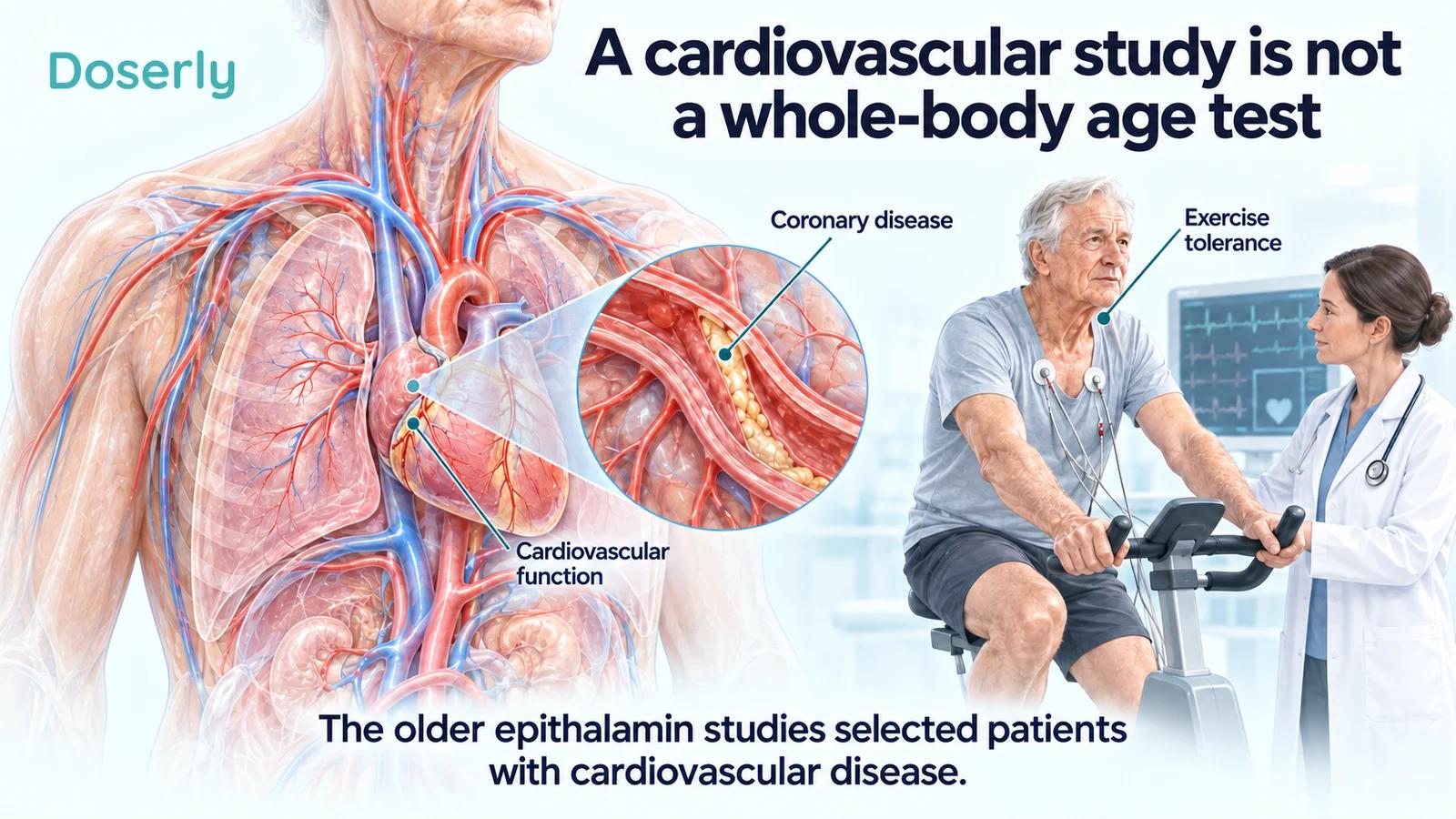
The older epithalamin literature includes selected patients described as having accelerated cardiovascular aging. That phrase is part of the investigators' framework; it should not be assumed to mean that they used a currently validated whole-body biological-age test.
In the 2006 report, the methods describe seventy older patients with coronary disease, divided into 36 receiving epithalamine and 34 receiving saline, alongside background treatment. They were observed from 1992 to 2004. The authors assessed cardiovascular and exercise-related measures as well as survival. Original full report.
This population is important to the interpretation. A finding in people already living with cardiovascular disease does not automatically establish prevention of aging-related illness in otherwise healthy adults. Nor does it tell us whether a benefit, if confirmed, would persist against today's background care.
The 266-person paper involved several interventions
The 2003 report describes 266 older people followed for six to eight years. It includes thymalin, epithalamin and their combination, with treatment during the first two to three years and a separate group receiving annual combined treatment for six years. The abstract reports lower mortality across treated groups, with different relative figures for different regimens. Original abstract.
That is not one uniform treatment comparison. A result for the combination cannot establish the effect of epithalamin alone, and neither result can be assigned directly to synthetic Epitalon.
The accessible abstract also does not provide enough participant-level or group-specific information to reconstruct every result independently. We should not fill those gaps with numbers repeated by commercial summaries. The reported findings can be described as the authors' findings without pretending that the abstract supplies a complete modern trial report.
A large-sounding total can also conceal small individual groups. When several interventions and schedules share one overall participant count, the precision of any particular comparison depends on the size and follow-up of that comparison, not on the headline total alone.
Treatment duration is not follow-up duration
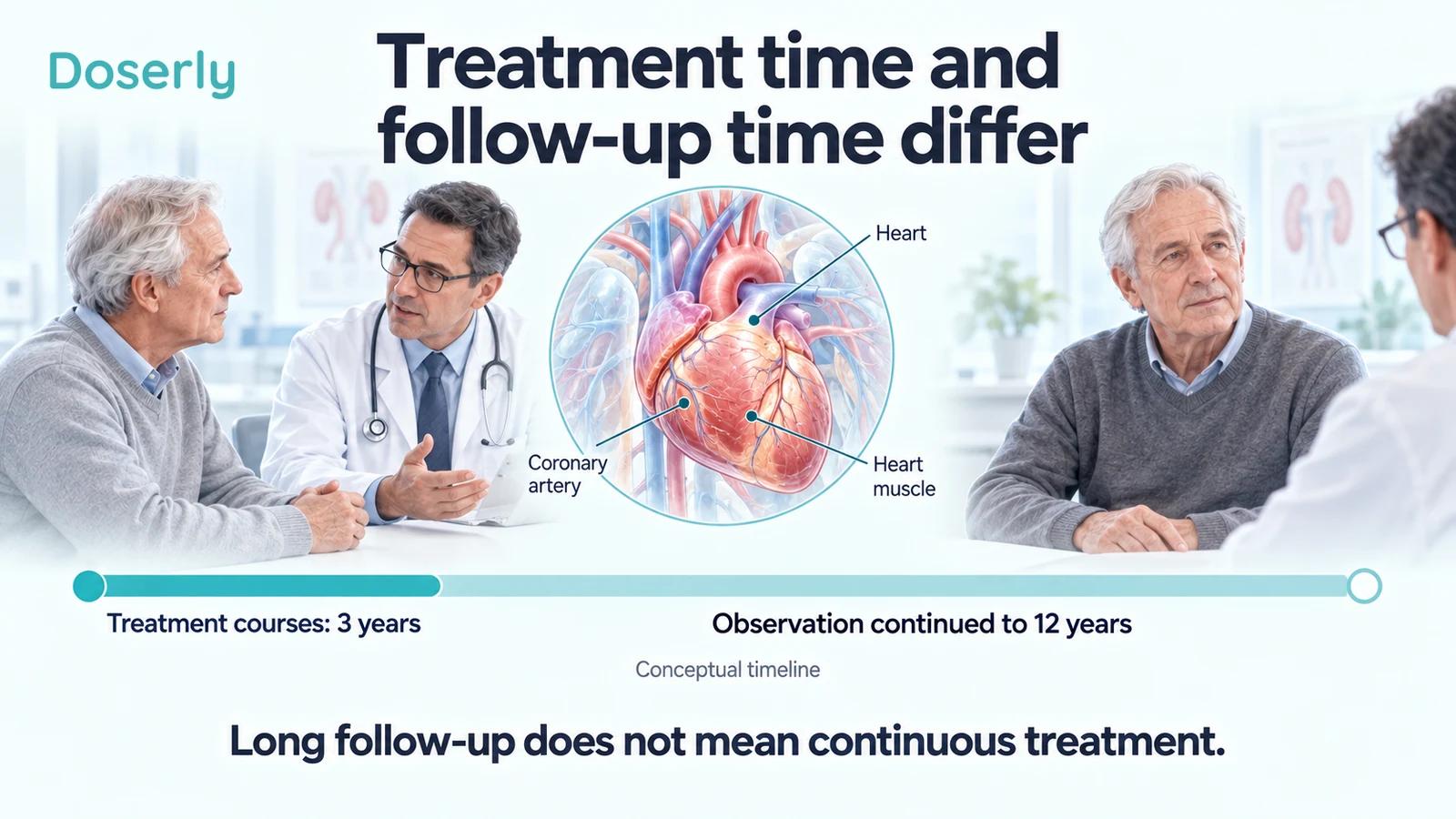
The 12-year study reported treatment courses over three years, followed by longer observation. The later 15-year report likewise describes six courses over three years. Twelve-year full report, fifteen-year abstract.
This matters whenever a summary says that people “took the peptide for fifteen years.” The title's follow-up period does not establish continuous exposure for that length of time.
Long observation can reveal events that a short trial would miss. It also raises questions about what happens after the planned treatment ends: whether participants receive additional courses, whether background therapy changes, and how completely outcomes are recorded.
For a treatment claim, those details help establish what was actually compared. For a safety claim, they determine how much exposure the study can reasonably speak about. A person observed for many years after a brief exposure does not supply the same safety information as someone treated continuously throughout those years.
The 12-year paper's survival counts need careful handling
The full 2006 report states that 28 of 36 treated participants and 19 of 34 controls were alive at the end of observation. The corresponding proportions calculated from those counts are 77.8% and 55.9%. The paper prints 77.7% for the treated group, a minor rounding difference. Original report, pages 358–359.
Reported group
Epithalamin
- Alive at end of follow-up
- 28 of 36
- Proportion calculated from counts
- 77.8%
Reported group
Control
- Alive at end of follow-up
- 19 of 34
- Proportion calculated from counts
- 55.9%
Those counts imply eight deaths among 36 treated participants and fifteen among 34 controls. They do not directly produce the paper's statement that total mortality decreased by 28%. The observed survival difference is about 21.9 percentage points, while the relative difference in the crude death proportions is a different calculation again.
We should not silently choose a new headline percentage and call the discrepancy solved. Without clarification, the responsible approach is to preserve the counts, identify the inconsistency and avoid repeating “28% lower mortality” as a clean effect estimate.
These are also crude proportions, not a hazard ratio. A time-to-event analysis considers when events occur and how follow-up is handled. Recalculating percentages from endpoint counts does not reconstruct that analysis or independently establish statistical significance.
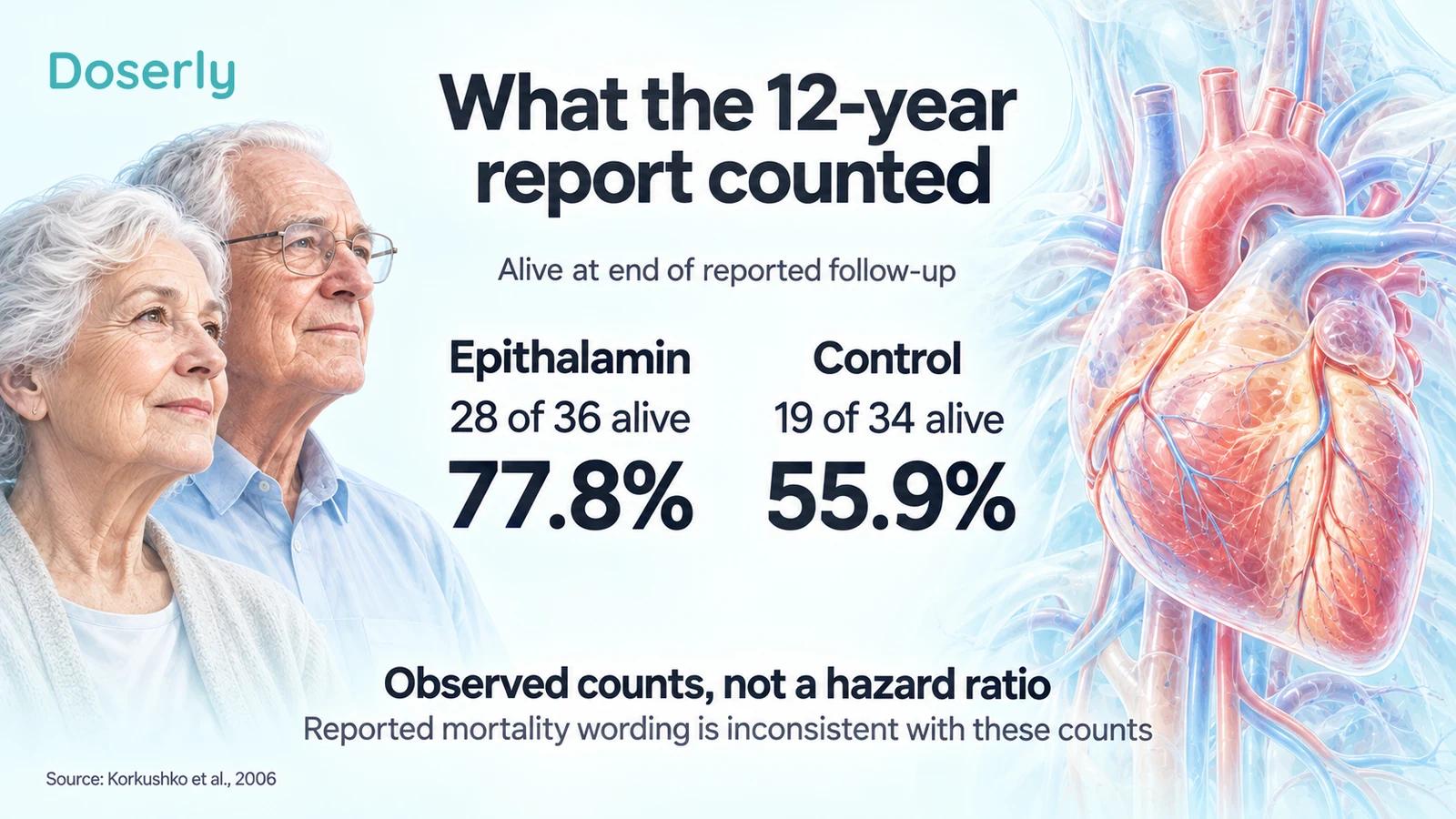
Percentages are calculated from the paper's stated counts. The illustration highlights a reporting inconsistency rather than supplying a new estimate of treatment efficacy. The people and anatomy are conceptual. Original report.
Why the number of events matters
In a small study, each event has a substantial influence on the estimated difference. That does not make a result worthless, but it makes precision and follow-up especially important.
A confidence interval would help show the range of effects compatible with the data under the chosen analysis. A clear participant-flow account would help establish whether everyone remained included and how missing information was handled. Information about baseline characteristics would help assess whether the groups started with comparable risk.
The 2006 paper calls the study randomized, but its brief methods do not fully describe the allocation sequence or concealment procedures. That is a reporting limitation, not proof that allocation was manipulated. The distinction matters: we can identify what is insufficiently documented without asserting misconduct or inventing a flaw that the available report cannot establish.
Likewise, objective outcomes such as death are less dependent on a patient's expectations than a symptom score, but they are not immune to problems in follow-up or analysis. Knowing that the outcome is important does not eliminate the need to understand how it was collected.
There is another question to ask when reading long follow-up reports: who contributed the later functional measurements? If only surviving participants completed an exercise test, their average describes that surviving group. It is not automatically the average outcome of everyone originally enrolled. Survival and later function should therefore be reported together, with clear denominators.
This is a general interpretation question, not an assertion that these authors deliberately excluded unfavorable results. In an older population, deaths, illness, and inability to attend can all affect which measurements are available. A full report should show how those circumstances were handled. Otherwise, a favorable functional average and a mortality comparison may describe different sets of people, even though both appear under the same study title. Separating those populations helps a reader understand what the evidence can support.
What does the 15-year report add?
The 2011 report describes 39 coronary patients receiving epithalamin plus basic therapy and forty receiving basic therapy alone. It reports favorable cardiovascular, metabolic and mortality findings. The publisher's accessible page provides an abstract, with the full article behind a subscription. Original abstract.
Those group sizes differ from the seventy-person 2006 paper. Similar authors, institutions, populations and interventions are reasons to investigate whether the reports are related, but they are not enough to declare the cohorts identical. Conversely, separate publication dates are not enough to declare them independent replications.
For this review, the relationship between the cohorts remains unresolved. We have not added their participant totals together to claim a larger evidence base, and we have not treated the later report as a completely independent confirmation.
The English title also says “pituitary,” while the abstract identifies epithalamin and a pineal preparation. Keeping the actual intervention description visible is more reliable than treating every word in a translated title as a precise chemical identifier.
“Functional age” is not the same as years of life gained
The older work used measures described as cardiovascular functional age. Such a measure summarizes selected features of cardiovascular performance according to a particular method. A change in the resulting number does not mean the person literally became younger by that many calendar years.
This is a common source of overstatement. If a composite score moves, the next question is which inputs changed and whether those changes predict a meaningful outcome in the intended population. The word “age” in the score does not answer that question.
Exercise tolerance is more directly recognizable to patients, but it also needs a defined method and comparison. A bicycle exercise threshold, a walking distance and the ability to manage daily activities measure related but different aspects of function.
A persuasive healthy-aging claim would connect such measurements with sustained improvements in daily life or reduced disease burden. It would not rely on relabeling a favorable score as whole-body rejuvenation.
The animal lifespan paper asks another question
A study of synthetic Epitalon in female Swiss-derived SHR mice used 54 animals per group. It found no change in mean lifespan but reported longer survival among the last tenth of survivors and a higher maximum lifespan. Original mouse report.
This is relevant to the synthetic peptide, but it is not a missing human replication of the extract studies. It also illustrates why the word “lifespan” needs an accompanying definition. Mean lifespan reflects the group as a whole; maximum lifespan concerns an extreme observation; the last tenth concerns a selected tail of the distribution.
A favorable result for one of those measures should not be rewritten as a favorable result for all of them. Nor can a percentage in mice be translated into a predicted number of extra years for a person.
What would resolve the important uncertainties?
The older reports would be easier to interpret with transparent group counts, allocation methods, follow-up completeness, adverse-event definitions and a clear explanation of any overlapping cohorts. Clarification of the 2006 mortality wording would be particularly valuable.
For today's clinical question, independent trials would need to test a characterized preparation against a suitable comparison in a clearly defined population. If the product is synthetic Epitalon, that product needs its own evidence; the extract's history is background rather than a substitute.
The goal should also be explicit. Preventing cardiovascular events in patients with coronary disease is different from improving function in frail adults or extending life in healthy people. Each question requires appropriate outcomes and enough observation to assess harms as well as benefits.
The older papers provide reasons for further investigation, including reported long-term patient outcomes. They do not establish a proven synthetic Epitalon longevity regimen. Keeping the preparation, population, exposure period and actual counts attached to the claim gives a much more useful picture than repeating a dramatic mortality percentage. Our Epithalon guide places those reports alongside the cell research and current safety uncertainties.
Sources
- Khavinson and Morozov, 2003: 266-person thymalin/epithalamin report; abstract reviewed.
- Korkushko and colleagues, 2006, original full paper: scanned pages 356–359 inspected, including group sizes, timing and survival counts.
- Korkushko and colleagues, 2011: 15-year report; abstract reviewed, cohort relationship unresolved.
- Anisimov and colleagues, 2003: synthetic Epitalon mouse lifespan findings.
- FDA Epitalon briefing, 2026: identity distinction between synthetic peptide and extract.