
Peptides
October 16, 2026
What mazdutide's Chinese phase 3 trial actually establishes
On this page
GLORY-1 provides randomized evidence that mazdutide reduced body weight more than placebo in Chinese adults with overweight or obesity without type 2 diabetes. That is a substantial clinical finding. Understanding it does not require dismissing the trial because of its location or treating its result as universal.
The key is to keep the study's boundaries attached to its numbers: who enrolled, which regimens were tested, when outcomes were measured and how treatment discontinuation was handled. Those details determine what the trial establishes.
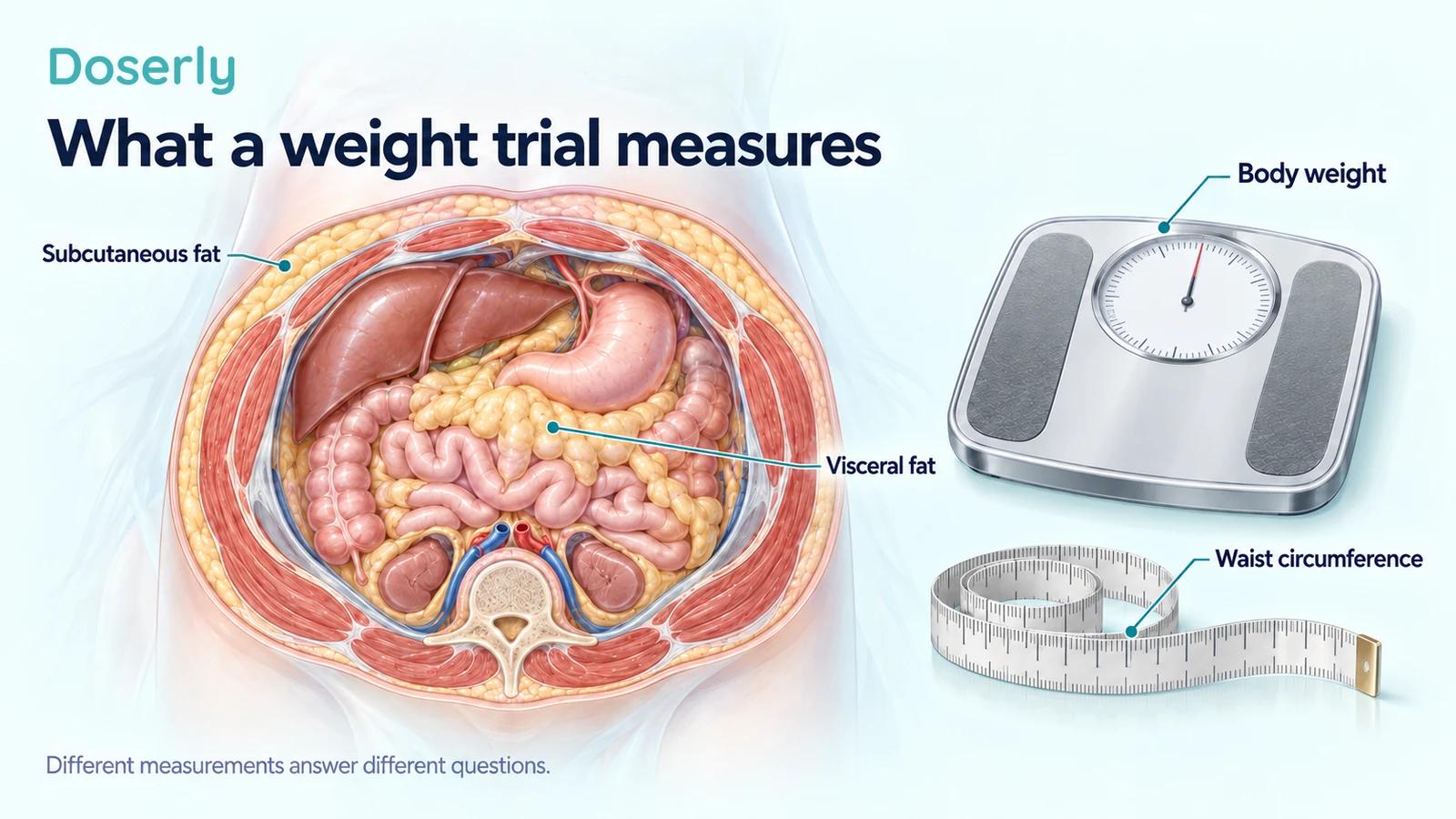
Published in 2025, GLORY-1 also reported changes in waist circumference and several cardiometabolic measurements. It did not establish that mazdutide prevents every complication associated with obesity, that its benefits persist indefinitely after stopping, or that it is superior to another active medicine.
The study in context
GLORY-1 was a double-blind, randomized, placebo-controlled phase 3 trial conducted at 23 hospitals in China. It assigned 610 adults to once-weekly mazdutide with a target dose of 4 mg or 6 mg, or to placebo.
All participants received diet and exercise guidance. The treatment period lasted 48 weeks, followed by 12 weeks off treatment. The two primary endpoints were assessed at week 32: average percentage weight change and the proportion of participants losing at least 5% of their starting weight. Original GLORY-1 publication.
This structure gives the placebo group an important role. It provides a comparison within the same study setting, with the same general follow-up and lifestyle instructions. The difference between groups is more informative about treatment effect than the weight change in the mazdutide group alone.
The target doses identify research groups. They should not be read as instructions to start, escalate or select treatment independently. The Doserly mazdutide guide provides broader context on the molecule and evidence.
Who was actually enrolled?
Participants were aged 18–75, but the average age was 34.2 years. Mean starting weight was 87.2 kg and mean BMI was 31.1. Men made up 49% of the cohort.
The trial used Chinese BMI definitions: obesity at a BMI of at least 28, or overweight from 24 to below 28 with a qualifying weight-related condition. Most participants had obesity by those criteria, and 88.9% had at least one weight-related coexisting condition. People with type 2 diabetes were excluded. GLORY-1 methods and baseline table.
Those characteristics matter more than the country label alone. A comparatively young population with a particular starting BMI distribution does not answer every question about older patients, people at substantially higher weights or those with diabetes.
The age range is another useful distinction. Eligibility up to age 75 does not mean the trial contains equally strong evidence at every age. Actual enrollment and subgroup precision are needed to support age-specific conclusions.
The primary results were measured at week 32
Under the treatment-policy analysis, estimated average weight change at week 32 was:
Study group
Mazdutide 4 mg
- Average change from starting weight
- −10.09%
- Participants reaching at least 5% weight loss
- 73.9%
Study group
Mazdutide 6 mg
- Average change from starting weight
- −12.55%
- Participants reaching at least 5% weight loss
- 82.0%
Study group
Placebo
- Average change from starting weight
- +0.45%
- Participants reaching at least 5% weight loss
- 10.5%
Both mazdutide groups differed significantly from placebo on both primary endpoints. The percentages in the second column describe an average change; the percentages in the third describe the share meeting a threshold. They are not competing estimates of the same quantity. GLORY-1 primary results.
For example, an 82% threshold-response rate does not mean participants lost 82% of their weight. It means the estimated proportion reaching at least 5% loss was 82% in that group.
Likewise, an average reduction is not a guarantee for each participant. People can have different responses around the group estimate, including responses below the stated threshold.
Week 48 extends the result, rather than replacing it
At week 48, estimated average weight changes were −11.00% with 4 mg, −14.01% with 6 mg and +0.30% with placebo under the same treatment-policy framework. The proportions reaching at least 15% loss were 35.7%, 49.5% and 2.0%, respectively. GLORY-1 secondary results.
These findings add information about the longer treatment period. They do not change the fact that the primary assessment occurred at week 32. A clear summary names the time point whenever quoting a percentage.
The trial also followed participants for 12 weeks after treatment ended and reported weight rebound. That short follow-up does not establish a complete long-term trajectory after stopping. It does show why a result achieved during treatment should not be presented as permanently maintained without treatment.
Questions about sustained benefit need their own follow-up. A 48-week treatment result cannot answer a multi-year durability question merely because the initial effect is substantial.
Why the analysis name changes the meaning
The paper reports a treatment-policy estimand and an efficacy estimand. An estimand defines the effect the analysis is trying to estimate, including how events such as stopping treatment or starting another weight-management intervention are handled.
The treatment-policy approach asks about the effect regardless of those specified events. It is therefore broader than describing only people who remained on the assigned regimen. A hypothetical efficacy analysis addresses a different scenario and can yield a different percentage. ICH estimands guidance.
Neither label eliminates uncertainty. Missing measurements still require assumptions and statistical methods. GLORY-1 used multiple imputation in its treatment-policy analysis, with the methods explicitly considering why participants might leave the trial.
The reader's task is to keep the chosen analysis consistent. It would be misleading to select a hypothetical efficacy estimate for one treatment and compare it with a treatment-policy estimate for another without explaining the difference.
Low discontinuation does not mean few symptoms
Adverse events leading to discontinuation of the trial regimen occurred in 1.5% of the 4 mg group, 0.5% of the 6 mg group and 1.0% of the placebo group. Those rates describe a particular consequence of adverse events: stopping treatment.
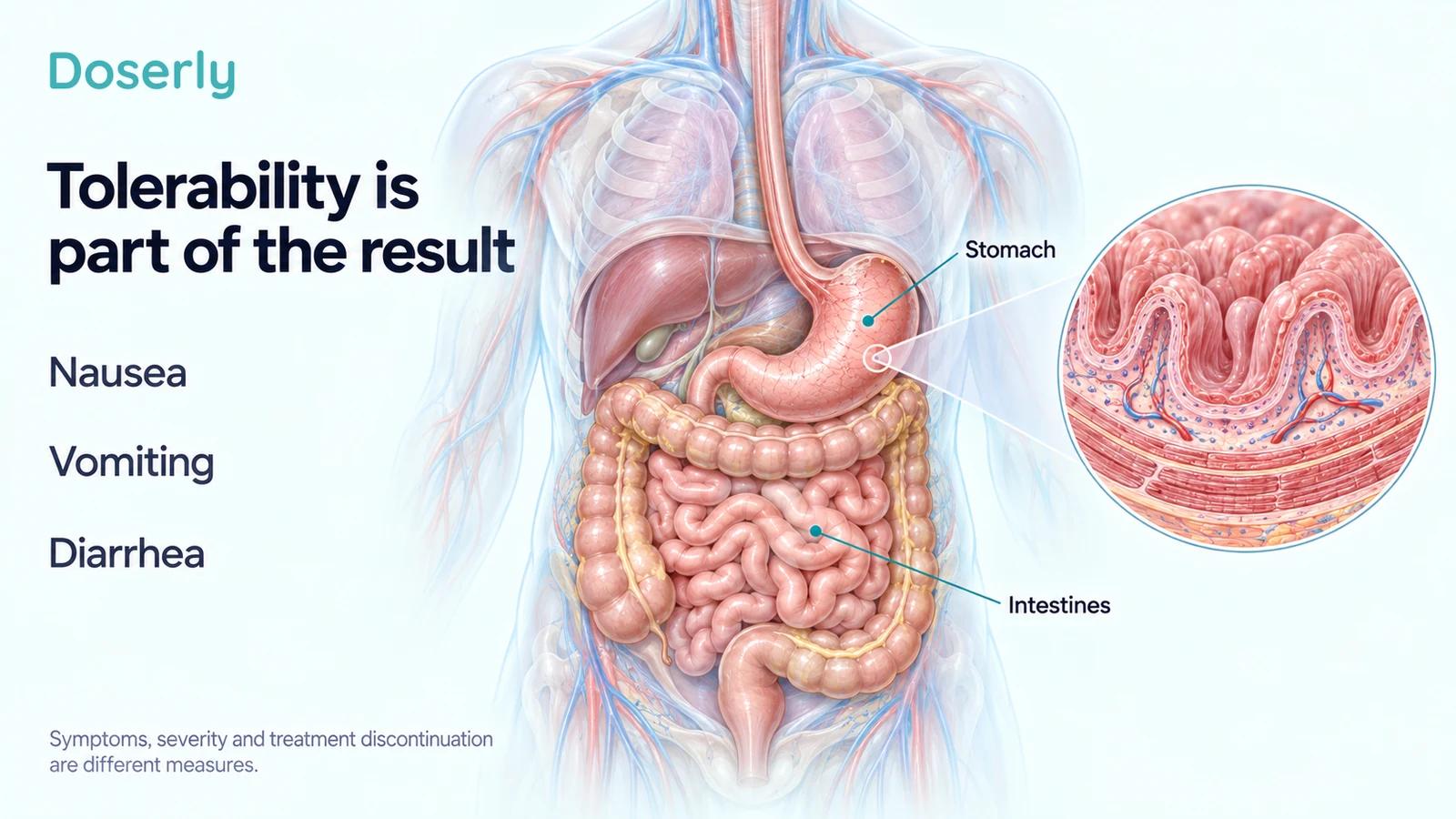
Gastrointestinal symptoms were much more common. Nausea occurred in 32.5% and 50.5% of the mazdutide groups, compared with 5.9% with placebo. Vomiting occurred in 26.1% and 43.1%, compared with 2.9%. Most gastrointestinal events were described as mild or moderate. GLORY-1 safety table.
A person can experience symptoms and remain on treatment. A low discontinuation percentage therefore cannot be used as a synonym for symptom-free treatment.
The reverse distinction matters as well. Stopping for any reason is not the same as stopping because of an adverse event. In GLORY-1, 56 participants discontinued the trial regimen prematurely for all reasons combined, while 567 completed the trial. Trial completion and treatment continuation are related but separate measures.
These details help describe tolerability honestly without turning the safety section into either reassurance based on one small number or alarm based on symptoms stripped of severity and context.
Cardiometabolic measurements are additional evidence
GLORY-1 reported favorable changes in prespecified cardiometabolic measures, including blood pressure, lipids, serum uric acid and alanine aminotransferase. Several analyses pooled the two mazdutide groups. GLORY-1 secondary-endpoint table.
Pooling can answer whether the combined treated group differs from placebo. It does not provide a separate estimate for each dose. When a pooled result is quoted, that fact should remain visible.
The larger interpretation is also bounded. Lower blood pressure or a favorable lipid change is not the same endpoint as fewer cardiovascular events. Lower serum uric acid is not the same as fewer gout flares. A liver-related laboratory change is not equivalent to proven prevention of liver failure.
These results can strengthen a biological rationale and motivate further studies. A claim about a different disease outcome needs evidence designed around that outcome.
How earlier and later studies fit
The earlier Chinese phase 2 study provided a shorter randomized test over 24 weeks in 248 participants. GLORY-1 expanded the sample and treatment duration, adding phase 3 evidence for its tested regimens. Chinese phase 2 trial.
Later evidence should be identified separately rather than blended into GLORY-1. GLORY-2 studied a 9 mg regimen over 60 weeks in Chinese adults with a BMI of at least 30, including participants with type 2 diabetes. Its analysis included 461 treated participants. That is a different trial and population. GLORY-2 publication.
The US phase 2 study also differed: 179 participants, higher-dose exploration and a primary weight assessment at week 32 using a hypothetical efficacy estimand. It broadens the program's evidence but does not create a randomized comparison between countries or between its regimens and those in GLORY-1. US phase 2 publication.
Keeping the studies separate prevents a composite headline that borrows the largest percentage, most favorable tolerability rate and broadest population from different experiments.
What the trial cannot rank
Because GLORY-1 compared mazdutide with placebo, it does not directly establish superiority over semaglutide, tirzepatide or another active treatment. Comparing percentages from separate studies can generate a question, but it cannot substitute for a suitable comparative design.
Differences in baseline characteristics, duration, doses, lifestyle support and analysis methods can all affect the observed results. Even the placebo groups may change differently across studies.
The same caution applies to the two mazdutide doses. The reported values provide useful information, but selecting a regimen for an individual involves more than choosing the larger average weight reduction. Tolerability, suitability and the evidence supporting the intended use all matter.
A trial result can be strong without answering every competitive or clinical question surrounding the medicine.
What a careful reader should retain
GLORY-1 establishes a meaningful treatment-group difference in weight outcomes over its specified study period. Its randomized, blinded design and placebo comparison support that conclusion in the enrolled population.
Its limits are equally specific: a relatively young Chinese adult cohort, no type 2 diabetes, tested target doses of 4 mg and 6 mg, 48 weeks of treatment and a short off-treatment follow-up. Secondary metabolic measurements add information without proving prevention of all related diseases.
For a clinician-patient discussion, the useful next step is to compare the individual's situation with those boundaries. Which characteristics match? Which important conditions were excluded? Which outcome is the actual treatment goal? Those questions translate the study into a clinical conversation more accurately than a single weight-loss percentage.
The strongest reading preserves both the positive result and its scope. Mazdutide worked better than placebo on the defined GLORY-1 weight endpoints; broader claims about long-term outcomes, other populations and comparisons with other medicines require their own evidence.
Sources
- GLORY-1: once-weekly mazdutide in Chinese adults — phase 3 randomized trial, 2025.
- ICH E9(R1) estimands guidance — methods reference.
- Chinese phase 2 mazdutide study — randomized trial, 2023.
- GLORY-2: 9 mg mazdutide — phase 3 randomized trial, 2026.
- US phase 2 mazdutide study — randomized trial, 2026.