
Peptides
October 16, 2026
What longer zenagamtide trials need to tell patients
On this page
Zenagamtide, formerly called amycretin, is an experimental medicine being developed for obesity and type 2 diabetes. Early studies found substantial changes in weight and blood sugar. For someone considering what future treatment might offer, the next questions are practical: Does the benefit last? Can people stay on treatment? What happens after stopping? Does a change on the scale translate into better health or daily function?
The early injection trial followed some groups for up to 36 weeks. Its findings justify further study, but they cannot describe years of treatment. A large early weight estimate is a starting point for the development program, not a complete account of long-term benefit and risk. Early phase 1b/2a trial
The current program includes longer weight trials, a withdrawal study and cardiovascular outcome studies. These designs answer different questions. Below, registry details are current to October 15, 2026; the listed zenagamtide studies had no posted results at that check. The zenagamtide guide provides broader background on the molecule and formulations.
First, does the effect persist beyond the initial months?
A weight-loss study needs more than a large early change. Longer observation can show whether the effect continues, reaches a stable level or becomes harder to maintain. It also helps distinguish the experience during dose escalation from the experience after a regimen has been established.
AMAZE 1 plans to study about 1,150 participants with obesity, with its main weight assessment at 84 weeks. The registry listed it as recruiting. This longer time point should provide more information about the injection program than an early trial ending at 20, 28 or 36 weeks. It still describes a planned assessment rather than an observed result. AMAZE 1 primary registry
A flattening weight curve is not automatically a treatment failure. Maintaining a clinically useful change can itself be valuable. Conversely, a curve still falling when a short trial ends does not prove that weight will continue to fall at the same rate. The useful result is the observed trajectory together with retention, exposure and uncertainty.
Patients also need to know how variable the response is. An average can conceal people with large changes, small changes or weight regain. Reporting the proportions reaching meaningful thresholds helps describe that variation, but those thresholds should remain tied to the trial population rather than used as individual promises.
The tablet needs its own long-term evidence
The oral program is not simply the injection program with the needle removed. The route and formulation affect exposure, and the practical task of taking a daily tablet differs from using a weekly injection. Evidence from one should not be relabeled as a result for the other.
AMAZE 9 is the oral obesity phase 3 trial, planning 950 participants and a primary weight-change assessment at 76 weeks. It was recruiting when checked, without posted results. Its longer follow-up can help clarify the durability and tolerability of the tablet formulation actually tested. AMAZE 9 registry
Even if both formulations ultimately show benefit, patients may experience them differently. Consistent use, symptom burden and convenience are outcomes worth understanding alongside laboratory exposure. A future preference for one route should rest on its own evidence and product information, not only on the appeal of avoiding an injection or taking medicine less often.
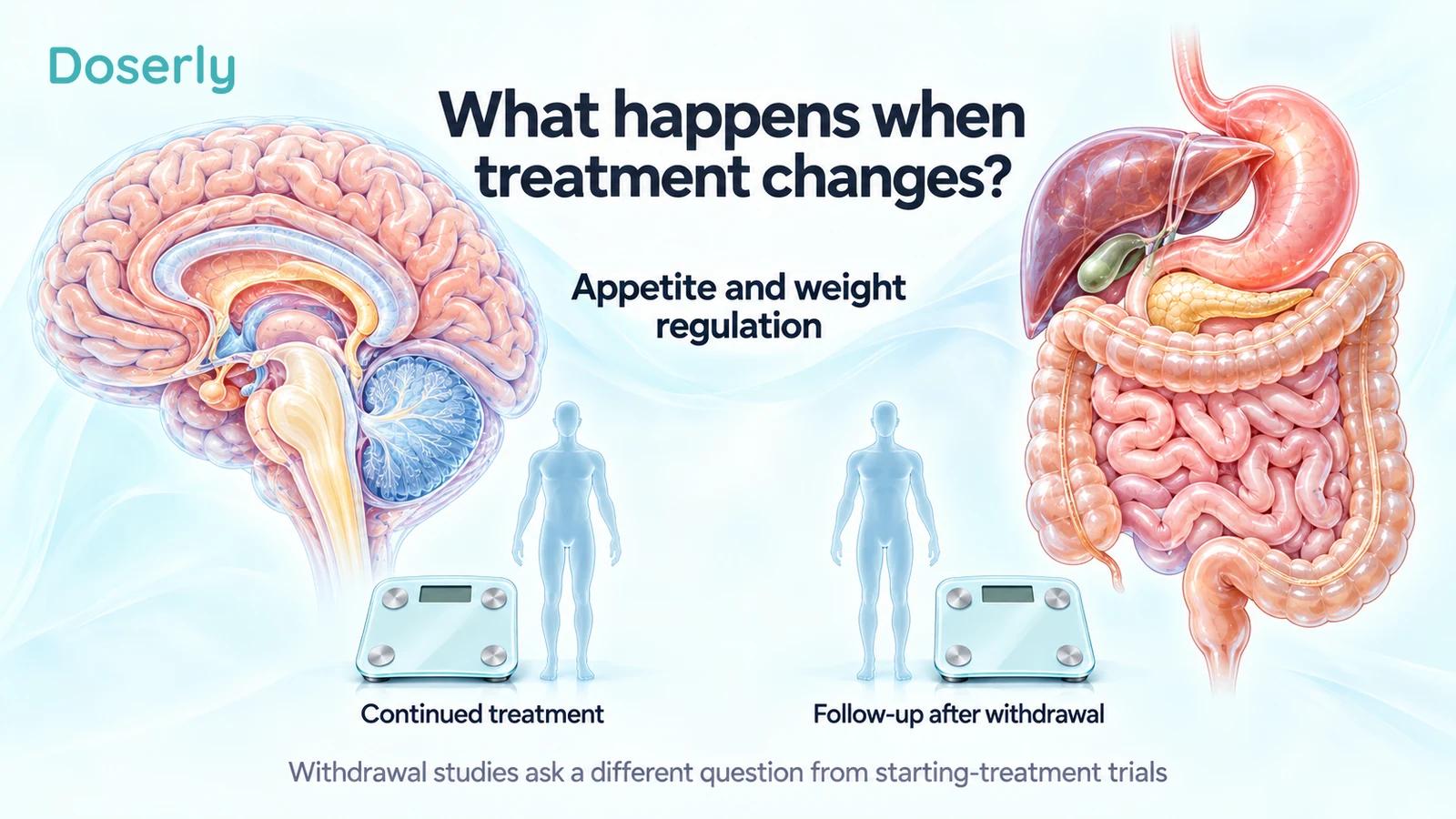
What happens when treatment is withdrawn?
Starting treatment and stopping it are separate clinical questions. A medicine may produce a useful change while being taken without permanently removing the processes that contributed to weight gain. Withdrawal research examines whether the change persists, reverses or requires continued treatment.
AMAZE 12 is designed around participants who reached a target dose during an initial run-in period. The registry listed 606 enrolled participants, active but no longer recruiting, with its primary weight-change assessment running from week 40 to week 92. This is a withdrawal/maintenance question in people who made it through the initial treatment period. AMAZE 12 registry
That selection is important. A study of people who reached a target can help answer what happens next for that group. It cannot directly tell us the experience of every person who starts, including those who stop early or never reach the target. Both starting-treatment and maintenance studies are useful, but their denominators mean different things.
There is a reason to take withdrawal seriously without assuming zenagamtide's answer. In the STEP 1 extension, 327 participants were analyzed after semaglutide or placebo and the structured lifestyle intervention were stopped. Over the following year, the former semaglutide group regained a substantial part of its prior weight loss. That was semaglutide research in a selected extension sample, not a zenagamtide withdrawal result. STEP 1 extension
The relevant lesson is the need to measure maintenance, not to copy another medicine's regain percentage. Zenagamtide's own withdrawal study must determine its pattern. Nor would a withdrawal result establish that scheduled breaks or “cycling” treatment are effective; that would require a different comparison.
Does weight loss translate into fewer serious cardiovascular events?
Weight, blood pressure and glucose are important measurements, but a reduction in one does not automatically prove that a medicine prevents hospitalization, stroke or death. An outcome trial follows clinically important events directly. It generally needs a population at risk of those events and enough follow-up to observe them.
The zenagamtide study NCT07567001, often called HF-POLARIS, concerns people with obesity and heart failure with preserved or mildly reduced ejection fraction. Ejection fraction describes the proportion of blood pumped from the heart's main pumping chamber with each beat; heart failure can occur even when that proportion is relatively preserved.
Its registry lists 5,610 planned participants, recruiting status and follow-up extending to 165 weeks for cardiovascular death and heart-failure events such as hospitalization or an urgent visit. The study is intended to examine morbidity and mortality, not merely change in body weight. Heart-failure trial registry
A positive weight result in an earlier trial cannot supply this answer in advance. People with heart failure have different clinical concerns and background treatments. The balance of symptoms, function, event prevention and tolerability must be evaluated in that setting.
A newly registered study addresses a different cardiovascular population
AMBIENCE, now registered as NCT07861100, plans to study 8,500 people with established atherosclerotic cardiovascular disease and overweight or obesity. Atherosclerosis involves disease of arteries, including plaque buildup. The record listed not-yet-recruiting status when checked on October 15, 2026.
Its primary endpoint combines cardiovascular death, nonfatal heart attack, nonfatal stroke, and heart-failure hospitalization or an urgent heart-failure visit, with observation potentially lasting 203 weeks or longer. These are planned clinical outcomes; no results were posted. AMBIENCE primary registry
A composite endpoint groups several events into one main measure. If the eventual combined result is favorable, the components will still matter. A benefit driven mainly by one type of event should not be described as proven prevention of every component. Confidence intervals and event counts will help show how precisely individual outcomes were estimated.
This also explains why “cardiovascular benefit” should not be used as a single undifferentiated claim. A heart-failure population and a population with established arterial disease overlap in some ways, but they are not identical. Their trials answer different treatment questions.
What about muscle, strength and everyday function?
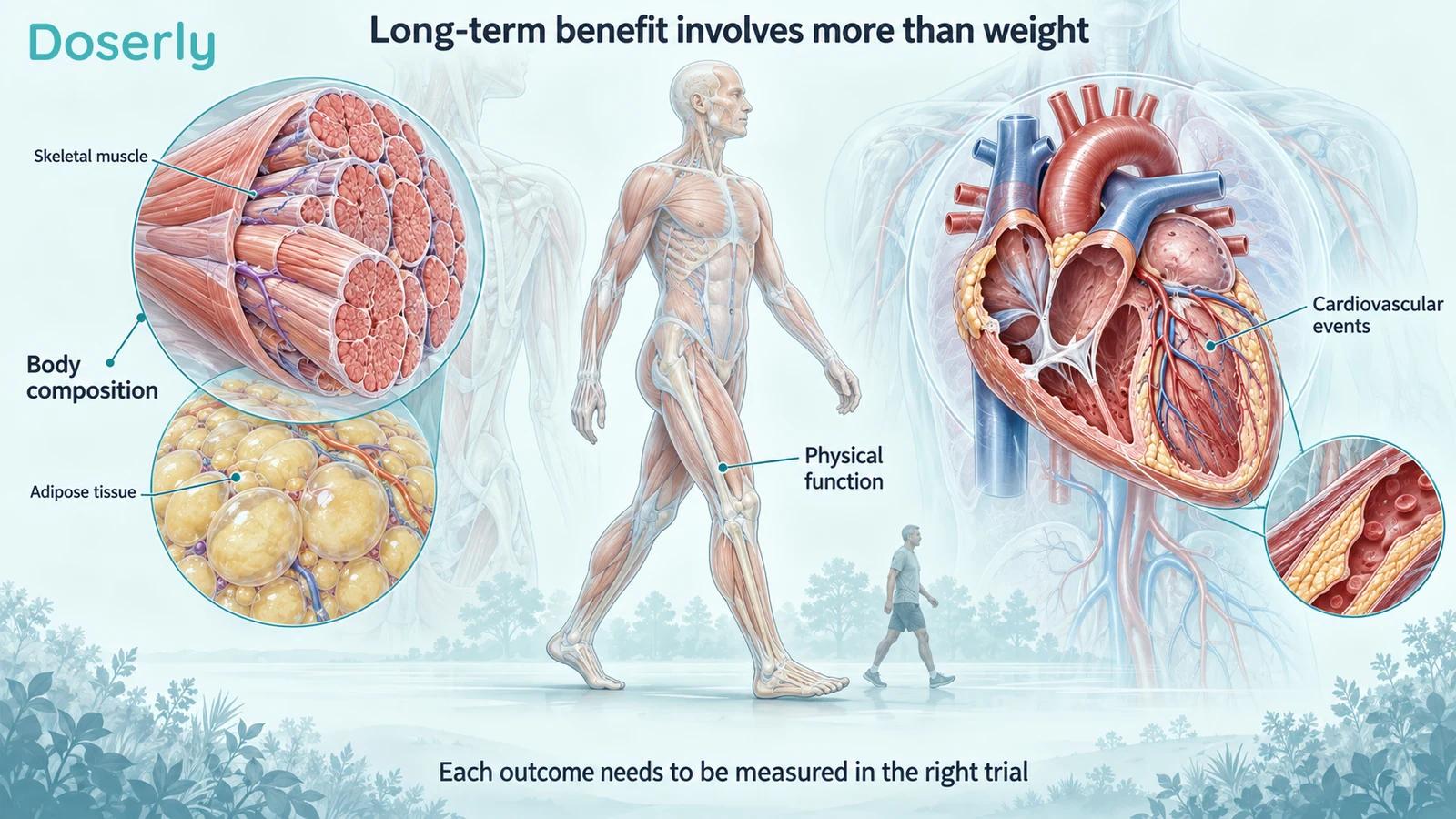
A scale measures total body weight. It cannot tell how much change comes from fat, lean tissue or fluid. Nor does a body-composition measurement by itself show whether someone can climb stairs, rise from a chair or walk farther.
Longer treatment research should therefore distinguish body composition from physical function. Imaging can help characterize tissue changes; strength and performance tests can examine what a person can do. Patient-reported measures can add information about symptoms and daily activities. These assessments are complementary rather than interchangeable.
This is particularly relevant when discussing older adults or people already limited by illness. A desirable change in weight should be considered alongside how they feel and function. It would be premature to claim that zenagamtide preserves muscle or improves strength simply because a preclinical mechanism sounds favorable or an early weight percentage is large.
These are questions to look for in complete reports and prespecified substudies. Their absence from a short registry summary does not prove they were never considered, but neither should an unlisted or unpublished analysis be assumed to have succeeded. The available result needs to identify exactly what was measured.
Can people sustain treatment, and do uncommon harms emerge?
The early injection trial reported substantial withdrawal. Later dose-finding work used structured regimens with specific rules for intolerance. Longer studies need to show how often people remain on treatment, what exposure they actually receive and why they stop. Early trial report
A larger sample helps characterize less common events, while longer exposure can reveal patterns that a brief study misses. Those are different dimensions of safety. Thousands of people observed briefly are not equivalent to the same people followed over several years.
Official guidance on medicines intended for long-term use recognizes the importance of both the size of the exposed population and duration of treatment. No finite trial can guarantee that every rare harm will be detected, but a broader safety program can progressively reduce uncertainty. FDA/ICH long-term exposure guidance
The reports should also make clear whether an event was merely observed after treatment or judged related to it. Comparison with the control group, timing and biological plausibility all contribute to interpretation. A list of events cannot establish causation on its own.
Which people do the results represent?
A longer trial is not automatically representative of everyone. Eligibility criteria may exclude particular illnesses, pregnancy, certain medicines or people who cannot complete study procedures. A result should be interpreted with those restrictions visible.
The early zenagamtide injection study recruited adults aged 18–55. Larger programs may broaden the evidence, but a claim about older people, people with multiple illnesses or a particular treatment combination still needs relevant participants and sufficient information. A subgroup containing only a few people can leave wide uncertainty even inside a large overall trial.
For an individual treatment discussion, the useful question is how closely their condition resembles the studied population. An obesity trial, a diabetes trial and a heart-failure trial should not be treated as three repetitions of the same experiment. Each adds a different part of the clinical picture.
What to look for when the results arrive
A helpful long-term report will connect the main outcome with treatment exposure, continuation, adverse events and the people studied. It will distinguish an analysis assuming continued treatment from one that follows people after treatment changes. It will report uncertainty and avoid turning every secondary finding into a definitive benefit.
Registry dates can move, and a completed study does not necessarily mean results are public. The records cited here document what investigators plan to test as of the research date. They should be refreshed before publication or when a major result is announced.
For now, zenagamtide's early findings justify interest. The longer studies should determine whether that interest translates into sustained, tolerable treatment and meaningful clinical outcomes. Those answers will be more useful to patients than projecting the first promising percentage indefinitely into the future.
Sources
- Early injectable amycretin trial, 2025
- AMAZE 1
- AMAZE 9
- AMAZE 12
- STEP 1 withdrawal extension, 2022
- Zenagamtide heart-failure outcomes study
- AMBIENCE
- FDA/ICH long-term clinical safety exposure guidance