
Peptides
October 16, 2026
What Humanin needs before a clinical longevity claim
On this page
Humanin is connected to aging research through several different kinds of evidence: cell-protection experiments, animal interventions, genetic associations and measurements in unusually long-lived families. The connection is scientifically interesting. It does not establish that administering Humanin makes people live longer or remain healthier for longer.
The missing step is specific. A defined intervention must produce a worthwhile outcome in people, with a safety profile appropriate to its intended use. Neither a favorable blood marker nor a longer-lived laboratory organism can complete that step on behalf of a human trial.
The Humanin guide introduces the broader evidence. Here, the focus is the transition from an aging hypothesis to a clinical claim: which findings are already available, what their limits are, and what a genuinely informative next study would need to establish.
First define what “longevity” is supposed to mean
Longevity language often moves between three outcomes without acknowledging the change. Lifespan concerns how long an organism lives. Healthspan concerns time spent in a sufficiently healthy or functional state. A biomarker is a measurement that may relate to either but is not automatically equivalent to them.
That distinction changes the claim a study can support. A shift in body composition is not a measured extension of life. Better performance on one task is not proof of preventing all age-related disability. A laboratory value associated with age is not necessarily a clock that can be reversed by changing the value.
A credible proposal should state its intended benefit before the experiment begins. Is the goal to preserve mobility, reduce the incidence of a disease, maintain cognitive function or change survival? Each requires its own population, follow-up and measurement strategy. “Healthy aging” is a useful aspiration, but it is too broad to serve as an endpoint without further definition.
The often-cited animal paper contains different answers
A 2020 Aging paper reported longer lifespan in transgenic worms expressing Humanin. In a separate experiment, older female mice received HNG, a modified Humanin analogue. Metabolic measures changed, but the groups did not differ significantly in lifespan after the treatment period. The paper also included human observations, including higher circulating Humanin in a small comparison of centenarian offspring with controls. These are three different designs, not one replicated human longevity result. Primary multispecies study.
The null mouse survival finding deserves to remain beside the positive findings. It does not prove that no possible Humanin-related intervention could affect mammalian lifespan. It does mean that this experiment cannot be presented as having demonstrated that effect. Explanations involving timing or exposure remain hypotheses unless tested in another appropriately designed study.
Transgenic expression also differs from administering a preparation. Lifelong or developmentally established expression can change biology in ways that an intervention begun later may not reproduce. The experimental method belongs to the result; replacing it with the generic phrase “taking Humanin” would change what was actually tested.
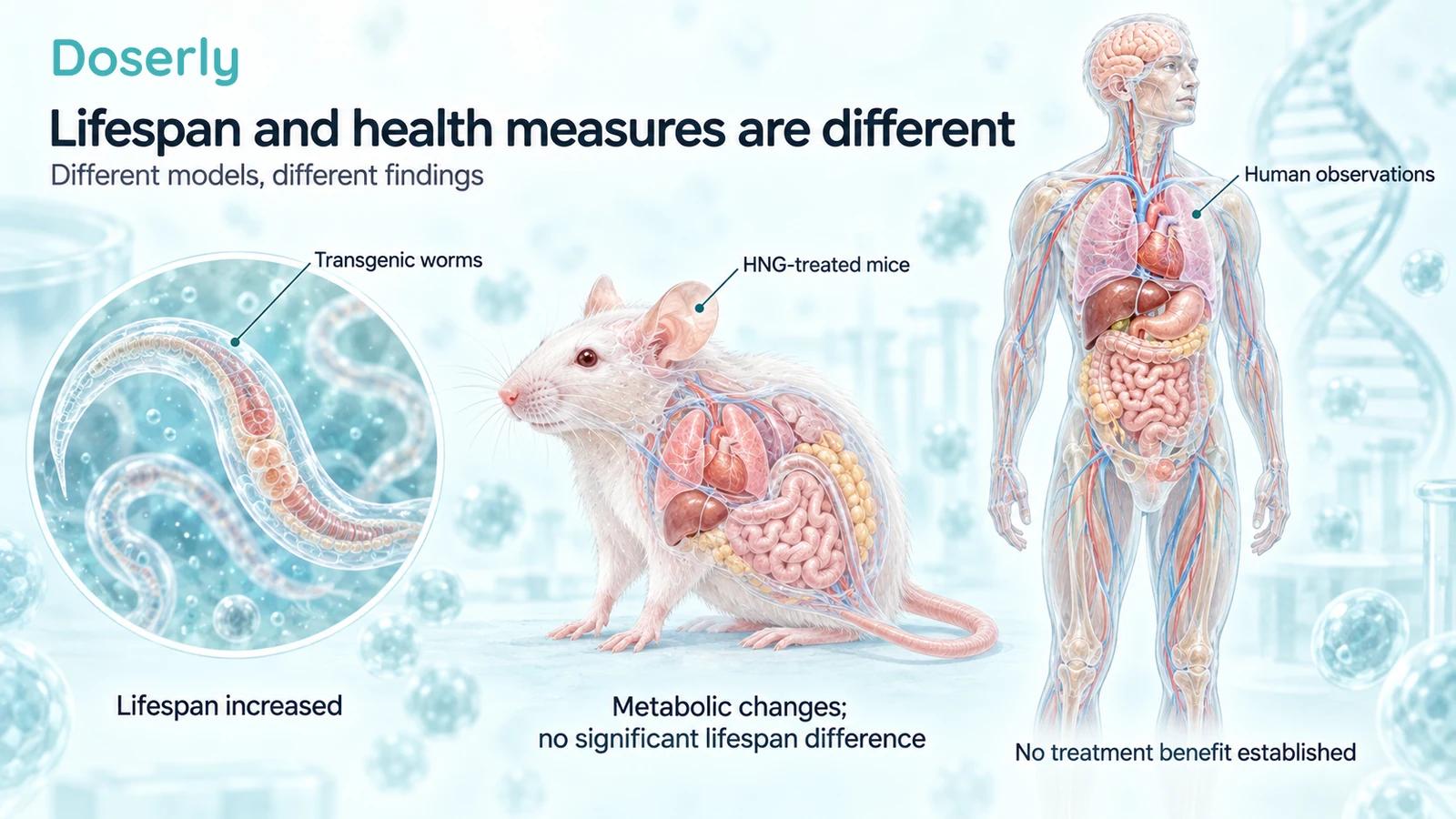
The worm lifespan result, mouse metabolic findings and human observations are separate evidence. The illustration does not show a progression toward a proven human longevity effect.
Human associations are relevant but not uniformly reassuring
A human aging study spanning 693 participants reported higher mitokine concentrations at older ages, with less favorable associations in the oldest group. This differs from a simple model in which Humanin always declines with age and higher concentrations invariably mean better health. Human aging and mitokine study.
The conflict is useful because it forces a better question. A circulating signal could be associated with resilience in one context and reflect physiological stress in another. Those are possible interpretations requiring further evidence, not established explanations for every cohort. The concentration alone does not reveal which process produced it.
The same issue limits a replacement narrative. If the body’s response to illness raises a marker, adding more would not necessarily address the illness. If a lower value accompanies disease, that does not prove the lower value caused it. A candidate therapeutic target needs evidence beyond being different between groups.
For a personal longevity claim, the relevant comparison is what happens when otherwise similar people receive the intervention or an appropriate control. Observing people who already have different concentrations cannot supply that comparison, however compelling their ages or family histories may be.
Genetic variants can sharpen the hypothesis
A 2018 study linked mitochondrial variation near the Humanin-coding region with circulating levels and cognitive-aging measures in human cohorts. Its human findings were associations; the same publication’s intervention experiments were in laboratory and animal settings. Human genetic and cognitive-aging study.
A later study examined the P3S Humanin variant in relation to APOE4 and exceptional longevity. It combined a human genetic observation with experiments involving amyloid biology, including a mouse model. This provides a more specific molecular hypothesis than treating every Humanin preparation as interchangeable. It still does not show that giving P3S or native Humanin extends human life. P3S primary study.
A published perspective on that study emphasized unresolved questions about the mitochondrial haplogroup background and generalizability beyond the sampled population. That is interpretive commentary rather than another treatment experiment, but it identifies why genetic context matters. Perspective on P3S and haplogroup N1b.
A naturally carried variant is present within a lifetime of biology and inherited context. Administering a peptide later in life is a different exposure. Genetic evidence can help choose a mechanism or candidate for testing; it cannot remove the need to test whether the proposed intervention reproduces a useful effect safely.
Read the intervention field on a trial registry
A live ClinicalTrials.gov API query for “humanin,” checked on October 15, 2026, returned seven records. Inspection of their study types and intervention fields found no record assigning Humanin itself as a treatment. Five were observational, and two were interventional studies of other exposures. This is a dated finding from that registry query, not a claim to have exhausted every study worldwide. ClinicalTrials.gov query.
For example, NCT03431844 concerns Humanin measurements in cardiac tissue and plasma around cardiac surgery. NCT06125249 examines Humanin as a potential marker of acute kidney injury after heart transplantation. Neither is a Humanin treatment trial. Cardiac study, transplant biomarker study.
The interventional label needs equal care. NCT07678073 compares anesthesia approaches during kidney transplantation and measures Humanin among its outcomes. NCT07438002 concerns an exercise program in chronic kidney disease. Their intervention status does not mean the peptide was administered. Anesthesia record, exercise record.
This distinction prevents a misleading shortcut from “registered human study” to “tested human therapy.” Registration documents a study’s design and reporting status. It does not establish efficacy, and a peptide mentioned as a measurement cannot be relabeled as the intervention.
The actual molecule and exposure need their own evidence
Humanin, HNG, HNGF6A and P3S are not interchangeable names for a single tested product. They involve different sequences or modifications. A study of one candidate may inform work on another, but it cannot supply that other candidate’s clinical evidence automatically.
Rodent pharmacokinetic work illustrates the problem. Different Humanin analogues and different animal species showed different circulating behavior and tissue-detection patterns. Those experiments inform development while leaving human exposure unresolved. They do not provide a validated human dosing schedule or demonstrate that a commercially offered preparation reaches the intended tissue. Analogue pharmacokinetics study.
A first clinical program would therefore need to characterize what is administered, what reaches the circulation, how it changes over time and whether a relevant biological target is affected. Product identity, purity and handling are necessary parts of that work, but they are not substitutes for exposure-response and safety evidence.
The route must also match the claim. Results after an experimental infusion cannot establish the behavior of a different route merely because the same family name appears on the label. A useful study would make the candidate and formulation reproducible enough that later investigators could test the same intervention.
A meaningful endpoint should survive a plain-language test
Imagine explaining a positive result without using the word “anti-aging.” Could you say what improved, by how much, compared with what, and for how long? If the answer is only that an experimental marker changed, the claim should stay at that level.
A mobility study might examine a validated functional task and whether a change matters in daily life. A cognitive study might distinguish practice effects from sustained benefit. A disease-prevention study would need enough relevant events and follow-up. These are examples of how claims can become testable, not established outcomes of Humanin treatment.
A composite healthspan measure would need similar clarity. Which events count? Are the components equally important to participants? Could a favorable change in one component hide an unfavorable change in another? A broad label does not eliminate the need to report the parts.
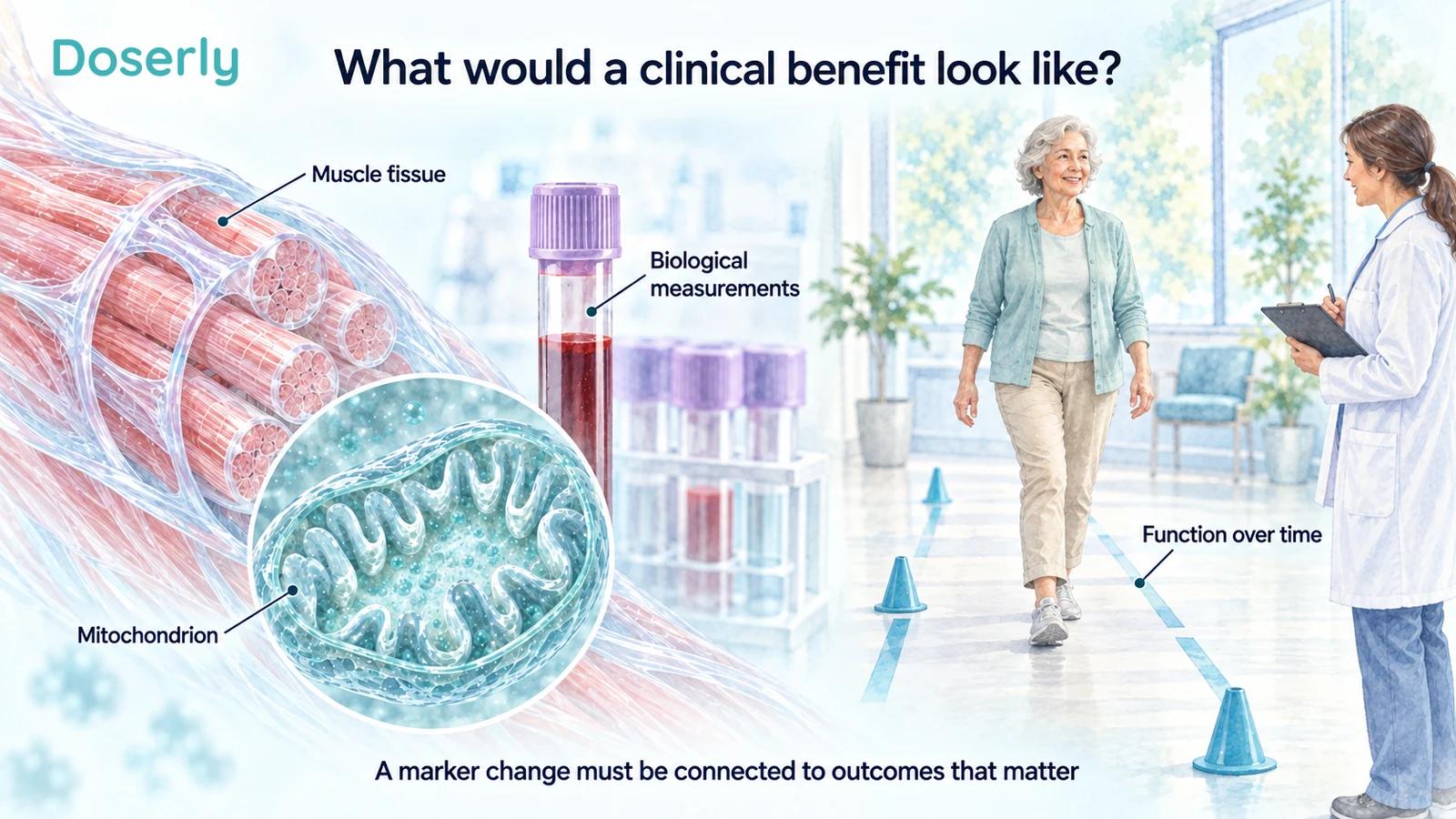
Biological measurements can help explain a result, while functional outcomes describe what changes for a person. The scene illustrates a possible assessment, not a demonstrated Humanin benefit.
Safety needs to match the duration of the promise
A longevity intervention is often imagined as repeated exposure over years. That makes long-term safety central to the claim, rather than a detail to address after a short-term biomarker result. The absence of an obvious immediate problem cannot establish that balance.
Humanin’s cell-survival effects raise a concrete example. Experimental triple-negative breast-cancer work reported tumor-supporting and chemotherapy-interference effects in its model. Other models have differed, but the adverse finding cannot be omitted from a broad safety narrative. Experimental breast-cancer study.
That result does not quantify cancer risk for a healthy person receiving Humanin. It identifies a question that development must investigate. A convincing program would look for unwanted effects in relevant tissues and settings, rather than measuring only the pathway expected to improve.
The standard should fit the intended population. People without a diagnosed condition may have little immediate benefit to balance against uncertainty. A narrowly defined treatment for a serious disease is a different decision. Evidence supporting one use would not automatically justify the other.
What would materially change the conclusion?
A completed, well-reported human study of an administered, clearly identified candidate would change the evidence base. Its contribution would depend on its design. A small early study could establish preliminary exposure and tolerability without establishing longevity. A later controlled study could test a defined clinical outcome without proving an effect on lifespan.
The most informative reports would specify the primary endpoint in advance, explain how missing data and discontinuations were handled, and present both favorable and unfavorable outcomes. Replication would matter, especially when many biomarkers or subgroups were explored. A result that survives independent testing is more useful than a collection of selected signals.
For a reader following the field, a few concrete details are therefore more informative than a dramatic headline: the exact candidate, the people enrolled, the intervention and control, the prespecified outcome, the duration, and the adverse-event findings. Those details reveal how far a new paper actually moves the claim.
Keep tracking separate from proving benefit
Recording symptoms, activity, medications and relevant clinical measurements can help organize a conversation with a clinician. It does not turn self-observation into a controlled longevity trial. If several things change together, a personal record usually cannot determine which caused an improvement or whether the change would have happened anyway.
Similarly, a laboratory result should not be assigned an “optimal Humanin” target from unrelated research cohorts. The current studies differ in methods and populations, and none of the registry records identified here establishes a Humanin replacement target for extending healthy life.
Humanin remains a worthwhile research hypothesis because its biology connects several areas of aging science. The clinical claim remains open because the decisive intervention evidence is missing. Progress means resolving that gap with specific, reproducible studies—not treating every new association as though the gap has already closed.
Sources
- Yen et al., 2020: multispecies lifespan and healthspan.
- Conte et al., 2019: human aging and mitokines.
- Yen et al., 2018: cognitive-aging genetics.
- Miller et al., 2024: P3S Humanin variant.
- Logan, 2024: P3S perspective.
- ClinicalTrials.gov cardiac record, transplant biomarker record, anesthesia record, exercise record.
- Chin et al., 2013: analogue pharmacokinetics.
- Moreno Ayala et al., 2020: experimental cancer tradeoff.