
Peptides
October 16, 2026
Thymosin alpha-1 and hepatitis: putting older trials in context
On this page
Thymosin alpha-1 has a longer clinical history in viral hepatitis than many readers realize. Researchers studied it as a way to modify immune responses against chronic infection, and a finished thymalfasin product, Zadaxin, has a hepatitis B indication in Singapore. That history deserves a careful explanation. It does not mean every positive result from an older trial answers today's treatment decisions. Singapore product record
The useful question is specific: what improved, in which patients, compared with what treatment, and for how long? Hepatitis research can report lower liver enzymes, less detectable virus, changes in viral antigens or improvements in a biopsy. These are different findings. A response that appears after treatment ends also needs to be distinguished from a response measured on the final treatment day.
For someone with hepatitis B or C, the stakes are practical. You want to know whether a proposed medicine adds value to the care available now, rather than whether it once produced an interesting laboratory result. We will look at several original trials and then place them beside current treatment guidance.
Begin with the infection and the liver
Hepatitis means inflammation of the liver. Hepatitis B virus and hepatitis C virus are different infections, despite sharing part of their names. A trial in one cannot establish efficacy in the other. The assessment also depends on whether infection is chronic and whether significant liver scarring has developed.
Blood tests are only one part of that assessment. Clinicians may use imaging, elastography, which estimates liver stiffness, and occasionally biopsy to understand the condition of the liver. Someone can have chronic infection without obvious symptoms, so feeling well is not enough to determine whether monitoring or treatment is needed. NIDDK hepatitis B information
Thymosin alpha-1 is an immune-modifying peptide rather than a general liver supplement. The relevant clinical question is whether a specified product changes the course of a defined viral illness. Our thymosin alpha-1 guide explains its broader biology and the distinction between the peptide name and finished medicinal products.
What do the measurements mean?
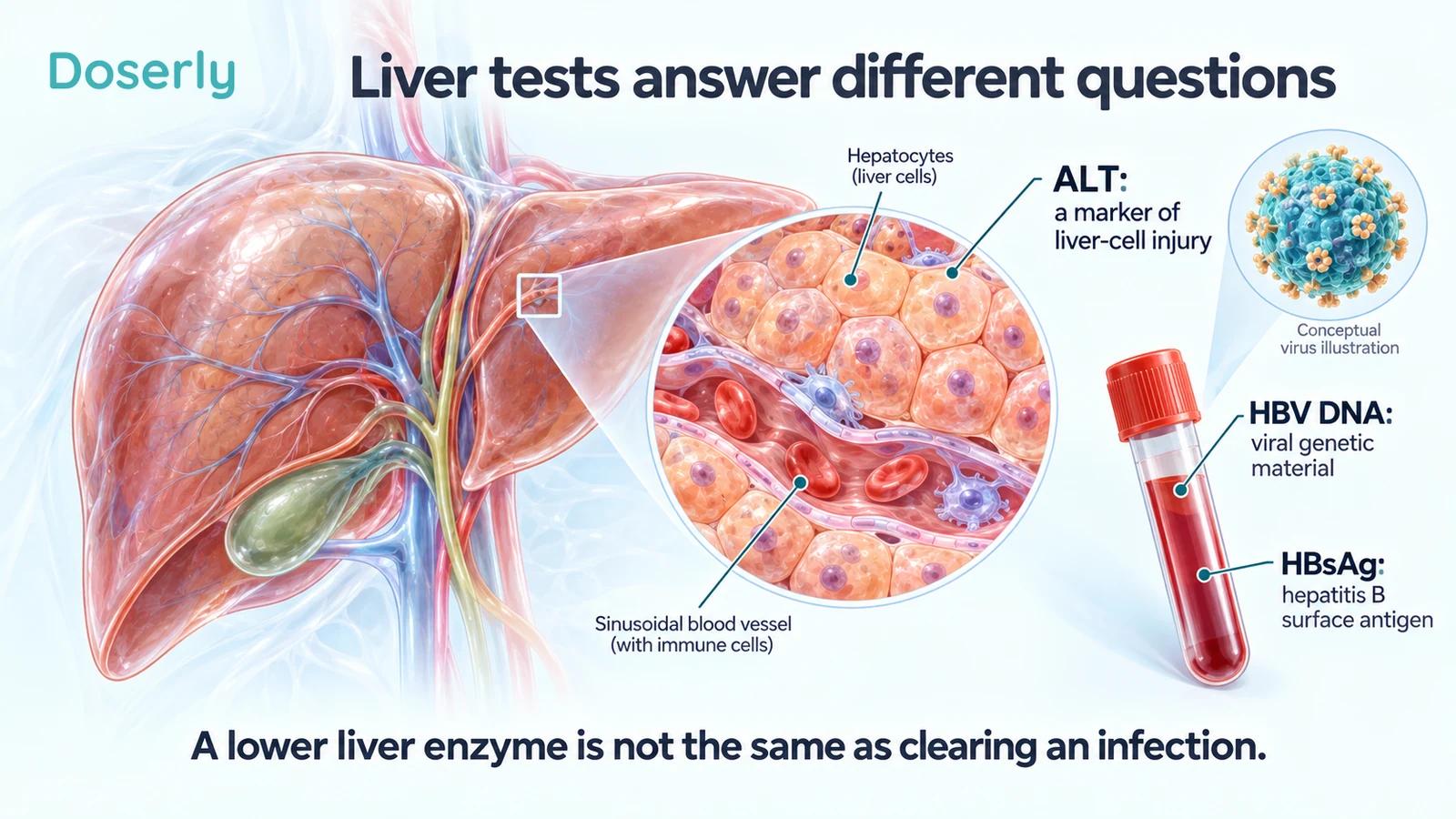
ALT, short for alanine aminotransferase, is an enzyme measured in blood that can reflect liver-cell injury. A lower ALT can be useful, but it is not itself a count of virus or a demonstration that scarring has disappeared.
HBV DNA measures hepatitis B viral genetic material. HBeAg, hepatitis B e antigen, and HBsAg, hepatitis B surface antigen, are different viral proteins. When a study defines response using loss of HBV DNA and HBeAg, that definition should not quietly be changed to loss of HBsAg or complete cure. The original trials below make these distinctions important.
Hepatitis C uses a different viral measurement, HCV RNA. Modern guidance assesses virologic cure by checking for undetectable HCV RNA at least 12 weeks after treatment finishes. That is different from a liver enzyme becoming normal during treatment. AASLD–IDSA HCV guidance
The 1998 hepatitis B trial: a response after treatment
Chien and colleagues randomized 98 patients with chronic hepatitis B to 26 weeks of thymosin alpha-1, 52 weeks of treatment, or no specific treatment. At 18 months after entry, complete virological response was reported in 40.6%, 26.5% and 9.4%, respectively. Response required clearance of serum HBV DNA and HBeAg. The 26-week comparison with control was statistically significant; the 52-week comparison was not. Original 1998 trial
At the end of treatment, response rates had been similar. Responses accumulated afterward, making follow-up timing central to the interpretation. None of the responders lost HBsAg. The report also described improvements in liver inflammatory histology, particularly scores excluding fibrosis; it did not establish that fibrosis had reversed.
This study is a reason that delayed response appears in discussions of thymosin alpha-1. It is not evidence that longer treatment is necessarily better, or that patients should stop a current antiviral and wait for an immune response. The study's untreated comparator and small groups are important limits when applying it to present-day care.
Consider how differently the result sounds if the timing is omitted. “Forty percent responded” could be interpreted as a prompt, dependable outcome after an injection course. The actual result refers to a selected group, a particular response definition and assessment many months after enrollment. Those details are the result, not optional qualifications to attach later.
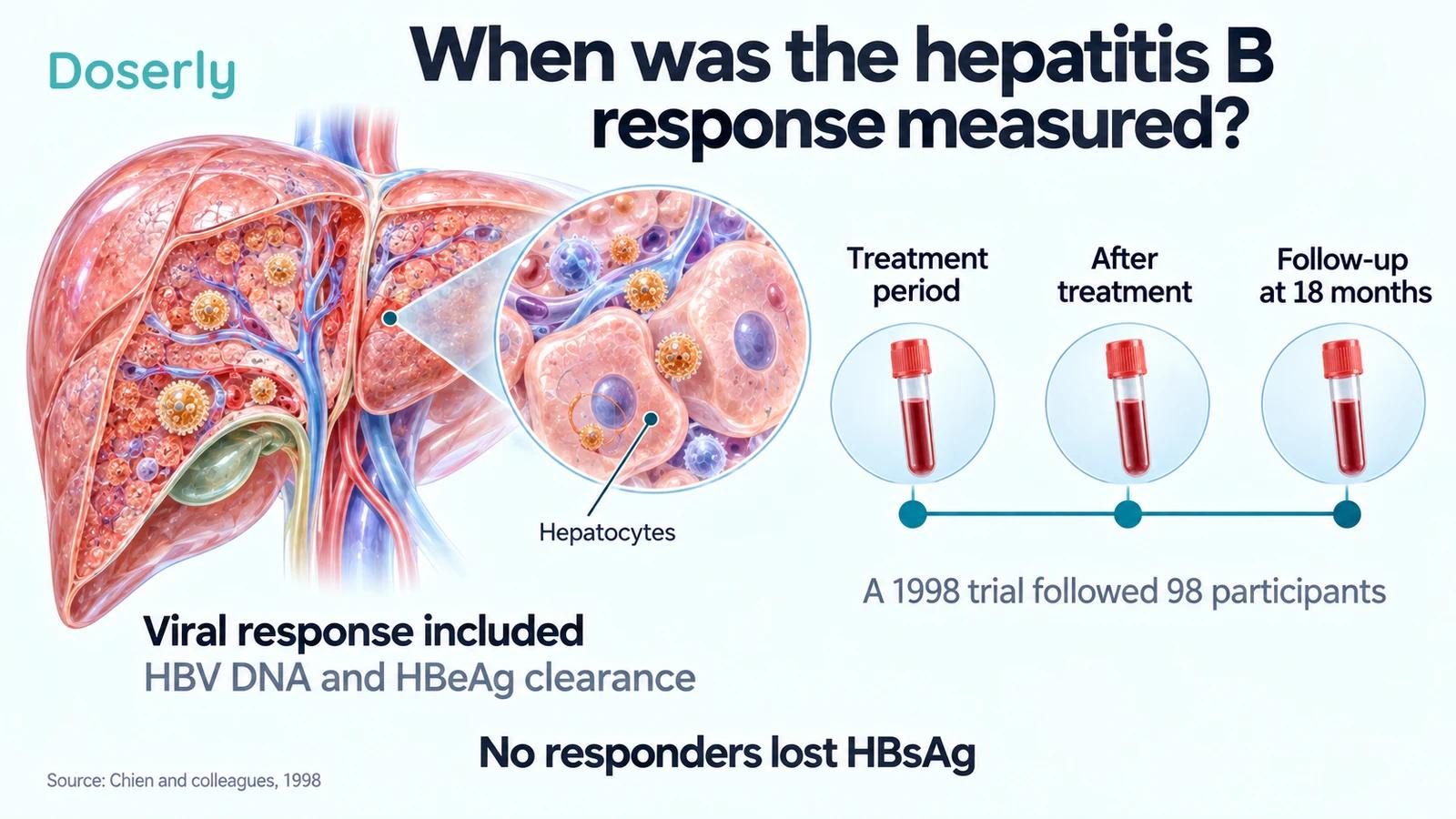
Image sources: Chien and colleagues
A blinded placebo-controlled study did not confirm the benefit
A 1999 multicentre trial studied 97 people with HBV DNA and HBeAg positivity. Forty-nine received thymosin alpha-1 and 48 received placebo for six months, followed by another six months of observation. Its complete-response definition required sustained HBV DNA negativity and negative HBV DNA and HBeAg at month 12. Mutchnick and colleagues
Complete response occurred in 7 treated participants, approximately 14%, and 2 placebo participants, approximately 4%. The difference did not meet the conventional significance threshold, with P=0.084. Additional delayed responders did not turn the overall findings into confirmation of efficacy; the authors explicitly concluded that their results did not confirm earlier observations.
It would be misleading to call this proof of no possible effect. The study was small and the estimate uncertain. It would be equally misleading to describe the numerical difference as an established treatment benefit. The uncertainty is relevant to a patient deciding whether to add another treatment, because an attractive percentage alone cannot show what they should expect.
A different hepatitis B population gives another perspective
Not all chronic hepatitis B patients have the same antigen pattern. A 2000 randomized study enrolled 44 people who were anti-HBe positive and HBV-DNA positive. It compared six months of thymosin alpha-1 with no treatment. Six months after therapy, the combined outcome of negative HBV DNA and normalized ALT occurred in 14% of treated patients and 4.5% of controls. Zavaglia and colleagues
The investigators did not conclude that thymosin alpha-1 increased the overall response rate. ALT changes suggested a possible effect on liver-cell injury, but none became HBsAg negative. This is a useful example of why a favorable change in one measurement should not be promoted into a broader claim about clearing chronic infection.
For a reader, this raises a concrete question about applicability: was the trial population selected for the same viral markers and liver condition as you? “People with hepatitis B” is a starting description, not a complete match. Prior treatment, antigen status and cirrhosis can change the question a clinician needs to answer.
What did the hepatitis C research show?
A 1998 double-blind randomized study assigned 109 people with chronic hepatitis C to thymosin alpha-1 plus interferon, interferon alone, or placebo for both agents. After 26 weeks, end-of-treatment biochemical response occurred in 37.1%, 16.2% and 2.7%, respectively. The comparison between combination treatment and interferon alone had P=0.04. Sherman and colleagues
The study also measured viral RNA and liver histology. Its reported cumulative sustained biochemical responses were 14.2% with the combination and 8.1% with interferon alone. Those figures concern sustained liver-enzyme response, not the modern HCV RNA-based definition of virologic cure.
This was meaningful investigation in the interferon era. It does not answer whether adding thymosin alpha-1 improves outcomes with today's direct-acting antivirals. It also does not establish that the peptide alone clears hepatitis C, because the active combination included interferon.
When interpreting a combination trial, the control is especially important. If both groups receive one medicine and only one receives the added peptide, the study estimates the added effect under those conditions. It does not describe the peptide's effect when used alone, with a different antiviral, or in someone whose infection has already been cured.
How today's treatment context changes the decision
WHO's current hepatitis B guideline recommends oral antivirals with a high barrier to resistance, particularly tenofovir disoproxil fumarate or entecavir, when treatment is indicated. The guideline also addresses selecting patients for therapy, monitoring and continued care. An older comparison against no specific treatment does not establish superiority to these regimens. WHO first-line treatment recommendations
For hepatitis C, AASLD–IDSA simplified guidance for eligible treatment-naive adults without cirrhosis uses oral direct-acting antiviral combinations. It includes assessment for cirrhosis, medication interactions and other infections before treatment, and confirmation of virologic cure afterward. That population-specific pathway is very different from an older interferon trial. Current HCV guidance
This does not make historical research worthless. It helps explain the compound's clinical development and possible immune effects. It changes the comparison needed to establish a useful role now. A contemporary trial would need appropriate current background care and a clear reason to expect an additional benefit.
There are several possible questions such a trial could ask: more durable viral control, a greater chance of a specifically defined antigen response, fewer clinical complications, or improved tolerability. These should not be collapsed into a general claim that a treatment “supports the liver.” Each requires its own outcome and enough follow-up to assess it.
What a product approval does—and does not—tell you
Singapore's Zadaxin record specifies a chronic hepatitis B indication. It supports the statement that a particular medicinal product has a clinical use in that jurisdiction. It does not make every online thymosin alpha-1 preparation equivalent, establish a hepatitis C indication everywhere, or replace local clinical guidance. Official product record
The product, its formulation and the clinical context belong together. A trial using a characterized medicine cannot verify the identity or quality of a separate research vial. Likewise, the existence of a regional indication does not answer whether adding treatment would benefit someone whose viral load is already controlled on another medicine.
For a patient already receiving care, the useful discussion is about the remaining clinical problem. Is the concern persistent viral replication, medication intolerance, fibrosis, or uncertainty about the diagnosis? An intervention should be judged against that problem, with a plan for monitoring it.
Questions to bring to a hepatitis consultation
Ask your clinician to explain which test is being used to judge response and why. A laboratory report may contain several unfamiliar abbreviations; understanding their roles makes a proposed treatment easier to assess. It also helps avoid interpreting one favorable number as evidence that all risks have resolved.
If thymosin alpha-1 is being considered, ask which original study most closely matches your infection, prior treatment and liver condition. Then ask what it would add to the recommended care you already receive. The answer should identify the intended benefit and how long it would take to evaluate, including what would count as treatment failure.
Keep a record of antiviral prescriptions, laboratory dates and results, and other medicines or supplements. Do not change a prescribed antiviral because an old trial reported responses after stopping a different treatment. The timing of an experimental study is not an instruction for managing your infection.
The hepatitis literature contains real human research, including positive findings and trials that did not confirm them. Its most useful lesson today is precise: distinguish the infection, the response definition, the follow-up period and the comparator before translating an older result into a current treatment claim.
Explore the research
- Chien and colleagues, 1998: 98-patient hepatitis B trial with responses assessed at 18 months.
- Mutchnick and colleagues, 1999: 97-patient blinded placebo-controlled hepatitis B trial.
- Zavaglia and colleagues, 2000: anti-HBe-positive hepatitis B population.
- Sherman and colleagues, 1998: interferon combination trial in hepatitis C.
- WHO hepatitis B first-line treatment recommendations, 2024.
- AASLD–IDSA simplified HCV treatment guidance.
- NIDDK hepatitis B information.
- Singapore Zadaxin product record.