
Peptides
October 16, 2026
What happens after tesamorelin stops?
On this page
A treatment result is easier to understand when the conversation includes what happens after treatment ends. With tesamorelin, that question is especially relevant: the pivotal program did not just measure visceral fat while participants were receiving the medicine. It also followed people who were switched to placebo after an initial treatment period.
The central finding was that visceral fat tended to reaccumulate after tesamorelin stopped. Continued treatment maintained more of the reduction, while discontinuation did not produce a demonstrated permanent reset. This does not mean every person follows an identical course or that all benefit vanishes on the same day. It does mean a short course should not be sold as a proven lasting solution. Long-term randomized extension, FDA medical review
For someone considering treatment for HIV-associated lipodystrophy, durability belongs in the first discussion alongside expected benefit, monitoring, cost, and the burden of ongoing injections. Doserly’s tesamorelin stopping guide covers the broader stopping context; the evidence below explains why that planning matters.
The extension phase tested continued exposure
The pivotal studies began with a 26-week comparison of tesamorelin and placebo. Participants who had received tesamorelin could then be assigned to continue it or switch to placebo for another 26 weeks. This design allowed researchers to ask whether the initial fat reduction persisted without ongoing treatment. Current prescribing information, clinical studies
That is more informative than looking only at the people who chose to keep taking a drug. If everyone who stopped had done so because of poor response or illness, their later outcomes would be difficult to compare with those who continued. Randomized reassignment helps address that problem, although the extension still represents a subset of the original participants rather than every person who started treatment.
The comparison also has a specific scope. It tested continued treatment versus withdrawal under the study conditions. It did not test every possible taper, intermittent schedule, substitute medication, or lifestyle maintenance program. A result from switching to placebo cannot establish that a particular commercial “cycle” preserves benefit.
What the continuation and stopping groups showed
The current label reports extension outcomes from weeks 26 to 52 separately for the two studies. In its model-based percentage-change analysis, visceral fat was approximately unchanged in the continuation group of one study and decreased about 5% in the other. The groups switched to placebo increased approximately 22% and 16%, respectively, from their week-26 values. These figures describe change during the extension, not change from the original untreated baseline. Label, Table 4
The FDA medical review provides another view of the trajectory. It describes visceral fat returning close to baseline by 13 weeks after discontinuation, the earliest post-discontinuation assessment in that analysis. This does not identify the exact day reaccumulation began, and it does not show that every participant had fully returned to baseline by that point. FDA review
These findings are consistent with the earlier extension publication, which reported that the visceral-fat effect was sustained with treatment through 52 weeks but did not persist after withdrawal. The evidence supports discussing ongoing treatment exposure; it does not establish an inevitable lifetime requirement for every person who tries the medicine. 2008 extension report
An individual may stop because the benefit is insufficient, adverse effects occur, circumstances change, or the ongoing burden outweighs the value. The trial tells us something about the likely durability of the tissue effect. It does not make the personal benefit-risk decision by itself.
Why the baseline changes the meaning of a percentage
Withdrawal results are easy to misread because they use a different starting point from the initial treatment phase. A reduction is usually described from the pretreatment value. Reaccumulation after stopping may be described from the lower value reached at the end of treatment.
For a simple arithmetic example, imagine a measurement falling from 200 to 170 units. That is a 15% reduction. If it later rises from 170 back to 200, the increase is about 17.6%, because the second percentage uses 170 as its denominator. The larger percentage does not mean the final value overshot the original starting point.
This example is not a trial result. It explains why a headline about a percentage increase after stopping needs to identify its baseline before calling the change a “rebound.” A return toward a prior level is different from evidence that treatment caused a worse-than-baseline state.
The label and the FDA review also use different statistical summaries in different tables. Model-adjusted percentage changes, raw average changes, and pooled results should not be combined into a single apparently exact trajectory. They can support the same broad conclusion while giving different numerical estimates because they answer slightly different analytical questions.
The studies measured a reversible tissue effect
Tesamorelin stimulates the growth-hormone pathway rather than surgically removing a fat compartment. Its clinical studies demonstrate changes in measured visceral adipose tissue during exposure. They do not demonstrate that the relevant fat cells have been permanently eliminated or that the underlying tendency toward abdominal fat accumulation has disappeared. Prescribing information
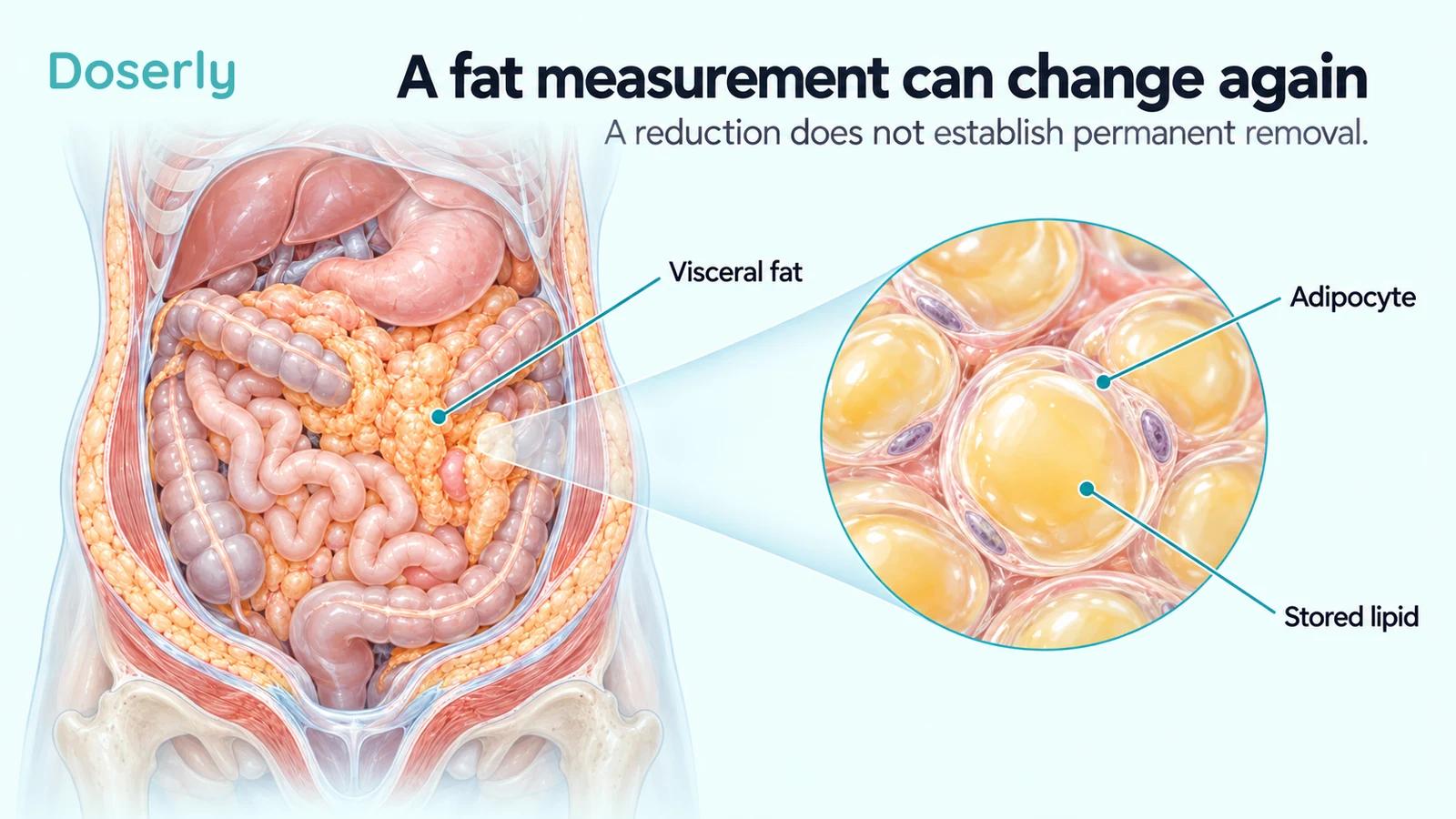
This is a useful distinction when interpreting words such as “reset,” “erase,” or “permanent.” A person can have a real benefit during treatment without the benefit being permanent afterward. Recognizing that does not make the treatment ineffective; it makes duration part of its effectiveness.
It also prevents a mistaken inference from drug clearance. The time a medicine remains measurable in blood is not the same as the time course of a tissue measurement after it is stopped. Hormone signaling, downstream responses, and body composition are different kinds of observations. The withdrawal studies are more relevant to durability than a calculation based only on the medicine’s half-life.
Fat reaccumulation is not a complete withdrawal syndrome
The extension evidence concerns outcomes such as visceral-fat area, hormone measurements, and metabolic parameters. It should not be expanded into an unsupported story about addiction, permanent endocrine shutdown, or a predictable syndrome of symptoms after stopping.
Equally, the absence of such a demonstrated syndrome in these results is not a reason to make treatment changes without the prescriber. A person may have other medications, endocrine conditions, or safety findings that need coordinated follow-up. The appropriate plan depends on the actual product, indication, and clinical situation.
The important distinction is between losing a treatment effect and proving a new disease caused by withdrawal. Reaccumulation toward baseline shows that the earlier reduction was not fully durable under those conditions. It does not, by itself, establish that the person’s body has become unable to regulate hormones normally or that a special replacement “stack” is required.
No maintenance protocol involving additional peptides can be derived from this extension comparison. To support such a protocol, a study would need to test the proposed approach, define the outcome, and follow participants long enough to assess both maintenance and safety.
A brief interruption is not the withdrawal experiment
The extension studies compared continued treatment with a sustained switch to placebo. They do not provide a precise forecast for a single missed injection, a short supply interruption, or an inconsistent pattern of use. Converting a 13-week assessment into a daily rate of fat regain would create a level of precision the research did not measure. FDA medical review
This distinction is useful when an interruption occurs for an ordinary reason such as travel or a prescription delay. The person needs instructions appropriate to their prescribed product and circumstances; they do not need an invented calculation about how much benefit disappeared each day. The withdrawal data can inform expectations about sustained discontinuation without supplying a catch-up schedule.
If access is repeatedly interrupted, that pattern belongs in the treatment review. It may affect how confidently a later response can be interpreted and whether the overall plan is practical. Recording the actual interruption dates is more useful than assuming exposure was continuous when comparing measurements months apart.
Continuing treatment has its own unanswered questions
The pooled trials provide evidence through a year of treatment, with substantial visceral-fat reductions among those continuing tesamorelin. That is meaningful follow-up, but it is not the same as many years of controlled evidence for clinical outcomes. Pooled phase 3 analysis
The current label states that long-term cardiovascular safety has not been established. It also calls for IGF-1 monitoring and assessment of glucose before treatment and periodically during treatment. Continuing because the fat measurement improved does not remove the need to reassess these other effects. Current label
A patient may reasonably value the benefit while finding injections, preparation, appointments, or costs difficult to sustain. Those are part of the treatment decision, not evidence of poor commitment. Planning for them early is more useful than discovering after several months that the proposed benefit depends on an arrangement the person cannot maintain.
The same applies to clinical response. If the outcome that mattered to the person has barely changed, continuing indefinitely simply because a hormone level rose may not make sense. Benefit should be assessed in relation to the treatment goal, alongside safety and burden.
Follow-up should connect the reason for stopping with the outcome
A stopping plan is most useful when it records why treatment ended. Stopping after a satisfactory response, stopping because there was little response, and stopping because of an adverse effect are different situations. The follow-up question changes accordingly.
If the concern is loss of abdominal-fat benefit, the clinician can discuss how to reassess the relevant clinical outcome. If the concern is elevated IGF-1 or worsening glucose, follow-up needs to address that safety finding. A single waist measurement cannot answer a laboratory question, and a normalized laboratory result does not establish that the original abdominal concern remains improved.
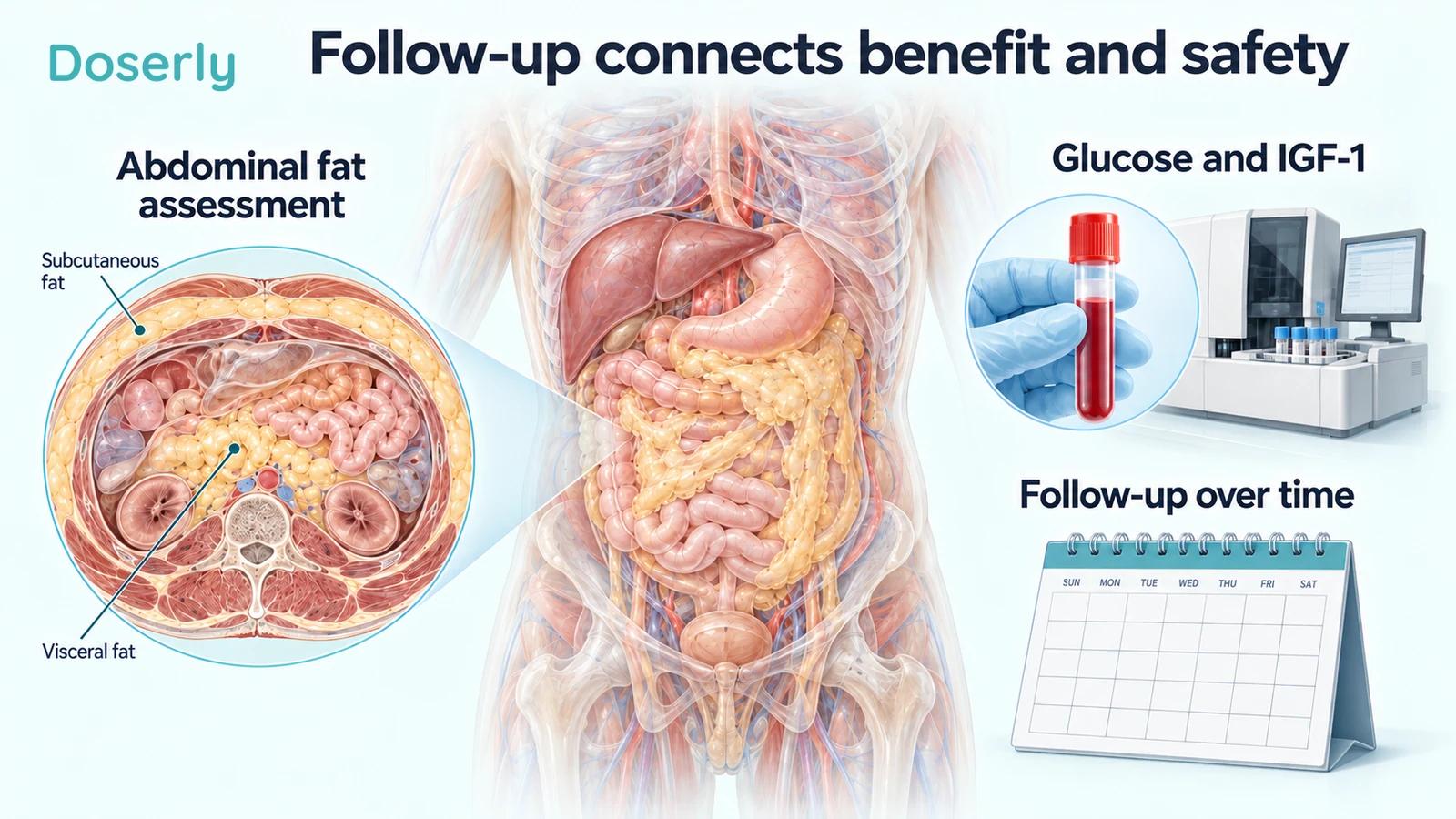
A simple record of treatment dates, the exact prescription product, relevant measurements, symptoms, and the reason for a change can help the clinical conversation. It is especially useful if several medications or lifestyle changes occurred around the same time. Without that context, a later change may be assigned to stopping tesamorelin when several explanations are possible.
Overall weight and HIV care remain separate priorities
Tesamorelin is not indicated for weight-loss management and is described as weight neutral. A stopping discussion about visceral fat should therefore not be treated as a complete plan for overall obesity or all metabolic risk. Those concerns may require their own assessment and care. Prescribing information
For people with HIV, the NIH guidance emphasizes ongoing effective antiretroviral treatment and says ART should not be interrupted or discontinued because of weight gain. It also recognizes the burden of daily tesamorelin injections and reversal of its effects after discontinuation. Maintaining viral suppression and addressing body-composition concerns belong in a coordinated plan. NIH guidance
Before treatment begins, a clear discussion should cover what would count as worthwhile benefit, how long it will take to judge, what monitoring is needed, and what happens if treatment stops. The withdrawal evidence makes that conversation more concrete: visceral-fat reduction commonly depends on continued exposure, and the available trials do not establish a permanent short-course result.
Sources
- Falutz and colleagues, 2008: long-term treatment and withdrawal findings.
- Pooled phase 3 efficacy and extension analysis.
- EGRIFTA WR prescribing information, including extension tables.
- FDA medical review of the original application.
- NIH guidance on weight gain in treated HIV.