
Peptides
October 16, 2026
What GHRP-6 combination trials really tell us about peptide stacks
On this page
A combination can make biological sense without having a demonstrated benefit. That distinction matters when a hospital trial involving GHRP-6 is used to support an entirely different “peptide stack” for recovery, longevity or performance.
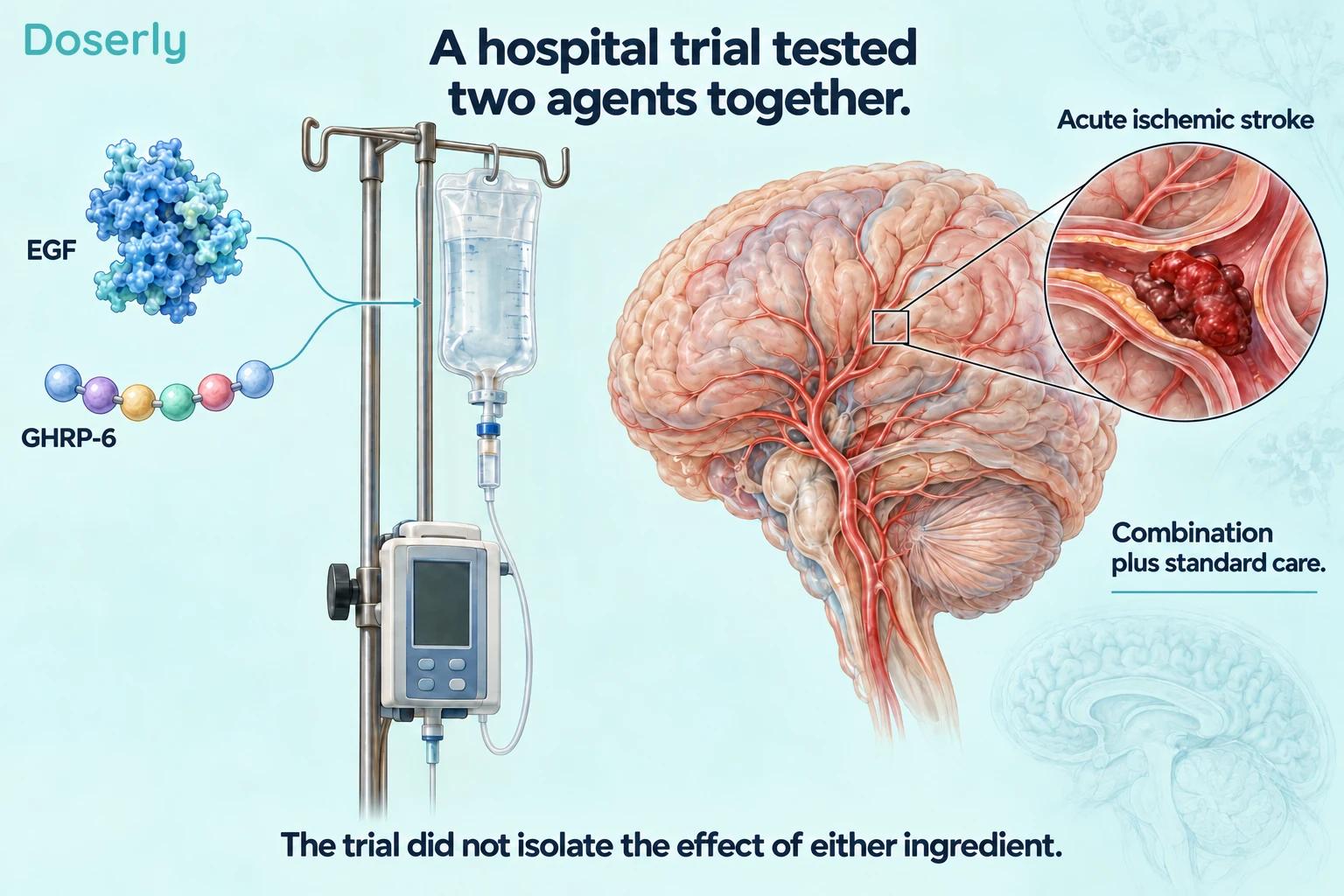
The human stroke program paired GHRP-6 with epidermal growth factor, usually shortened to EGF. Researchers studied a defined intravenous treatment in people with an acute ischemic stroke. They did not test a collection of interchangeable recovery peptides. The larger phase III trial also failed its primary efficacy endpoint in the overall population. Its existence establishes that a particular combination was investigated; it does not establish that combining peptides is generally beneficial. Phase III trial.
There is a useful question underneath the marketing: when two biologically active substances are given together, how do we know what either one contributed? The GHRP-6 research provides a concrete way to answer it.
The combination was built around a specific injury
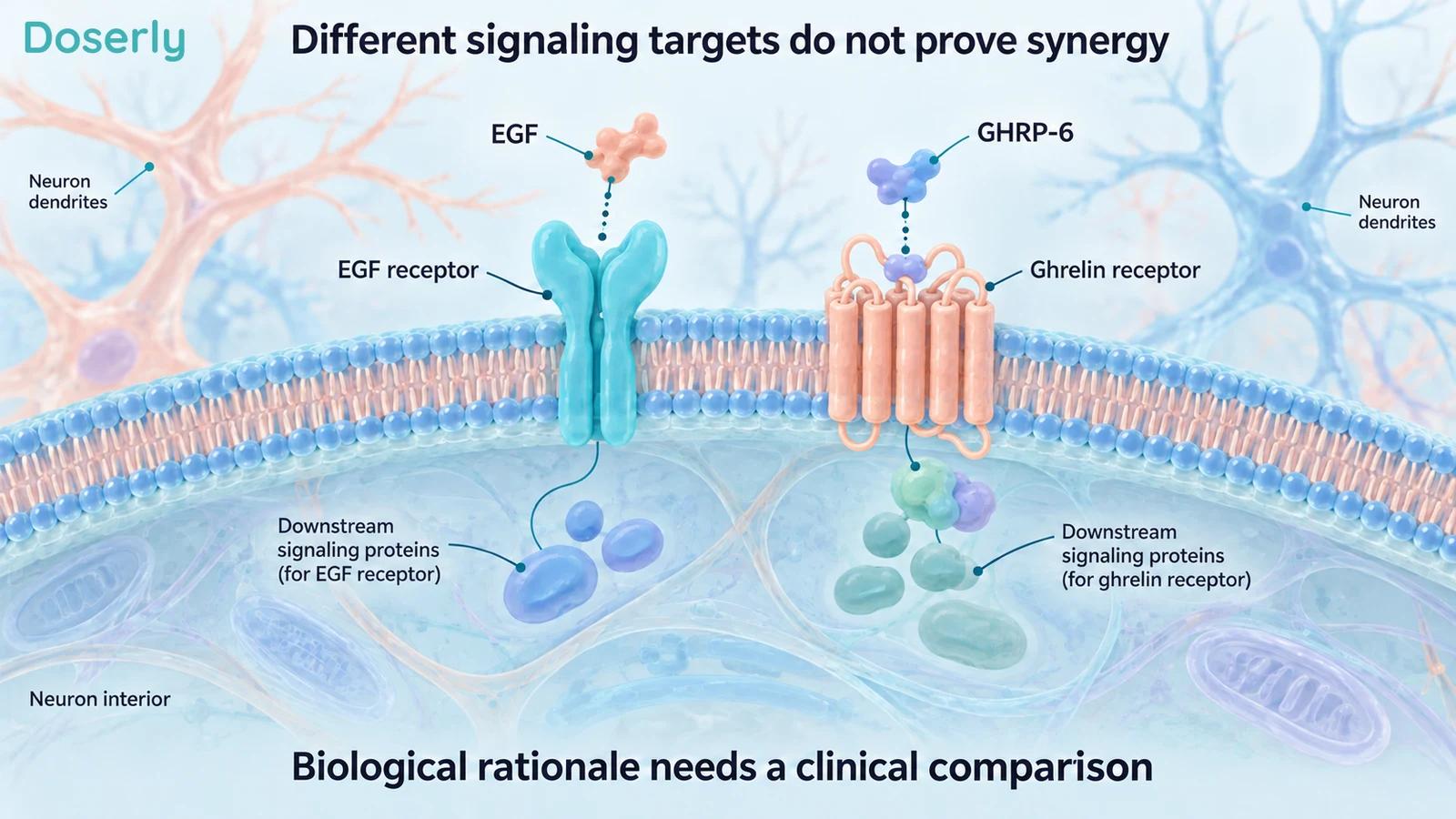
An ischemic stroke occurs when blood supply to part of the brain is interrupted. The experimental EGF–GHRP-6 combination was intended to address injury in that setting. EGF and GHRP-6 are different molecules with different biological targets, rather than two names for the same growth-hormone stimulus.
Before the human trials, a gerbil experiment compared treatment after a deliberately induced period of global brain ischemia. It examined EGF, GHRP-6 and their combination, reporting favorable findings for the combined treatment on neurological signs, tissue injury and neuronal preservation. Those comparisons gave the investigators a reason to explore the combination further. They remained animal results from an experimentally controlled injury, not proof of recovery in people. Gerbil ischemia experiment.
That distinction is particularly relevant to stacks. The rationale involved the identities of both ingredients, the injury being treated and when treatment was given. Removing EGF, replacing it with another peptide, moving treatment months after an injury or changing the route creates a different research question. A familiar ingredient does not make the new regimen equivalent.
What the human trials actually compared
The early phase I/II report enrolled 36 people. Treatment groups received the EGF–GHRP-6 combination alongside conventional care, while a control group received conventional care. Safety was the primary concern. The report also described a substantial allocation problem: six participants initially assigned to treatment were moved to the control group because treatment could not be started within the required window. That makes efficacy comparisons less secure than a clean randomized allocation would have been. Phase I/II report.
The later phase III trial included 188 participants, with 95 assigned to the combination and 93 to standard care. It was open-label, meaning treatment assignment was known. Participants had acute ischemic stroke and started within a specified early window; the combination was administered intravenously for seven days. The overall results did not demonstrate the intended improvement in disability, independence or survival. An exploratory severe-stroke subgroup produced a more favorable signal, but that subgroup did not turn the overall primary result into a successful trial. Phase III trial.
For the stacking question, the key design feature is simple: the human comparisons did not separately test EGF alone and GHRP-6 alone against the combination. Even a clearly positive overall result would therefore have left uncertainty about how much each ingredient contributed.
The negative overall result adds another limit. It is not reasonable to say that a successful GHRP-6 stack has already been demonstrated in humans and then use that claim to justify a different combination. The published trial does not supply that premise.
A combination effect and synergy are different claims
Suppose a trial compares treatment A plus treatment B against standard care. If the combination improves an outcome, several explanations remain possible: A supplied most of the effect; B supplied most of it; both contributed independently; or their interaction produced something different from either alone.
Synergy is the stronger claim that the combined effect exceeds what would be expected from the individual effects under a defined model. Showing that two substances act at different targets is insufficient. Showing that the combination differs from an untreated control is also insufficient when the individual-treatment comparisons are missing.
One way researchers can investigate contribution is a design containing four groups: neither experimental treatment, A alone, B alone and A plus B, with appropriate standard care in every group. This can help separate individual effects and interactions. It is not automatically the right or ethical design for every condition, and detecting an interaction may require more participants than detecting a main treatment effect.
FDA's guidance on developing two or more new investigational drugs together treats the contribution of the individual drugs as an important development question. That guidance has a specific regulatory scope; it is not a blanket rule covering every product sold as a stack. The underlying question is nevertheless exactly the one a reader should ask here: what evidence shows that both components are needed? FDA combination-development guidance.
Growth-hormone synergy does not answer the stroke question
There is another combination finding that can confuse this discussion. In an early human physiology study, GHRP-6 and growth-hormone-releasing hormone, or GHRH, produced a stronger growth-hormone response together than the investigators expected from the separate low-dose responses. That is evidence about an endocrine response under the study's conditions. Human GHRP-6/GHRH experiment.
EGF is not GHRH. EGF–GHRP-6 stroke research and GHRH–GHRP-6 hormone experiments therefore involve different combinations, different participants and different endpoints. Replacing one name with the other is not a minor shorthand error.
The endpoint matters as much as the ingredients. A larger growth-hormone pulse is a blood-test observation. A meaningful improvement after stroke concerns disability, daily functioning or survival. Evidence for the first does not supply evidence for the second, even if growth-related pathways feature in the biological explanation.
This is also why adding more hormone-active ingredients cannot be assumed to improve recovery. The desired outcome may not increase in proportion to a hormone measurement, and other effects may change at the same time. The Doserly GHRP-6 guide explains the compound's endocrine background; a proposed combination still needs evidence for its own purpose.
An IGF-1 rise cannot identify the useful ingredient
A small retrospective report provides another real-world example. Researchers reviewed men receiving testosterone therapy who also used a combination of GHRP-6, GHRP-2 and sermorelin. Only 14 of 105 reviewed patients met the study's inclusion criteria. Their IGF-1 concentrations increased during treatment. Retrospective combination report.
IGF-1 is a growth-related hormone often measured when studying the growth-hormone axis. A change can show that the regimen was associated with endocrine activity. It cannot tell us which of three peptides produced the change, how much testosterone treatment or other differences contributed, or whether participants became stronger or recovered from injury faster.
Because this was a selected chart review rather than a randomized comparison of individual ingredients, it also cannot establish that the three-peptide combination was better than one component. The number of ingredients is not evidence of added value.
For a person reading a clinic's claim, that leads to a practical distinction: “this regimen raised IGF-1 in a small report” and “each ingredient is necessary for a health benefit” are separate statements. The first does not verify the second.
Safety also belongs to the exact combination
When multiple active substances are started together, a new symptom is harder to attribute. It may relate to one ingredient, an interaction, another medication, the underlying illness or something unrelated. A report that no adverse event was judged treatment-related does not resolve all those possibilities, particularly in a small study.
The phase III stroke trial illustrates why the full safety comparison matters. Severe adverse events occurred in both groups, and the numerical frequency was higher in the combination group, although the reported comparison did not establish a statistically significant difference. Investigators did not attribute those events to treatment. Neither statement justifies describing every EGF–GHRP-6 regimen as proven safe, and neither proves the combination caused the observed events. Phase III safety results.
FDA separately identifies potential GHRP-6 concerns involving cortisol, insulin sensitivity, blood glucose and immunogenicity, alongside limited safety information. Those concerns are not erased by adding another peptide. Nor can safety findings from a monitored hospital formulation automatically characterize a product from a different manufacturer. FDA GHRP-6 safety entry.
A study evaluates more than an ingredient list. Product identity, purity, route, concentration, treatment duration and concomitant care are part of the exposure. Two labels with the same peptide names do not establish that the products or circumstances match. The guide's risk discussion helps separate the compound's pharmacology from these additional product questions.
What would make a proposed combination convincing?
Start with the clinical goal. “Recovery” could mean eating enough after illness, returning to work after stroke, healing a specific injury or regaining strength. Those goals require different participants and outcome measures. A hormone experiment cannot settle all of them.
Then look for a comparison that answers the decision you actually face. If the question is whether an additional ingredient helps, a study of the combination against no experimental treatment may be less informative than a study comparing the combination with the existing treatment alone. If the question is long-term function, a result measured minutes after administration is incomplete.
Finally, examine whether the treatment being offered matches the study. A route change, a substituted molecule or a different population can materially alter how relevant the findings are. Similar names and a shared receptor family are starting points for a hypothesis, not evidence that the same clinical result will follow.
These questions do not dismiss combination medicine. Many established treatments use more than one drug. They explain why those combinations need evidence about their particular use rather than a general assumption that complementary mechanisms must help. FDA combination-development framework.
What tracking can—and cannot—add
A medication and symptom record can make a clinical conversation more useful. Recording product names, start dates, concurrent treatments and new symptoms helps a clinician understand the sequence of events. Bring the complete list, including supplements and nonprescription products, because interactions can involve more than prescription medicines. FDA drug-interaction advice.
Tracking cannot create a missing comparison group. If sleep, training, diet and several compounds change together, an improvement cannot reliably be assigned to a particular ingredient. Repeated measurements may describe what happened; they do not establish that a stack was necessary or safe.
The strongest lesson from GHRP-6 combination research is specific. A hospital trial belongs to the exact treatment and clinical question it studied. For a different combination, the useful next step is to identify the missing comparison and the patient benefit that would need to be demonstrated—not to assume that adding ingredients carries the original evidence with it.
Explore the research
- Acute ischemic stroke phase III combination trial.
- Early human EGF–GHRP-6 stroke trial.
- Preclinical gerbil ischemia study.
- FDA guidance on codevelopment of investigational drugs.
- Human endocrine response to GHRP-6 and GHRH.
- Three-peptide combination and IGF-1 chart review.
- FDA GHRP-6 safety concerns.
- FDA drug-interaction advice.