
Peptides
October 16, 2026
What eloralintide needs to demonstrate beyond early weight loss
On this page
Eloralintide has already passed an important test: in a randomized phase 2 study, people receiving the investigational amylin receptor agonist lost substantially more weight than people receiving placebo. That is a meaningful result. It is also the beginning of the clinical story, because weight change alone cannot tell someone how a treatment might fit into years of care.
The next questions are more concrete than “does it work?” Does the benefit persist? How do people with type 2 diabetes respond? Can patients remain on treatment without symptoms disrupting daily life? What happens to body fat, strength and physical function? And which health improvements are actually measured, rather than assumed from a smaller number on the scale?
As of October 15, 2026, registered phase 3 studies are pursuing some of those questions. Their protocols describe a plan, not a completed answer. The useful way to follow eloralintide now is to distinguish what the human trials have demonstrated from what later studies are designed to establish. The Doserly eloralintide guide provides the broader mechanism and development background.
What the phase 2 result has already established
The 48-week phase 2 trial randomized 263 adults with obesity, or overweight with a weight-related condition, across six eloralintide schedules and placebo. Participants did not have type 2 diabetes. Average baseline BMI was 39.1, and the mean age was 49 years. These were adults selected for a particular obesity trial, not a representative sample of everyone interested in losing weight.
Under the publication’s efficacy estimand, mean weight reductions ranged from approximately 9% to 20% across active groups, compared with about 0.4% with placebo. The stronger results justify larger trials. They do not establish a universal expected response, a long-term maintenance strategy or the best choice among approved treatments. Phase 2 primary publication
An estimand defines the treatment effect a trial is trying to estimate, including how it handles events such as stopping medication. That matters when readers turn a study average into a forecast for everyday care. An estimate focused on the effect of the assigned regimen under specified assumptions and an estimate incorporating what happens after treatment discontinuation can answer different questions. Neither should be silently substituted for the other. ICH estimand guidance
The phase 2 result therefore supports a specific statement: eloralintide produced a substantial weight-loss signal in a selected population over 48 weeks. Broader claims need broader evidence.
Longer observation needs to address maintenance
A treatment can reduce weight during an initial study and still leave important maintenance questions unresolved. Researchers need to know whether weight stabilizes, whether the response varies over time, and how many participants continue treatment long enough to realize the benefit.
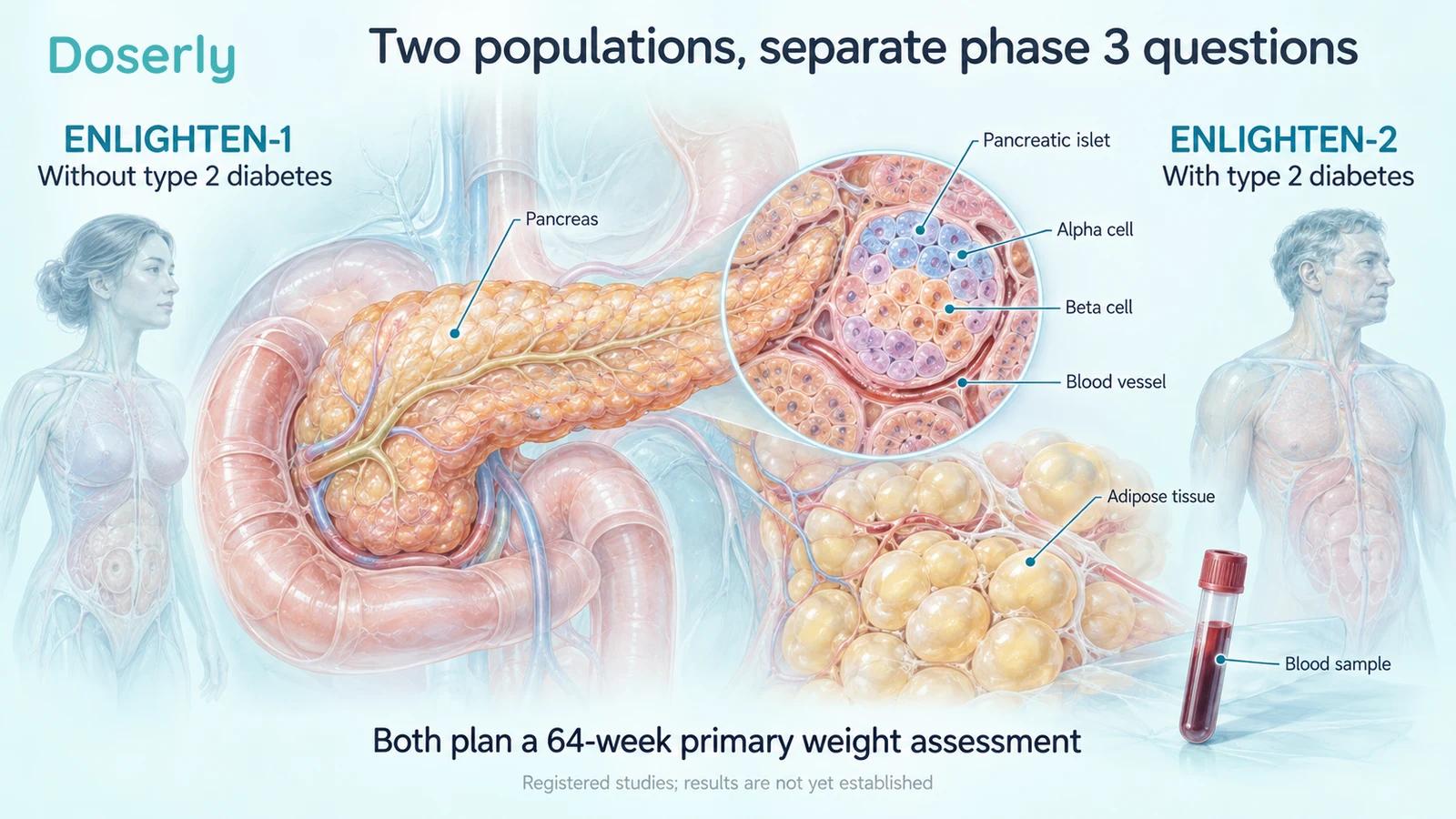
ENLIGHTEN-1, the registered phase 3 study in people without type 2 diabetes, plans a primary weight assessment at 64 weeks. Its registry also includes longer follow-up for participants with prediabetes, including weight and progression to type 2 diabetes. Those are valuable additions because they look beyond the shorter early-development window. They remain planned outcomes, with completion dates that may change. ENLIGHTEN-1 registry
Longer treatment follow-up does not automatically answer what happens after treatment stops. A withdrawal question requires information about who discontinued, when they discontinued, subsequent treatment, and how weight was measured afterward. Results from another weight-management medicine cannot supply an eloralintide-specific regain percentage.
Maintenance also has a practical meaning. A sustained average among people who remain under observation may conceal different individual paths: steady benefit, a plateau, interrupted treatment or poor tolerability. Participant-flow information and analyses of discontinuation help explain those paths. A single final percentage cannot carry that entire burden.
Diabetes deserves its own evidence
The phase 2 obesity population excluded type 2 diabetes. That makes it inappropriate to present its weight-loss average as an established expectation for someone with diabetes, especially someone already taking several glucose-lowering medicines.
ENLIGHTEN-2 is a separate phase 3 trial in adults with type 2 diabetes and obesity or overweight. It plans a 64-week primary weight assessment and includes HbA1c among its secondary outcomes. The distinction is purposeful: weight and glucose control are related clinical concerns, but they are not interchangeable measurements. ENLIGHTEN-2 registry
A person can have a meaningful weight change without reaching an individualized glucose target. Conversely, a change in HbA1c does not establish how much weight someone lost or how their physical function changed. The eventual report needs to describe both benefits and the medication background against which they occurred.
Eligibility still limits interpretation. ENLIGHTEN-2 requires specified stable diabetes treatment and excludes certain recent medications, including insulin and GLP-1, GIP or amylin therapies within the protocol’s stated window. A diabetes trial is not automatically evidence for every possible diabetes combination. The published population and actual concomitant treatments will matter when results become available.
Body fat, muscle and function are different outcomes
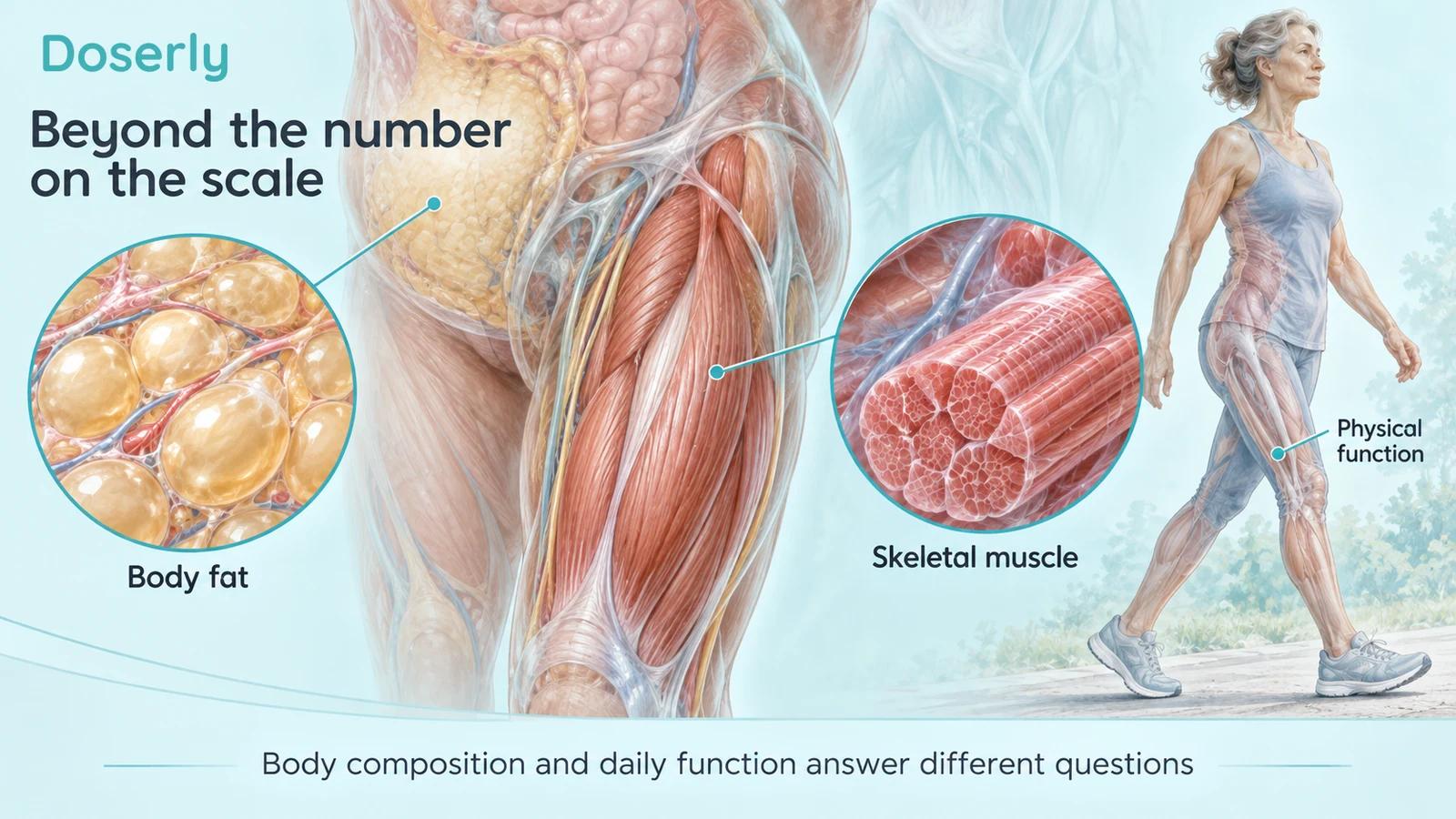
Weight is an aggregate measurement. A scale does not distinguish adipose tissue from lean tissue, and a lean-mass estimate is not a direct test of muscle strength. A complete clinical picture needs those concepts kept separate.
The ENLIGHTEN-1 registry includes change in total body fat and patient-reported physical-function measures among its outcomes. These can add useful information to the weight result. A reduction in total body fat, however, would not by itself prove that muscle was preserved. Nor would it establish that someone could climb stairs more easily, carry groceries or recover from exertion better. ENLIGHTEN-1 registry
Body-composition methods estimate tissue compartments. Function measures ask what a person can do or how they experience physical limitations. Both are useful, but each has its own measurement error, timing and interpretation. A favorable result in one domain should not be used as an unmeasured result in the other.
This distinction becomes particularly important when a headline says that a treatment produces “better-quality weight loss.” Readers need to know what that phrase refers to: measured fat mass, measured lean mass, an objective performance test or a questionnaire. Without that information, the phrase is more expansive than the evidence.
Animal body-composition findings may help explain why investigators examine these outcomes. They cannot establish muscle preservation in treated humans. The relevant evidence must come from the actual human population and the actual intervention being discussed.
Tolerability needs a longer and broader account
Early safety findings can identify issues worth following, but small studies are poorly suited to ruling out uncommon harms. Larger studies add participants; longer studies add time at risk. Both matter.
The phase 2 publication reported nausea and fatigue, with frequencies that differed considerably across treatment groups. These symptoms matter even when they are not categorized as serious adverse events. Repeated nausea can affect meals and daily routines; fatigue can affect how worthwhile a treatment feels to the person taking it. A benefit assessment should give those experiences room alongside the efficacy result. Phase 2 publication
The earlier 100-participant phase 1 study also reported changes in pulse and several mood-related events. Three participants in the highest-exposure cohort discontinued after mood-related events, which resolved during follow-up. These observations do not establish that eloralintide causes a particular psychiatric disorder, but they should not disappear from discussion simply because weight loss was encouraging. Phase 1 full report
Later reports should describe severity, duration, timing, reversibility and treatment discontinuation. They should also make clear how symptoms were collected and which people were excluded at enrollment. “No serious events observed” and “well tolerated by everyone” are different claims.
Dose escalation is part of that account. A schedule that changes exposure gradually may produce a different experience from a schedule that starts at a fixed dose. If a development program changes its schedules, readers should examine the results of the actual schedules studied rather than treat tolerability as a permanent property of the molecule.
Patient experience must be measured directly
A person may care about weight, but also about hunger, energy, physical limitations and the burden of treatment. These are legitimate outcomes. They need appropriate instruments and planned analyses if they are to support specific clinical claims.
ENLIGHTEN-1 lists measures including the Control of Eating Questionnaire and general health or physical-function questionnaires. Their inclusion shows that the development program is asking about more than kilograms. It does not yet show a clinically meaningful improvement in those domains. ENLIGHTEN-1 registry
The FDA’s patient-reported outcome guidance emphasizes that an instrument must measure the relevant concept in the intended population. A questionnaire score is most useful when readers understand what was asked, the recall period, how much change is meaningful, and how missing responses were handled. FDA patient-reported outcome guidance
For example, reduced hunger during a standardized test meal is not automatically the same as less intrusive food-related thinking throughout daily life. Improved reported physical function is not automatically improved muscle strength. A strong report names the construct precisely and avoids expanding it into a more appealing but unmeasured promise.
Risk factors are not clinical events
The ENLIGHTEN-1 registry includes measures such as systolic blood pressure, triglycerides, HbA1c and inflammatory markers. These can help describe metabolic changes during treatment. They cannot, on their own, establish fewer heart attacks, strokes or deaths.
That is a distinction between a risk-related measurement and an outcome that people directly experience. A cardiovascular event claim requires suitable event data, follow-up and analysis. It should not be inferred by combining several favorable laboratory changes.
The longer prediabetes follow-up is also a different question from a short-term HbA1c change. A planned assessment of progression to type 2 diabetes can address whether participants cross a diagnostic threshold over time. Until results are reported, it is a research objective rather than a demonstrated preventive benefit.
These boundaries do not diminish a favorable biomarker result. They make it possible to describe that result accurately, without borrowing certainty from a more consequential outcome that was not established.
The eventual comparison is a clinical one
Patients and clinicians will eventually need to understand how eloralintide compares with available options. A placebo-controlled trial can establish efficacy against placebo; it cannot independently rank treatments that were studied in different populations, at different times and under different analysis plans.
Useful comparisons will consider more than maximal average weight loss. Persistence, symptoms, glucose outcomes, physical function and the practical treatment burden may all influence the decision. Some of those questions require direct comparative trials; others will need careful interpretation of a larger evidence base.
There is already a newer comparative combination setting: Lilly's September 2026 disclosure describes eloralintide plus tirzepatide in adults with type 2 diabetes, with tirzepatide and other groups in the same study. That sponsor-reported result addresses a specific combination question. It does not settle how eloralintide monotherapy compares with every available treatment, or demonstrate the longer-term outcomes discussed here. Keeping the regimen and evidence type visible allows newer findings to inform the picture without being stretched beyond their design. Original combination disclosure
The next meaningful eloralintide milestone is therefore not simply a larger headline percentage. It is a more complete account of who benefits, how durable the benefit is, what people experience during treatment, and which health outcomes actually improve. The existing weight-loss signal provides a reason to pursue those answers. It does not substitute for them.
Sources
- Eloralintide phase 2 randomized trial
- Eloralintide phase 1 proof of concept
- ENLIGHTEN-1 registered protocol
- ENLIGHTEN-2 registered protocol
- FDA patient-reported outcome guidance
- ICH E9(R1) estimand guidance
- Lilly EloraTZP phase 2b disclosure, September 30, 2026 — original sponsor disclosure, not a peer-reviewed full report.