
Peptides
October 16, 2026
Petrelintide tolerability: what the trials actually show
On this page
Petrelintide is being developed to help people with overweight or obesity lose weight through amylin signalling, a system involved in the body's response to food. An important question is whether it can produce a useful change in appetite without making everyday eating unpleasant. For someone who has struggled with nausea on another medicine, that question can matter as much as the average weight result.
The early studies offered encouraging tolerability findings, but “well tolerated” needs a description. It can mean that most symptoms were mild, that few participants stopped treatment, or that investigators found no reason to halt development. Those statements aren't interchangeable. None means that everyone felt well or that long-term safety is settled.
There is also newer evidence to consider. A phase 2 petrelintide trial was published in September 2026, followed by sponsor-reported diabetes findings in October. The clearest account now combines the early results with those updates, keeping their populations and reporting limits visible.
What did the first studies set out to learn?
The first two randomized, blinded trials primarily examined safety and tolerability. They also measured how petrelintide entered and left the bloodstream and explored changes in body weight. One trial gave single doses; the other included six-week and sixteen-week repeated-dose portions.
Across the two trials, 133 participants were randomized and 132 were dosed. Only 48 were in the sixteen-week portion most relevant to sustained weight treatment. They were otherwise healthy adults with overweight or obesity, and approximately four in five were men. Investigators worked at one German research centre. Phase 1 report
This was an appropriate way to begin development. It also means that “the trials” shouldn't be imagined as hundreds of diverse patients receiving treatment for a year. Some people received only a single dose, and the longer repeated-dose groups were small.
Eligibility matters for safety. A selected research population may have fewer competing illnesses and medicines than people seen in routine obesity care. That doesn't invalidate the findings; it explains why later studies need to broaden the experience.
What did participants actually report?
In the sixteen-week portion, each petrelintide group contained 12 participants, with 12 in the pooled placebo group. Nausea affected two people in one active group and four people in each of the other two, compared with two receiving placebo. Those counts become 16.7%–33.3% versus 16.7%.
Most reported adverse events were mild. No serious or severe treatment-emergent events were reported in these phase 1 trials, and one participant discontinued because of gastrointestinal symptoms. The publication describes vomiting in the sixteen-week portion only in that participant. These observations support further study; they don't establish the absence of serious risks in larger populations. Phase 1 safety findings
The difference between counts and percentages is especially useful here. In a group of 12, one additional person changes a proportion by about eight percentage points. A rate of one third can sound very precise while representing just four people.
The placebo group also reported symptoms. People can experience nausea, headache or other illnesses during a trial for reasons unrelated to its active drug. Recording events in both groups helps investigators distinguish a treatment pattern from the background experience of participating in a study.
Does feeling full count as a side effect?
Reduced appetite and nausea can both reduce food intake, but they are different experiences. Someone may comfortably stop a meal earlier because they feel satisfied. Another person may want to eat but find the thought of food unpleasant because they feel sick.
Trials can record decreased appetite as an adverse event even when appetite change is part of the intended pharmacology. That doesn't make it equivalent to nausea, and it doesn't tell us whether food intake remains nutritionally adequate. The phase 1 report recorded appetite-related experiences separately from gastrointestinal symptoms. Phase 1 publication
For readers, the practical distinction is between a manageable change in eating and a symptom that disrupts daily life. Future treatment experience should describe both. A falling weight alone cannot show whether a participant was comfortably eating smaller meals or struggling to tolerate food.

What does “mild” mean for the person experiencing it?
Symptom severity describes intensity. Seriousness has a different clinical and regulatory meaning, involving outcomes such as hospitalization, a life-threatening event or significant disability. An event can be unpleasant without meeting the definition of serious. FDA explanation of serious adverse events
A mild symptom can still matter when it happens repeatedly. Mild nausea before several meals may influence work, social eating or willingness to continue. Conversely, one brief episode may have little practical effect. A report that states the percentage of participants affected doesn't necessarily describe those differences.
This is why timing, duration and recurrence add value. Was the symptom limited to an escalation period? Did it return after each administration? Did it require other treatment, delay escalation or lead to stopping? These questions turn a severity label into a more useful account of daily experience.
Researchers also need to distinguish the number of people affected from the number of episodes. One person with ten episodes and ten people with one episode represent different patterns. A participant-level percentage alone cannot separate them.
What did the larger ZUPREME-1 trial add?
ZUPREME-1 randomized 493 adults without type 2 diabetes, and 485 received at least one dose. It studied several weekly maintenance doses over 42 weeks, with weight change at week 28 as the primary endpoint. The publication provides a more informative safety comparison than the early cohorts.
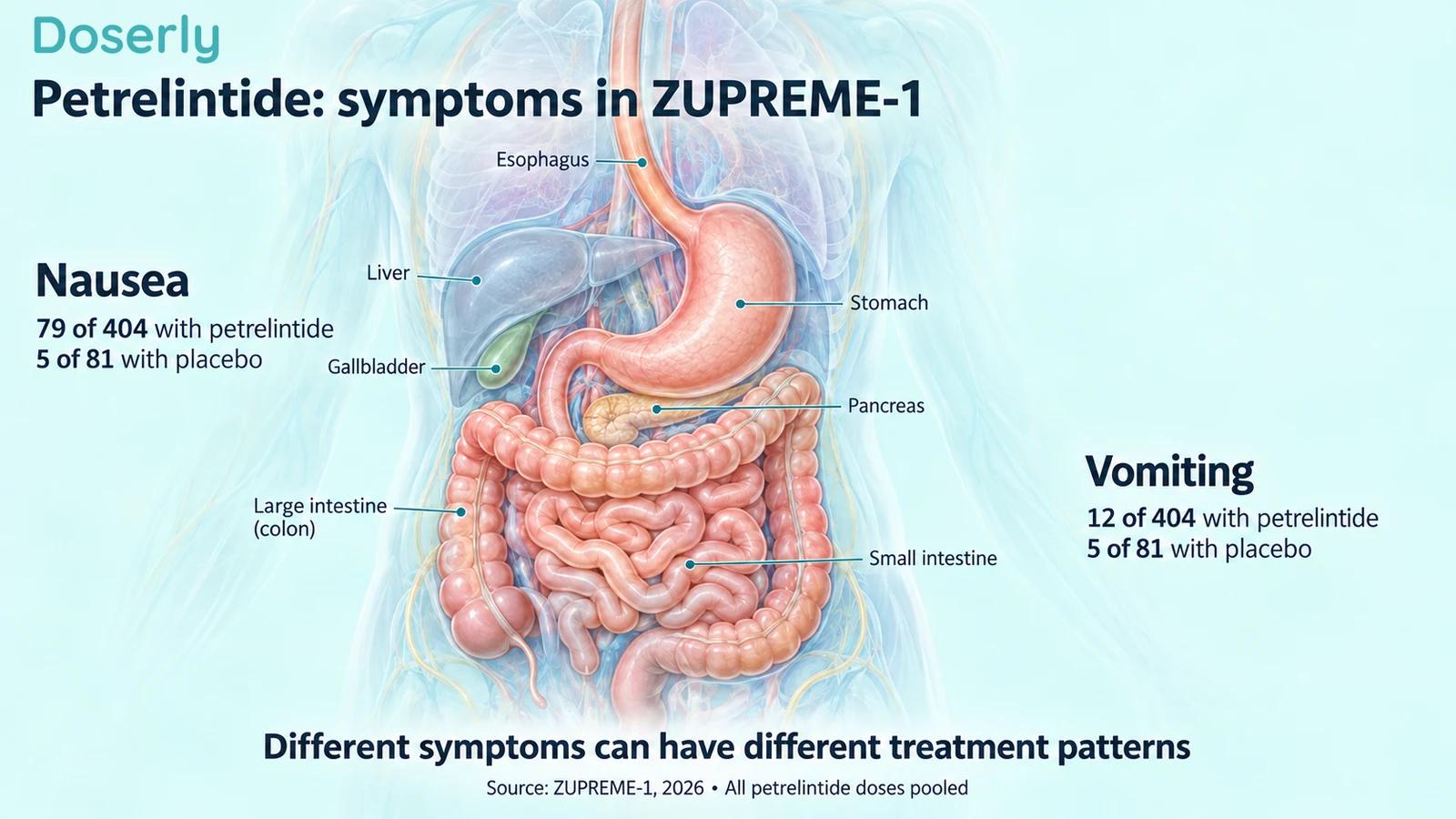
Across all petrelintide doses, nausea occurred in 79 of 404 participants, approximately 20%, compared with five of 81, approximately 6%, receiving placebo. Vomiting occurred in 12 of 404, approximately 3%, versus five of 81, approximately 6%. Diarrhea was reported in about 7% of both groups. ZUPREME-1 primary publication
These findings should be described symptom by symptom. Nausea was more common with petrelintide; vomiting was uncommon. A blanket statement that all gastrointestinal tolerability was the same as placebo would erase the nausea difference.
Pooling all active doses also has a purpose and a limitation. It describes the overall active-treatment experience, but it isn't the rate for one particular maintenance dose. A headline about a selected dose group cannot be substituted for the pooled result without saying which group is being discussed.
How should we interpret serious events?
The absence of serious events in small phase 1 trials must not be carried forward as a statement about the whole development program. Larger studies create more opportunities to observe uncommon problems, and longer exposure can reveal a different pattern.
The primary supplementary table reports serious adverse events in 14 of 404 petrelintide participants (3.5%), with 15 events in total, and three of 81 placebo participants (3.7%), with three events. Among the active-treatment events were two cases of cholelithiasis, or gallstones, and one case of obstructive pancreatitis. ZUPREME-1 appendix, Table S10
These pooled proportions do not establish equivalent safety. The counts are small, the events differ, and an event occurring during treatment is not by itself proof of causation. Detailed clinical assessment and larger studies are needed to determine which patterns are reproducible.
The appendix also gives a practical view of symptom management: six of 404 petrelintide participants permanently stopped treatment because of gastrointestinal events, compared with none of 81 receiving placebo. Nine active-treatment participants had a dose reduction because of gastrointestinal events, and one had an escalation delay; these categories can overlap. These findings show why low discontinuation and absence of symptoms are different claims. Appendix Tables S7–S8
This is one reason safety and tolerability should be discussed together but kept distinct. Low vomiting frequency may improve everyday acceptability while leaving separate questions about uncommon serious outcomes.
Does slower escalation explain the tolerability pattern?
The sixteen-week phase 1 portion generally escalated doses every two weeks. ZUPREME-1 used four-week escalation steps. Roche's earlier phase 2 announcement suggested that most nausea was mild and concentrated during escalation. Roche phase 2 announcement
A slower increase is a plausible contributor to tolerability, but these trials didn't randomly assign the same population to two different escalation speeds. Their participants, doses, follow-up and study settings also differed. Comparing them cannot isolate the effect of escalation alone.
Petrelintide's long persistence makes this particularly relevant: exposure after repeated administration isn't captured by the nominal dose on a single day. A tolerability result belongs to the studied schedule, including its monitoring and rules for responding to symptoms.
It therefore doesn't support designing a faster personal schedule or assuming that an even slower one is proven safer. Those are different interventions that would need appropriate clinical evaluation.
What do the October diabetes findings tell us?
ZUPREME-2 studied people with type 2 diabetes and overweight or obesity. The October 7 announcement reported gastrointestinal-event discontinuation in 1.9% of petrelintide participants versus 1.7% with placebo. Participants were on metformin, with or without an SGLT2 inhibitor.
That adds experience in a population excluded from ZUPREME-1, but it is still a topline company report. The complete results are needed to examine individual symptoms, serious events, doses and background medicines. It shouldn't be described as proof that every person with diabetes will tolerate petrelintide well. ZUPREME-2 announcement
A discontinuation rate also answers a narrower question than a symptom rate. People may continue despite symptoms or stop for reasons unrelated to side effects. Knowing both helps explain treatment persistence.
Can petrelintide be called easier to tolerate than GLP-1 medicines?
The trials discussed here compared petrelintide with placebo. They didn't directly randomize participants between petrelintide and semaglutide, tirzepatide or another active treatment. A superiority claim would need more than placing percentages from unrelated studies next to one another.
Different studies can use different escalation rules, patient populations, symptom collection methods and treatment durations. A person who volunteers for an early research study may also receive more support than someone managing a prescription in everyday care.
A useful future comparison would examine not only nausea frequency but how long it lasts, whether participants can maintain nutrition, and why they stop treatment. For someone whose previous medicine caused persistent vomiting, those details are more useful than a broad ranking of drug classes.
What should a reader take into a clinical conversation?
Start with the experience you want to avoid or improve. Was a previous problem nausea, vomiting, constipation, difficulty eating or something else? Those symptoms shouldn't be treated as one category simply because they involve digestion.
Then ask how closely the supporting study matches your health and treatment history. A trial in otherwise healthy adults doesn't answer the same question as a trial in people with several chronic conditions and multiple medicines. If a proposed treatment remains investigational, the study setting and monitoring arrangements are part of the discussion.
Petrelintide's research offers reasons for continued interest, including low vomiting rates in the larger published trial. It also shows a clear nausea signal and leaves longer-term and uncommon risks to be characterized. Our petrelintide guide explains the broader development program; tolerability is one part of deciding what future results would mean for care.
Sources
- Petrelintide phase 1 trials.
- ZUPREME-1 primary phase 2 publication.
- Roche March 2026 announcement.
- ZUPREME-2 October topline findings.
- FDA serious-event definition.
- ZUPREME-1 primary appendix.