
Peptides
October 16, 2026
What counts as a pet peptide study? Reading veterinary evidence without borrowing from rats
On this page
When a treatment is described as “studied in animals,” a pet owner needs one more sentence: which animals, with what condition, receiving what treatment? A rat experiment, a study in healthy research cats, and a trial involving dogs living with a diagnosed illness can all be animal research. They answer different questions.
Peptides are a broad group of molecules, not a single treatment category with one level of evidence. Some peptide medicines have specific clinical uses. Other compounds have only laboratory findings. The useful question is whether the evidence supports the particular product and purpose being discussed for your pet.
Feline studies of exenatide, a glucagon-like peptide-1 receptor agonist, provide a helpful example. They include early pharmacology work, a pilot in newly diagnosed diabetic cats, and a later trial in cats already in remission. Looking at those studies separately shows how veterinary evidence develops—and why a promising result should keep its original context.
A study in cats can still be the wrong study for your cat
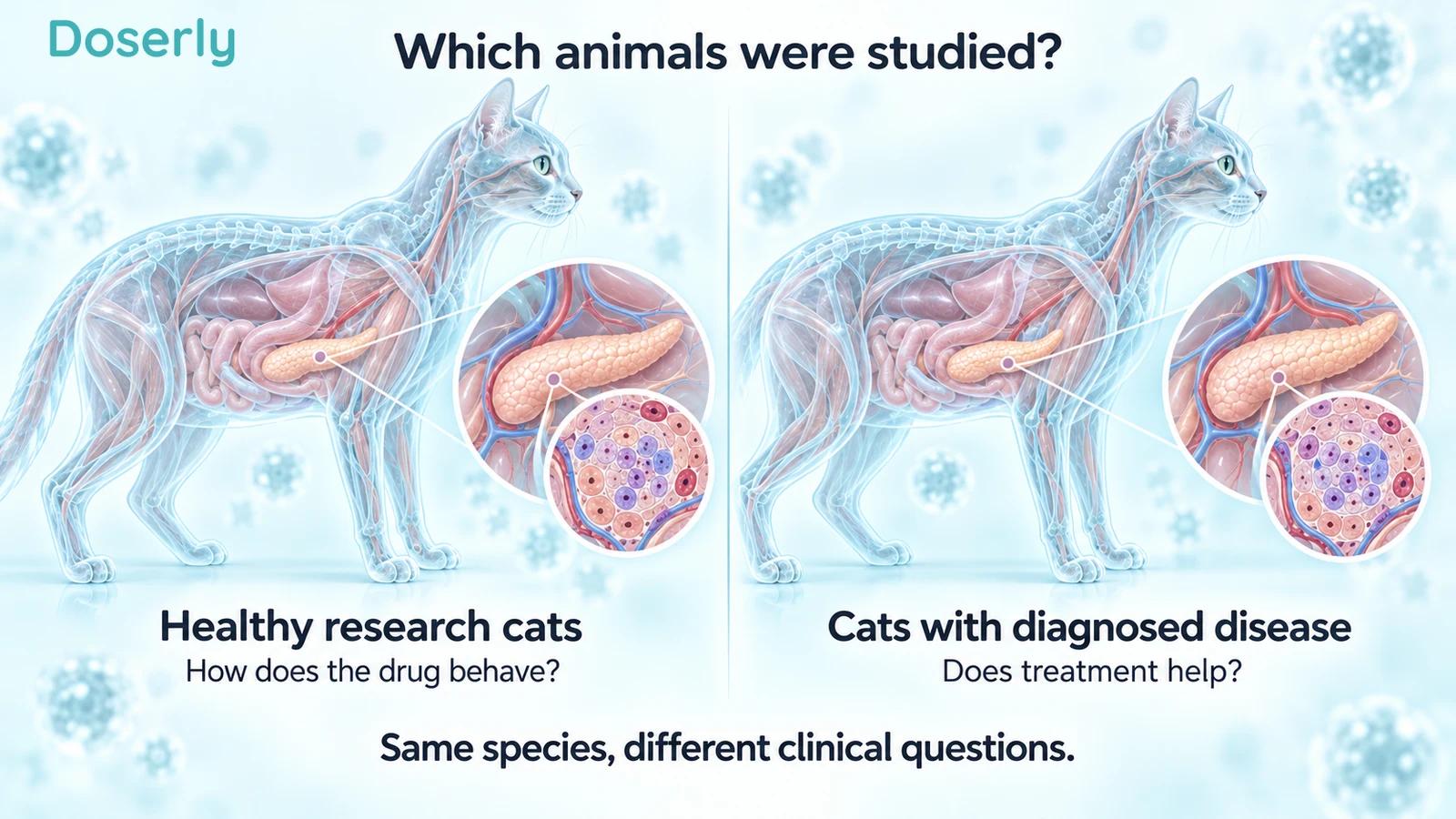
Species is the first filter, but it is not the last. A healthy young research cat does not have the same clinical circumstances as an older pet with diabetes and other conditions. A carefully controlled experiment may be excellent for measuring drug exposure while leaving everyday treatment questions unanswered.
One exenatide extended-release pharmacology study involved six healthy cats. Its purpose was to examine the behaviour of the drug in that species. That is useful groundwork, but the animals were not a group of diabetic pets whose remission or long-term wellbeing was being tested. Healthy-cat pharmacology study
The phrase client-owned means animals living with owners and enrolled through veterinary care. Such a study can be more directly relevant to clinical practice, but that label does not automatically make every conclusion reliable. The diagnosis, comparison, sample size, outcome definitions, and follow-up still matter.
For example, a trial in cats with newly diagnosed diabetes may not answer what to do for a cat with longstanding disease. A trial in remission asks a different question again. The closer the study population is to the animal's actual situation, the fewer assumptions are needed to interpret the result.
Why exenatide interested veterinary researchers
Exenatide acts on the GLP-1 receptor, part of a signaling system involved in glucose regulation. Its extended-release formulation is designed to release the medicine over time. A shared biological pathway can make a veterinary study worth pursuing, but it cannot determine the result in advance.
That distinction is particularly important when a familiar human medicine attracts attention. Human experience can suggest mechanisms and questions. It does not establish the correct feline formulation, exposure, benefit, or adverse-effect frequency.
Nor should results for one GLP-1 medicine be reassigned to another solely because both belong to the same class. Exenatide and semaglutide are distinct medicines. Our semaglutide guide discusses human research; it should be read as human-treatment background, not as a dosing or treatment guide for pets.
The veterinary evidence below concerns the medicine and animals actually studied. It does not justify giving an owner’s prescription to a cat or substituting a research-peptide product for a veterinarian's plan.
The 30-cat pilot: an add-on question
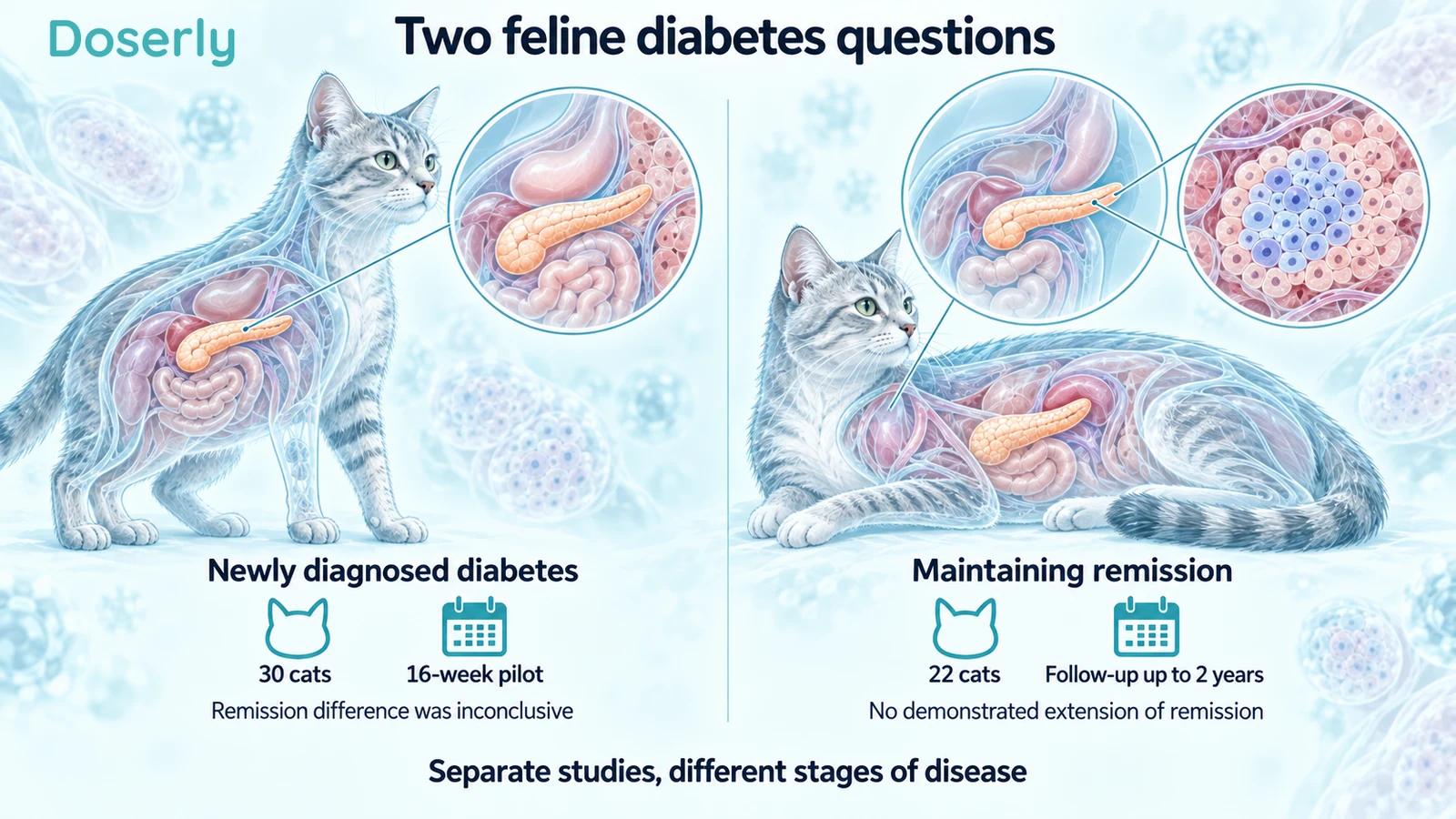
A study published in 2016 enrolled 30 client-owned cats with newly diagnosed diabetes mellitus. It compared exenatide extended release with saline placebo. Both groups also received insulin glargine and a low-carbohydrate diet, so the question was whether adding exenatide improved care already being provided.
Treatment lasted up to 16 weeks, with a specific continuation period for cats entering remission. Reported remission proportions were 40% with exenatide and 20% with placebo, but the difference was not statistically significant (P=.427). The corresponding comparison for good metabolic control was also inconclusive. Decreased appetite and vomiting were reported in both groups. Riederer and colleagues
This was a pilot: a small study that can help estimate effects and plan further research. The numerical difference does not prove that exenatide doubled a cat's chance of remission. The uncertainty is too large for that conclusion.
It is equally inaccurate to call the result proof that exenatide has no effect. An inconclusive pilot leaves questions open. Its contribution is a specific, measured comparison in diabetic pets, with limitations that need to travel with the percentages.
Background care is part of the result
The insulin and diet in that pilot are not minor details. If a summary says only “cats improved on exenatide,” it leaves out treatments that could contribute substantially to improvement in both groups.
An add-on trial asks about the incremental effect of adding the experimental treatment to a shared care plan. It does not show what would happen if the experimental medicine replaced that plan. This is why a cat owner should not infer that an insulin-treated study supports stopping insulin.
The same principle applies beyond diabetes. If a dog receives rehabilitation, pain management, and an experimental intervention together, the report needs to explain what the comparison group received. Otherwise, it is difficult to know which part of care produced the difference.
A useful account of veterinary evidence therefore includes the full treatment context. The headline medicine may be the newest part of the study, but it is not necessarily the only active part.
The 2025 trial asked about staying in remission
A later placebo-controlled, single-blinded trial enrolled 22 client-owned cats with recent diabetic remission. Twelve were assigned exenatide extended release and ten placebo. Follow-up continued for up to two years or until relapse, with low-carbohydrate feeding and active weight management.
The study did not show a difference in remission duration (P=.9). Thirteen cats completed two years without relapse; nine left earlier, with three relapses among those departures. A blood marker of longer-term glucose control showed a treatment-related finding, but that did not translate into a demonstrated extension of remission. Gilor and colleagues, 2025
This trial belongs beside the earlier pilot, not inside it. The cats started at a different stage of disease, the treatment schedule and follow-up differed, and the central question was maintenance rather than achieving initial remission.
A reader who sees only the older favourable percentages may miss this later clinical result. A reader who sees only the newer null result may also miss that the earlier question was different. Good interpretation preserves both.
A laboratory measurement is not the same as a pet benefit
A medicine can change a biological measurement without producing the outcome an owner most wants. In feline diabetes, glucose-related measurements may help describe control, while remission duration describes how long the cat remains in a particular clinical state.
The measurements are related, but they are not interchangeable. The later exenatide study is a useful example because its findings differed depending on which outcome was considered.
For other conditions, the same distinction might involve a blood inflammation marker versus comfortable walking, or tissue measurements versus a return to normal activity. A study that measures the first cannot simply rename it as the second.
Owners can ask what the researchers counted as success. Was it a laboratory value, a veterinarian's examination, an owner-reported change, a reduction in another medicine, or a durable clinical outcome? The answer makes a treatment claim more concrete and easier to discuss.
Why the diagnosis and baseline state matter
A study's eligibility criteria tell you what problem researchers were actually treating. They also help identify which animals were not represented.
AAHA's feline diabetes guidance emphasizes a complete history, examination, body and muscle condition assessment, and appropriate blood and urine evaluation. It also notes that stress can complicate the interpretation of a high glucose result in a cat. AAHA feline diabetes recognition guidance
That diagnostic context matters when reading research. A change in a healthy animal's blood sample is not equivalent to control of established diabetes. Likewise, an overweight cat without diabetes is not interchangeable with one that has recently entered remission.
Ask whether the study's animals resemble your pet in the features that matter for the treatment question. Age alone is not enough. Diagnosis, disease stage, kidney or liver problems, current medicines, and nutritional status can affect relevance. A veterinarian can help decide which differences are likely to be important.
What rat experiments can contribute
Rodent experiments can investigate mechanisms that are difficult to isolate in clinical patients. Researchers may control genetics, induce a particular injury or disease process, and examine tissue in ways that are not feasible in a pet trial.
Those strengths also define their limits. An experimentally created condition is not identical to a naturally occurring illness in a dog or cat. The same named pathway can operate in different physiological settings, and a route used in a laboratory experiment may not resemble a proposed veterinary treatment.
A rat result can therefore support a reason to investigate a compound in the relevant species. It cannot supply the missing canine or feline clinical outcome. The accurate wording is that a mechanism or effect was observed in the model, followed by a separate statement about whether pet studies exist.
This is not a reason to dismiss preclinical research. It is a way to give that research its proper role without promising an owner a benefit that has not been measured.
“Safe in the study” needs a denominator and duration
A safety statement is more useful when it says how many animals were exposed, for how long, and how adverse effects were collected. A small pilot cannot reliably exclude uncommon events, and a brief experiment cannot answer every question about repeated long-term treatment.
The report should also explain withdrawals. An animal that leaves because of poor tolerance is part of the safety result, even if it is missing from a final effectiveness analysis. If reasons for leaving are unclear, the uncertainty belongs in the interpretation.
Owner reports matter in veterinary medicine because pets cannot describe nausea, discomfort, or other symptoms directly. Changes in eating, activity, or behaviour may be valuable observations. Their interpretation is stronger when the study specifies how they were recorded and whether the observer knew the treatment assignment.
A reassuring phrase in a conclusion should therefore be read with the methods and results. It does not mean every animal, formulation, or duration has been established as safe.
A legitimate veterinary prescription is different from a research-product claim
In the United States, veterinarians can use approved human or animal drugs outside their labelled conditions under specified requirements, including a valid veterinarian-client-patient relationship. That framework is called extra-label use. It is not blanket approval of any online product with the same compound name. FDA extra-label use resource
Compounding is a separate issue. FDA explains that compounded animal medicines can have a role when an appropriate approved option is unavailable, but products compounded from bulk substances have not undergone the same approval review. The formulation and source therefore remain relevant to the decision. FDA animal drug compounding
These distinctions help frame a conversation with the prescribing veterinarian. They do not turn a published experiment into permission for owners to obtain and administer a research peptide. The clinical decision includes diagnosis, product selection, monitoring, and alternatives.
A practical way to bring a study to your veterinarian
Bring the actual paper or its stable link rather than only a screenshot of a conclusion. Explain the benefit you hope for: easier movement, better glucose control, fewer symptoms, or another specific goal.
Then ask:
- Were these dogs or cats with the same condition, or healthy animals and laboratory models?
- Which exact medicine and formulation were studied?
- What care did both groups receive?
- What improved between groups, and how uncertain was the difference?
- What adverse effects and withdrawals were recorded?
- Does this evidence change the care plan for this particular pet?
A good veterinary study does not have to answer everything to be useful. It should make its contribution identifiable. Exenatide's feline literature shows why the species, disease stage, comparator, and outcome belong in the same sentence as the result. That level of precision helps owners and veterinarians discuss possibilities without borrowing a promise from a different animal.
Sources
- Healthy-cat exenatide ER pharmacology study — early species-specific pharmacology.
- Riederer et al., 2016 — 30-cat add-on pilot in newly diagnosed diabetes.
- Gilor et al., 2025 — 22-cat remission-maintenance trial.
- AAHA feline diabetes recognition guidance, 2026 — diagnostic context.
- FDA extra-label drug use resource — US prescribing framework.
- FDA animal drug compounding — product and approval distinctions.