
Peptides
October 16, 2026
What ARA-290 sarcoidosis research can tell people with other neuropathies
On this page
If you have burning feet, tingling, or persistent nerve pain, a study reporting nerve-fiber changes can feel immediately relevant. The symptoms may sound familiar even when the participants had a different underlying disease.
That is the central challenge with ARA-290, also called cibinetide. Much of its human small-fiber research involved people with sarcoidosis. Those studies provide useful evidence about a specific population and a possible biological response. They do not automatically establish benefits for diabetic, chemotherapy-related, inherited, idiopathic, or compression-related nerve problems.
There is also a separate study in type 2 diabetes. It adds relevant information, but its findings and limitations must be read on their own terms. Counting every neuropathy paper as confirmation of the same effect would obscure the differences that matter most to patients.
A shared symptom is not a shared diagnosis
Peripheral nerves can be affected by metabolic disease, immune-mediated illness, inherited conditions, medications, and other causes. Sometimes a cause remains unidentified after evaluation.
Small-fiber neuropathy describes involvement of particular nerve fibers, including those contributing to pain, temperature sensation and autonomic function. It does not, by itself, explain why those fibers are affected. NINDS peripheral neuropathy guidance
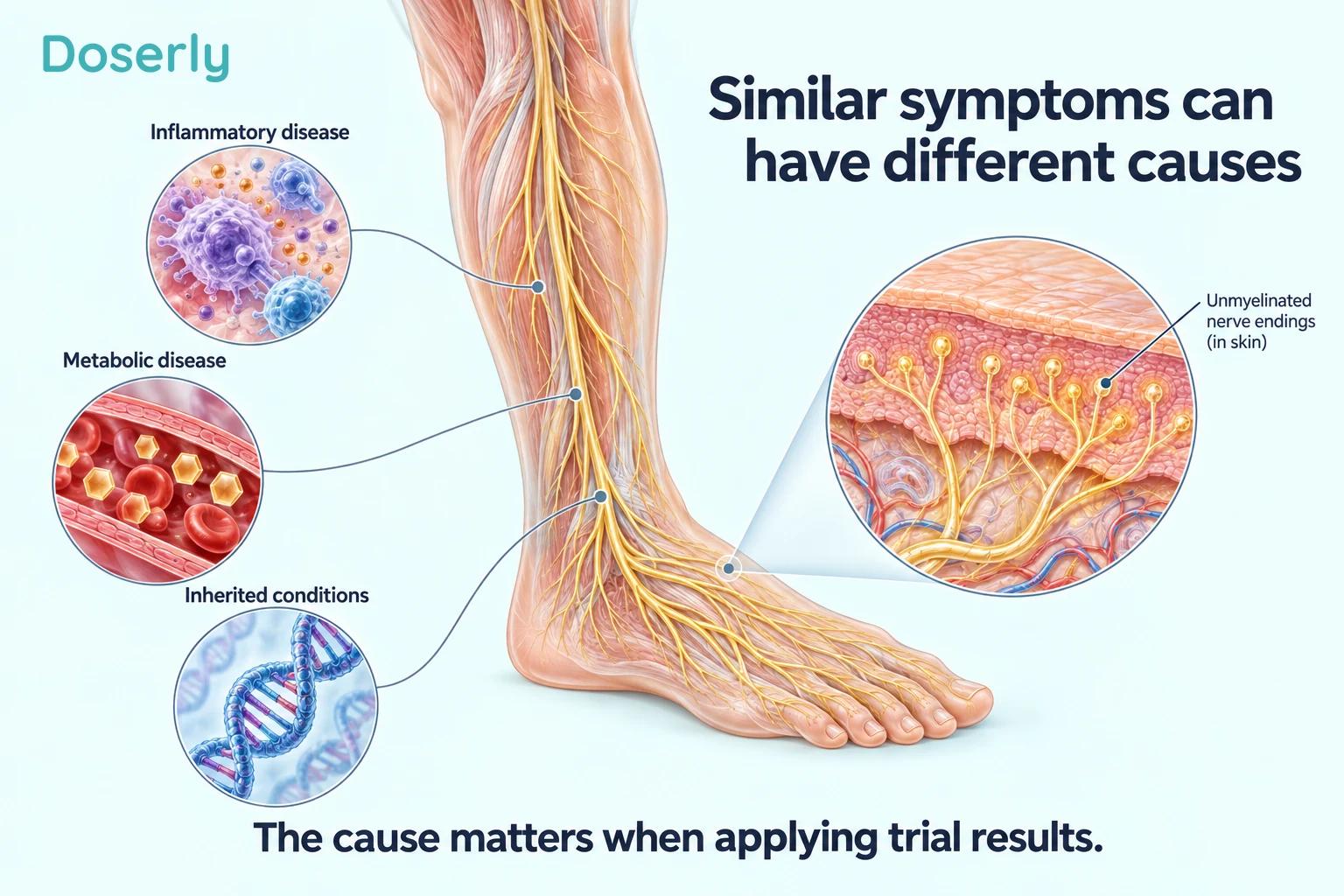
A person with reduced small-fiber density and diabetes may have a different clinical problem from someone with sarcoidosis, or from someone whose symptoms result from a focal nerve injury. Even the same description—“burning in my feet”—can occur in different settings.
That is why a trial population cannot be matched to a reader using symptoms alone. The diagnosis, evidence of nerve involvement, underlying cause and other illnesses all affect the relevance of the results.
A primary diagnostic study published in 2019 supported combining clinical signs with functional and structural assessment, rather than relying on sensory complaints alone. Its purpose was diagnostic reliability, not testing ARA-290. Small-fiber diagnostic validation study
Who entered the sarcoidosis trials?
The 2012 pilot enrolled 22 people with sarcoidosis and symptoms consistent with small-fiber neuropathy. It compared ARA-290 with placebo over four weeks and used several symptom instruments.
The later 2017 trial randomized 64 people with sarcoidosis-associated painful small-fiber loss. Entry required more than an interest in trying a peptide: participants had defined pain characteristics and evidence of reduced small nerve fibers from corneal or skin assessment.
The protocol generally excluded other conditions known to be associated with small-fiber loss, apart from well-controlled diabetes. Five participants had controlled diabetes, but this did not make the study a trial designed to establish efficacy in diabetic neuropathy. 2012 pilot, 2017 trial
That exception is worth understanding. Real patients can have more than one illness, and a trial does not need a perfectly pure population to be informative. But a few participants with a second condition do not provide the same evidence as a properly designed trial in that condition.
The registered protocol also helps distinguish planned outcomes from later interpretations. It identifies corneal nerve fiber area as the primary endpoint, with symptom, functional and safety assessments alongside it. NCT02039687 protocol and results
What result can reasonably travel beyond sarcoidosis?
The most defensible transferable idea is a research hypothesis: cibinetide may influence aspects of small nerve-fiber structure under some conditions.
In the 2017 trial, the middle treatment group showed a significant increase in corneal nerve fiber area compared with placebo after 28 days. A growth-associated skin marker also showed a signal. These observations suggest biological activity worth investigating in other populations.
They do not establish that a person with another neuropathy will experience the same tissue response. They establish even less about whether that person will have less pain or better daily function.
The pain comparison with placebo in the more symptomatic subgroup was not statistically significant. Conventional skin nerve fiber density did not show a significant treatment-group difference either. A summary that says only “ARA-290 regrew nerves” skips both the measurement specificity and the uncertain patient benefit. 2017 clinical findings
Doserly's ARA-290 guide provides a broader introduction to the molecule. When applying its research to a particular diagnosis, the trial population and endpoint are more informative than a general label such as “nerve-repair peptide.”
Structural findings cannot substitute for your main problem
For some patients, the priority is pain. For others, it is sleep, walking tolerance, numbness, sweating abnormalities, or another autonomic symptom. A study needs an outcome relevant to that problem.
Corneal imaging assesses the nerve network at the front of the eye. A skin biopsy assesses a local tissue sample. A questionnaire captures reported symptoms. A walking test measures performance under specified conditions.
These measurements may be related, but they are not equivalent. An imaging change cannot directly answer whether someone can sleep through the night, and a reduction in pain does not prove that nerve structure has normalized.
The 2012 pilot illustrates this within a single population. The Small Fiber Neuropathy Screening List improved more with ARA-290, while the Brief Pain Inventory and fatigue scores improved similarly in the active and placebo groups. “Symptoms improved” needs the name of the symptom measure and the comparator to become meaningful. 2012 results
For another neuropathy, the distance between the evidence and the desired outcome grows further. A corneal-area signal in sarcoidosis is several steps removed from proven relief of chemotherapy-related pain or recovery after a compressed nerve.
The diabetes study is relevant, but not uniformly positive
A separate placebo-controlled study enrolled 49 people with type 2 diabetes and neuropathic symptoms. One participant stopped treatment after worsening renal function and was excluded from the main analysis, leaving 48. The number included in particular endpoint analyses varied because some measurements were unavailable.
Treatment lasted 28 days, followed by another month of observation. Participants continued a range of existing treatments for diabetes and pain. The study therefore did not test whether ARA-290 could replace ordinary diabetes management or established symptom treatment.
The PainDetect questionnaire favored ARA-290 over placebo. However, the Neuropathic Pain Symptom Inventory improved in both groups at the end of dosing, and the Small Fiber Neuropathy Screening List did not show significant improvement. Quantitative sensory testing also did not show a clear treatment change.
The full-group corneal nerve-density change was not statistically significant. A post hoc subgroup with reduced baseline corneal density had a more favorable within-group change after ARA-290. That subgroup result should not be rewritten as proof of regeneration throughout the entire diabetic study population. Type 2 diabetes trial
The study is useful because it directly investigates a second disease context. Its mixed endpoints and short observation period still leave important questions about reliable symptom benefit, durability and which patients might respond.
“Idiopathic” does not mean the sarcoidosis mechanism applies
When neuropathy is described as idiopathic, its cause has not been identified. That term does not establish that the condition is inflammatory, nor does it identify the pathway that a proposed treatment should target.
It is understandable to reason that a tissue-protection mechanism might help regardless of what caused the injury. That is a hypothesis. It requires testing because different diseases can alter the nerve, surrounding cells, blood supply and ongoing injury in different ways.
The same caution applies to a positive skin biopsy. It may document small-fiber loss in the appropriate clinical setting; it does not, by itself, name the cause or establish responsiveness to cibinetide.
A clinician can help distinguish what the available tests have established from what remains uncertain. The 2019 diagnostic study's combined clinical, functional and structural approach supports that distinction. It should not be used to make every patient undergo the same test package or to dismiss symptoms when one test is normal. Diagnostic research
Preserving diagnostic uncertainty is useful. Replacing it with a confident treatment story can narrow attention before the underlying problem has been adequately assessed.
Four questions make applicability clearer
A practical reading of an experimental-treatment paper can start with four questions.
- Was the cause of neuropathy similar? Sarcoidosis, diabetes and medication-related injury are not interchangeable categories.
- Was the nerve problem confirmed in a comparable way? Pain descriptions, clinical signs, skin findings and corneal measurements convey different information.
- Did the trial measure the outcome you want? A tissue marker is not the same as less pain, better sleep or restored function.
- Did the benefit exceed the comparator and last long enough? Improvement from baseline and a durable treatment effect are different claims.
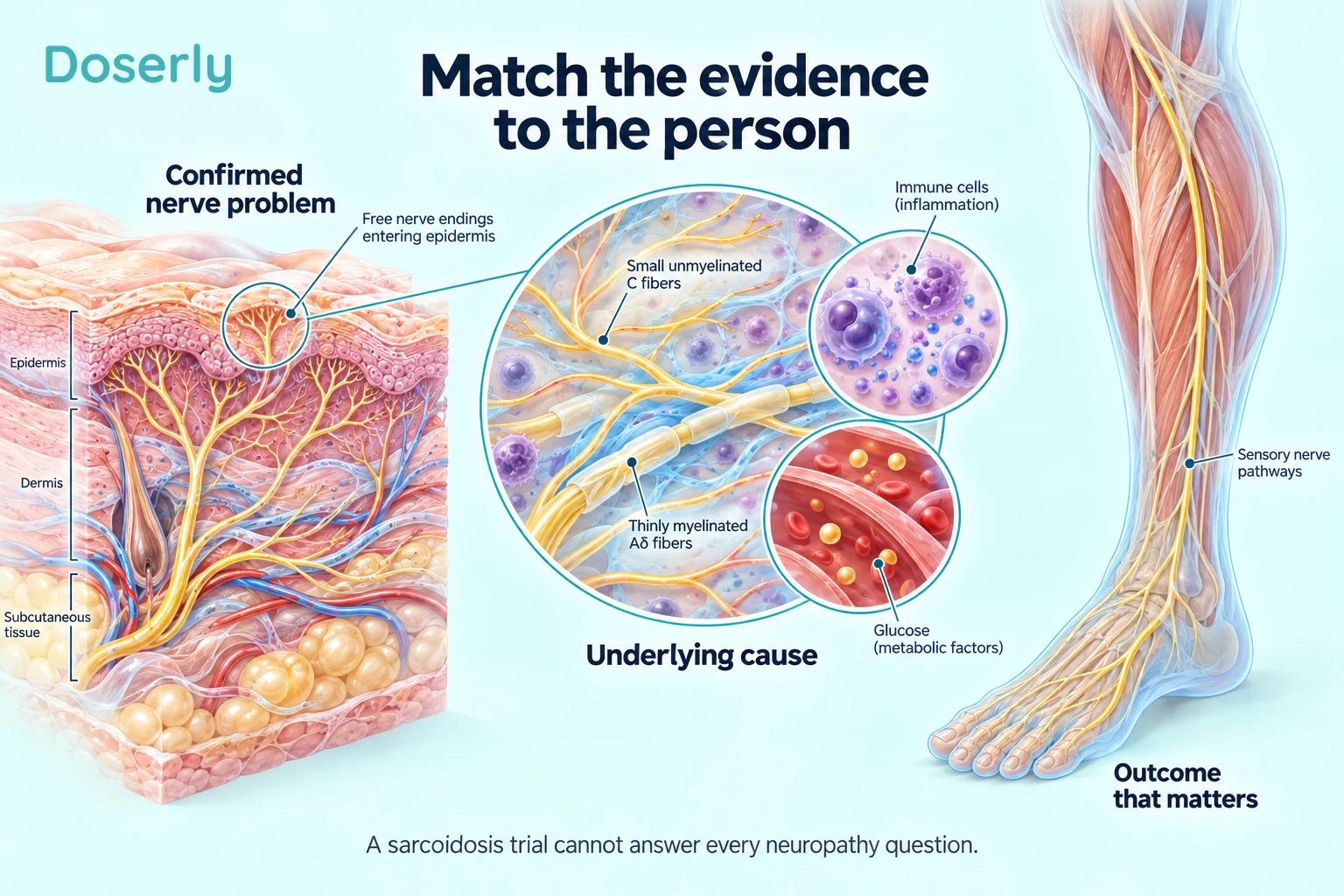
Consider a hypothetical person with unexplained burning feet and no established small-fiber diagnosis. The first task is not to select the most impressive peptide study. It is to clarify what the symptoms represent.
Now consider someone with confirmed diabetic small-fiber neuropathy. The diabetes trial is more directly relevant than the sarcoidosis trial, but the mixed symptom results, subgroup analysis and short follow-up still matter.
For someone with sarcoidosis and documented painful small-fiber loss, the 2017 population is closer. Even then, the study does not guarantee pain relief or identify an approved treatment plan. Better applicability reduces one uncertainty; it does not remove all the others.
Trial duration limits claims about lasting repair
The major studies discussed here used short treatment periods. The 2017 trial's dosing lasted 28 days, although study participation and safety follow-up extended beyond that period.
A four-week exposure can reveal a biological signal or common short-term tolerability problems. It is less suited to proving that chronic neuropathy has been durably modified or that repeated courses are beneficial.
In the 2017 report, corneal nerve area trended back toward baseline after treatment stopped. That finding argues against presenting the observed change as permanent restoration after one short course. Follow-up findings
Anecdotes about cycling, maintenance treatment, or combining peptides do not fill this evidence gap. They involve different exposure patterns, often without a comparator or standardized outcome assessment.
For another disease, longer-term uncertainty is compounded by the population difference. A treatment must first show a useful effect in that condition before a lasting recovery claim becomes credible.
Safety also has to be matched to the patient
The trials were too small to establish uncommon or long-term risks across a broad neuropathy population. Their safety findings should also be read from the full reports.
The 2017 sarcoidosis study recorded serious events in three active-treatment participants. Suicidal ideation in one participant in the highest study group was considered possibly related. This does not prove causation, but it prevents a blanket statement that the trial found no serious safety concerns.
The diabetes study reported four serious adverse events in the active arm, with differing assessments of relationship to treatment. One participant stopped treatment in the context of worsening renal function and a concurrent diuretic change. Sarcoidosis safety report, diabetes safety report
Different patients may have different kidney function, medications, immune treatments and other illnesses from those permitted in a trial. A favorable short-term observation in selected participants cannot establish safety in everyone excluded from the study.
No approved cibinetide product was identified in the US FDA approval database in the October 2026 research check. Trial evidence does not verify the identity or quality of a product marketed outside that research setting. FDA approval databases
How to use the evidence in a clinical discussion
Bring the actual study or its identifier, not only a claim that it “repairs nerves.” Ask which parts of its population resemble your diagnosis and which endpoints address your main limitation.
A concise symptom record can help: where symptoms occur, whether they are constant or episodic, effects on sleep and walking, medication changes, and any new functional problems. The purpose is to improve the clinical picture, not to diagnose a mechanism from a pattern alone.
The sarcoidosis research offers a reason to keep investigating cibinetide and small-fiber biology. The diabetes research offers an additional, still limited clinical context. For people with other neuropathies, the responsible conclusion is neither guaranteed benefit nor proven futility. It is that the relevant treatment question remains unanswered, and care should continue to address the confirmed diagnosis, possible cause and symptoms that matter.
Sources
- 2012 sarcoidosis pilot
- 2017 sarcoidosis trial
- NCT02039687 protocol and results
- Type 2 diabetes trial
- NINDS peripheral neuropathy guidance
- Small-fiber diagnostic validation study
- FDA approval databases