
Peptides
October 16, 2026
LL-37 wound trials: what healing means beyond a photograph
On this page
A chronic leg ulcer can affect far more than the appearance of skin. Dressings, discomfort and repeated appointments can become part of everyday life. A photograph showing a smaller wound is understandably encouraging. The question is whether a proposed treatment helps more wounds close, whether they stay closed, and what it adds to the care already being provided.
LL-37, a peptide involved in the body's defense and injury responses, has been investigated as a treatment applied directly to wounds. Early findings justified further study. But the larger HEAL LL-37 trial did not demonstrate a significant improvement in healing across its full study population. That result is important when interpreting impressive individual images or claims that LL-37 has already proved itself as a general wound-healing treatment. HEAL report.
Understanding the evidence starts with the wound itself. A venous leg ulcer, a diabetic foot ulcer and a fresh surgical wound do not have identical causes or treatment needs. We'll focus on the venous-ulcer trials, explain the smaller diabetic-foot study, and show why route, background care and the definition of healing all matter.
Why venous ulcers need more than a topical ingredient
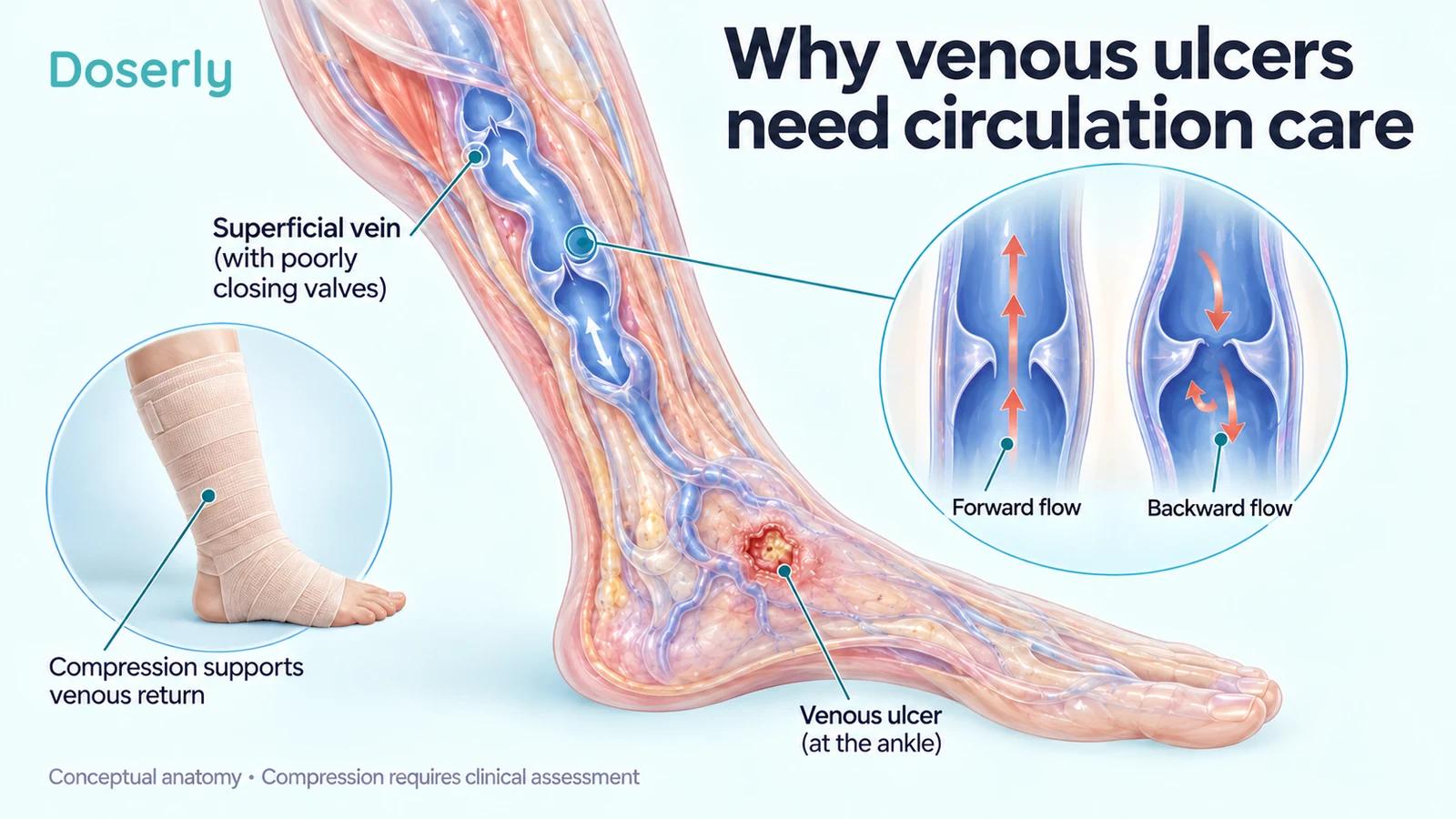
Veins return blood from the legs toward the heart. When this circulation does not work adequately, pressure and swelling can contribute to persistent skin damage. Treating the open area is only one part of caring for a venous ulcer. Compression, applied appropriately by trained professionals, supports venous return and helps control swelling. Cleaning and dressings address the wound itself. NHS venous-ulcer treatment.
Before compression is selected, clinicians assess circulation, including whether there may also be inadequate arterial blood supply. Arteries deliver blood to the tissues; veins carry it back. These are different problems, and the distinction affects safe treatment. An ankle-to-arm blood-pressure comparison can be part of that assessment. NHS diagnosis guidance.
This is why a wound's improvement after a new cream doesn't identify the cream as the cause. Better compression, consistent dressing changes and attention to the underlying condition can all occur at the same time. A clinical trial must keep those aspects of care comparable if it is going to estimate the additional contribution of LL-37.
For the person receiving care, background treatment is not a nuisance that obscures an otherwise clear drug effect. It is the foundation on which the new treatment would need to offer something useful. A trial comparing LL-37 with placebo on top of compression asks a practical question: does adding the peptide help beyond the care patients should already receive?
What did the early LL-37 study find?
The first randomized venous-ulcer study included 34 participants. After a three-week placebo run-in, the blinded treatment phase lasted four weeks, followed by another four weeks of observation. Participants received topical LL-37 at one of three concentrations or placebo, twice weekly. The two lower concentrations showed promising changes in healing measures, while the highest concentration did not outperform placebo. Grönberg and colleagues, 2014.
The reported healing-rate comparison was statistically significant for the lowest concentration, with p=0.003, but not for the middle concentration, with p=0.088. Those numbers are useful because the paper's positive title can otherwise make all the dose groups sound equally successful. The study was small and focused on early healing measures; it did not establish a universal relationship in which more peptide produced more benefit.
The clinical lesson is not to select one of those concentrations for home use. It is that a promising early signal needed a larger, more definitive test. Researchers had to determine whether it would translate into an outcome that matters directly to patients: reliable closure of the wound.
What did HEAL add?
HEAL was a multicenter, double-blind phase IIb study comparing two topical LL-37 concentrations with placebo alongside compression therapy. There were 149 randomized participants and 148 who received treatment. The publication reported estimated confirmed-closure proportions of 26.5%, 24.7% and 25.3% in the lower-concentration, higher-concentration and placebo groups, respectively. The overall differences in healing outcomes were not statistically significant. HEAL primary report.
The registered primary outcome was closure by the end of treatment at 13 weeks, with confirmation at a later visit. The registration's results also describe how participants without confirmed closure were handled in time-to-event analyses. Those details matter because a trial follows a group over time; it doesn't simply choose a photograph from each participant's best-looking visit. EU trial results, 2018-000536-10.
A nonsignificant result does not prove that every conceivable LL-37 preparation is ineffective for every wound. It does mean this study failed to establish the hoped-for overall benefit under its tested conditions. Someone describing LL-37 as a proven wound treatment needs to address that result, rather than relying only on the earlier small study.
What about the encouraging large-wound subgroup?
The HEAL investigators reported a post hoc analysis suggesting benefit in participants whose wounds were at least 10 square centimeters. “Post hoc” means this subgroup analysis was undertaken after examining the study data, rather than serving as the main planned test of success. HEAL subgroup analysis.
There is a reasonable clinical question here: perhaps people with larger, harder-to-heal wounds respond differently. But selecting a subgroup after seeing the data makes a positive finding less secure. Different subdivisions can produce different results, especially when participant numbers become smaller.
The useful next step would be a new trial designed around that proposed population, with the main outcome and analysis chosen in advance. Until then, the subgroup is a reason for further investigation. It does not overturn the overall result or establish that an individual with a large ulcer is likely to benefit.
This is also why a dramatic photograph from a person in that subgroup cannot settle the question. It may show genuine improvement. What remains unknown is whether similar patients would have improved as much with the same compression and wound care but without LL-37.
Smaller, filled in and completely closed are different outcomes
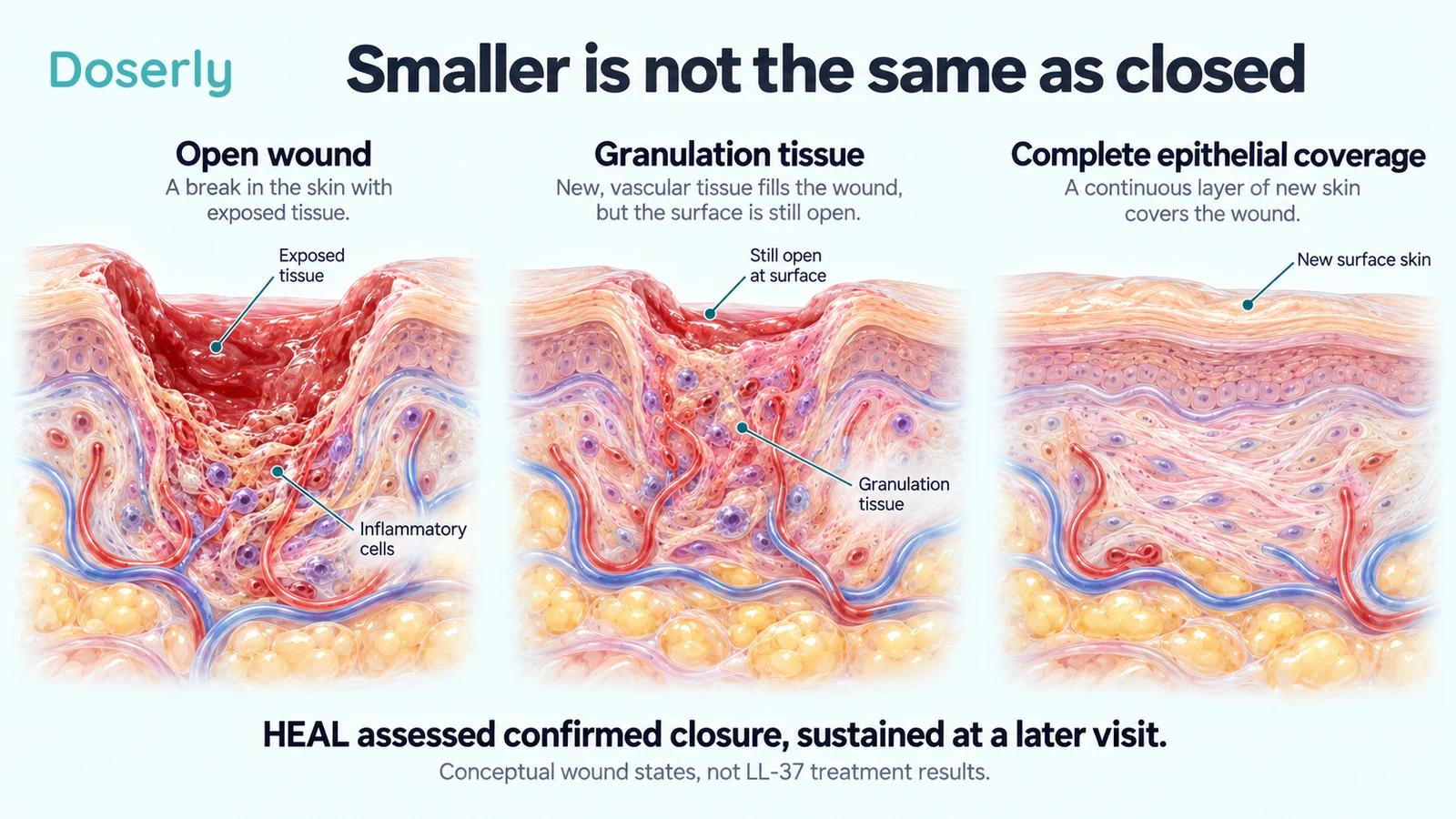
A wound can shrink at its edges while remaining open. It can develop granulation tissue, the new tissue filling part of the wound bed, while still lacking a continuous protective surface. Complete epithelial coverage concerns the new surface skin. Each observation is useful, but they describe different stages or features of repair.
FDA's guidance for developing chronic-wound treatments treats complete closure as a particularly meaningful outcome and recommends confirmation rather than relying on one observation. It distinguishes lasting healing from temporary coverage and calls attention to follow-up and effects on surrounding tissue. FDA wound-treatment development guidance.
Consider a hypothetical wound that becomes half its original area. That is a real improvement in size, but it is not “half the patients healed,” and it does not say whether the remaining opening will close. Similarly, a faster early reduction need not mean fewer recurrences months later. These are separate questions requiring separate measurements.
For a patient, a useful report should make the outcome recognizable. Does “healing” mean less exposed area, complete closure, less drainage, fewer dressing requirements or less pain? The answer changes what the result could mean for daily life.
What does the diabetic-foot cream study contribute?
A separate randomized study reported in 2023 enrolled 25 people with mildly infected diabetic foot ulcers: 13 received LL-37 cream and 12 placebo cream. Follow-up lasted four weeks. The researchers reported greater improvement in a granulation index with LL-37, while changes in measured inflammatory markers and aerobic bacterial counts did not establish a clear between-group advantage. Diabetic-foot trial.
That finding concerns a small study, a different ulcer population and a topical cream. It adds a clinical observation worth investigating, but it doesn't resolve the negative overall venous-ulcer result. Nor does it establish that the peptide can replace infection treatment or prevent amputation.
The comparison illustrates why “wound healing” is too broad a label on its own. A granulation measure after four weeks and confirmed closure of a chronic venous ulcer by 13 weeks are not interchangeable endpoints. They may both be relevant, but they need to retain their names and context when results are communicated.
Infection and colonization are not the same thing
An open ulcer can contain bacteria without being clinically infected. NICE advises managing underlying causes and reserving antibiotics for ulcers with signs or symptoms of infection, such as spreading redness or swelling, warmth, increasing pain or fever. Antibiotics do not promote healing of an ulcer that is not clinically infected. NICE NG152.
This distinction matters for an antimicrobial peptide. A laboratory ability to affect bacteria does not tell us whether it improves closure in a colonized wound, treats a clinically important infection, or adds anything to appropriate care. Those benefits need their own human comparisons.
If an ulcer is deteriorating, a new image or a change in bacterial count should not displace clinical assessment. The question is what is causing deterioration and what treatment addresses it. A wound trial should report infection and other complications alongside apparent improvement, rather than presenting the attractive photographs alone.
Why a wound application doesn't validate an injection
The LL-37 trials discussed here applied defined preparations directly to the affected tissue. An injection at another site changes the route, exposure and tissues encountered. The fact that both products use the same peptide name does not establish that enough active material reaches the wound or that the risks are comparable.
FDA identifies unresolved safety issues for compounded LL-37, including possible immunogenicity with some routes and complexities involving impurities and ingredient characterization. Those concerns are not answered by a short topical study that reports acceptable local tolerability. FDA safety information.
Our LL-37 guide's human-research section helps place the different preparations and study populations alongside one another. The relevant question is not whether LL-37 has ever been studied in a person. It is whether the proposed product and route have evidence for the condition being treated.
Using photographs well in your own care
Photographs can help document an ulcer when used consistently and with the care team's guidance. Similar lighting, distance and orientation make changes easier to interpret. Dates and a record of dressing or treatment changes add context. A clinician may also use a measurement scale or a formal wound-assessment method.
Still, a photograph is only one part of the record. Pain, drainage, surrounding skin, signs of infection and the circulation assessment may matter even when the visible area looks smaller. Ask what the team is measuring, what improvement they expect, and what changes should prompt reassessment.
When comparing a sequence of photographs, check whether visits are missing. An absent later photograph is not evidence that a wound closed; the record needs an actual assessment of the outcome being claimed.
For an LL-37 claim, ask for the whole trial result, the definition of healing and the comparison treatment. The most helpful evidence connects those details to a durable improvement in the person's life. The image can illustrate that improvement; it cannot establish which treatment caused it.
Sources
- Grönberg et al., 2014: early randomized venous-ulcer study.
- Mahlapuu et al., 2021: HEAL LL-37 primary report.
- EU Clinical Trials Register: HEAL results.
- Miranda et al., 2023: diabetic-foot cream trial.
- NHS: venous-ulcer treatment and diagnosis.
- NICE NG152: infection assessment and antibiotics.
- FDA: developing chronic-wound treatments.
- FDA: compounded-substance safety concerns.