
Peptides
October 16, 2026
What an LH rise after gonadorelin can and cannot prove
On this page
An increase in luteinizing hormone, or LH, after gonadorelin shows that a measurable pituitary response occurred under the conditions of that test. It does not, by itself, establish normal natural hormone signaling, sustained testosterone production, ovulation, sperm production or fertility.
That boundary is easy to lose when a laboratory result is presented as proof that a treatment is “working.” Working at which step, over what period and toward which goal? An LH rise can be useful evidence, but its meaning depends on the question being asked and on the information surrounding the sample.
This article explains how to read the result without either dismissing it or asking it to prove too much. The Doserly gonadorelin guide provides background on the peptide's pituitary action and the distinction between diagnostic use and pulsatile treatment.
LH is a signal, not the final outcome
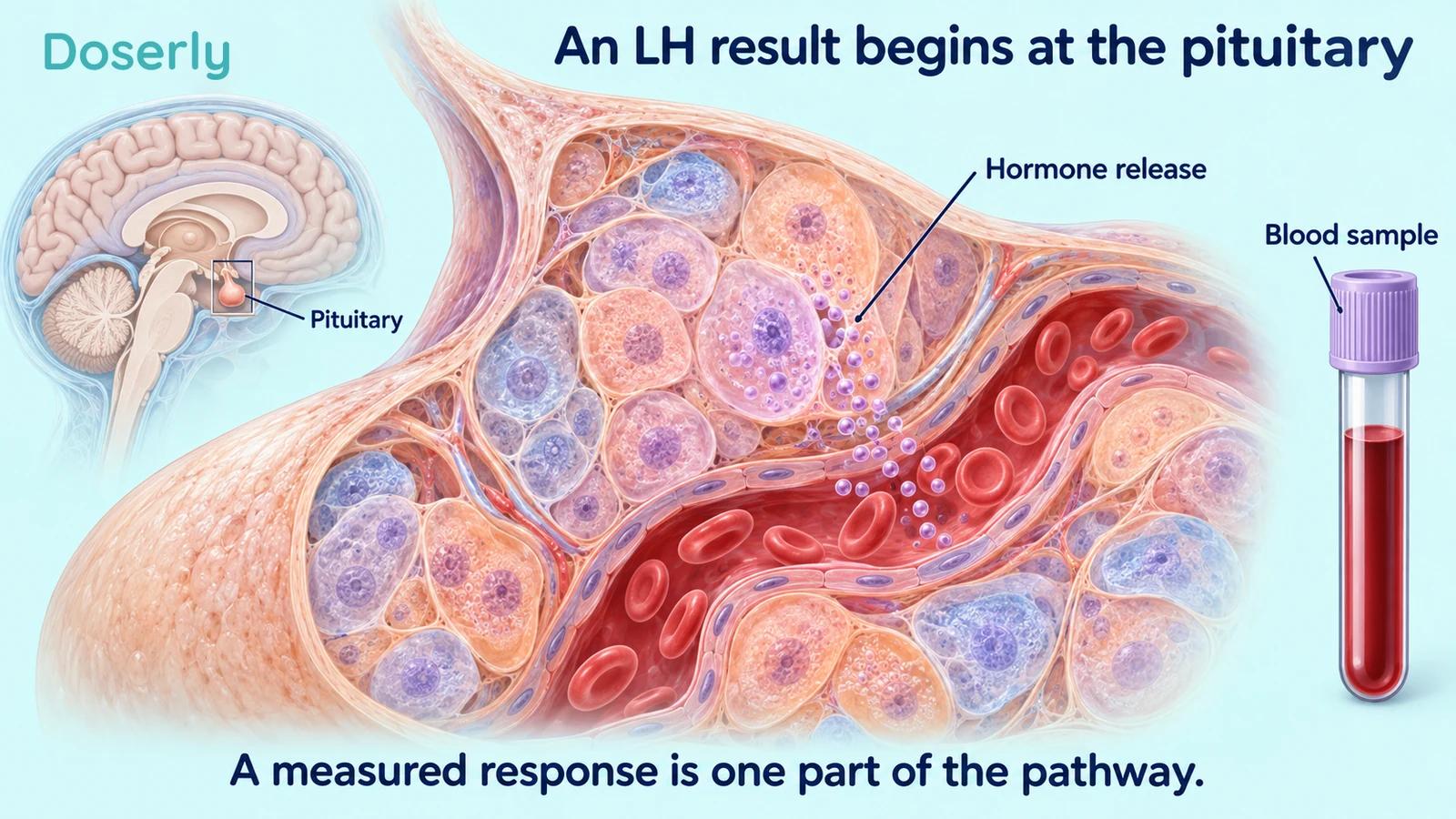
Gonadorelin is a manufactured version of gonadotropin-releasing hormone, or GnRH. GnRH stimulates cells in the pituitary to release LH and follicle-stimulating hormone (FSH). Those hormones act downstream on the testes or ovaries.
A blood LH measurement therefore describes one part of a pathway. In men, LH supports testosterone production through testicular Leydig cells. In women, its role depends on the reproductive context and stage of the cycle. A numerical increase does not directly measure the resulting function of the gonads.
The UK gonadorelin label describes a normal diagnostic response as evidence of functioning pituitary gonadotropes. It explicitly limits the test's ability to identify the cause of a subnormal response or measure pituitary gonadotropic reserve. Gonadorelin product information.
This is the appropriate starting interpretation: the pituitary responded to an administered signal. Each further claim needs additional evidence. If the goal is sperm production, semen needs assessment. If the goal is ovulation, the relevant reproductive events need to be evaluated. If the goal is symptom relief, the patient's symptoms and their causes still matter.
The sample time is part of the result
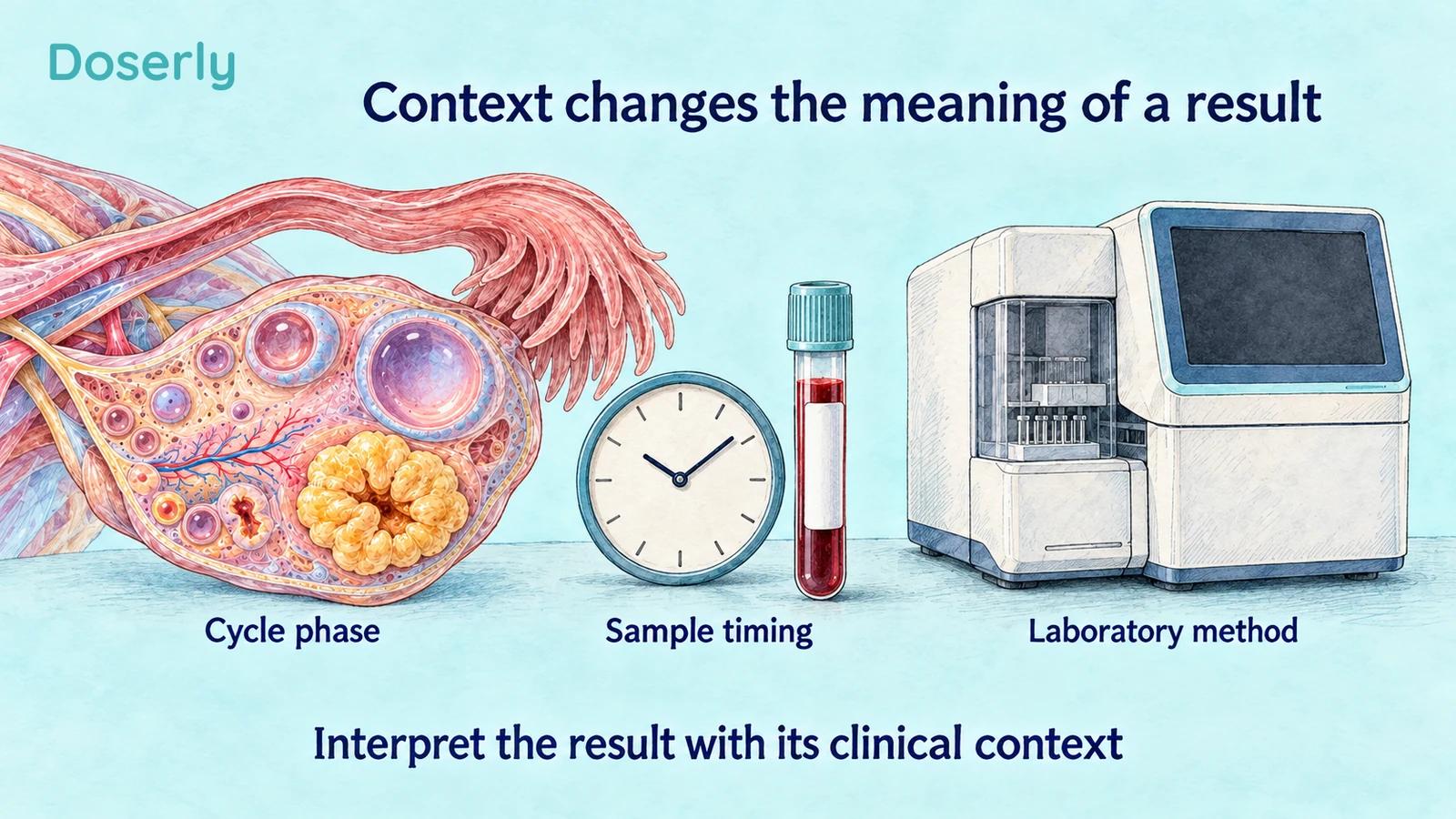
LH after a challenge is not a fixed property like a blood group. It changes over the observation period. A sample taken near a response peak can look different from one taken later, even when both come from the same person after the same administration.
An early human study of synthetic LH/FSH-releasing hormone included 18 men and five women in the follicular phase. It observed rapid, dose-dependent LH increases, with peaks around 20–30 minutes after intravenous administration under those study conditions. Besser and colleagues, 1972.
That historical timing is not a universal instruction for every product, route or patient. Its value here is to show why an isolated number without timing is incomplete. A laboratory comparison should identify whether each sample was baseline, post-challenge or part of ongoing therapy.
The current UK label describes a series of timed blood samples rather than relying on one unanchored value. It also emphasizes the reliability and reference standards of the laboratory performing the assay. Gonadorelin product information.
If a report contains a graph, the horizontal axis should therefore be read as carefully as the height of the curve. If only two values are shown, ask what happened between them and whether they were collected under comparable conditions. Neither presentation proves that LH remained elevated throughout the day.
A large percentage rise can start from a small baseline
Relative change and absolute concentration answer different questions. As a purely arithmetic example, an increase from 1 to 4 is fourfold, while an increase from 4 to 8 is twofold. The second final value is higher despite the smaller fold increase. These are invented numbers to illustrate arithmetic, not clinical LH thresholds.
This matters when promotional claims emphasize a percentage without showing the baseline, units or final concentration. A large relative rise can sound impressive while leaving the clinical meaning unresolved. Conversely, a smaller percentage change is not automatically a poor response.
The appropriate interpretation uses the actual values, sampling conditions and relevant reference framework. A percentage change is a description of the data; it is not a diagnosis. There is no universal fold-rise rule in this article because the test's interpretation depends on more than arithmetic.
The same caution applies to comparing two people. One person's larger increase may reflect a different starting state, different timing or different test conditions. It should not be treated as a score of reproductive health or a reason to increase treatment independently.
Cycle phase changes the comparison
In women, the reproductive system changes across the menstrual cycle. A response obtained during one phase should not automatically be compared with a result from another phase as if the conditions were identical.
A human physiology study examined LH and FSH responses across follicular, preovulatory and luteal phases. Peak responses were highest in the preovulatory phase and lowest in the follicular phase, while an analysis based on the area under the response curve gave a different pattern. The study illustrates that both cycle context and the chosen summary measure affect the interpretation. 1976 menstrual-phase response study.
Peak height and total response over time are therefore not interchangeable. A single highest value describes a moment. An area-under-the-curve measure summarizes exposure across a defined interval. Neither automatically establishes that an ovulation occurred or that a treatment improved fertility.
The UK diagnostic label specifies early-follicular testing when cycle phase can be established. That is a product-specific instruction for clinical use, not an invitation to schedule or interpret a test independently. Gonadorelin product information.
A responsive pituitary does not identify the whole diagnosis
Diagnostic groups can overlap in their responses. In a 2020 study of males evaluated for congenital hypogonadotropic hypogonadism or constitutional delay of puberty, 47% of the congenital-hypogonadism group had peak LH values overlapping with the constitutional-delay group. The study included 127 men with congenital deficiency, 74 with constitutional delay and 31 controls. Mosbah and colleagues, 2020.
The finding means that a response within another group's range did not reliably exclude congenital deficiency in that setting. It does not mean every response is meaningless. Very low results and other clinical findings can still contribute to assessment, but a single stimulated value should not replace the complete diagnostic picture.
This is a useful distinction between population averages and individual interpretation. A statistically different average does not create a perfect cutoff. The clinical history, pubertal development, examination and other investigations help establish what the result means for the person being evaluated.
It also prevents a second overreach: a normal-looking LH response cannot prove that a symptom is unrelated to endocrine function. The test examines a particular response, not every possible endocrine cause of fatigue, sexual symptoms or menstrual disturbance.
LH and FSH should not be treated as the same measurement
Gonadorelin can stimulate both gonadotropins, but reporting an LH rise does not tell us the full FSH response. The hormones have different roles, and the pattern of stimulation can affect their secretion differently.
In an eight-man physiology study, investigators changed the frequency of administered GnRH pulses after a period of repeated stimulation. LH behavior changed with the altered pattern. The experiment concerned hormone dynamics, not sperm production or pregnancy. Sauder and colleagues, 1988.
A result after one administered pulse also cannot reveal the person's natural pulse pattern across the rest of the day. To characterize pulsatility, research uses repeated sampling and an analysis designed for that purpose. A pair of blood draws does not provide the same information.
For treatment discussions, the practical question is whether the chosen monitoring captures what the intervention is intended to change. An LH peak may demonstrate an immediate response while leaving sustained gonadotropin support and downstream function unresolved.
Medications can change the context
The endocrine system responds to ongoing hormonal exposure. A result obtained during testosterone or other sex-steroid treatment should not be casually compared with an untreated reference situation. The gonadorelin label specifically identifies medicines that can affect the test. Gonadorelin product information.
A human experiment also demonstrated that testosterone administration could reduce pituitary gonadotropin responses during controlled physiological GnRH stimulation in men with GnRH deficiency. The experiment was small and short, but it shows why an administered GnRH signal does not erase the surrounding feedback environment. Finkelstein and colleagues, 1991.
This does not permit a reader to diagnose the effect of a particular prescription from one number. It does make an accurate medication history essential. The clinician needs the substance, schedule and timing, including recent changes. Any preparation for testing should follow the clinical team's instructions rather than a general online rule about stopping medicines.
Why normal hormones do not guarantee sperm production
Longer-term treatment evidence makes the endpoint distinction concrete. In a cohort of 76 men with idiopathic hypogonadotropic hypogonadism treated with GnRH for 12–24 months, LH and testosterone normalized in most participants. Nevertheless, 18% of the subgroup with absent puberty remained azoospermic. That percentage belongs to the subgroup, not to the entire cohort. Pitteloud and colleagues, 2002.
The finding does not diminish the value of hormonal monitoring. It shows that upstream normalization and downstream sperm production are separate observations. A favorable LH result can be one encouraging part of a treatment course without establishing completion of the fertility goal.
For a couple trying to conceive, even sperm detection is not the final outcome. Semen characteristics, partner factors and the broader reproductive assessment remain relevant. Male infertility guidance recommends evaluating both partners and interpreting semen alongside the clinical picture. EAU male infertility guideline.
What to keep with the laboratory report
A useful record includes the reason for testing, the exact product and administration time, each blood-draw time, the laboratory's units and reference information, and the current medication list. Where relevant, it should also include menstrual-cycle context and the clinician's interpretation.
Keeping these details together prevents accidental comparisons between a baseline value and a stimulated value, or between differently timed visits. If a dose or schedule changed, recording that change is more informative than simply labeling the next number “better.”
The record should also identify the outcome that still needs assessment. A clinician may be satisfied that a pituitary response occurred while still needing to evaluate semen, ovulation, symptoms or another part of the diagnosis. That is not contradictory; it reflects the different questions being asked.
A precise conclusion is more useful than a broad promise
The strongest conclusion from an LH rise is usually the narrow one: gonadorelin was followed by a measurable pituitary response under documented conditions. Whether that response is appropriate, diagnostically useful or relevant to treatment requires the surrounding clinical information.
It does not alone prove sustained hormone output, normal natural pulsatility, a particular diagnosis or preserved fertility. Those claims require different measurements and, often, a longer period of observation. The gonadorelin evidence overview helps separate these levels of evidence so a laboratory response can inform care without being mistaken for the whole outcome.
Explore the research
- Gonadorelin product information
- Early human LH/FSH-releasing hormone study, 1972
- Menstrual-phase variation in LH and FSH responses, 1976
- Diagnostic response overlap, 2020
- Changing GnRH pulse frequency, 1988
- Testosterone feedback during GnRH stimulation, 1991
- Long-term GnRH treatment outcomes, 2002
- EAU male infertility guideline