
Peptides
October 16, 2026
What a wound-healing study must report beyond closure time
On this page
For someone living with an open wound, faster healing sounds like a straightforward goal. Fewer dressing changes, less discomfort and an earlier return to ordinary activities could make a real difference. Yet a headline saying that a treatment “accelerates closure” can leave out much of what a patient needs to know.
Did more wounds heal, or did a small subset heal sooner? Was closure confirmed, and did the skin stay closed? Were people who developed complications still included in the analysis? These questions matter whether the proposed treatment is a peptide gel, a dressing, a surgical procedure or something else.
A useful wound study follows the person as well as the wound surface. It explains the initial injury, the care both groups received, the definition of healing and what happened afterward. Real trials show why those details can change the interpretation of an apparently simple result.
First, establish what “closed” means
A wound can become smaller without closing completely. It can develop tissue across the surface while still requiring dressings. It can also look improved in one photograph and reopen before the next appointment. These are different states, even though all might be described casually as healing.
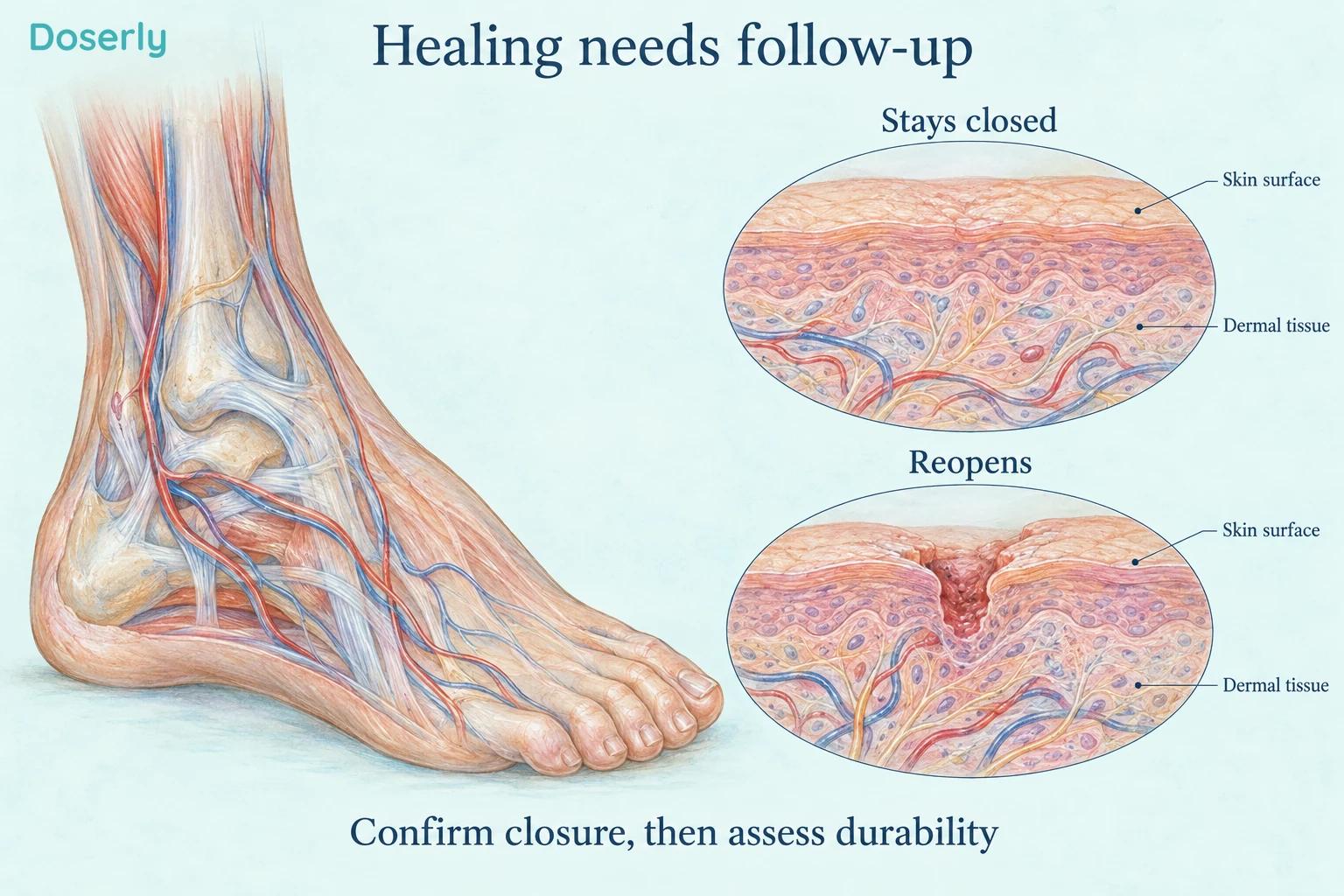
The FDA's wound-product guidance defines complete closure in terms of re-epithelialization, meaning restoration of the skin's surface covering, without drainage or a dressing requirement. It recommends confirmation at two consecutive study visits two weeks apart and generally at least three months of follow-up after closure. These are development recommendations, not a claim that every historical trial followed the same schedule. FDA wound-treatment guidance
That definition gives a reader something concrete to look for in a paper's methods. “Healing assessed at week eight” is not enough information by itself. The study should say what assessors saw, whether they needed a second assessment and whether the reported date was the first apparent closure or confirmed closure.
Consider a hypothetical wound that appears closed on Monday but begins draining again on Friday. A single Monday photograph could support a very different conclusion from a protocol requiring sustained closure. The discrepancy would come from how the outcome was defined, even if both observers described the photograph accurately.
Surface area and depth answer different questions
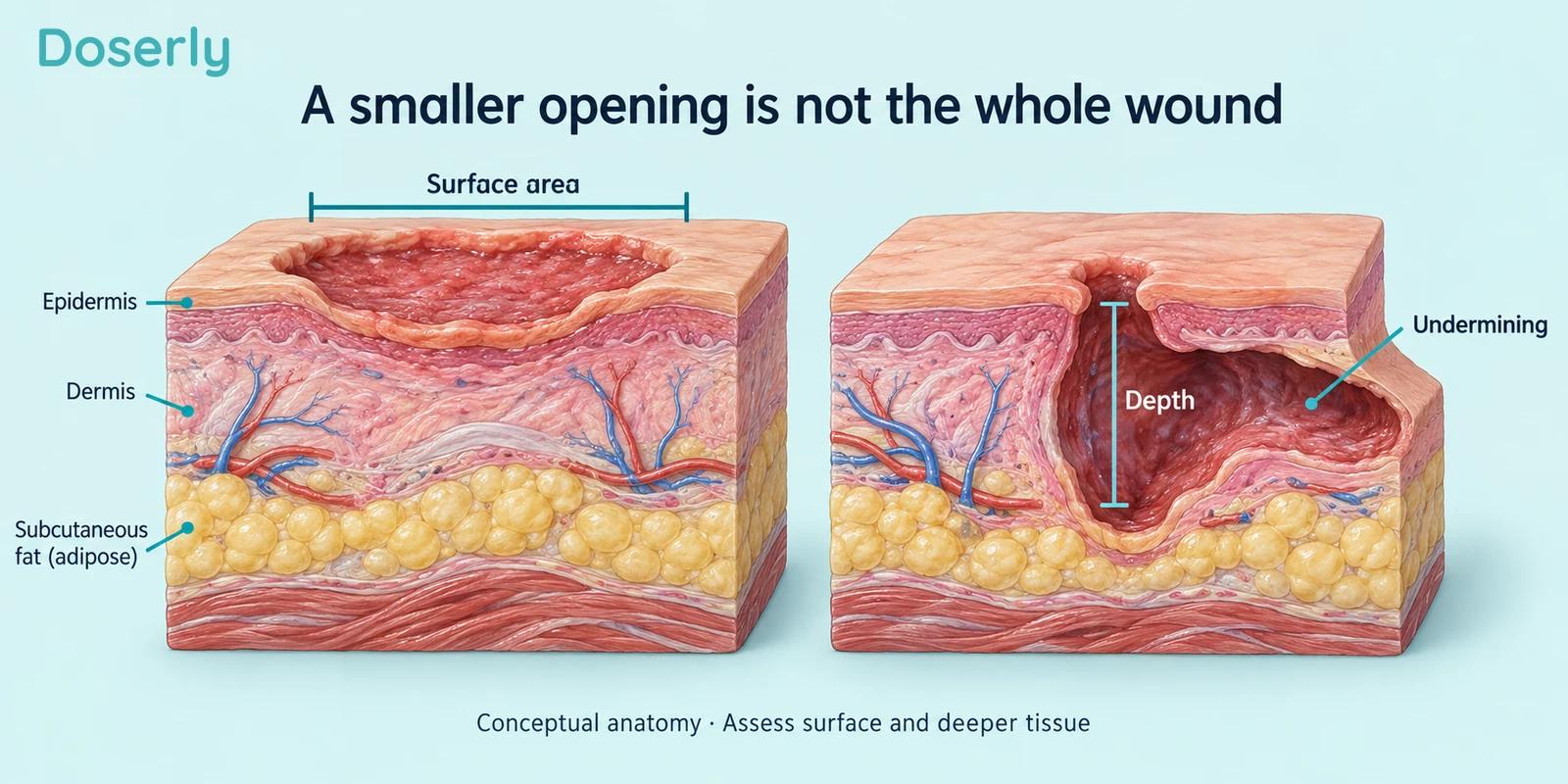
A smaller opening can be an encouraging observation, but it does not describe every part of a wound. A deep cavity and a shallow surface defect may have similar visible openings. Tissue can also extend beneath an overhanging wound edge, a feature called undermining.
The FDA guidance discusses measuring wound area and, where relevant, depth or volume and undermining. It also recommends consistent methods across sites, including standardized photography when photographs are used. FDA assessment recommendations
The implication is practical. If an experimental treatment produces a percentage reduction in surface area, ask whether that was the study's intended early biological signal or its claimed patient benefit. A change in area may help decide whether to run a larger trial. It cannot automatically establish durable closure, freedom from infection or restored function.
Photographs need their own context. Lighting, scale, distance and the timing of wound cleaning can change what the reader sees. A compelling pair of images should accompany a defined measurement process, rather than replace the numerical results for all participants.
Ask how many people healed, as well as how quickly
Time to healing and the proportion healed by a chosen date are related, but they are not interchangeable. A study might find earlier closure while eventually reaching similar healing proportions. Another might increase the number of wounds that close without markedly changing the timing among those that would have healed anyway.
The EVRA trial provides an example of reporting both. It randomized 450 people with venous leg ulcers to compression plus early endovenous ablation or compression with deferred ablation. Ablation treats abnormal superficial venous reflux; this was a vascular intervention study, not a peptide trial. Median healing times were 56 days with early intervention and 82 days with deferred intervention. Healing at 24 weeks was reported in 85.6% and 76.3%, respectively. EVRA randomized trial
The two results answer different patient questions. The median describes the middle of the healing-time distribution; it does not promise that a particular person's ulcer will close on day 56. The 24-week proportion describes how many had reached the endpoint by that time. Together, they are more informative than either figure alone.
EVRA enrolled a defined group, including people with ulcers lasting between six weeks and six months who could tolerate compression and were suitable for the procedure. Its results should retain those boundaries when applied to a patient with a different wound history or circulation problem. EVRA detailed trial report
The people whose wounds never closed must remain visible
A common analytical trap is to compare healing times only among people who healed. Imagine two hypothetical treatments: one closes ten of twenty wounds quickly, while the other closes eighteen of twenty somewhat more slowly. Reporting only the average time among healed wounds could make the first treatment sound preferable while hiding its much lower chance of closure.
Time-to-event methods are designed to use follow-up information from people who have not yet experienced the event. The details still matter: when observation ended, why someone left, and what assumptions the analysis made about those people. A statement that a result was “statistically significant” does not answer those questions.
For a real example of why participant flow deserves attention, the topical thymosin beta-4 pressure-ulcer registry reports 72 randomized participants but only 51 who completed the study: 14 of 18 placebo participants and 37 of 54 active participants. The posted healing endpoint used the randomized group sizes, reporting 3 of 18 and 8 of 54. Pressure-ulcer participant flow and outcomes
Those figures should prompt a closer look at how missing observations were handled. They do not justify replacing the reported denominators with completers, treating every departure as a drug reaction or assuming that every missing wound healed. Each shortcut would create a new result that the study itself did not report.
Closing once and staying closed are separate achievements
The ESCHAR trial makes this distinction particularly clear. It randomized 500 people with open or recently healed venous leg ulcers to compression alone or compression plus superficial venous surgery. At 24 weeks, reported healing rates were 65% in both groups. But recurrence at 12 months was lower in the surgery group: 12% compared with 28% with compression alone. Original ESCHAR trial
A summary focused only on initial closure would miss the recurrence finding. A summary focused only on recurrence could wrongly imply that surgery accelerated initial healing. Both outcomes deserve their own sentence.
Longer follow-up strengthened the importance of durability. The ESCHAR follow-up reported four-year recurrence rates of 31% with compression plus surgery and 56% with compression alone. This was follow-up of the same randomized program, not an independent second trial. Long-term ESCHAR results
These results do not tell us that every wound treatment needs the same follow-up duration or that surgery suits every patient. They demonstrate why an early photograph cannot settle the longer clinical question. Someone who spends months free of an ulcer has experienced a different outcome from someone whose wound briefly closes and repeatedly returns.
Count time without a wound
Ulcer-free time can combine aspects of initial healing and recurrence. It asks how much of the observation period a person spent without an open ulcer. That can be more intuitive than a single first-closure date, especially when repeated episodes are common.
The detailed EVRA report included ulcer-free time as well as healing and quality-of-life measures. Median ulcer-free time during the first year was 306 days in the early-ablation group and 278 days in the deferred group. These are trial summaries, not a guaranteed extra number of ulcer-free days for each individual. EVRA clinical outcomes
For a hypothetical patient whose wound closes early and then reopens, the first closure date still looks favorable. Ulcer-free time captures some of what happens afterward. For another patient whose wound closes later and remains closed, the later course may be more reassuring than the initial date suggests.
No single endpoint contains the whole story. The value of reporting several clearly defined outcomes is that patients and clinicians can see which part of recovery improved.
Pain, function and treatment burden deserve direct measurement
A healed surface does not automatically tell us whether someone can walk comfortably, sleep well or manage everyday care. It also does not tell us how burdensome the treatment was. An intervention requiring frequent visits may be acceptable when it provides a substantial benefit, but that burden belongs in the discussion.
EVRA included quality-of-life assessments alongside its wound outcomes. The detailed report found differences favoring early treatment on several measures over follow-up, while also reporting procedural complications including pain and deep-vein thrombosis. EVRA health technology assessment
The important reading habit is to ask whether symptoms and function were actually measured. “Patients healed faster, so their quality of life improved” is an inference unless the study collected suitable patient-reported information. Conversely, a product might make dressing changes more comfortable without changing closure rates; that could be a meaningful benefit if measured and described accurately.
A patient considering a wound treatment can make this concrete: which daily problem is the treatment expected to improve, how soon might that change occur, and how will we recognize that it has happened? That conversation is more useful than an undefined promise of regeneration.
Safety reporting needs denominators and context
A wound study should make clear how many people received treatment and were included in safety monitoring. In the thymosin beta-4 pressure-ulcer registry, the active safety population was 53 even though 54 participants were randomized to active treatment. Serious adverse events were reported in both groups. Pressure-ulcer safety population
Those details do not establish that the treatment caused the events. They do show why a reassuring sentence such as “well tolerated” should be read alongside actual safety tables, exposure duration and participant flow. An older person with a pressure ulcer may have several illnesses; separating background events from treatment effects requires more information than an event count.
Similarly, absence of an observed rare complication in a small study is not proof that it cannot occur. The study can only describe the people and follow-up it actually observed. Longer-term treatment proposals need a safety argument that matches the proposed duration.
What this means for peptide claims
When reading a thymosin beta-4 wound study, keep the molecule, formulation and route attached to the outcome. Evidence for a topical gel in a particular ulcer does not establish that an injected product improves muscle recovery or that a similarly named fragment has the same effects. The Doserly thymosin beta-4 guide provides background on those distinctions.
A useful research summary should let you identify the wound diagnosis, comparison care, number randomized, closure definition, missing participants, recurrence follow-up and safety observations without hunting through promotional language. If a headline supplies only a percentage improvement or a striking photograph, the missing information may be exactly what determines whether the result matters to you.
The goal is not to dismiss closure time. Earlier closure can be valuable, as EVRA illustrates. The goal is to understand the recovery that follows it: how many people heal, how long they stay healed and what life is like along the way.
Sources
- FDA: Chronic Cutaneous Ulcer and Burn Wounds—Developing Products for Treatment
- EVRA: randomized trial of early endovenous ablation, 2018
- EVRA: detailed health technology assessment, 2019
- EVRA: clinical outcomes chapter
- ESCHAR: original randomized trial, 2004
- ESCHAR: long-term randomized follow-up, 2007
- Topical thymosin beta-4 pressure-ulcer registry results