
Peptides
October 16, 2026
What a stronger Selank clinical trial would need to improve
On this page
Selank has a small human literature that reports favorable anxiety-related findings. The next useful study would need to make the size, reliability and practical meaning of those findings clearer. For someone considering treatment, the goal is not simply another positive abstract. It is a dependable answer about benefit and harm in people like them.
A stronger trial would identify the exact product, choose a specific patient population, use an appropriate comparison and measure outcomes that matter in daily life. It would also follow people who stop treatment and report enough information for independent assessment.
The Selank guide explains the wider biological and clinical background. This article uses the existing human reports to show which improvements would make the next result more informative.
Begin with what the existing studies actually asked
The 2008 report compared Selank with medazepam in 62 patients with generalized anxiety disorder or neurasthenia. The 2014 report compared Selank with phenazepam in 60 patients with phobic-anxiety and somatoform disorders. The 2015 report compared phenazepam alone with phenazepam plus Selank in 70 patients. 2008 study, 2014 study and 2015 study.
These are related but different questions. The last is an add-on comparison; it does not isolate Selank monotherapy. The diagnoses and measurements also vary.
The accessible abstracts provide favorable descriptions but do not supply all the numerical results and methodological details needed for a full appraisal. That does not prove that every unreported safeguard was absent. It means a new study should make those features clear and accessible.
Rather than combine the reports into a single broad claim, researchers could choose one clinical question that is both useful and answerable.
Choose a defined patient population
A trial in generalized anxiety disorder should establish that diagnosis and describe baseline severity, duration of symptoms and previous treatment. It should state how it handles common accompanying conditions and other medicines.
A study of healthy people under temporary stress would be a different project. So would a trial of panic disorder, a cognitive-enhancement study or an investigation of benzodiazepine withdrawal.
Mixing several conditions can be reasonable in some research, but the analysis must explain what conclusion applies to whom. A favorable average across a mixed group does not establish benefit in every subgroup.
For patients, this information answers the first practical question: how similar were the participants to me? Age alone is not enough; diagnosis, severity, co-treatments and functional impairment all influence relevance.
Define the actual Selank preparation
The study should identify the peptide and its chemical form, formulation, route and delivery device. It should describe relevant quality testing and stability so the treatment can be reproduced.
This is especially important when a common name is used for different derivatives or nasal products. A result from a defined preparation should not become evidence for every similarly named product.
FDA identifies potential immunogenicity concerns related to Selank acetate aggregation and impurities and notes important missing human safety information. Those issues belong in the development plan, not merely in a disclaimer after the trial. FDA Selank acetate entry.
A clinical trial also needs to explain why the exposure being tested is reasonable. That requires a scientific and safety rationale; it is not a reason for readers to copy a research schedule.

Choose the comparator to match the claim
If the question is whether Selank has an effect beyond placebo under defined conditions, a placebo comparison may be informative when ethically appropriate. If the question is whether it performs as well as an established treatment, an active comparator is needed.
An add-on trial asks whether Selank improves outcomes on top of existing care. A substitution trial asks whether one treatment can replace another. These designs should not be described as though they answer the same question.
FDA/ICH guidance explains that the choice of control affects the conclusions a trial can support. It also emphasizes the need for an active-control study to be capable of distinguishing effective from less effective treatment. ICH E10 guidance.
A strong Selank trial would state its intended claim before enrollment and choose a design that can actually test it.
Make allocation and masking transparent
Random assignment helps reduce systematic differences between groups. Allocation concealment prevents the next assignment from influencing who enters which group. Masking reduces the influence of knowing the treatment on assessments and behavior.
These are separate safeguards. Simply calling a study randomized does not explain how the sequence was generated or concealed. Calling it blinded does not identify who was blinded or whether the treatments were plausibly indistinguishable.
For a nasal product compared with a tablet, researchers would need to address the obvious differences in administration. A double-dummy design, where each group receives one active treatment and a matching placebo for the other form, is one possible approach. Whether it is appropriate depends on the study.
The 2025 CONSORT statement provides reporting guidance for randomized trials, including information needed to understand methods and participant flow. It is a reporting standard, not proof that a study was well conducted merely because it cites the checklist. CONSORT 2025.
Select one main clinical outcome in advance
An anxiety trial should specify its primary outcome and the time at which it will be assessed. A validated symptom measure can be useful, but the study should explain what degree of change would matter clinically.
The existing Selank reports name several scales. A stronger report would provide starting values, results in each group, the between-group difference and uncertainty around it.
Researchers should also distinguish improvement from remission. A participant may improve while still having substantial symptoms. The definitions used to classify response and remission need to be stated before the analysis.
A brain scan or blood biomarker could be included as an exploratory measure. It should not replace a clinical outcome or become the headline only because the main symptom result was disappointing.
Measure daily function alongside symptoms
Patients care about what they can do: work, sleep, maintain relationships, travel or complete necessary tasks. A change in a total symptom score can be useful while still leaving these questions open.
A trial could include a validated functional or quality-of-life measure and patient-defined goals. It should report those outcomes directly rather than assume that lower anxiety automatically improves every aspect of life.
The 2014 and 2015 reports mention quality of life. That is a relevant direction for further work, but the accessible summaries do not provide a complete account of the size and durability of those changes. 2014 comparison and 2015 add-on report.
A new study could make the clinical meaning clearer by showing whether symptom improvement accompanies a worthwhile functional difference.
Plan sample size around a useful difference
A sample-size calculation should begin with the effect the study needs to detect, expected variability and an allowance for missing follow-up. It should not begin with whichever number of participants is convenient.
A very small study can identify a promising signal, but its estimate may be too imprecise to guide treatment. The confidence interval should show the range of effects compatible with the data, including the possibility of little benefit.
If the goal is noninferiority to another medicine, the acceptable margin must be justified before results are known. A nonsignificant difference between groups does not establish equivalence.
There is no responsible single sample size to prescribe here without a detailed protocol and assumptions. The important improvement is a transparent calculation tied to the actual clinical question.
Treat adverse effects as a planned outcome
Safety collection should be systematic and comparable between groups. The study should state how often symptoms were sought, how severity was recorded and how investigators evaluated their relationship to treatment.
For an anxiety treatment, potentially relevant assessments include sleepiness, attention, memory, sleep, nasal symptoms and other reported problems. These are domains to investigate, not a list of established Selank harms.
The 2015 report named the UKU side-effect scale and cognitive tasks. A stronger study would publish the numerical findings and explain how changes related to daily function, while keeping the add-on design distinct from monotherapy. 2015 methods summary.
Small trials also cannot settle every uncommon or delayed risk. The safety conclusion should match the number of people exposed and the length of observation.
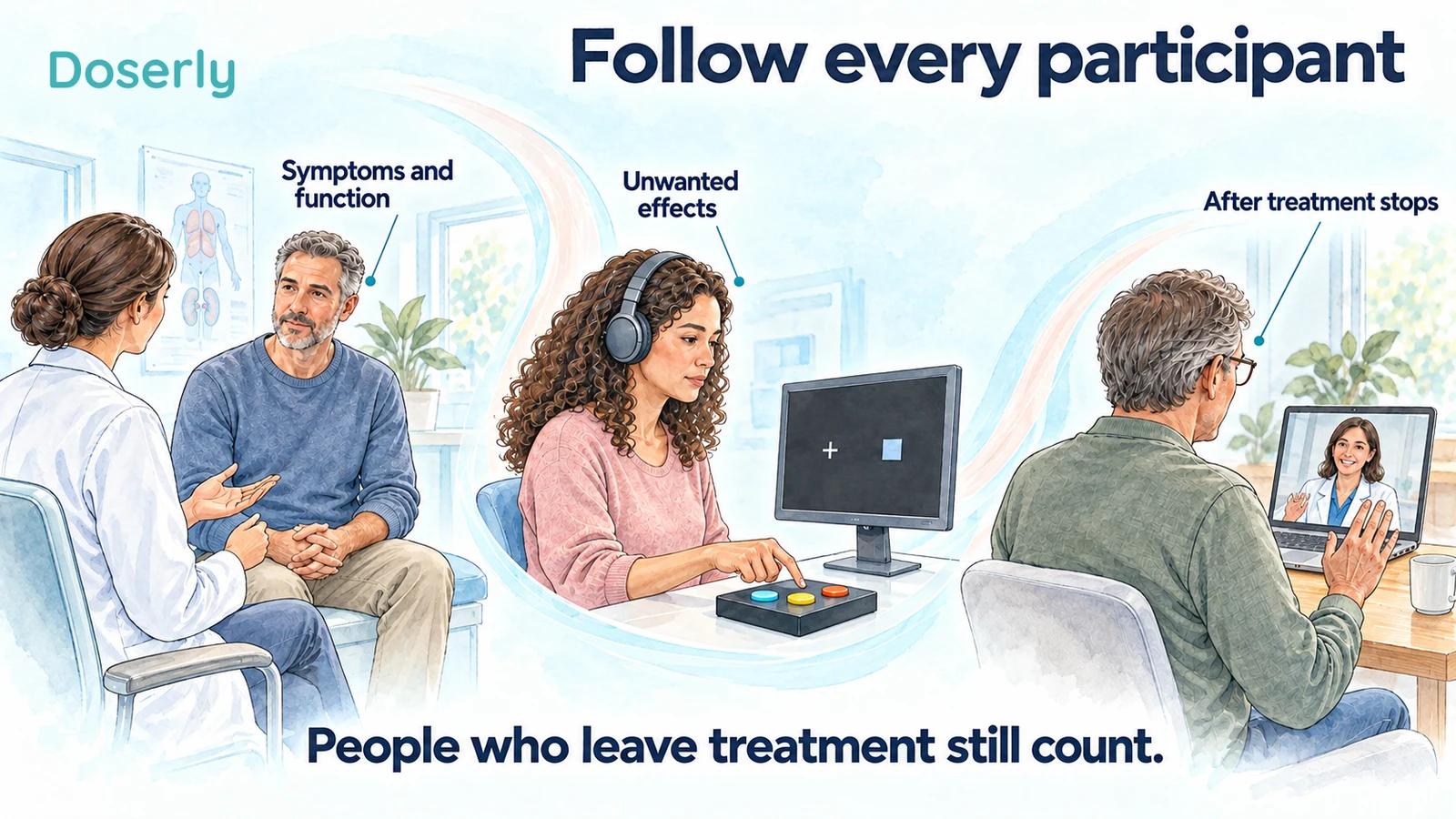
Keep following people who stop treatment
Discontinuation is part of the treatment experience. A participant may stop because of an adverse effect, lack of benefit, inconvenience or an unrelated event. Those reasons should be recorded.
Stopping the product need not mean stopping all outcome collection, provided the participant agrees. Continued assessment can reveal whether symptoms resolve, return or change after exposure ends.
The analysis should explain how missing data were handled and examine whether plausible assumptions alter the conclusion. Reporting only the people who completed every visit can create an overly favorable impression.
A participant-flow diagram helps readers see how many people were assigned, treated, followed and analyzed. CONSORT includes participant flow because these details affect interpretation. CONSORT reporting statement.
Separate immediate effects from durable benefit
A short trial can assess an early symptom response. It cannot establish that the benefit persists through months of ordinary life or that repeated exposure remains safe.
The study should distinguish treatment duration from follow-up duration. A visit months later does not mean participants received the product continuously for those months.
Follow-up after stopping can address recurrence of symptoms and possible discontinuation problems. These should be defined and assessed rather than summarized simply as an aftereffect.
If long-term use is the intended claim, the research program needs evidence matched to that intention. It may require several studies rather than one trial asked to answer every question at once.
Register the plan and report the whole result
Prospective registration makes the intended study easier to identify. A dated protocol and analysis plan help readers compare what was planned with what was reported.
The final report should make clear which outcomes were primary, which were secondary and which analyses were exploratory. If the plan changed, the timing and reason should be explained.
Funding, conflicts of interest and access to supporting materials also matter. They do not automatically invalidate a result, but transparency helps independent readers assess it.
CONSORT 2025 includes an expanded emphasis on open science and clear reporting. For Selank, accessible reporting would be particularly valuable because many existing clinical descriptions are difficult to appraise fully from indexed abstracts alone. CONSORT 2025 statement.
What would change the clinical conversation?
A well-reported positive study would provide an estimated benefit for a defined population, with uncertainty and a clear account of harms. Independent replication would make that estimate more dependable.
A negative study would also be useful. It could show that a promising mechanism or preliminary report does not translate into a worthwhile outcome under the tested conditions. Research is informative when it narrows uncertainty, not only when the result is favorable.
The strongest next step is therefore a focused, reproducible trial with meaningful outcomes and adequate follow-up. More biomarkers or more confident language cannot substitute for those features.
For patients, the Selank guide provides the existing context. The question a stronger trial should answer is practical: does this specific preparation help people with this specific problem enough to justify its risks and burden?
Sources
- Selank versus medazepam, 2008.
- Selank versus phenazepam, 2014.
- Selank added to phenazepam, 2015.
- FDA/ICH E10: choice of control group, 2001.
- CONSORT 2025 statement.
- FDA Selank acetate safety-information entry.