
Peptides
October 16, 2026
What a non-significant ipamorelin result actually means
On this page
Ipamorelin was investigated as a way to help the bowel recover after surgery. The clinical idea was plausible: stimulating the ghrelin receptor might improve gastrointestinal movement and help patients tolerate food sooner.
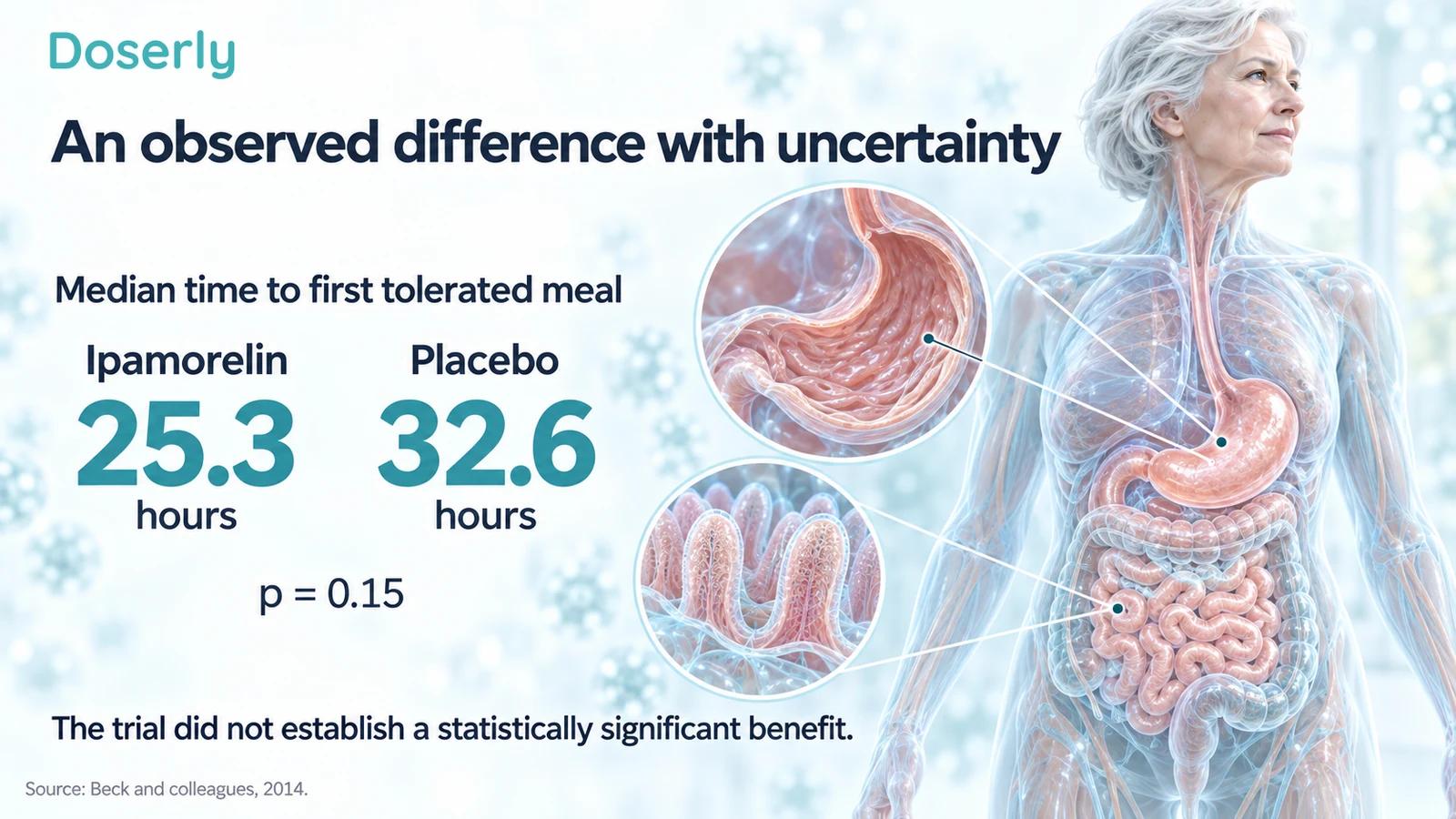
In the published randomized trial, the ipamorelin group reached the main meal-tolerance endpoint sooner in the numerical summary: a median of 25.3 hours compared with 32.6 hours for placebo. But the difference was not statistically significant, with p=0.15. The authors reported no significant differences in the key or secondary efficacy analyses. Primary trial report.
That result is neither proof that ipamorelin has absolutely no effect nor evidence that it reliably speeds recovery. To see why, it helps to look at what was measured, how the groups differed and what the statistical result can actually tell us.
What problem were researchers trying to treat?
After bowel surgery, gastrointestinal activity may temporarily slow or stop. This postoperative ileus can make it difficult to tolerate food and can complicate recovery. The trial's aim was a clinical benefit in hospitalized surgical patients, rather than a general increase in growth hormone.
Before the human study, investigators had tested ipamorelin in a rat surgical model. Some measures of bowel transit and recovery improved, depending on the treatment pattern and endpoint. That provided a rationale for human research, but it did not guarantee the same result in people. Preclinical study.
The human trial was registered as NCT00672074, a phase 2 randomized placebo-controlled investigation. The registry documents the study's identity and design; it should not be counted as an additional successful trial alongside the publication. Official registration.
Our ipamorelin guide explains why its ghrelin-receptor activity led researchers to examine gastrointestinal outcomes as well as GH release.
Who took part, and what did they receive?
The trial enrolled 117 adults undergoing small or large bowel resection. After exclusions before study treatment, 114 participants composed the safety and modified intention-to-treat populations: 56 received ipamorelin and 58 placebo.
Treatment was intravenous and given twice daily during the early postoperative period, stopping at discharge or after the specified treatment period of up to seven days. This was a monitored hospital study, not a trial of ongoing subcutaneous use in healthy adults. Publication; FDA review.
Random assignment was intended to make the groups comparable, and blinding reduced the influence of knowing which treatment someone received. These design features strengthen the comparison. They do not eliminate variation in recovery or make a small trial precise enough to answer every question.
The difference between 117 enrolled and 114 analyzed is also worth preserving. Quoting either number without identifying what it represents can create avoidable confusion about the study population.
What was the main outcome?
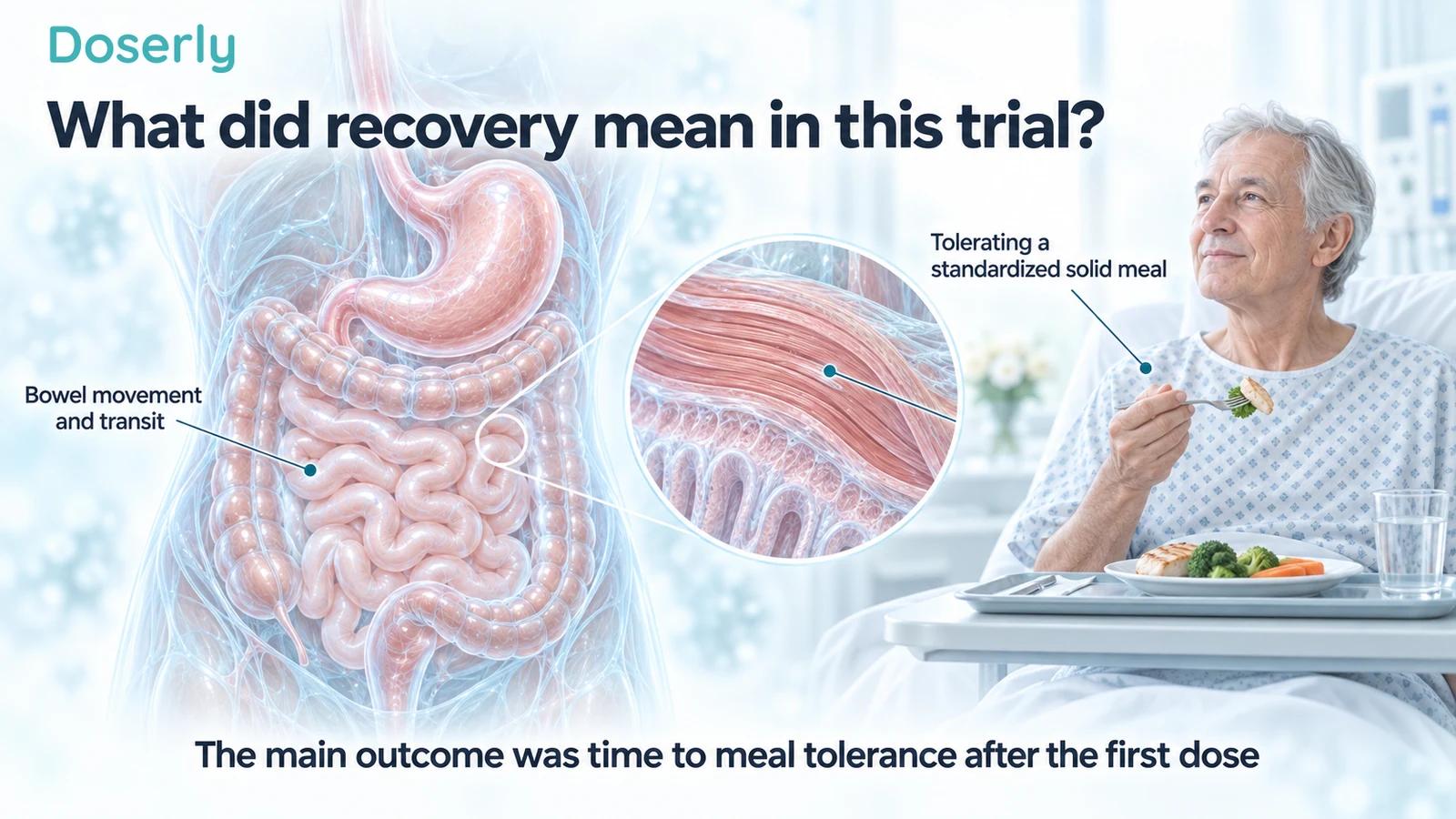
The key efficacy endpoint was the time from the first study dose to tolerance of a standardized solid meal. FDA's review describes a defined quantity consumed within a set period, with criteria involving vomiting and worsening nausea. This was a structured assessment, not a casual report of appetite.
The starting point matters. The headline times were measured after the first dose, not necessarily from the end of surgery. Changing the starting point changes the meaning of “recovery time.”
The study also examined other measures, including bowel movement, broader gastrointestinal recovery and discharge-related outcomes. These can help explain the clinical picture, but they should not replace the main result simply because one analysis looks more favorable. FDA review of endpoints.
A patient might value several hours less discomfort or an earlier return to eating. Whether a treatment reliably produces that benefit is different from whether the observed medians happen to be separated by several hours.
What do 25.3 and 32.6 hours mean?
A median is a measure of the center of a distribution. It is not the same as an arithmetic average. The paper reported a median time of 25.3 hours in the ipamorelin group and 32.6 hours with placebo.
Subtracting those values gives 7.3 hours. That is a descriptive difference between the reported group medians. It is not evidence that every treated patient recovered 7.3 hours sooner, nor is it a proven treatment effect ready to apply to another patient. Published results.
People recover at different rates, and a sample is only one realization of what a study could observe. Statistical analysis evaluates the difference in the context of that variability and the study design.
The abstract reports p=0.15 for the comparison. We should preserve that result alongside the numerical difference, rather than quoting the faster median alone. Conversely, we should not erase the observed difference and pretend the two groups had identical results.
What does p=0.15 actually tell us?
A p-value describes how incompatible the observed data are with a specified statistical model, under its assumptions. In a conventional no-difference test, it concerns results at least as extreme as those observed if the no-difference model holds.
It does not mean that there is a 15% probability the drug is ineffective, an 85% probability it works, or a 15% probability that chance caused the result. It also does not measure how important the effect would be to patients. These are central cautions in the American Statistical Association's guidance. ASA statement.
The reported result did not meet the conventional threshold used for statistical significance. That limits the support for an efficacy claim from this comparison.
A confidence interval for an appropriate effect estimate would help show the range of uncertainty. The abstract's two medians and p-value are not enough to reconstruct a trustworthy interval, so this article does not invent one.
Why “not significant” is not the same as “equivalent”
A trial can fail to demonstrate a difference because the true effect is small, because results vary substantially, because the sample is limited, or because there is no worthwhile effect. More than one explanation can fit an inconclusive result.
Establishing that two treatments are equivalent is a separate statistical objective. It requires an acceptable margin chosen in advance and a design capable of assessing that margin. A nonsignificant superiority comparison does not automatically meet those requirements.
For this trial, the appropriate wording is that a clear efficacy benefit was not demonstrated. Saying “ipamorelin definitely does nothing” goes beyond the result. Saying “it works, but the trial was too small” also goes beyond it.
The study's limitations are reasons to be cautious and, if scientifically justified, to investigate further. They are not a way to convert an unmet endpoint into a positive finding.
Could the study simply have needed more participants?
Possibly, but that possibility is not proof. A larger trial can provide a more precise estimate. The estimate itself may also change when more people are studied.
The investigators described the study as small and involving patients with a broad range of underlying conditions. FDA's review also notes limitations in eligibility and subgroup size. Publication; FDA assessment.
It would therefore be reasonable to say that the result leaves uncertainty. It would not be reasonable to assume that enrolling more people would necessarily produce a significant benefit of exactly 7.3 hours.
A follow-up study would need a justified expected effect, an appropriate sample-size calculation and a clear clinical question. Repeating a favorable number without its uncertainty does not accomplish that planning.
What about a favorable subgroup?
FDA describes an analysis in which participants undergoing open laparotomy appeared to have shorter bowel-recovery times with ipamorelin. That can identify a hypothesis worth examining, especially if surgery type affects the biological problem.
But a favorable subgroup does not overturn the overall main result by itself. The subgroup is smaller, and examining multiple outcomes or groups increases the opportunities for an apparently favorable finding.
A convincing claim that treatment works differently by surgery type would need a suitable comparison of the treatment effects across groups, along with attention to whether the analysis was planned. A positive-looking result in one subgroup and a negative-looking result in another do not automatically prove a difference between them.
The careful interpretation is that the subgroup observation may inform future research. It does not establish routine efficacy for all postoperative patients. FDA discussion.
Does “well tolerated” change the efficacy conclusion?
No. Safety and efficacy are separate questions. The paper described short-term treatment as well tolerated, but that statement cannot make an uncertain efficacy result positive.
Nor does it mean no adverse events occurred. Surgical patients in both groups experienced events, including serious complications. FDA notes two deaths among ipamorelin recipients and explicitly states that their relationship to the drug was unclear. FDA safety assessment.
A balanced account preserves both sides: the study did not establish efficacy, and its short duration and clinical setting do not establish long-term safety in other uses. Neither conclusion requires assigning every postoperative complication to the drug.
What can a reader take from this result?
The trial is useful because it tested a real clinical question with randomization and a placebo comparison. Its result should remain visible even though it was not a clear success.
For someone considering ipamorelin for sleep, muscle or general wellness, it also has limited direct relevance: those outcomes and populations were not studied. An inconclusive bowel-recovery trial cannot validate unrelated benefits.
The most accurate summary is specific: the ipamorelin group had a shorter reported median time to meal tolerance, but the study did not demonstrate a statistically significant efficacy benefit. That leaves room for further research without presenting an unproven effect as established care.
When reading a claim based on this trial, keep the population, route, endpoint, numerical difference and uncertainty together. Those details provide a much more useful answer than either “failed completely” or “worked faster.”
Explore the research
- Prospective, randomized, controlled, proof-of-concept study of the Ghrelin mimetic ipamorelin for the management of postoperative ileus in bowel resection patients (2014): Abstract via Europe PMC freshly reviewed; full safety details cross-checked against FDA; small heterogeneous surgical sample.
- FDA Briefing Document: Ipamorelin-Related Bulk Drug Substances, October 29, 2024 (2024): Advisory briefing, not itself a final legal determination; safety events do not prove causality.
- Safety and Efficacy of Ipamorelin for Management of Post-Operative Ileus (NCT00672074) (2008): Registration is not a separate efficacy result.
- Efficacy of ipamorelin, a novel ghrelin mimetic, in a rodent model of postoperative ileus (2009): Rodent surgery model does not establish human efficacy.
- American Statistical Association Releases Statement on Statistical Significance and P-Values (2016): General statistical principles, not reanalysis of ipamorelin trial.