
Supplements
October 16, 2026
What chondroitin trials can tell you about joint symptoms—and what they cannot
On this page
A chondroitin study can report less knee pain without showing that cartilage has regrown. Another can find less cartilage loss on an MRI while participants’ symptoms remain similar. Neither result is inherently contradictory: the studies are measuring different parts of the problem.
This distinction is especially useful when a headline promises “joint protection.” Protection might mean a lower symptom score, a small difference in joint-space narrowing, or less tissue loss in a selected imaging region. Those outcomes matter in different ways, and none should be silently substituted for another.
The strongest way to read chondroitin research is to keep four details together: the preparation, the joint and population studied, the comparator, and the outcome. Several trials offer encouraging findings. Others do not establish a benefit. Understanding their boundaries produces a more useful conclusion than counting positive headlines.
Why a cartilage ingredient still needs clinical testing
Chondroitin is a component of cartilage involved in its resistance to compression. Oral products usually contain chondroitin sulfate. Some countries use particular preparations as prescription medicines, while in the United States it is sold as a dietary supplement, often combined with glucosamine. NCCIH overview
The biological connection makes research plausible; it does not establish what swallowing a preparation will do to a painful joint. A constituent of cartilage is not automatically a replacement part that travels intact from a capsule to the site of damage.
Likewise, “pharmaceutical grade” describes the preparation and its quality context. It is relevant when matching a product to a study, but it is not an independent clinical outcome. A carefully characterized product still needs a trustworthy comparison demonstrating a meaningful benefit.
These distinctions prevent two opposite mistakes: treating all chondroitin preparations as proven equivalents, or assuming that a preparation with favorable manufacturing credentials must work.
What CONCEPT found about knee symptoms
The 2017 CONCEPT trial randomized 604 people with knee osteoarthritis to pharmaceutical-grade chondroitin sulfate, celecoxib, or placebo for six months. Its chondroitin preparation supplied 800 mg daily. Pain on a visual analogue scale and the Lequesne index of symptoms and functional limitation were the two primary outcomes. CONCEPT primary report
Mean pain reduction was 42.6 mm with chondroitin, 39.5 mm with celecoxib, and 33.3 mm with placebo. The chondroitin-placebo difference was therefore 9.3 mm, rather than the full 42.6 mm improvement within the chondroitin group. Both active groups also improved the Lequesne index more than placebo.
This supports a symptom benefit for that preparation under those trial conditions. It does not establish cartilage repair: the investigators explicitly designed the trial around symptoms, not bone or cartilage markers. The study was sponsored by IBSA, a company marketing chondroitin sulfate, and the publication discloses editorial assistance from the sponsor.
Industry sponsorship does not make a result automatically invalid. It does make transparent methods, complete reporting and independent replication particularly valuable. A product-specific positive result is a useful piece of evidence, not a substitute for examining the rest of the literature.
“Similar to celecoxib” needs careful interpretation
The CONCEPT title describes chondroitin as being as effective as celecoxib. The results showed no statistically significant difference between those active groups on the reported outcomes. That wording is easy to overextend into “these treatments are interchangeable.”
A failure to detect a difference is not, by itself, proof that two treatments are equivalent for every patient or purpose. Establishing equivalence requires a design and analysis that specify what difference would be small enough to count as equivalent. The CONCEPT sample-size calculation was based on a chondroitin-versus-placebo pain difference. CONCEPT methods
The practical interpretation is that both active groups outperformed placebo in this trial and their average results were similar. It is not a recommendation to replace a prescribed medicine without discussing its indication, benefits and risks. A six-month symptom comparison cannot settle every difference in onset, safety, interactions or suitability.
It also cannot tell you whether a different retail chondroitin preparation would reproduce the same result. Similar words on a label do not establish that the trial’s intervention has been replicated.
The larger GAIT study provides an important counterweight
GAIT randomized 1,583 people with symptomatic knee osteoarthritis to glucosamine, chondroitin sulfate, their combination, celecoxib, or placebo for 24 weeks. Chondroitin alone did not significantly outperform placebo on the primary outcome of achieving at least a 20% decrease in knee pain. Its response rate was 5.3 percentage points above the 60.1% placebo rate, with a P value of 0.17. GAIT primary report
The overall combination comparison was also not significant. A favorable result appeared for the combination in an exploratory subgroup with more severe baseline pain. That subgroup cannot establish the efficacy of chondroitin alone, and it should not replace the overall trial finding.
GAIT and CONCEPT therefore should both remain visible in a fair account. Their preparation details and outcome definitions differ, but those differences do not automatically explain the disagreement. Differences in populations, design, chance, reporting and bias also need consideration.
For someone trying to judge a product, the useful response is to ask how closely its evidence matches the intended use. Choosing only the favorable study overstates confidence; declaring every positive result impossible because one large trial was negative also loses information.
Hand evidence is its own research story
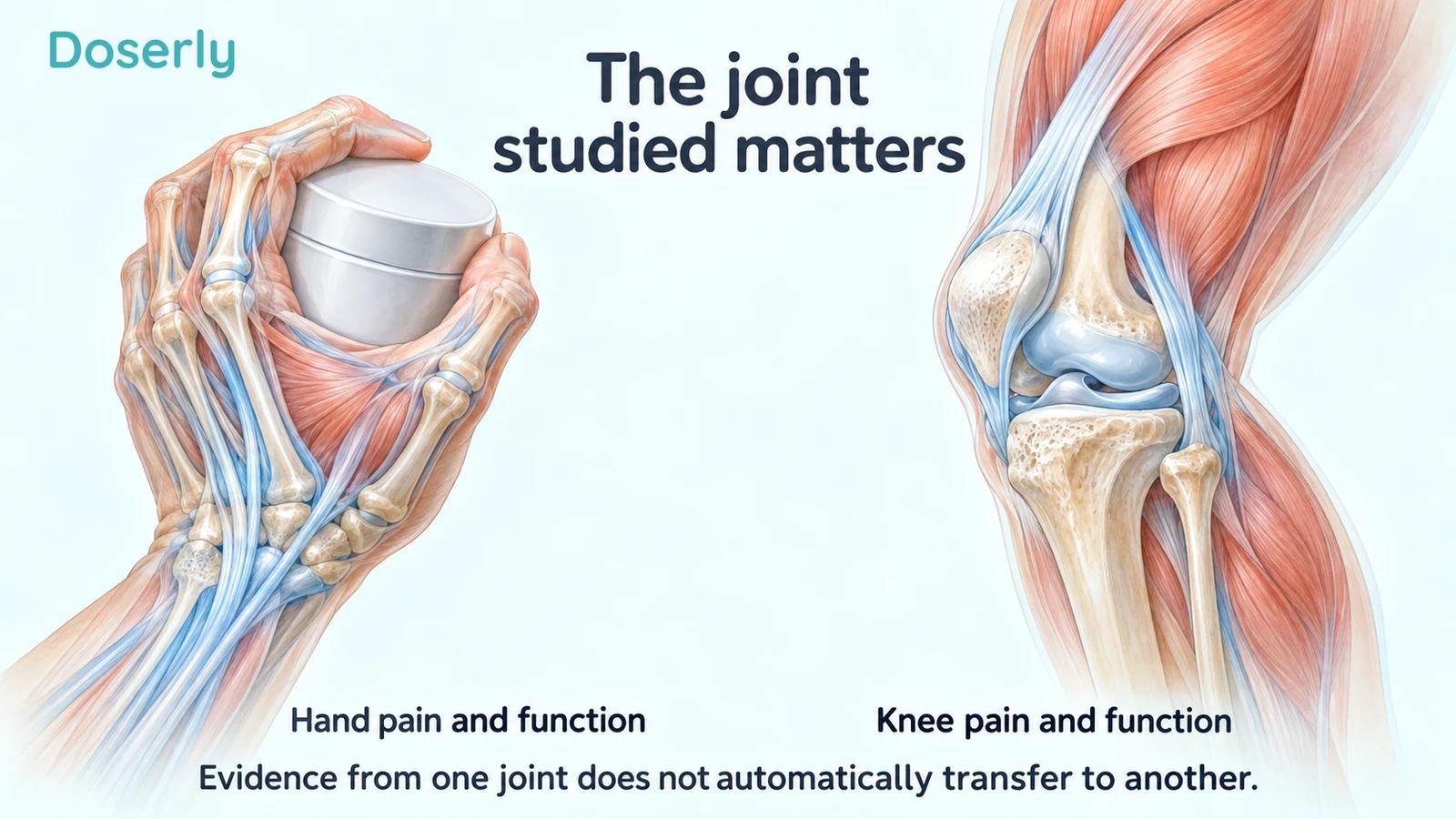
A knee trial does not automatically answer whether a supplement helps the hand. A 2011 single-center trial addressed that separate question in 162 people with symptomatic hand osteoarthritis. Participants received highly purified chondroitin sulfate or placebo for six months. Gabay and colleagues
The chondroitin group had a greater improvement in hand pain and in a hand-specific function index. The between-group pain difference was 8.7 mm on a 100-mm visual analogue scale. Grip strength and acetaminophen consumption did not differ significantly between groups.
This is a useful example of why “improved function” should not be expanded to “improved every measure of hand performance.” A questionnaire about hand function and a grip-strength measurement are related but distinct endpoints.
The distinction also appears in the ACR/AF guideline: it conditionally recommends chondroitin for hand osteoarthritis while strongly recommending against it for knee or hip osteoarthritis. A conditional recommendation reflects a qualified decision, not a universal endorsement for all joints. ACR/AF guideline
What the longer structural studies add
The two-year STOPP trial randomized 622 people with knee osteoarthritis to chondroitin sulfate or placebo. Its primary outcome was loss of minimum joint-space width in the medial knee compartment on radiographs. Average loss was 0.07 mm with chondroitin and 0.31 mm with placebo, favoring chondroitin. Pain also improved faster in the treatment group. STOPP primary report
That is evidence of a radiographic difference in that study. It should not be translated into a claim that lost cartilage was rebuilt. Preserving more of an imaging measure over time and creating new tissue are different propositions.
The LEGS trial offers a less favorable result for chondroitin alone. Among 605 participants assigned to glucosamine sulfate, chondroitin sulfate, their combination, or placebo, neither single ingredient showed a significant structural effect. The combination had a small adjusted advantage in joint-space narrowing, but no treatment group demonstrated a significant symptom advantage over placebo. LEGS primary report
The combination finding belongs to the combination. It does not repair the negative single-ingredient result by association. Together, these trials explain why the structural literature remains unsettled rather than providing a simple promise of joint preservation.
MRI can reveal tissue changes without better symptoms
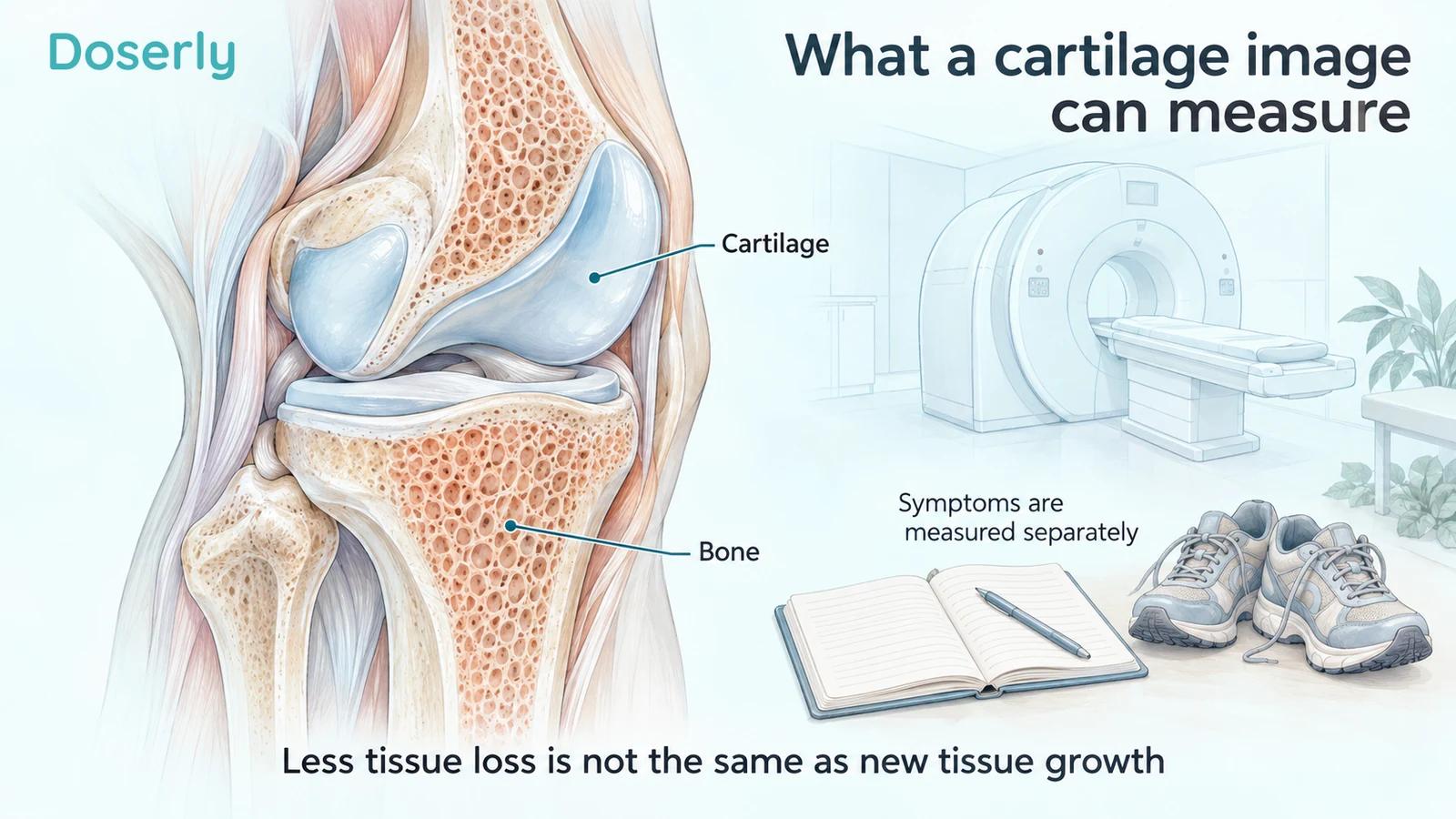
A small MRI pilot trial enrolled 69 people with knee osteoarthritis and clinical signs of synovitis. It compared chondroitin sulfate with placebo for six months, followed by a six-month open-label phase in which both groups received chondroitin. Wildi and colleagues
The initial chondroitin group had less cartilage volume loss in several measured regions, with some later bone-marrow-lesion differences. Disease symptoms were similar between groups. This makes the study especially informative: the imaging signal did not come with a demonstrated symptom advantage.
The second half also needs its own label. Once both groups are taking the active preparation, the comparison no longer represents a full year of continuous chondroitin versus continuous placebo. It reflects the original allocation followed by a shared-treatment period.
Small pilot studies can identify promising signals and help design larger trials. They cannot, by themselves, establish that a treatment prevents joint replacement, restores normal cartilage, or will help an unselected person whose knee hurts. The participants’ synovitis and other eligibility criteria also matter when considering applicability.
Read a result in the units of the decision
For a symptom study, look for the difference between assigned groups, its uncertainty, and the scale used. A large before-and-after improvement can coexist with a modest treatment advantage because the comparison group improves too. A statistically significant average difference also does not mean that every participant experienced a worthwhile change.
For an imaging study, ask which tissue or measurement changed, over what interval, and whether the study demonstrated a corresponding improvement in symptoms or major clinical outcomes. Avoid converting millimetres of joint space or a regional MRI finding into a promise about years of pain-free life.
For a product claim, check whether the cited trial tested chondroitin alone or a combination, and whether the formulation matches. “Clinically studied ingredients” can describe a blend whose exact combination has never been tested. The evidence needs to follow the intervention that was actually assigned.
The Doserly chondroitin guide covers ingredient and product background. The glucosamine guide is useful when reading combination studies or comparing labels that contain both.
Where this leaves a practical joint-care plan
The ACR/AF recommendation against chondroitin for knee and hip osteoarthritis is an important part of the decision, even when a particular trial is encouraging. It reflects the panel’s assessment of the broader evidence. The separate hand recommendation should not be borrowed to justify use for the knee. ACR/AF guideline
Safety is also product- and person-dependent. NCCIH reports no major safety problems identified in large osteoarthritis studies, but notes an association with increased bleeding risk in people taking warfarin and limited pregnancy or breastfeeding information. Discuss the complete product and medication list with a pharmacist or clinician. NCCIH safety information
If a clinician and patient are evaluating a trial of a supplement, agree beforehand on what improvement would be useful and when to reassess. Keep track of daily activity, symptom patterns and other treatment changes. That can support a clearer conversation without pretending a personal before-and-after record proves causation.
Chondroitin research contains real positive findings, real negative findings, and important differences between joints and outcomes. Its most defensible promises are therefore specific and limited. A symptom trial can support a symptom claim for the studied preparation; it cannot silently become proof of cartilage regeneration or a guarantee for every joint supplement.
Explore the research
- CONCEPT: pharmaceutical-grade chondroitin and knee symptoms
- GAIT: chondroitin, glucosamine and combination comparisons
- Hand osteoarthritis trial
- STOPP: two-year radiographic progression study
- LEGS: single and combination preparations
- MRI pilot: cartilage loss and symptoms
- ACR/AF osteoarthritis guideline
- NCCIH overview and safety information