
Supplements
October 16, 2026
Vitamin E is a reminder that antioxidant is not a clinical outcome
On this page
Vitamin E helps protect cell membranes from oxidative damage. That is a real biological role, and getting enough vitamin E is part of adequate nutrition. The harder question is whether taking extra vitamin E for years prevents cancer, heart attacks or other diseases.
Large randomized trials have tested that question. They did not establish a general prevention benefit, and some identified harm. The most familiar example is SELECT, in which men assigned vitamin E alone developed prostate cancer more often than men assigned placebo.
Understanding those findings does not require treating vitamin E as a harmful substance in all contexts. It requires separating ordinary dietary adequacy, treatment of deficiency and concentrated supplementation for disease prevention. Our vitamin E guide covers the nutrient’s forms and wider clinical context.
What does “antioxidant” actually describe?
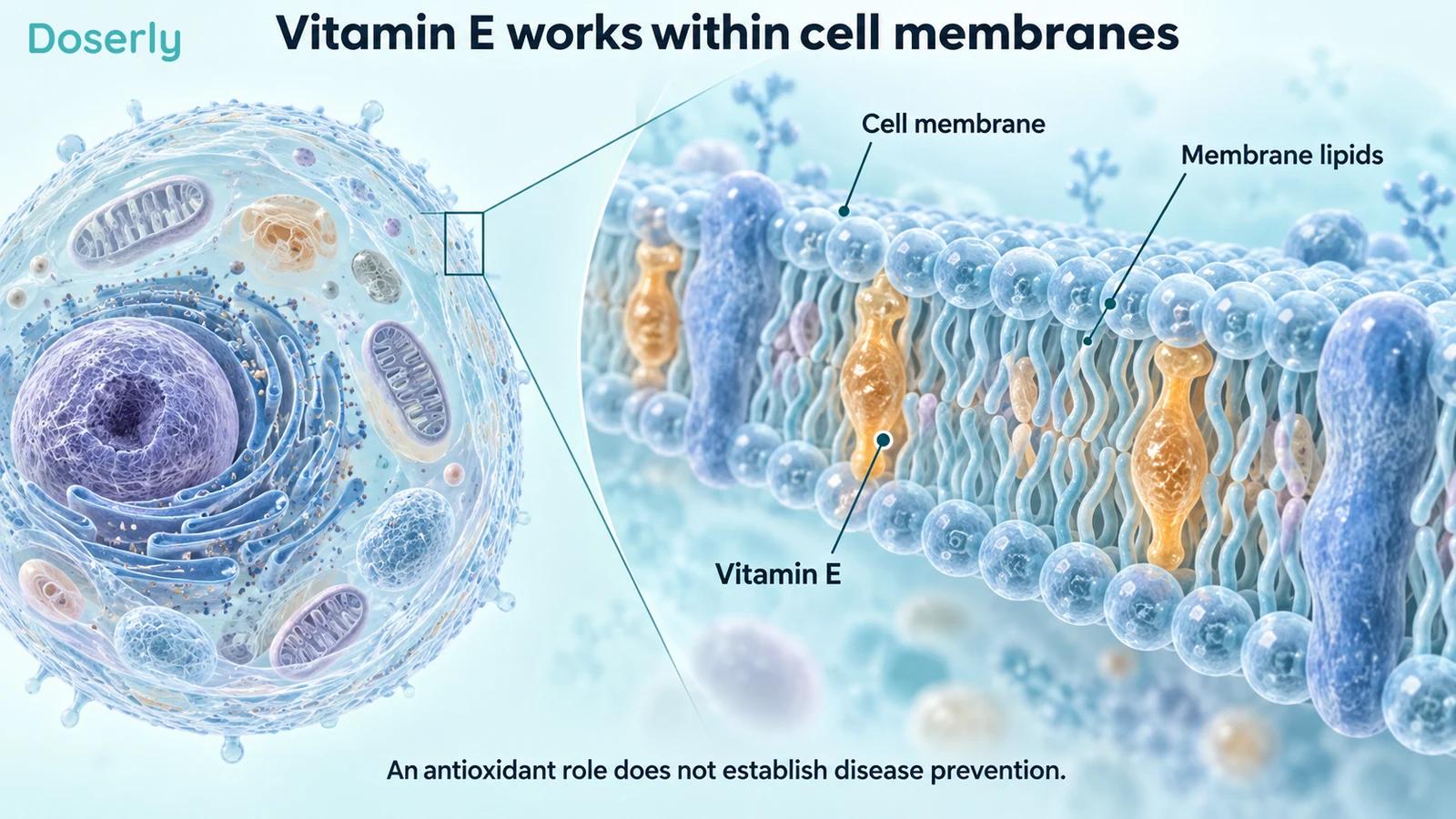
Oxidation is part of normal chemistry in the body. Reactive molecules can participate in signaling but can also damage cellular components when their production and handling become unbalanced. Vitamin E is fat-soluble and helps limit oxidation involving lipids, including those in cell membranes.
Vitamin E is also a family of compounds, including tocopherols and tocotrienols. Alpha-tocopherol is the form used to meet human vitamin E requirements. Products that use different forms, combinations or amounts should not be assumed to share an identical clinical effect. NIH vitamin E fact sheet.
The word antioxidant identifies a biochemical property. It does not specify whether a person will have fewer strokes, less disability or a lower cancer risk. Those outcomes depend on what happens across the whole body over time. A laboratory effect can provide a reason to conduct a trial; it cannot supply the trial’s answer.
What SELECT tested
The Selenium and Vitamin E Cancer Prevention Trial, or SELECT, tested whether selenium, vitamin E or their combination could prevent prostate cancer. The primary analysis included 34,887 men across four groups. Participants were selected older men without findings suspicious for prostate cancer at enrollment.
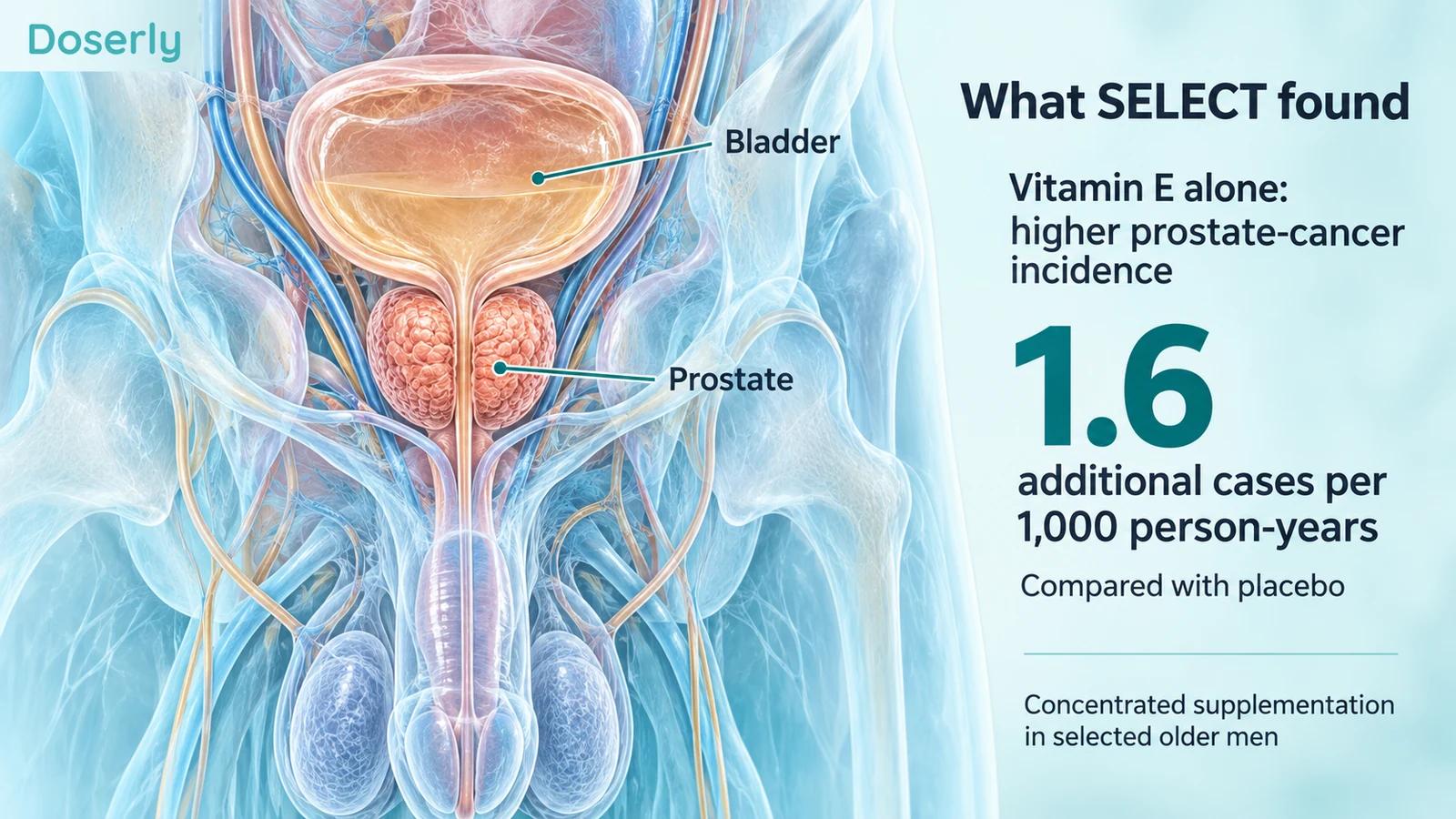
The vitamin E group received 400 IU daily of synthetic all-rac-alpha-tocopheryl acetate. In the 2011 follow-up, prostate cancer had been diagnosed in 620 of 8,737 men assigned vitamin E alone and 529 of 8,696 assigned placebo. The hazard ratio was 1.17, with a 99% confidence interval of 1.004–1.36. SELECT follow-up.
The trial therefore found an increased incidence with the studied vitamin E regimen, rather than prevention. Selenium alone and the combination did not show a statistically significant reduction compared with placebo. Their results should not be used to recommend adding selenium as a remedy for taking vitamin E.
The exposure was a concentrated supplement regimen. SELECT did not test whether eating nuts, seeds or vegetable oils causes prostate cancer.
What does 1.6 additional cases per 1,000 person-years mean?
SELECT reported an absolute increase of 1.6 prostate-cancer cases per 1,000 person-years with vitamin E alone. Person-years combine people and observation time: 1,000 people observed for one year contribute approximately 1,000 person-years, as do 500 people observed for two years.
This is a rate difference. It is not a 1.6% annual personal risk, and it is not the same quantity as the 17% relative increase represented by the hazard ratio. The two descriptions help answer different questions: how large the difference was on an absolute scale, and how the groups compared over follow-up. SELECT report.
A personal risk estimate would require more than the trial average, including baseline risk and the applicability of its population and regimen. Multiplying the annual rate difference indefinitely would also assume that the difference stays constant over time, which the result does not establish.
What happened in women?
The Women’s Health Study provides a different population and formulation. It enrolled 39,876 initially healthy women aged at least 45 and compared 600 IU of natural-source vitamin E on alternate days with placebo. Average follow-up was 10.1 years.
There were 482 major cardiovascular events with vitamin E and 517 with placebo, a difference that was not statistically significant. Total invasive cancer was also unchanged: 1,437 versus 1,428 cases. Cardiovascular death was reduced in a component analysis, but overall mortality did not improve. Women’s Health Study.
That favorable component deserves acknowledgment. It does not turn the neutral primary cardiovascular outcome and cancer result into a broad prevention success. A conclusion should reflect the outcomes the trial was designed to test and the overall pattern, not select the most attractive finding.
This study also makes it difficult to dismiss disappointing results solely as a problem with synthetic vitamin E. It used a natural-source preparation and still did not show the proposed overall prevention benefit.
What about people with vascular disease or diabetes?
The HOPE trial and its HOPE-TOO extension examined vitamin E in people aged at least 55 with vascular disease or diabetes. The intervention was 400 IU daily of natural-source vitamin E or placebo. Median follow-up across the extended investigation was seven years.
Cancer incidence, cancer deaths and major cardiovascular events did not significantly improve. Heart failure, a secondary outcome, was more frequent with vitamin E: relative risk 1.13, with a 95% confidence interval of 1.01–1.26. HOPE-TOO report.
Not all original participants continued taking the study intervention during the extension; some participated only through follow-up. That complicates interpretation of long-term exposure. Even with this limitation, the findings do not support assuming extra vitamin E protects the heart in a high-risk patient.
Heart failure is a clinical condition in which the heart cannot meet the body’s needs adequately. A possible increase in that outcome matters more to a patient than a favorable change in an isolated oxidation marker.
What prevention guidance says
The US Preventive Services Task Force recommends against vitamin E supplementation for preventing cardiovascular disease or cancer in community-dwelling, nonpregnant adults within the recommendation’s scope. It concludes that supplementation has no net benefit for those purposes. USPSTF recommendation.
This is a recommendation about prevention, not a declaration that no one ever needs vitamin E treatment. It does not cover every clinical circumstance, including known nutritional deficiency. Keeping that boundary clear helps prevent two opposite mistakes: taking extra indefinitely because vitamin E is essential, or stopping necessary replacement because a cancer-prevention trial was disappointing.
The same recommendation does not classify every vitamin or multivitamin identically. Evidence considered insufficient for another product is not equivalent to demonstrated benefit. Each claim still needs to be matched with the actual formulation and health goal.
Dietary adequacy is a different goal
The adult recommended allowance is 15 mg of alpha-tocopherol daily. Nuts, seeds and certain vegetable oils are useful food sources. Eating foods that contribute vitamin E also supplies other nutrients and changes the composition of the diet; taking an isolated capsule does not reproduce that pattern. NIH dietary sources and requirements.
Frank deficiency is uncommon in otherwise healthy people, but it can occur with disorders of fat absorption or rare inherited conditions. Neurological or other symptoms in that setting need clinical assessment. Correcting a deficiency addresses inadequate availability of an essential nutrient; attempting to prevent cancer in adequately nourished adults is a different intervention.
A clinician may use a specialized preparation or amount when absorption is impaired. That should not be copied as a wellness regimen. Conversely, SELECT is not evidence that people with documented deficiency should leave it untreated.
For everyday food choices, the prevention trials provide no reason to remove vitamin-E-containing foods solely because a high-dose supplement trial found harm.
Natural, synthetic and mixed forms need precise labels
Vitamin E labels can use milligrams or older international units. The conversion differs by form: NIH lists one IU of natural alpha-tocopherol as 0.67 mg and one IU of synthetic alpha-tocopherol as 0.45 mg. Thus identical IU and milligram numbers are not interchangeable.
Ingredient names help: natural-source alpha-tocopherol is often labeled “d-alpha,” while synthetic material may be labeled “dl-alpha” or “all-rac.” Tocotrienol or mixed-tocopherol products are different formulations again. NIH forms and label conversions.
These distinctions matter for interpreting exposure and comparing a product with a trial. They do not establish that a less-studied form delivers the benefits a studied form failed to provide. “Not the same formulation” is a reason to seek relevant evidence, not proof of superiority.
If a product combines multiple forms, record the full label rather than reducing it to “vitamin E.” That detail helps a clinician identify overlap with other products and avoids comparing amounts expressed in different units.
Bleeding and medicine interactions deserve their own review
High-dose vitamin E can interfere with blood clotting. NIH identifies particular concern when it is combined with anticoagulant or antiplatelet medicines, especially when vitamin K intake is low. The exact amount at which a clinically significant interaction occurs is uncertain. NIH vitamin E interactions.
This risk is separate from SELECT’s prostate-cancer finding. A person does not need to match SELECT’s population for an interaction review to be useful. Tell a pharmacist or prescriber about the actual amount and every product containing vitamin E, including combination formulas.
Unusual bleeding should not be dismissed as a harmless supplement effect. Seek appropriate medical assessment rather than changing prescribed blood-thinning treatment yourself. Before a procedure, follow the treating team’s instructions about supplements; an internet timing rule cannot account for the procedure and medicines involved.
What if vitamin E is part of an eye formula?
AREDS and AREDS2 are combinations studied for specific stages of age-related macular degeneration. Vitamin E is one component. A benefit of the complete formula does not show that vitamin E alone prevents eye disease, just as a neutral single-vitamin trial does not fully answer the combination question.
The National Eye Institute advises discussing the formula with an eye-care professional and reviewing other medicines and supplements. These products are not general prevention for everyone with healthy eyes. NEI AREDS/AREDS2 guidance.
If you have a recommended eye formula, keep that indication visible during a supplement review. The useful question is whether the whole regimen fits your diagnosis and other exposures, not whether one ingredient sounds favorable or unfavorable in isolation.
A more useful way to review your routine
Write down the reason for vitamin E use, its exact form and amount, and whether it appears in other products. If the reason is simply “antioxidant protection,” ask what clinical outcome is expected and which human evidence supports it.
A dated Doserly record can help document formulation changes and the rest of the regimen. It cannot detect silent long-term effects or prove prevention because you felt well while taking something. That is why large trials with appropriate comparators are necessary for these questions.
Vitamin E’s normal biological role remains important. The clinical lesson is that more exposure does not automatically improve that role in a way that benefits health. The vitamin E guide offers further background for a discussion grounded in the specific purpose of treatment.
Sources
- NIH: vitamin E.
- SELECT follow-up, 2011.
- Women’s Health Study, 2005.
- HOPE-TOO, 2005.
- USPSTF prevention recommendation, 2022.
- NEI: AREDS/AREDS2 questions.