
Supplements
October 16, 2026
Vitamin D and fractures: what VITAL did—and did not—settle
On this page
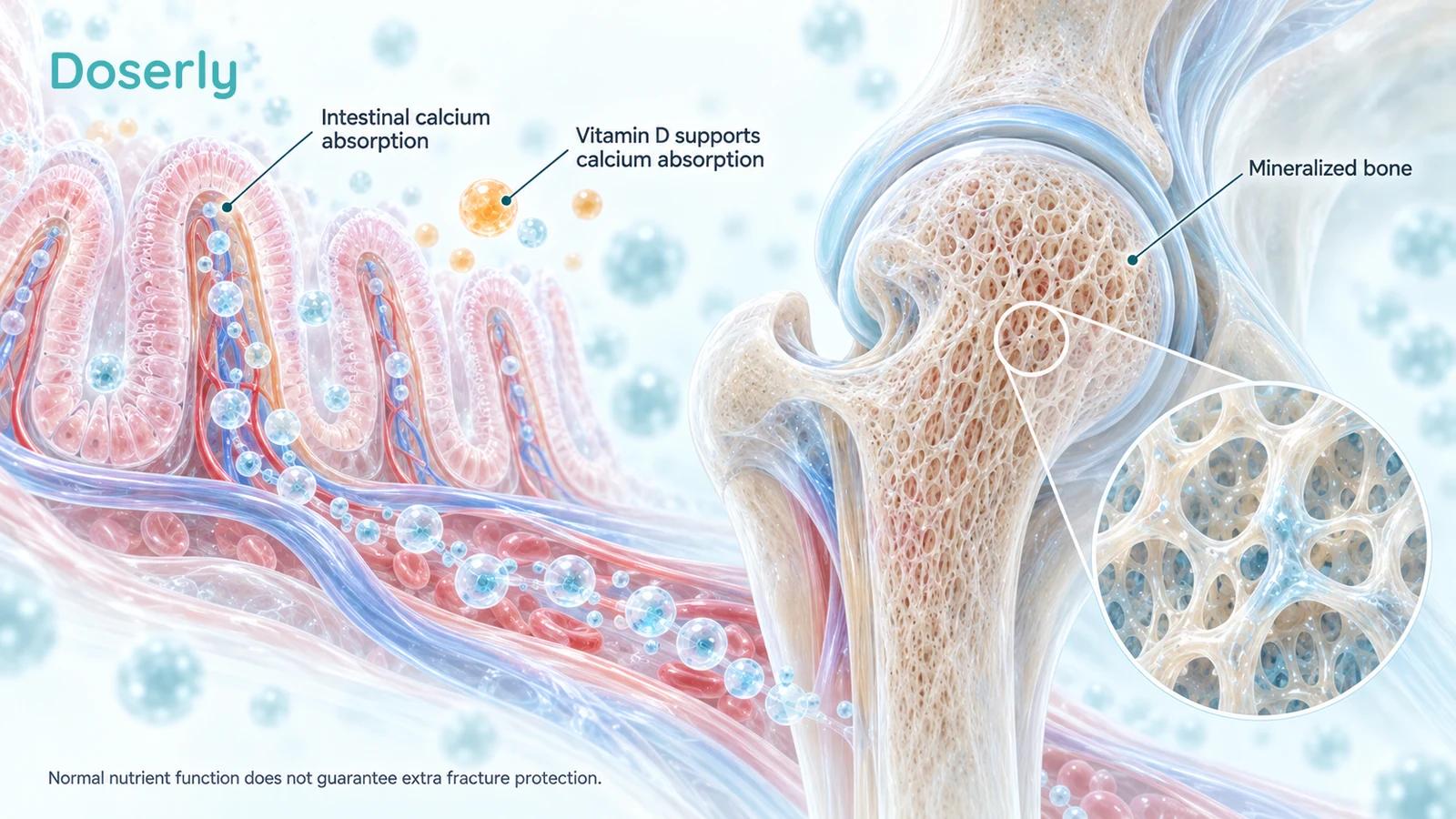
Vitamin D helps the body absorb calcium and supports normal bone mineralization. Severe deficiency can cause osteomalacia in adults, a condition in which bone does not mineralize properly. Those established functions make vitamin D important, but they do not guarantee that adding more will prevent fractures in everyone who already has an adequate supply. NIH vitamin D fact sheet.
The VITAL fracture study tested that broader prevention question. It found that taking 2,000 IU of vitamin D3 daily did not significantly reduce fractures in the population studied. The participants were not selected because they had vitamin D deficiency, osteoporosis or low bone mass. That is why the result should neither be dismissed nor interpreted as a reason to leave a diagnosed deficiency untreated. VITAL fracture report.
The useful distinction is between ensuring enough of an essential nutrient and using additional supplementation as a fracture-prevention treatment. Understanding that distinction can make a conversation about blood tests, supplements or osteoporosis care much clearer. Our vitamin D3 guide explains the nutrient's forms and wider clinical context.
Why normal bone biology does not predict the trial result
Bone is living tissue. Its strength depends on mineral content, structure, remodeling and the forces placed on it. Calcium provides much of the mineral component, while vitamin D helps maintain the conditions needed for mineralization. A fracture also depends on what happens to the person: a fall, an impact or a load the bone cannot withstand.
This makes fracture prevention more complicated than raising one laboratory number. An intervention could increase vitamin D levels without meaningfully changing the person's fall risk or bone strength. It could correct a real nutritional problem while leaving other causes of fragility untouched.
Calcium and vitamin D also have different roles. Calcium is a mineral supplied by foods and, when appropriate, supplements. Vitamin D is involved in its absorption and regulation. Taking one does not automatically supply the other, and a blood calcium measurement does not directly tell you how much calcium a person eats. NIH calcium fact sheet.
What VITAL tested
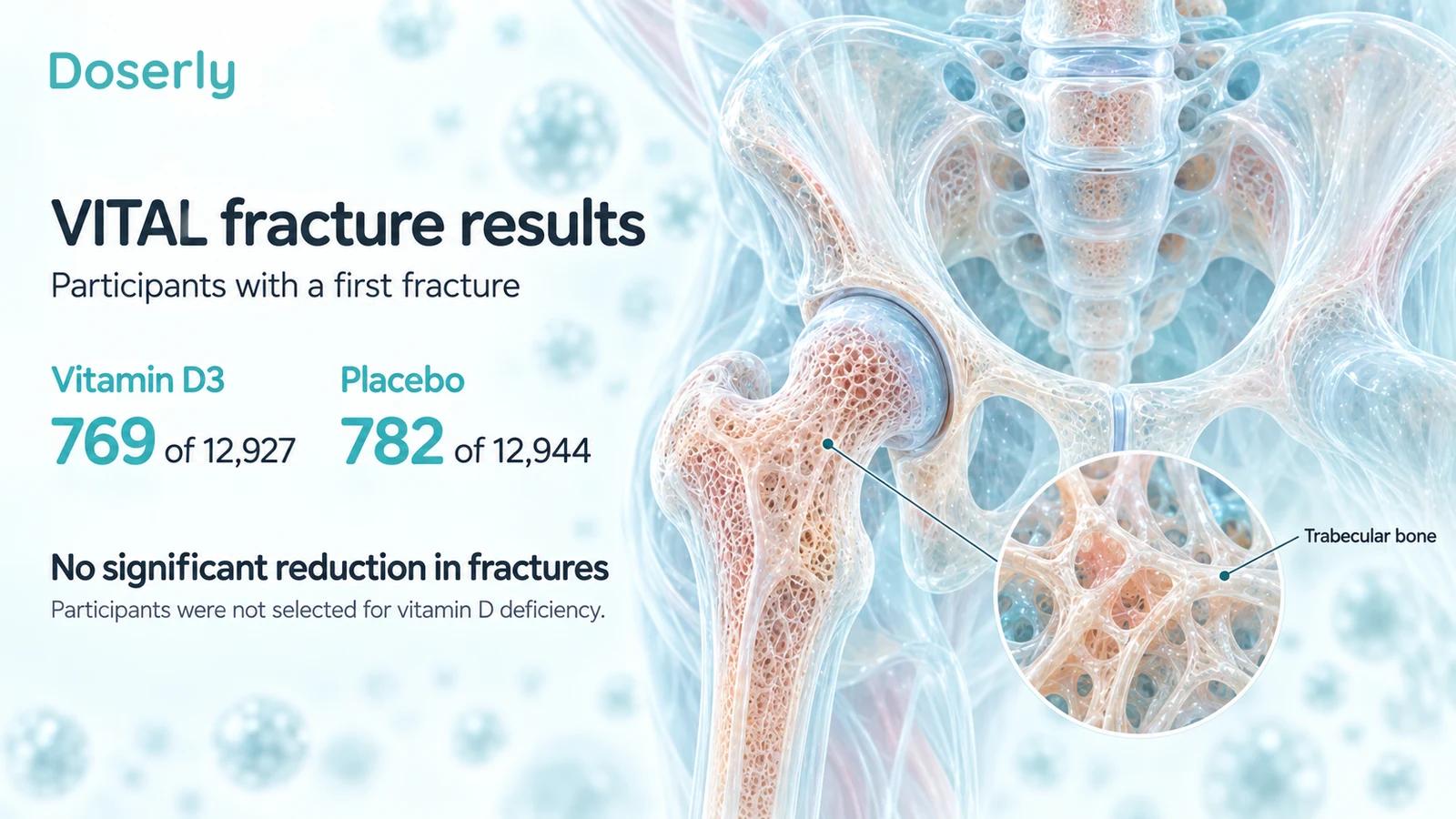
The fracture analysis included 25,871 US adults, men aged at least 50 and women at least 55, followed for a median of 5.3 years. Participants were randomly assigned vitamin D3 at 2,000 IU daily or placebo, within a larger factorial trial that also tested omega-3 supplementation. The main fracture outcome was a first incident total fracture. VITAL methods.
First fractures occurred in 769 of 12,927 vitamin D participants and 782 of 12,944 placebo participants. The hazard ratio was 0.98 (95% confidence interval 0.89–1.08). Neither nonvertebral nor hip fractures were significantly reduced. VITAL results.
The crude proportions are approximately 5.95% and 6.04%. They are close, but the trial's hazard ratio is the more appropriate summary of its time-to-event analysis because it accounts for follow-up. A hazard ratio of 0.98 is not evidence that bone strength improved by 2%, and the confidence interval includes no difference.
This was a substantial test of routine supplementation in a broad midlife and older population. The result argues against assuming that an extra daily vitamin D supplement will prevent fractures simply because vitamin D is necessary for healthy bones.
Why this was not a deficiency-treatment trial
VITAL did not recruit a population specifically because its members had severe deficiency. In the measured baseline sample, only a small minority had very low vitamin D values. The trial did not identify a convincing benefit by baseline vitamin D subgroup, but a small subgroup cannot answer every question about treating an established deficiency disorder. VITAL subgroup analysis.
This is a question of applicability, not a way to rescue a disappointing result. If a generally healthy person resembles the broad trial population, the overall null result is directly relevant. If a person has osteomalacia, malabsorption or another clear clinical indication, the reason for treatment is different from the routine prevention strategy VITAL tested.
Imagine two people discussing the same bottle. One has no established deficiency and hopes extra vitamin D will prevent a future fracture. The other has a clinician-diagnosed disorder affecting vitamin D status and mineralization. They may use the same ingredient, but the treatment question, monitoring and expected benefit are not the same.
The appropriate response is therefore specific: avoid promising routine fracture protection from vitamin D alone, while still evaluating and treating genuine nutritional or metabolic problems. Neither “everyone needs more” nor “vitamin D does nothing” captures the evidence.
What a vitamin D blood test can tell you
The usual status marker is 25-hydroxyvitamin D, abbreviated 25(OH)D. It reflects vitamin D obtained from food, supplements and production in the skin. It differs from the active hormone, 1,25-dihydroxyvitamin D, which is regulated differently and is not generally the routine test for nutritional status. NIH laboratory explanation.
Results may be reported in ng/mL or nmol/L; one ng/mL equals 2.5 nmol/L. Comparing numbers without checking units can create a large apparent discrepancy. Assay variation also matters, so a single result should be interpreted alongside the person's circumstances rather than as a complete description of bone health.
Guideline groups do not endorse one universal blood target for every disease-prevention outcome. The National Academies framework identifies increased deficiency risk below 12 ng/mL and regards 20 ng/mL or more as sufficient for most people. That is not a reason to keep increasing intake until a result reaches the top of a laboratory range. NIH summary of thresholds.
For someone already being treated, the useful questions are why the test was ordered, what clinical problem it addresses and how the result would change the plan. Repeating a test without a decision attached to it may add information without improving care.
Why older calcium-plus-vitamin-D trials looked different
A landmark 1992 trial studied 3,270 older women, with an average age of 84, and compared 800 IU vitamin D3 plus 1.2 g elemental calcium daily with placebo for 18 months. It reported fewer hip and other nonvertebral fractures with the combined intervention. Chapuy and colleagues.
This does not conflict automatically with VITAL. The population, nutritional circumstances and intervention were different. It was also a combination trial. Its result cannot be attributed to vitamin D alone, and it does not prove that every person should add the same amount of supplemental calcium.
The distinction between dietary intake and a supplement dose is important here. A trial's calcium amount is not necessarily the amount someone should add on top of an already calcium-rich diet. A clinician or dietitian can consider food intake before deciding whether a supplement fills a gap.
These differences explain why a recommendation for one setting may not fit another. Care-home populations, people with low intake, and generally healthy community-dwelling adults may have different baseline needs and risks. A useful comparison looks at those details instead of counting how many studies are positive or negative.
More at once is not necessarily better
A separate randomized trial tested a very large 500,000-IU oral dose once a year in 2,256 women aged 70 or older. Falls and fractures increased rather than decreased. The fall incidence-rate ratio was 1.15 (95% CI 1.02–1.30), and the fracture-rate ratio was 1.26 (1.00–1.59). Sanders and colleagues, 2010.
This was not the same schedule as VITAL. It illustrates why the total amount divided by 365 is not enough to decide that two regimens are equivalent. A large intermittent exposure can behave differently from a smaller daily exposure. It is unsafe to infer that an annual or monthly “catch-up” strategy reproduces a daily trial just because the arithmetic averages look similar.
The result also undermines the assumption that a nutrient cannot cause harm because the body needs it. Excessive supplementation and appropriate replacement are different exposures. Dose and schedule belong in the evidence question, not just the ingredient name.
What current prevention guidance says
The Endocrine Society's 2024 disease-prevention guideline suggests against routine supplementation above recommended dietary intake in generally healthy adults younger than 75. For adults aged 75 and older, it suggests empiric supplementation because of a potential mortality benefit, while favoring lower daily doses over large intermittent doses. It also advises against routine vitamin D testing in generally healthy people without an established indication. Endocrine Society guideline.
These are prevention recommendations for defined populations. They do not mean that a clinician should ignore an abnormality in someone being evaluated for a relevant disorder. The guideline's scope also does not turn vitamin D into a complete osteoporosis treatment.
“Empiric” means using an intervention without first selecting people through the proposed test threshold. It does not mean using unlimited amounts. The guideline notes that intake can come from fortified food, vitamin formulations and supplements. A person's total intake matters when applying any recommendation.
If your concern is a fracture, ask about fracture risk
A vitamin D result is only one part of the conversation. A previous low-trauma fracture, bone-density findings, medications, falls and other health conditions can change what prevention or treatment is appropriate. Someone who has already fractured a bone should not assume that buying a vitamin replaces a broader assessment.
A useful appointment can begin with a specific question: “Am I treating a deficiency, supporting adequate intake, or trying to reduce my overall fracture risk?” The answer helps determine whether the plan should focus on nutrition, additional assessment, a bone-specific treatment, falls prevention or several of these together.
Bring all supplement labels, including multivitamins and combination calcium products. It is easy to count a stand-alone vitamin D capsule and forget that other products supply it too. Record the amount per serving and how often each product is taken rather than relying on the product name.
If a clinician has prescribed replacement for a specific reason, discuss a change before stopping because of a headline. Conversely, if a supplement was started only for general fracture prevention, VITAL provides a strong reason to revisit whether it is doing what you expect. That conversation can be individualized without dismissing the trial.
Vitamin D remains essential. VITAL clarified that essential biology does not guarantee extra fracture protection from routine supplementation in a broad population. The next step is to match the intervention to the actual problem: adequate intake, a diagnosed deficiency, or a fracture-risk plan that addresses more than one nutrient.
Explore the research
- Supplemental Vitamin D and Incident Fractures in Midlife and Older Adults: VITAL (2022).
- NIH: Vitamin D.
- NIH: Calcium.
- Vitamin D3 and calcium to prevent hip fractures in elderly women (1992).
- Annual high-dose oral vitamin D and falls and fractures in older women (2010).
- Endocrine Society: Vitamin D for the Prevention of Disease (2024).