
Supplements
October 16, 2026
Vitamin C and colds: prevention, shorter illness and treatment
On this page
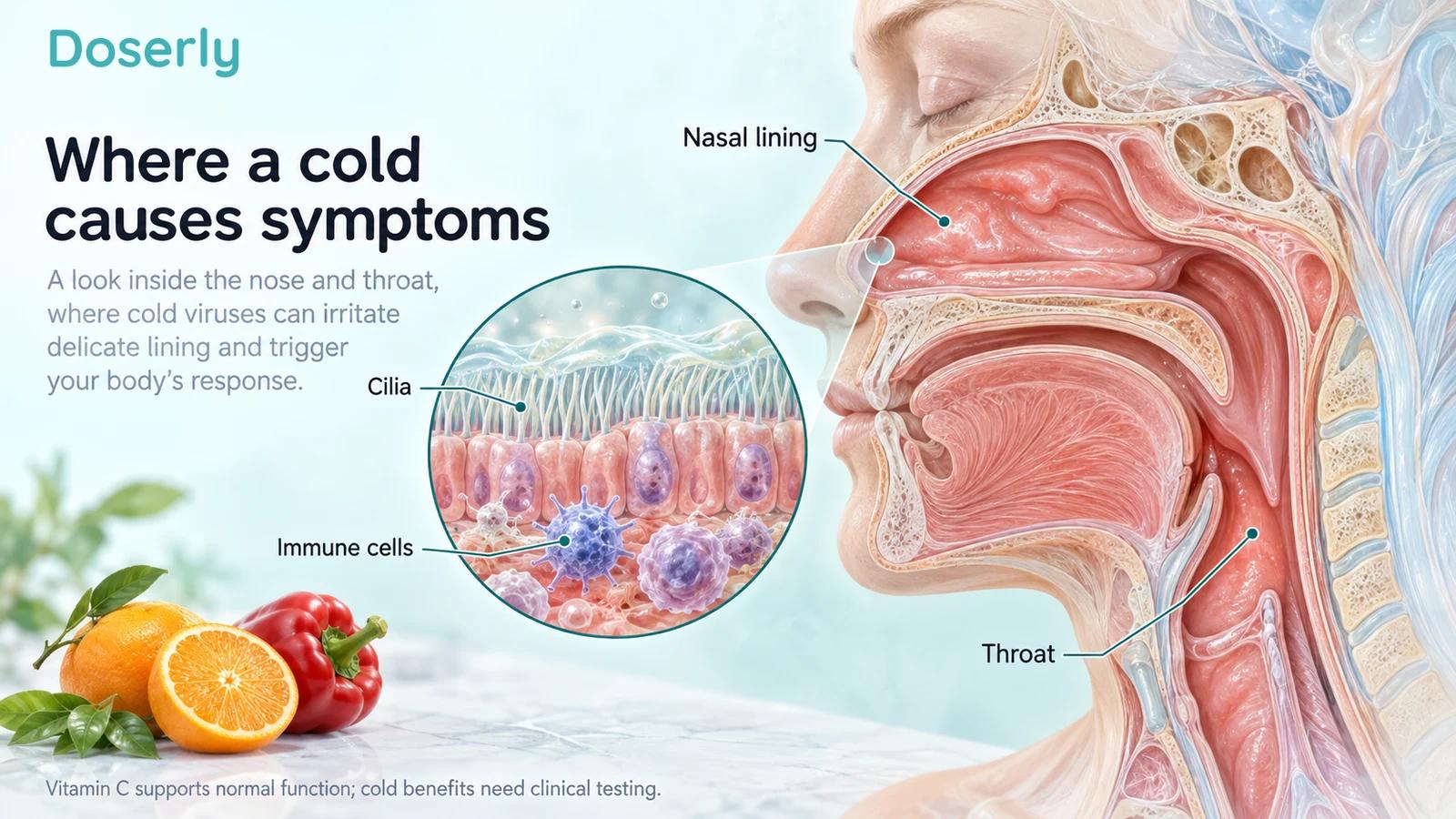
Vitamin C supports normal immune function and helps maintain the tissues that protect the body. That makes it a plausible nutrient to study during respiratory infections. It doesn't make every cold claim equivalent. Taking vitamin C every day through winter, starting it at the first sore throat and hoping to avoid illness after an ultramarathon are different interventions.
For most readers, the evidence supports a modest expectation: regular supplementation has shortened average cold duration in trials, but it hasn't meaningfully prevented colds in the general population. Starting vitamin C only after symptoms appear has produced less consistent results. The timing of use is essential to understanding those statements. Cochrane review
We'll examine the main comparisons, what a percentage reduction means in everyday time, and why larger doses are not automatically more useful. Our vitamin C guide covers its nutritional role more broadly.
First, separate the three questions
Prevention asks whether fewer people develop a cold during follow-up. Duration asks how long an episode lasts once someone gets sick. Severity asks how troublesome the illness is—for example, symptom intensity or days when ordinary activities are restricted. A product might affect one of these without affecting the others.
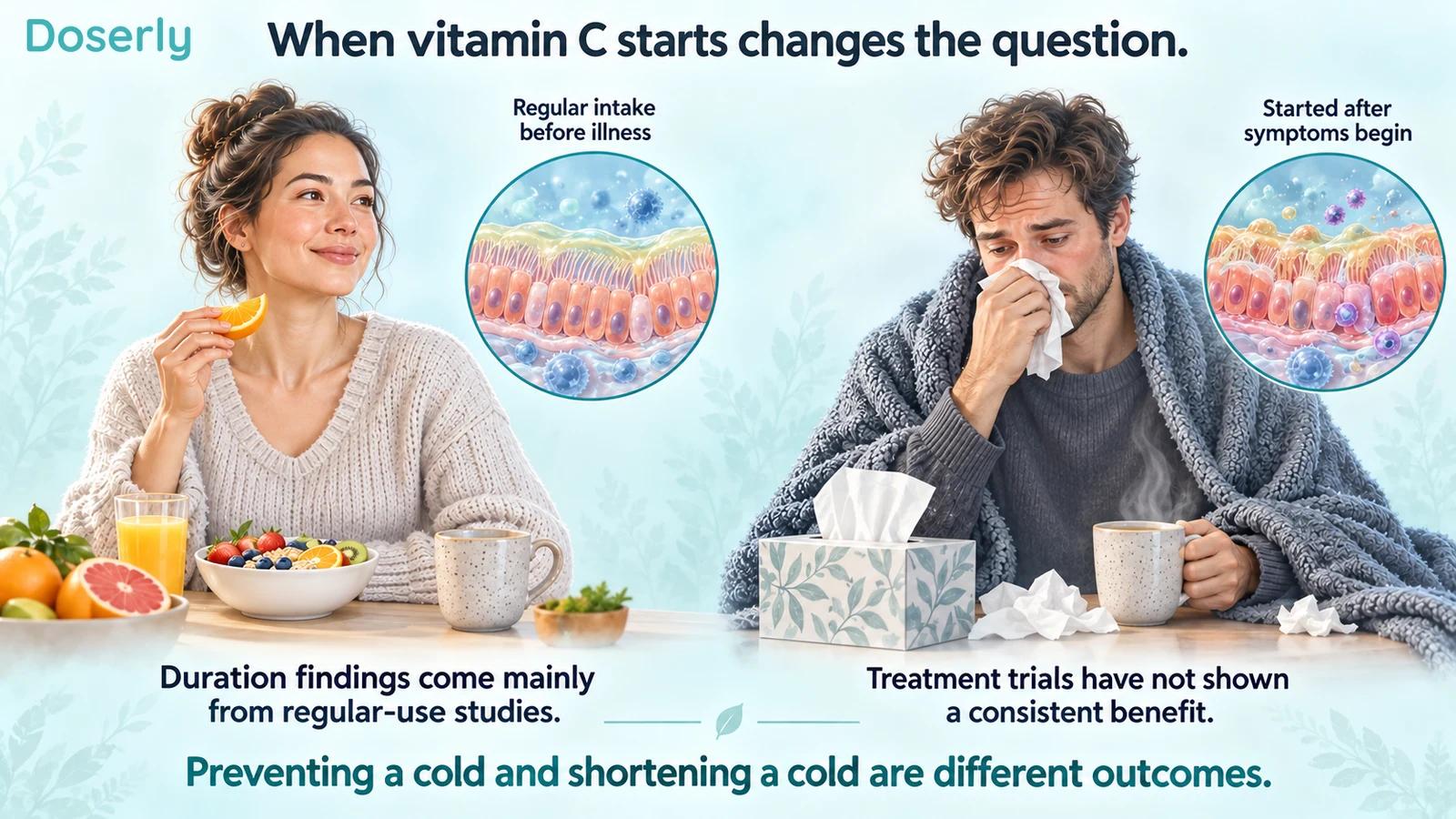
Timing creates a second distinction. In a regular-use study, participants start taking the supplement before the illness happens. A treatment study begins supplementation after symptoms appear. A duration benefit in the first design cannot simply be transferred to the second.
Imagine two people comparing experiences. One has taken a supplement for months; the other buys it after waking with a sore throat. Even if they use the same bottle, they haven't reproduced the same intervention. If an advertisement cites regular-use trials to promise rapid treatment, it has skipped an important part of the evidence.
Does taking vitamin C regularly prevent a cold?
The 2013 Cochrane review combined 29 comparisons involving 11,306 participants for the risk of developing a cold during regular supplementation. In general-community trials involving 10,708 people, the pooled risk ratio was 0.97, with a 95% confidence interval of 0.94–1.00. That is not evidence of a large preventive effect in the ordinary population. Cochrane review
The result is compatible with little or no reduction. It should not be translated into “vitamin C prevents almost all colds,” or into the opposite claim that vitamin C has no biological role. Nutritional function and the added benefit of a supplement are separate questions.
For someone buying a daily product to avoid every winter infection, the expected preventive payoff is therefore limited. A decision to meet nutritional needs may still be sensible, but it should not depend on a promise the trials didn't establish.
The early trials were already more nuanced than the reputation
A large double-blind trial reported in 1972 tested the claim that a gram of vitamin C daily substantially reduced cold frequency and duration. The vitamin group experienced somewhat less illness, but differences in average cold number and sickness days were smaller than popular claims and were not statistically significant. Anderson, Reid and Beaton
This historical result matters because the public reputation of vitamin C often sounds more decisive than the actual comparisons. It also shows why the outcome definition needs to be retained. A finding about days away from normal activities, for example, is not automatically a finding about whether an infection occurred.
Older trials are useful evidence, but their dates should remain visible. They used the formulations, populations and symptom-recording methods of their time. A new publication discussing an old trial does not turn it into a newly conducted experiment.
How much shorter were colds during regular use?
Across regular-use comparisons, the Cochrane review estimated average duration reductions of 8% in adults and 14% in children, with confidence intervals of 3–12% and 7–21%, respectively. These were averages across study episodes, not a guarantee for each person. Cochrane review
To understand the scale, apply the adult estimate to a hypothetical seven-day cold: 7 × 0.08 equals 0.56 days, or about 13 hours. Applying 14% gives approximately one day. These are illustrative calculations, not observed results from a trial in which every untreated cold lasted seven days.
A difference of that size might matter to someone, but it is far from an immediate cure. A longer starting illness produces a larger absolute time difference for the same percentage, while a short illness produces a smaller one. Reporting only the relative percentage can make the benefit hard to judge.
The child finding also isn't an instruction to give an adult supplement to a child. Age-appropriate safety and product decisions require their own consideration; a pooled research estimate does not supply a personal dosing plan.
What if you start only when the sore throat begins?
A 2001 double-blind randomized trial addressed that practical question. Researchers recruited 400 healthy volunteers, with 149 returning records for 184 cold episodes. Participants began their assigned product after four hours of early symptoms and continued it for the next two days. The groups received 30 mg vitamin C as the low-dose control, 1 g, 3 g, or 3 g with additives.
No significant differences appeared in cold duration or severity between groups. This was a trial of treatment started after symptoms, rather than a study of sustained supplementation before illness. The lower-dose control wasn't completely vitamin-C-free, a detail worth retaining when describing the comparison. Audera and colleagues
The gap between recruitment and returned illness records also limits interpretation. The result does not test every imaginable timing or duration, but it does challenge a confident claim that starting gram-level amounts shortly after symptoms reliably shortens a cold.
A negative trial isn't a reason to invent a larger schedule that must work. The appropriate conclusion is narrower: the tested treatment regimens didn't show a significant advantage, and results from regular-use studies don't fill that gap.
Why endurance-event findings look different
Some research involved brief periods of unusually heavy physical stress. In a 1993 randomized study of ultramarathon runners, supplementation with 600 mg daily was compared with placebo, and upper-respiratory symptoms were monitored for 14 days after the race. Symptoms were reported by 68% of placebo runners and 33% of supplemented runners. Peters and colleagues
That is a substantial difference in this particular setting. It is also a study of reported symptoms after an extreme endurance event, not proof of fewer laboratory-confirmed viral infections in ordinary daily life. The runners' exposure and physiology differ from those of someone working at a desk or doing a moderate gym session.
The research amount describes what was tested; it is not a recommendation for every athlete. Readers should resist stretching “physical stress” to cover any demanding day. The better question is how closely the circumstances match the trial, including event intensity and when supplementation began.
More swallowed vitamin C does not mean proportionally more in blood
A controlled depletion-and-repletion study in seven healthy volunteers examined vitamin C handling across a wide range of amounts. Participants were studied for four to six months under closely controlled conditions. Blood concentrations and absorption did not increase in a simple straight line as oral amounts increased. Levine and colleagues, 1996
This is pharmacokinetic evidence: information about how the body handles a substance. It helps explain why doubling an oral dose cannot be assumed to double the useful exposure. It does not identify an optimal cold-treatment schedule, because the experiment wasn't a cold-treatment trial.
The distinction is particularly useful when comparing products advertised as “high absorption.” Better absorption would be a property to investigate; faster cold recovery would still need to be measured. A blood-concentration claim cannot stand in for evidence that a formulation helps you return to normal activities sooner.
Intravenous vitamin C also belongs to a different exposure and clinical question. Findings from an infusion study should not be used as though they describe an oral tablet, and cold research is not a justification to pursue an infusion.
Tolerability is part of the decision
High vitamin C intake can cause diarrhea, nausea and abdominal cramps. NIH also discusses potential increases in urinary oxalate and concerns about kidney stones, especially in susceptible people; the evidence is not a simple claim that every supplement user develops stones. Kidney disease, a stone history or disorders of iron handling warrant a clinician's review before high-dose supplementation. NIH vitamin C fact sheet
Adding gastrointestinal symptoms to a respiratory illness is not a trivial tradeoff if the expected benefit is modest or uncertain. Include powders, multivitamins and combination cold products when reviewing exposure. A large number on one label can become a larger total when products overlap.
An upper intake limit is not a cold-treatment target. Nor should a study dose be treated as personal advice just because it appears in a peer-reviewed paper. The research tells us what was compared; it doesn't establish that the same amount fits every reader.
What to do with a cold today
Most colds improve with time, and supportive measures such as rest, fluids and appropriate symptom relief can help. CDC advises seeking care for concerns including trouble breathing, dehydration, fever lasting more than four days, symptoms persisting more than ten days without improvement, or symptoms that improve and then worsen. People at increased risk of severe respiratory illness should seek prompt advice about testing and treatments for illnesses such as influenza or COVID-19. CDC cold treatment guidance
Vitamin C should not become a reason to postpone that assessment. “It feels like a cold” isn't a laboratory diagnosis, and the evidence reviewed here does not show that supplements replace treatments for other infections.
If you choose to discuss a vitamin C product with a pharmacist or clinician, explain whether the goal is nutrition, prevention or shortening an established illness. Record when symptoms began and when the product started. Those two dates determine which research question is relevant.
Keep expectations tied to the comparison
For ordinary prevention, regular vitamin C has not shown a large benefit. For duration during regular use, the average benefit has been modest. For treatment begun after symptoms, the trials discussed here do not support a dependable shortcut to recovery. These conclusions can coexist because they answer different questions.
A personal cold ending soon after a supplement is taken can feel persuasive, but without knowing how that same illness would have progressed otherwise, it cannot establish the treatment effect. Track experience if it helps describe symptoms; don't turn one episode into a dosing rule.
The vitamin C guide can help with food sources, forms and broader safety. For cold decisions, the most useful details remain simple: who was studied, when supplementation began and which outcome actually improved.
Sources
- Cochrane review, 2013: separate regular-use and treatment comparisons.
- Anderson et al., 1972: early double-blind trial.
- Audera et al., 2001: treatment after symptom onset.
- Peters et al., 1993: post-ultramarathon symptoms.
- Levine et al., 1996: controlled vitamin C pharmacokinetics.
- NIH vitamin C fact sheet: nutritional context and adverse effects.
- CDC: Manage Common Cold: supportive care and reasons to seek assessment.