
Supplements
October 16, 2026
Vitamin B6 across several supplements: how to check the daily total
On this page
Vitamin B6 may be present in a multivitamin, a magnesium blend and a B-complex taken on the same day. None of those products needs to have “B6” as its main selling point for the amounts to add together. That makes the complete routine more informative than the label on the bottle a person thinks of as their vitamin supplement.
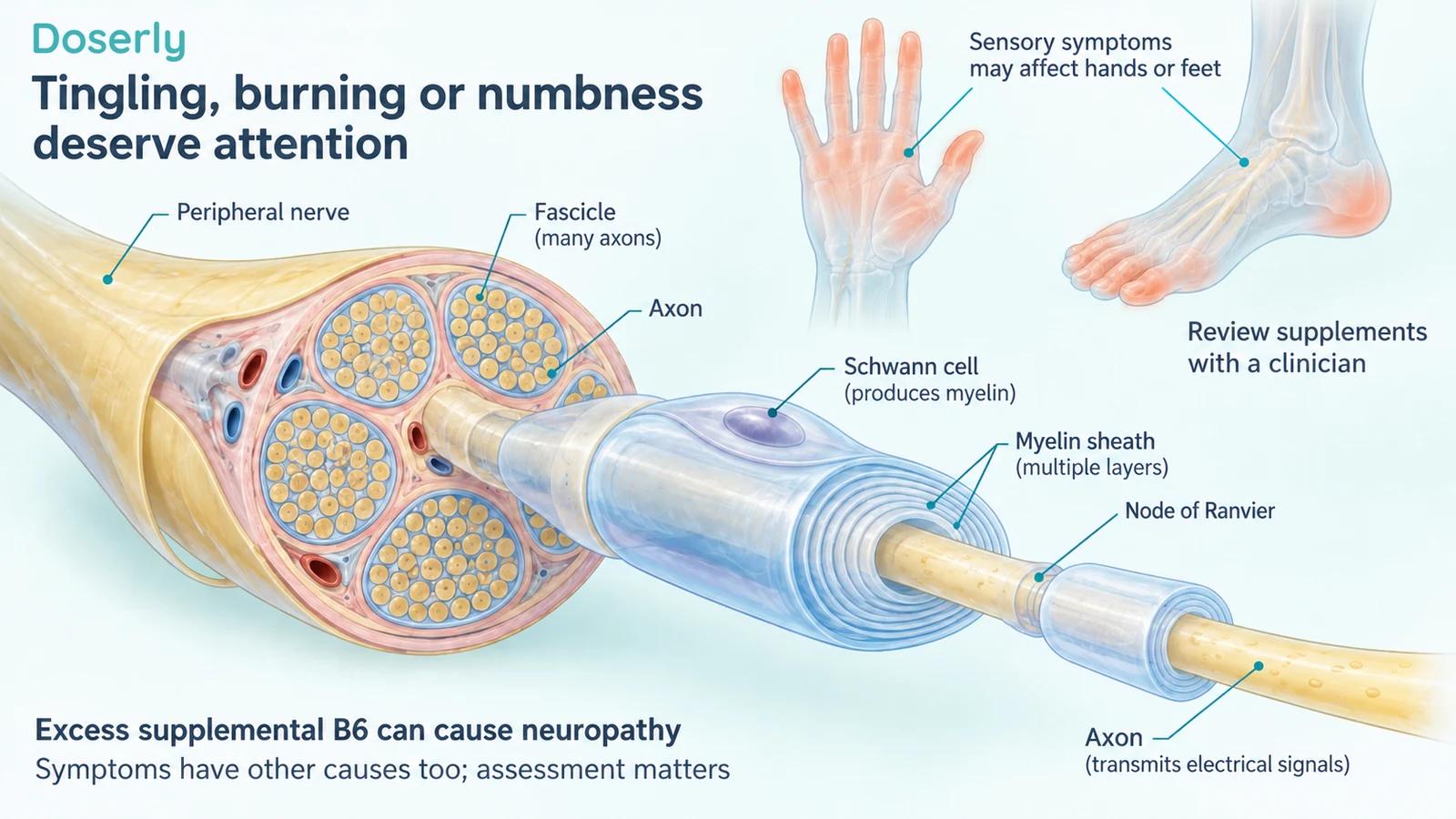
B6 is an essential nutrient involved in many enzyme reactions. It is also a vitamin for which excessive supplemental exposure can cause peripheral neuropathy—damage affecting nerves outside the brain and spinal cord. Tingling, burning or numbness in the hands or feet can be warning symptoms. The fact that B6 is water-soluble does not make high or overlapping supplemental intake harmless. NIH B6 overview
The useful response is a careful inventory, not fear of ordinary food. Identify every B6-containing product, calculate what is actually taken, and seek clinical advice if symptoms occur or the purpose of the combined intake is unclear.
Why a “magnesium supplement” may still matter
Product names usually emphasize a purpose or a featured ingredient. They do not necessarily describe everything inside. B6 may be added to multivitamins, B-complexes and some mineral products. The Australian Therapeutic Goods Administration has specifically highlighted magnesium and zinc products as potential overlooked sources.
In its safety review, the TGA found reports of neuropathy in people taking several B6-containing products, including people who did not realize that a magnesium product contained B6. This is not a claim that all magnesium or zinc supplements include it. It is a reason to read each ingredient panel rather than infer the contents from the front label. TGA safety update
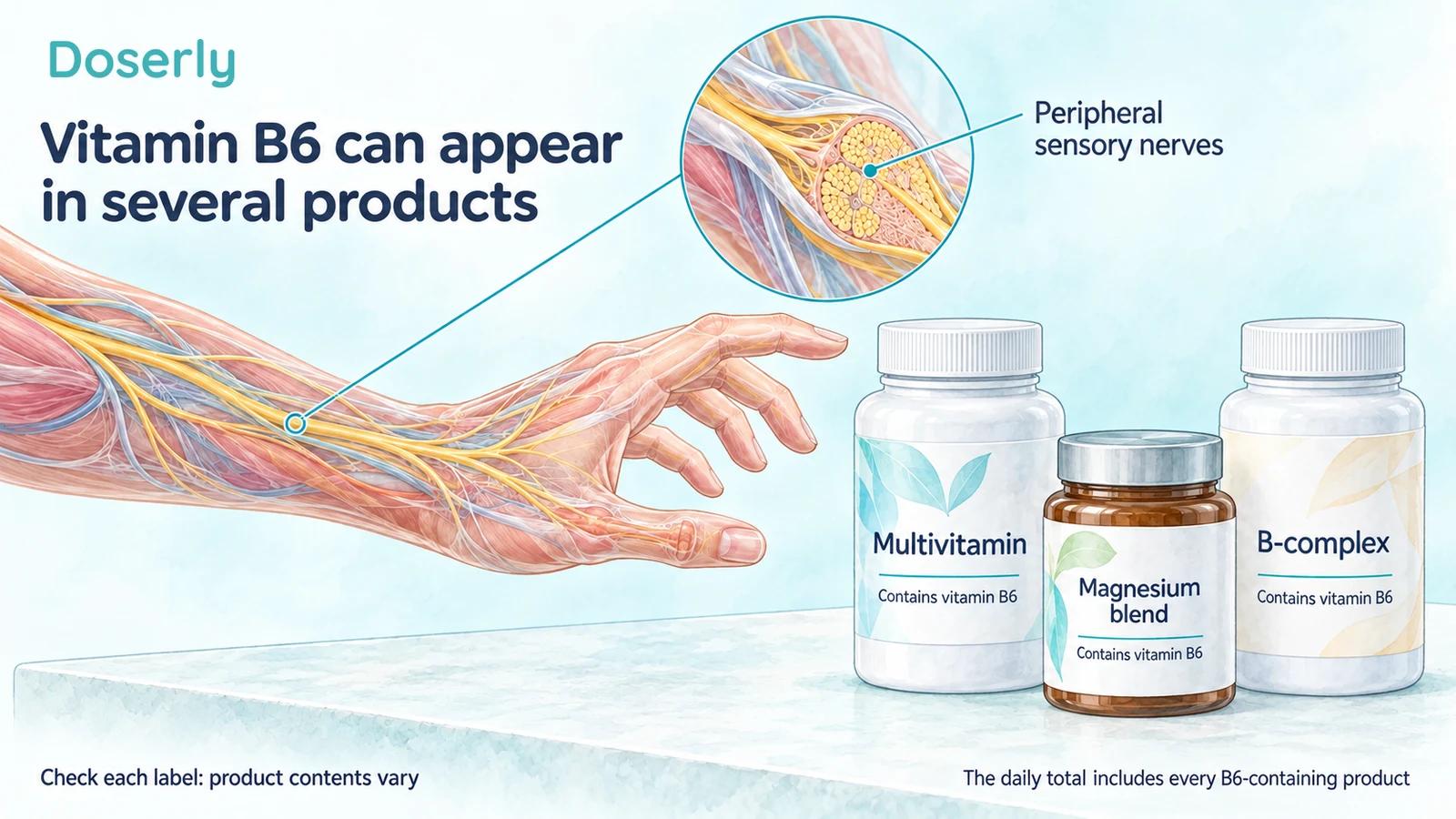
The problem can develop gradually. A multivitamin is already part of the routine. A second product is added for a different reason, and a third is used only on training days or during a stressful period. Each decision may feel separate, while the body receives the combined exposure. Keeping products in different drawers or taking them at different times does not prevent their B6 amounts from contributing to the same day's total.
Learn the names that can appear on a label
Vitamin B6 is a family of related compounds, rather than a single label name. Pyridoxine, pyridoxal and pyridoxamine are forms of the vitamin, and their phosphate forms also have B6 activity. Pyridoxal 5′-phosphate is often abbreviated PLP or P5P in product discussions.
An “active form” claim does not exempt a product from being counted. EFSA's 2023 upper-limit assessment covers all B6 vitamers, and the TGA's current labeling discussion explicitly includes pyridoxine hydrochloride, pyridoxal 5-phosphate and pyridoxal 5-phosphate monohydrate. It would be misleading to treat a switch in form as established protection from neuropathy while leaving total intake unexamined. EFSA scientific opinion, TGA labeling consultation
Some labels distinguish the mass of a chemical ingredient from the equivalent amount of vitamin B6 it supplies. Use the stated B6 amount for the total. If the label is ambiguous, a pharmacist or manufacturer can clarify it; adding both the ingredient mass and its equivalent B6 amount would double-count the same source.
Also check units. Milligrams and micrograms are different: 1 mg equals 1,000 micrograms. A percentage of a daily reference value is not itself a milligram amount, and reference values can differ across jurisdictions. Keep the actual quantity and serving size visible when comparing products.
A simple inventory catches the common mistakes
Start with every supplement and fortified product used regularly, including powders, drinks and occasional “energy” or “stress” formulas. For each one, record the B6 amount per labeled serving and the number of servings actually taken. If a serving is two capsules, establish whether the listed amount applies to both capsules together.
For example, imagine a multivitamin providing 4 mg per daily serving, a mineral blend providing 6 mg per daily serving, and a B-complex providing 10 mg per tablet. Taking all three would supply 20 mg from those products that day. This is hypothetical arithmetic, not a recommended combination or an example of a reliably safe intake. Food would contribute additional B6, and any fortified drink would need to be considered separately.
Do not assume that taking a product only on some days makes the highest-use day irrelevant. Record the pattern as it occurs: daily products, occasional products and the dates when several overlap. A clinician reviewing symptoms needs the timing and duration of exposure, not just a weekly average that hides the days with the largest amount.
Finally, keep a dated photo of the ingredient panel and the full product name. Formulations can change, and two similarly named versions may contain different amounts. The record should describe the product used during the period in question, not a label found online months later.
What the neuropathy evidence shows
A 2023 systematic review included 20 articles concerning B6 and peripheral neuropathy. It found evidence supporting a neurotoxic role for high B6 exposure, often associated with supplements, with a predominantly sensory pattern in relevant reports. Some patients reported improvement after stopping pyridoxine, but the literature did not establish a predictable recovery schedule for everyone.
The same review did not establish B6 as a general treatment for neuropathy. Studies reporting benefit often used combinations with other vitamins or treatments, making it difficult to isolate B6's contribution. Finding a low B6 measurement in a patient with neuropathy also does not automatically prove that low B6 caused the symptoms. Systematic review
This matters because “nerve support” marketing can lead someone with tingling to add more B vitamins. If excessive B6 is contributing, that response can increase the exposure being investigated. Symptoms should prompt assessment of both the supplement history and other possible causes, rather than an automatic assumption of vitamin deficiency.
A 2025 analysis from the Netherlands Pharmacovigilance Centre Lareb examined 224 spontaneous reports through the end of 2023. Reports involving lower B6 amounts continued after a national change limiting supplement doses. The authors called for further investigation of lower-dose associations. These reports help identify a safety signal, but they cannot reveal what proportion of all users develops neuropathy: there is no reliable denominator of everyone exposed, and reporting is incomplete and selective. Lareb reporting-pattern study
Why one advertised threshold cannot guarantee safety
The TGA's review identified neuropathy reports below 50 mg per day and reports involving multiple products. It did not identify a minimum dose or duration that reliably excludes risk for every individual. That does not mean every small dose is dangerous; it means a single reassuring cutoff should not override symptoms or a careful exposure review. TGA safety findings
Upper intake limits are population-level tools for reducing risk, not personal targets. They also reflect the evidence and assessment methods used by the authority setting them. The US Food and Nutrition Board's adult upper limit is 100 mg per day. EFSA's 2023 assessment established a much lower adult upper limit of 12 mg per day, including during pregnancy and lactation, covering dietary and supplemental sources. NIH upper limits, EFSA assessment
Those values should not be presented as two equally useful dosing recommendations from which to choose the larger. Neither says that an adult needs that amount, that approaching it improves health, or that symptoms below it can be ignored. The ordinary recommended dietary allowance for adults aged 19–50 is much smaller—1.3 mg per day in the US framework. Requirements differ with age and pregnancy or lactation. NIH recommended intakes
A clinician may use B6 for a specific medical indication under supervision. That situation is different from combining several wellness products without a defined reason. If a product was prescribed, discuss new symptoms and the full routine promptly with the prescribing clinician rather than independently changing essential treatment.
Current warnings and future rules are different things
As checked on October 15, 2026, Australia's existing listed-medicine requirements include a neuropathy warning for products supplying more than 10 mg of B6 per day. The threshold is a labeling requirement; it is not a guarantee that products below it cannot contribute to harm, particularly when combined. TGA existing warning requirements
On October 14, 2026, the TGA announced a consultation on stronger warnings and clearer statements of the presence and amount of B6. Those labeling proposals were not yet a final decision at the time of this review. Separately, the agency stated that oral preparations supplying more than 50 mg and up to 200 mg per recommended daily dose are scheduled to become pharmacist-only medicines from June 1, 2027. That access change is future-dated, not a rule already in force in October 2026. TGA October 2026 announcement
These are Australian regulatory developments, not a description of every country's retail rules. Their relevance to a reader elsewhere is the underlying practical issue: a product can be legally available and still require attention to total exposure, duration and symptoms.
What to do if tingling, burning or numbness appears
The TGA advises stopping a B6-containing supplement if these symptoms occur and seeking medical advice promptly. Do not add another B-complex or assume that the symptoms are evidence that more B6 is needed. If B6 is part of prescribed medical treatment, contact the prescriber urgently about the symptoms and all additional sources. TGA symptom advice
Bring the actual products or label photographs and a timeline. Include when each product began, changes in serving size, when symptoms started and whether they progressed. Mention prescribed medicines and medical conditions as well. B6 exposure is one possible explanation; neuropathy has other causes that still need evaluation.
A blood B6 result can contribute information, but it does not replace the clinical history and examination. The Lareb analysis found that the reported daily amount explained only a limited proportion of variation in measured blood levels. A single number therefore should not be treated as a complete reconstruction of exposure or a stand-alone explanation of nerve symptoms. Lareb analysis
Improvement after stopping an implicated supplement may take time, and recovery is not guaranteed to be immediate or complete. Follow-up matters if symptoms persist or worsen. The objective is to identify the cause and prevent continued harm, not to conduct repeated stop-and-restart experiments to prove the connection yourself.
Keep the reason for each product visible
An ingredient inventory is most useful when it includes why each product is being taken. If several products serve overlapping purposes, a pharmacist or clinician can help determine whether all are needed. Removing unnecessary duplication can be more sensible than searching for a different B6 form while maintaining the same total exposure.
The Doserly vitamin B6 guide provides additional ingredient context. For the everyday routine, the key information is concrete: which products contain B6, how much each supplies, how often they overlap and whether symptoms have appeared. A complete list turns a vague concern about “too many supplements” into a question that can be assessed and acted on.
Sources
- NIH Office of Dietary Supplements: B6 forms, recommended intakes and upper limits.
- TGA safety update: symptoms, overlapping products and warning requirements.
- EFSA scientific opinion, 2023: adult upper limit and scope across B6 forms.
- Systematic review, 2023: B6-related neuropathy and limits of treatment claims.
- Lareb study, 2025: spontaneous-report patterns after regulatory changes.
- TGA announcement, October 14, 2026: proposed labeling changes and scheduled 2027 access controls.