
Supplements
October 16, 2026
Urolithin A and immune aging: what changed in the human trial?
On this page
Urolithin A is a compound that some gut bacteria make from substances in pomegranates, berries and nuts. Researchers are interested in its relationship with mitochondria, the small structures that help cells use energy. That includes immune cells: responding to an infection requires cells to change their activity, multiply and use fuel differently.
The question behind the 2025 MitoImmune trial was whether taking urolithin A could change aspects of this biology in middle age. The researchers found changes in selected blood immune-cell measurements after four weeks. They did not establish that participants caught fewer infections, responded better to vaccines or lived longer. MitoImmune primary report.
That leaves a useful result to understand, rather than a simple yes-or-no verdict on “reversing immune aging.” What changed inside the laboratory measurements, how does that fit the wider urolithin A research, and what would someone hoping to stay healthier actually need to know? Our urolithin A guide provides broader background on the compound and its formulations.
Why researchers are looking inside immune cells
Your immune system includes barriers such as skin, cells that respond quickly to threats, and cells that recognize particular targets and retain memory of previous encounters. T cells belong to that last, adaptive part of the system. B cells, which can produce antibodies, are another component. These different functions cannot be captured by one universal “immunity score.” NIH explanation of immune function.
A stronger response is not automatically a better response. Inflammation helps defend the body, but excessive or poorly controlled inflammation can injure tissue. This is why a supplement's effect on an immune marker needs to be considered alongside the actual health problem being studied. The goal might be fewer serious infections, a useful vaccine response or better control of a particular disease; those are different outcomes.
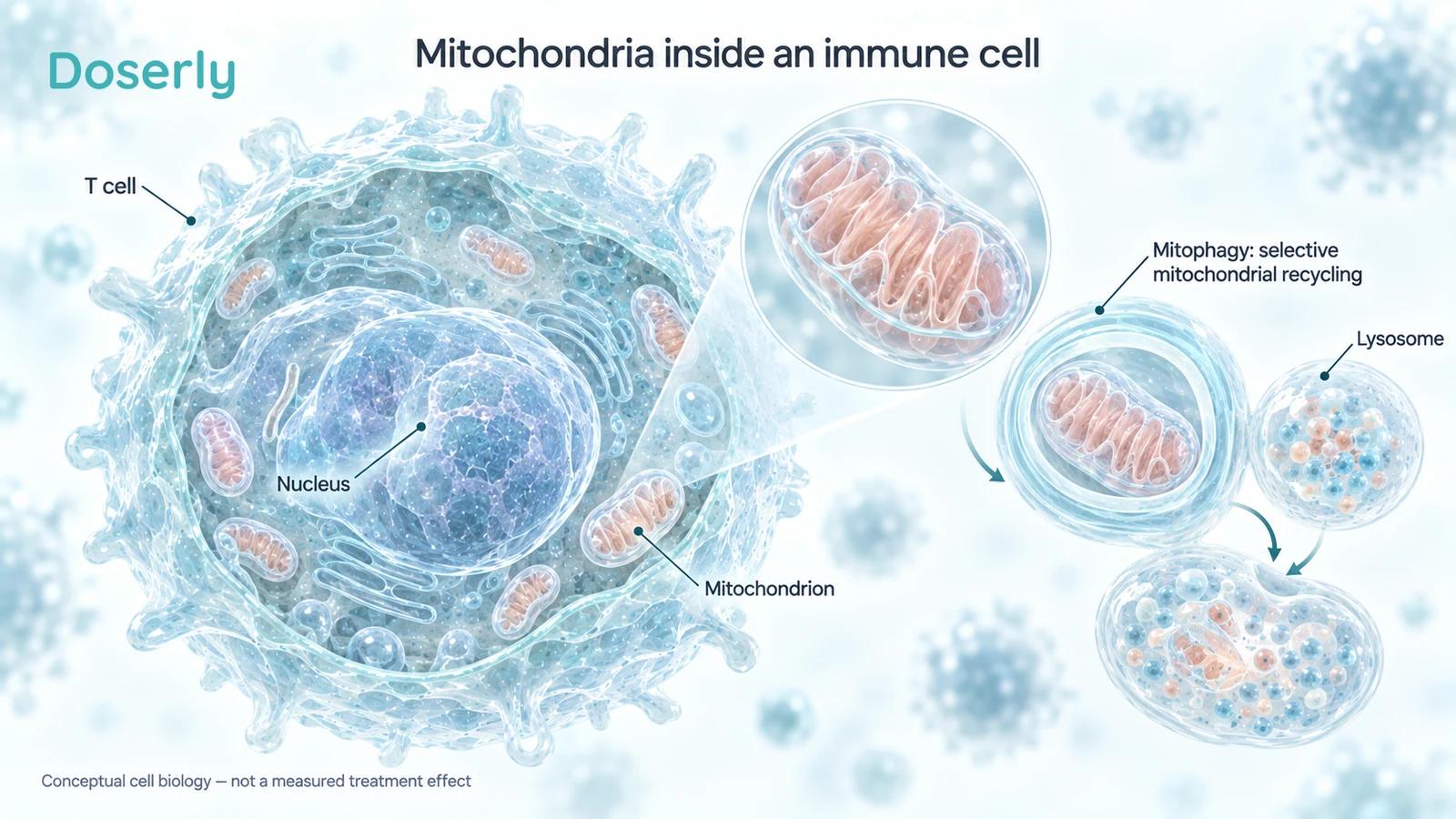
Mitochondria are relevant because their maintenance affects how cells function. Mitophagy is selective recycling of mitochondria through the cell's disposal and recycling machinery. Early urolithin A experiments connected this process with longer survival in worms and better muscle performance in rodents. Those experiments helped establish the biological rationale, but the lifespan result was in Caenorhabditis elegans, not people. Ryu and colleagues, 2016.
The distinction is practical. A biological process can be important without a supplement that influences it necessarily improving every condition related to that process. We need human studies to find out which tissues respond, at what exposure, and whether a change is beneficial enough to matter outside a laboratory.
What MitoImmune actually tested
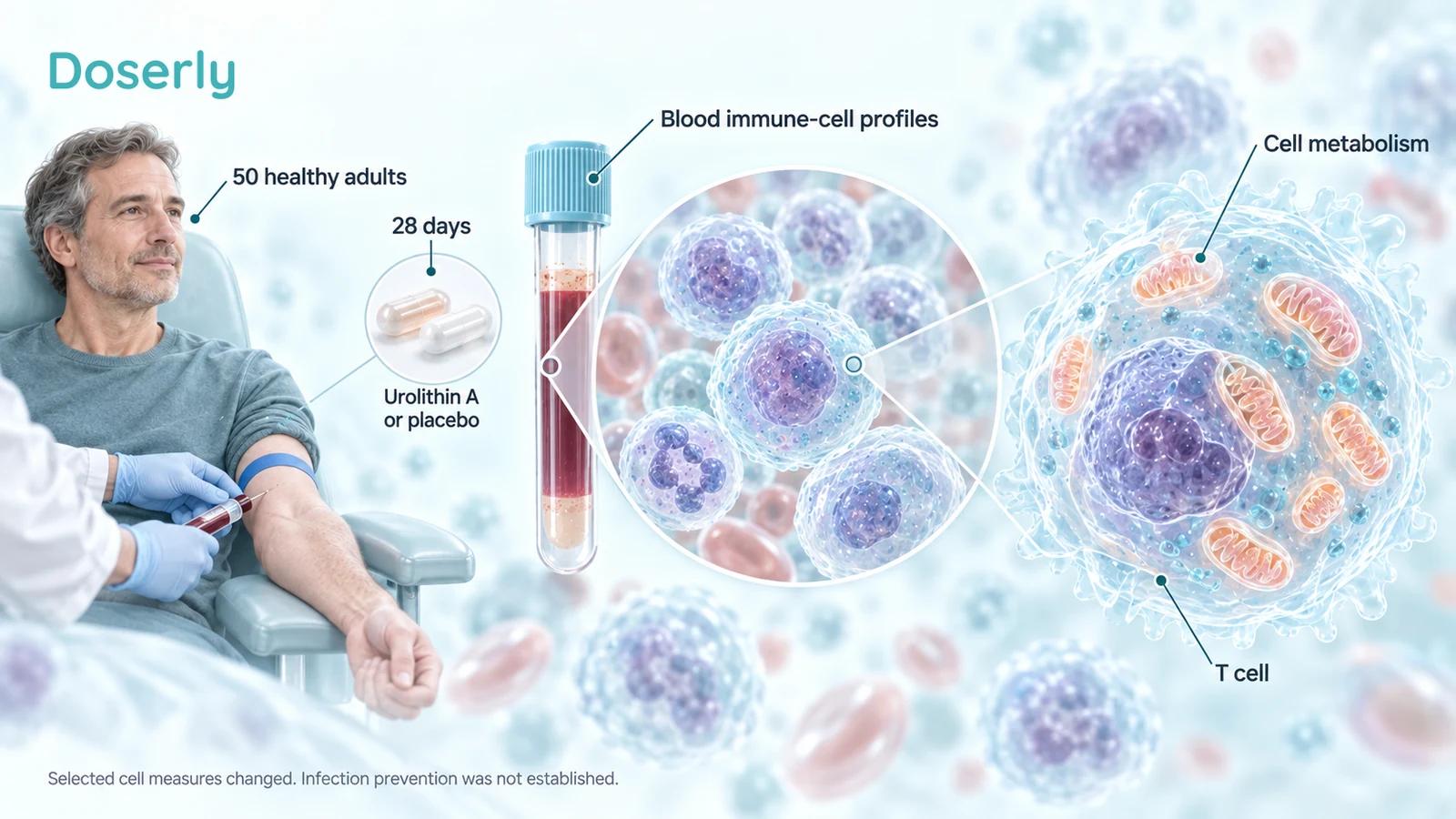
The randomized, double-blind study assigned 50 healthy middle-aged adults, 25 per group, to 1,000 mg daily of the studied urolithin A product or placebo for 28 days. Its main outcomes concerned T-cell populations and immune-cell metabolism. The reported treatment difference in a naive-like CD8 T-cell measure was 0.50 percentage points (95% confidence interval 0.16–0.83); the difference in a fatty-acid-oxidation-capacity measure was 14.72 percentage points (6.46–22.99). Comparisons were not adjusted for multiple testing. These are laboratory changes, not percentage reductions in infections. The trial also reported four adverse events with urolithin A and five with placebo. MitoImmune.
CD8 is a marker used to identify a particular T-cell group. “Naive” describes cells that have not yet developed a specialized response to their matching foreign target; it does not mean weak or defective. The study's language about a more naive-like profile refers to cellular characteristics associated with immune aging. It should not be translated into a number of years taken off someone's age.
The two percentage-point differences also refer to different measurements. They cannot be added together to create a total improvement in immunity. Neither is a clinical target that a routine blood test can use to tell an individual whether supplementation is working.
Why the laboratory methods matter
The trial’s blood samples allow investigators to examine cell populations and test how those cells behave under controlled conditions. That is useful because a symptom questionnaire alone cannot show which immune pathway may have changed. It also means the result describes the cells sampled and the assay used, rather than every part of immunity throughout the body.
Consider two possible future studies. One might ask whether a supplement changes how isolated cells use fuel. Another might follow people through a respiratory-virus season and count laboratory-confirmed illnesses. A positive answer to the first gives a reason to investigate the second, but it does not supply the second study's result. Many steps lie between a cell's metabolic capacity and whether a person develops a symptomatic infection.
The same applies to vaccine responses. Researchers would need a trial that actually administers a defined vaccine, measures the relevant response and follows appropriate outcomes. It would be misleading to infer a particular vaccine benefit from an unrelated laboratory endpoint. The existing trial helps identify a research question; it cannot determine how much protection an individual should expect.
A correction worth knowing about
The journal published an author correction in January 2026. One panel, Figure 3e, had inadvertently duplicated Figure 3b. The publisher replaced it with the correct panel in the article's HTML and PDF. Author correction.
This matters if you encounter an older screenshot or presentation. It is sensible to use the corrected version when examining the metabolic results. The correction notice identifies a figure-panel problem; it does not announce that the entire trial was withdrawn. Equally, a corrected figure does not resolve the broader questions of clinical relevance or long-term safety. Those require further evidence.
Is taking urolithin A equivalent to eating pomegranate?
No. Food supplies precursor compounds that gut microbes may convert to urolithin A. Direct supplementation supplies the compound itself. A randomized crossover bioavailability study in 100 healthy adults compared pomegranate juice with a product containing 500 mg urolithin A. It found substantial differences in exposure related to microbial conversion and direct supplementation. This was an absorption study, not a trial of infection prevention. Human bioavailability study.
“Bioavailability” means that a substance becomes available to the body after it is consumed. It answers an important preliminary question: did the intended compound reach the circulation? It does not, by itself, answer whether that exposure improves health. Higher blood concentrations may help explain why two products behave differently without establishing that the higher concentration is a goal everyone should pursue.
For the same reason, being a low producer after a particular food challenge is not equivalent to being diagnosed with an essential-nutrient deficiency. The study did not establish a replacement requirement or a universally desirable blood level. A commercial test or product claim should not quietly turn a metabolic difference into a disease diagnosis.
What earlier human studies add
The first human clinical study, published in 2019, examined single doses and repeated dosing over four weeks in healthy sedentary older adults. It found that urolithin A reached the circulation and that repeated dosing affected selected blood metabolites and muscle gene-expression measurements. Safety and tolerability were central objectives. It did not demonstrate extended human lifespan. Andreux and colleagues.
A later randomized trial involved 66 adults aged 65–90 and compared 1,000 mg daily with placebo for four months. Selected muscle-endurance tests improved, but the between-group differences in the main six-minute walking and maximal ATP-production outcomes were not significant. ATP is a molecule involved in transferring usable energy within cells. Liu and colleagues, 2022.
These studies broaden the human evidence beyond a single immune experiment. They also show why a general promise of “more energy” is too imprecise. Repeated contractions of one muscle, walking performance, blood metabolites and immune-cell function are separate measurements. A person interested primarily in walking further should pay attention to the walking result, even when another test in the same study is encouraging.
A study published in October 2026 examined vascular function in 50 middle-aged adults with obesity. Its peripheral endothelial-function result was not statistically significant, while selected cerebrovascular measurements improved. Endothelial function concerns the cells lining blood vessels; cerebrovascular measurements concern circulation related to the brain. This was another distinct biological question, not confirmation of infection protection. 2026 vascular trial.
What safety evidence can—and cannot—tell you
The available trials provide short-term observations under specific study conditions. Small studies are useful for identifying common tolerability problems, but they have limited ability to detect uncommon adverse effects. Following someone for weeks or months also cannot settle what happens after years of continuous use.
If no serious problem occurs in a small study, that is reassuring within the observed period. It is not proof of unrestricted safety in people with complex illness or multiple medications. Safety is also specific to the substance and formulation assessed. Evidence for the product studied should not be assumed to validate every marketplace capsule using the same ingredient name.
Several studies involved the product developer or researchers with company relationships, disclosed in their publications. Those relationships do not automatically invalidate a randomized result, but independent replication would strengthen confidence. 2019 trial disclosures, 2022 trial disclosures.
How to make the question useful in a clinical conversation
Start with the concern that brought you to the topic. Repeated infections, persistent fatigue, reduced exercise tolerance and an interest in healthy aging are not interchangeable problems. A clinician can help decide whether symptoms need evaluation and which outcomes would be appropriate to follow.
If you are considering supplementation, bring the exact product label and your medication list. Ask which human outcome supports the proposed use and whether the participants resembled you. For an immune claim, the key question is whether the evidence concerns illness in people or measurements taken from their cells. For a muscle claim, ask which functional test improved and which did not.
Keeping a dated record of a product, symptoms and treatment changes can make that discussion clearer. It cannot prove that a supplement caused a change: infections vary over time, and sleep, exposure, exercise and other treatments may change too. Avoid interpreting one unusually good month as a personal reproduction of a controlled trial.
Urolithin A has a credible human research program and a specific new signal in immune-cell biology. The next important step is connecting such changes with durable outcomes that people can feel or experience. Until then, the useful takeaway is precise: selected cellular measures changed under controlled conditions, while the clinical benefit of targeting immune aging this way remains unsettled.
Explore the research
- Denk and colleagues: Effect of the mitophagy inducer urolithin A on age-related immune decline (2025).
- Author correction to the immune trial (2026).
- NIH: Dietary Supplements for Immune Function and Infectious Diseases.
- Ryu and colleagues: urolithin A, mitophagy and animal outcomes (2016).
- Direct supplementation and dietary exposure: human bioavailability study (online 2021; issue 2022).
- Andreux and colleagues: first human urolithin A trial (2019).
- Liu and colleagues: muscle endurance and mitochondrial health trial (2022).
- Urolithin A and endothelial and cerebrovascular function (2026).