
Supplements
October 16, 2026
Undenatured collagen and collagen peptides: what the difference means
On this page
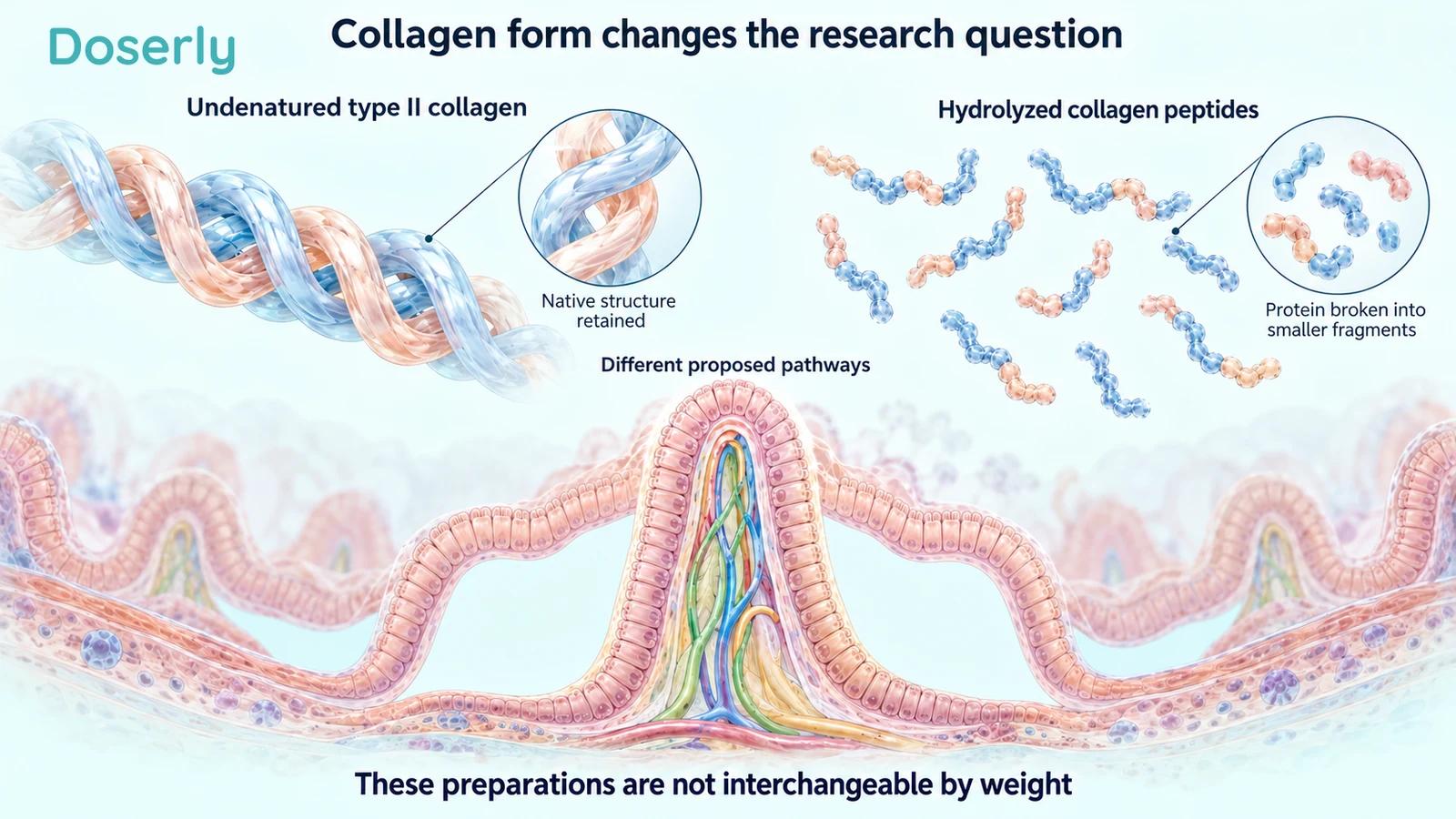
Two products can both say “collagen for joints” while containing very different preparations. Hydrolyzed collagen peptides are protein fragments, commonly studied in gram quantities. Undenatured type II collagen retains aspects of its native structure and has been studied in much smaller amounts, often as a specific chicken-cartilage-derived ingredient.
That difference is central to the research. The proposed purpose of a small undenatured-collagen preparation is not to supply the same protein mass as a scoop of collagen peptides. The studies also ask different questions, ranging from discomfort during exercise to symptoms of diagnosed knee osteoarthritis.
A lower milligram amount does not mean a weaker version of the same supplement, and a larger gram amount does not mean greater joint benefit. To compare them fairly, we need to identify the preparation, the population and the outcome. Neither type should be described as swallowed replacement cartilage.
What “undenatured” and “hydrolyzed” describe
Collagen is a family of structural proteins. Type II collagen is prominent in articular cartilage, the tissue covering bone ends inside joints. The type number describes the protein, while processing terms describe what has happened to its structure.
Denaturation alters a protein's folded organization. Hydrolysis breaks protein into smaller fragments. Hydrolyzed collagen is therefore a mixture of peptides rather than an intact native collagen network. “Undenatured” indicates that the relevant native structural features have been retained in the preparation.
A human absorption study detected small collagen-derived peptides in blood after gelatin-hydrolysate ingestion. That finding belongs to the hydrolysate research: it demonstrates systemic exposure to certain fragments, not incorporation of intact collagen into a joint. Iwai and colleagues.
The words “type II” alone don't tell you which preparation is present. A label can describe the source protein without establishing that it remains undenatured. Likewise, “collagen peptides” does not establish that the product matches the particular mixture used in a clinical trial. The collagen guide and UC-II guide provide background on those identities.
Why a small amount is studied
For undenatured type II collagen, one proposed explanation involves oral tolerance: immune responses to a protein encountered through the digestive tract. Researchers hypothesize that exposure to preserved collagen structures could influence immune regulation relevant to joint symptoms. This is different from simply providing amino acids as nutritional building material.
The proposal should remain a proposal. A symptom trial can show that an intervention performs better than a comparator without proving which immune pathway caused the difference. The 2016 osteoarthritis study itself called for additional research on mechanism. Lugo and colleagues.
It would be an overreach to say that the supplement “reprograms” a person's immune system, treats autoimmune disease generally or teaches the body to rebuild cartilage. Those claims go beyond the knee symptom endpoints discussed here. The small amount makes sense in the context of a proposed signaling mechanism, but the mechanism doesn't establish efficacy by itself.
This distinction also explains why adding the weights of different collagen products is not useful. Milligrams of a native preparation and grams of a hydrolysate are not equivalent units of clinical potency. A comparison needs trials, not arithmetic on the package front.
The first exercise-discomfort study
A 2013 randomized placebo-controlled trial enrolled fifty-five people who had no history of arthritis or joint pain at rest but developed knee discomfort during a standardized stepmill test. They received a UC-II preparation or placebo for 120 days.
At the end of the study, measured knee extension was greater in the UC-II group than in the placebo group. Participants taking UC-II also exercised longer before initial discomfort compared with their own baseline. That second finding was a within-group comparison; it should not be rewritten as a demonstrated between-group doubling of pain-free exercise time. 2013 trial.
The population is important. These were people with exercise-provoked discomfort, not a trial of reversing established osteoarthritis. The stepmill provided a repeatable challenge, but it wasn't a measurement of cartilage thickness or injury healing. The findings support interest in joint function under the tested conditions while leaving structural claims unanswered.
If you experience knee pain only after a particular activity, this trial may feel more relevant than an osteoarthritis study. It still cannot determine the cause of your symptoms. Similar experiences can arise from different conditions, and a supplement study doesn't replace an assessment when symptoms persist.
A later trial measured flexibility over twenty-four weeks
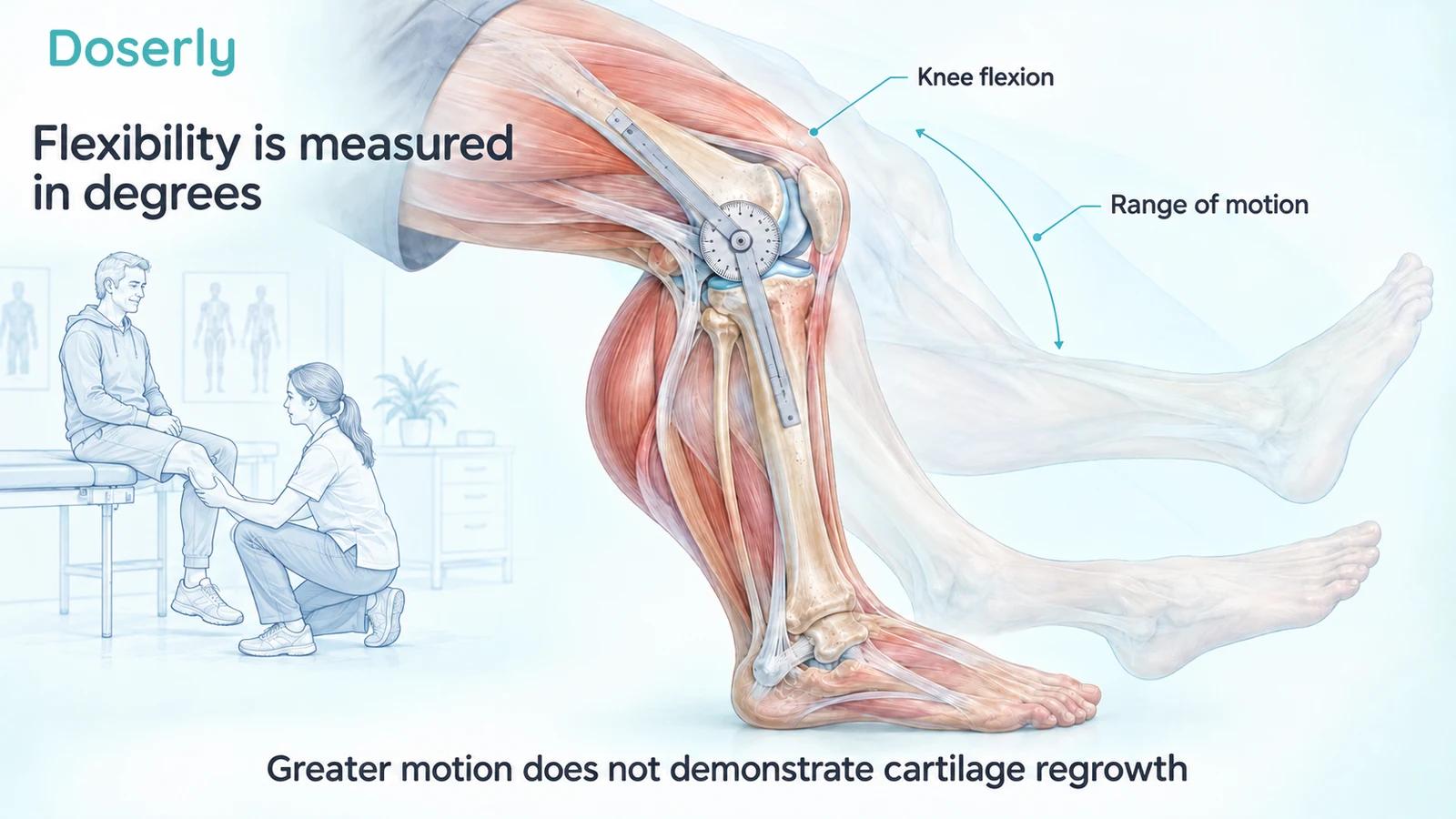
A 2022 multicentre trial randomized ninety-six adults aged 20–55 who experienced activity-related joint discomfort without a history of osteoarthritis or joint disease. They received undenatured collagen or placebo for twenty-four weeks. Researchers measured knee range of motion using a digital goniometer, an instrument that measures angles.
Knee-flexion range increased by 3.23 degrees with undenatured collagen versus 0.21 degrees with placebo. The difference was statistically significant. Extension improved within the collagen group, but the fact that one group changes significantly and the other doesn't is not, by itself, a significant difference between groups. Schön and colleagues, 2022.
A few degrees of motion is a specific result. It isn't a percentage increase in joint health, a measure of pain relief or evidence of new cartilage. Its practical value depends on whether the change helps a person do something that matters to them. The study's age subgroup findings are also less definitive than its overall randomized comparison.
What has been tested in knee osteoarthritis?
An earlier ninety-day study compared UC-II with glucosamine plus chondroitin. It reported greater improvements from baseline with UC-II on several symptom scales. Because it did not include a placebo group, changes within either group cannot show how much came from the intervention rather than symptom fluctuation, expectations or other aspects of participation. Crowley and colleagues, 2009.
A later 180-day trial randomized 191 adults with knee osteoarthritis to UC-II, glucosamine hydrochloride plus chondroitin sulfate, or placebo. The main total WOMAC symptom score favored UC-II over both comparators. WOMAC combines questions about pain, stiffness and physical function. Safety outcomes did not differ among groups. The study was sponsored by the ingredient company, with disclosed employee and consultant relationships. 2016 trial.
These findings are relevant to symptoms in the studied osteoarthritis population. They do not establish that UC-II is superior to every treatment, that it prevents surgery or that it restores cartilage. The active comparator was a particular glucosamine/chondroitin combination; the study did not directly compare UC-II with hydrolyzed collagen peptides.
A positive trial can be useful while leaving those boundaries intact. Sponsorship is a reason to inspect methods and seek independent replication, rather than an automatic reason to accept or dismiss the result.
The ingredient amount and native-collagen amount can differ
Several UC-II trials describe 40 milligrams of the studied ingredient daily. That does not necessarily mean forty milligrams of analytically measured undenatured type II collagen. In the 2016 paper, the preparation supplied 1.2 milligrams of undenatured type II collagen by the reported extraction-and-assay method. Trial formulation details.
This is a label-reading distinction, not a suggested dose. Ingredient mass, total collagen content and the amount retaining a specified native structure are different quantities. They can be measured and described differently, so apparently conflicting numbers may refer to different definitions.
When comparing a product with a paper, look for the actual ingredient identity and standardization. A generic capsule advertised as “type II collagen” should not automatically inherit the evidence for a proprietary undenatured preparation. Nor does a large total collagen number establish that the relevant native features are present.
How the peptide trials differ
A twelve-week trial in 139 athletic adults tested 5 grams daily of specific collagen peptides or placebo for activity-related knee discomfort. Pain during activity improved more in the peptide group, while resting pain and joint mobility did not show the same clear between-group advantage. Zdzieblik and colleagues.
This offers a different research route to a similar broad consumer concern: joint comfort. It does not establish that peptides and undenatured collagen act through the same pathway. It also doesn't tell us which would work better in the same person because the trials used different participants, formulations, durations and measurements.
Comparing percentages across unrelated trials would be especially misleading. A percentage reduction in one pain scale cannot be ranked directly against a degree change in knee flexion or a composite WOMAC score. Each has a different denominator and meaning.
A useful head-to-head trial would randomize comparable people to the preparations, use the same follow-up and outcomes, and report tolerability as well as symptom changes. Until then, a claim that one form is definitively the best collagen for all joint problems is stronger than the evidence allows.
What neither research story establishes
Neither the exercise-discomfort trials nor the symptom-focused osteoarthritis trials demonstrate that taking collagen prevents future joint disease in a healthy person. They also do not establish a treatment for an acutely torn meniscus or ligament. Those problems involve different questions and care pathways.
The name of a structural protein can make a replacement story feel intuitive, but biological plausibility doesn't identify a clinical effect. A joint may feel better without structural change, and a laboratory marker may change without improving function. Both possibilities are compatible with the current research.
This is also why the absence of a repair claim shouldn't make symptom relief seem trivial. Less discomfort during a meaningful activity can matter. The point is to describe that benefit accurately and to compare it with the cost, uncertainty and other available care.
Making a practical choice with your clinician
Begin with the diagnosis and the activity that is difficult. If osteoarthritis is the problem, established management includes tailored exercise and, where appropriate, weight management. NICE places these approaches within core care rather than relying on a supplement to address the whole condition. NICE recommendations.
Bring the full label, including source and other ingredients. Chicken-derived native collagen matters for relevant allergies and dietary restrictions; hydrolysates may use other animal sources. A multi-ingredient joint formula also introduces effects and tolerability considerations that a single-ingredient trial cannot isolate.
If a supplement trial is reasonable, define success in ordinary terms before starting: a familiar walk, stairs, a prescribed exercise or a symptom score under comparable conditions. Keep other treatment changes dated and agree on when to review the result. The clinical studies lasted months, but that doesn't mean indefinite use is automatically worthwhile.
Undenatured type II collagen and hydrolyzed peptides deserve to be understood as distinct interventions. Both have human symptom or function findings worth discussing, and both have limits. The useful comparison begins with the exact preparation and the person's problem, not the largest number on a label.
Explore the research
- Human absorption of collagen peptides, 2005: hydrolysate exposure in blood.
- UC-II and exercise discomfort, 2013: fifty-five participants, 120 days.
- UC-II and knee flexibility, 2022: ninety-six adults, twenty-four weeks.
- UC-II versus glucosamine/chondroitin, 2009: active-comparator study without placebo.
- UC-II in knee osteoarthritis, 2016: 191 adults, formulation details and disclosures.
- Specific collagen peptides and activity-related pain, 2017: a different preparation and symptom trial.
- NICE osteoarthritis care: established management context.