
TRT
October 18, 2026
Low ferritin on TRT: when blood donation leaves iron stores behind
On this page
The hematocrit is finally lower, but you feel worse. Perhaps you have donated blood several times while taking testosterone, and a new laboratory report shows low ferritin. It can seem contradictory: how can someone with too many red cells also be short of iron?
The contradiction disappears once the measurements are separated. Hematocrit describes the proportion of blood occupied by red cells. Hemoglobin is the oxygen-carrying protein inside those cells. Ferritin helps assess iron reserves. A person can have substantial circulating red-cell mass while the reserve available to support future production has become depleted.
That distinction matters during TRT because testosterone can keep stimulating red-cell production while donations remove iron from the body. A lower hematocrit after blood removal answers only part of the follow-up question. It does not establish that iron stores are adequate, that fatigue has a hormonal cause, or that the next donation is appropriate.
The goal is to understand the whole pattern: why blood was removed, what happened to iron stores, and whether the ongoing treatment plan needs adjustment. Neither ignoring low ferritin nor adding iron without revisiting the donation cycle is a complete response.
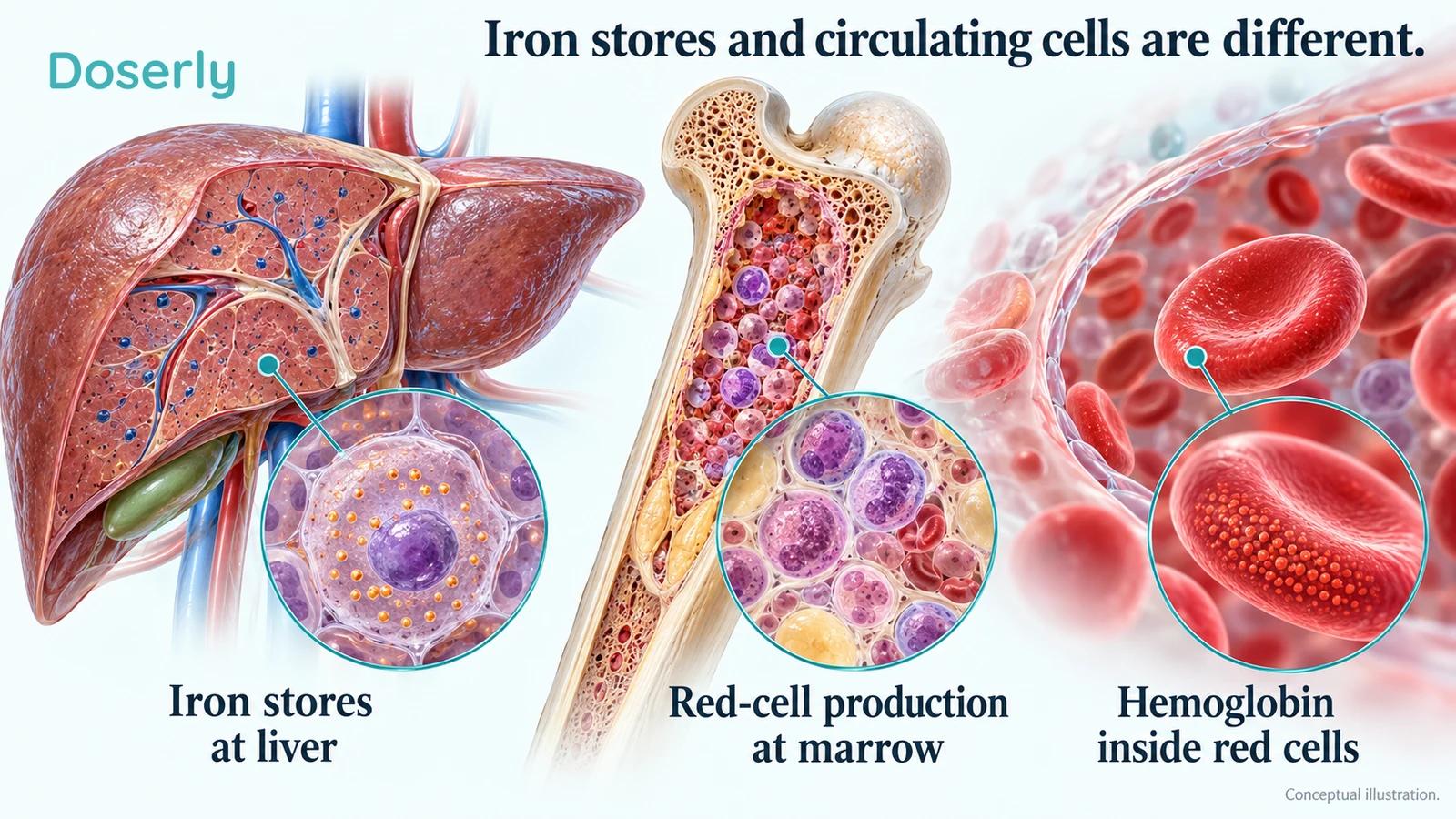
Ferritin and hemoglobin tell different parts of the story
Iron serves several jobs. It is part of hemoglobin, supports myoglobin in muscle, and participates in cellular metabolism. Some iron is held in storage rather than circulating in red cells. Serum ferritin usually provides useful information about those stores, whereas hemoglobin reports the concentration of a protein already being carried in the blood.
Iron depletion can appear before iron-deficiency anemia. That is why a reassuring hemoglobin result does not rule out low reserves. Ferritin is also influenced by inflammation, so interpretation is not simply a matter of matching one number to a chart. NIH Office of Dietary Supplements: iron
The distinction is particularly easy to miss at a donation appointment. A finger-prick hemoglobin check is often remembered as an “iron test.” It is useful for its intended purpose, but it is not the same test as ferritin. Canadian Blood Services explicitly distinguishes its hemoglobin assessment from ferritin testing and notes that low stores may be present without anemia. Canadian Blood Services: ferritin testing
Passing the donation screen therefore does not establish that repeated donation is harmless for your iron balance. The screen and your clinician's follow-up serve overlapping but different purposes. A donation centre decides whether a collection can proceed under its rules; your prescribing team needs to decide whether blood removal belongs in your medical plan.
What leaves the body during a donation
Whole-blood donation removes red cells containing hemoglobin-associated iron. Replacing fluid is not the same task as rebuilding those cells or restoring iron reserves. Drinking afterward may help with the immediate experience of donation, but it does not replace the iron that left in the collection bag.
The body can draw on stored iron and absorb dietary iron to support recovery. How quickly that happens depends on the starting stores, ongoing losses, absorption and the demand for new cells. If another donation occurs before reserves recover, the next recovery begins with a smaller buffer.
A randomized trial of 215 donors followed recovery after a single whole-blood donation for 24 weeks. Participants received oral iron or no iron. Iron shortened hemoglobin recovery, but the more revealing result concerned reserves: 67% of unsupplemented participants had not regained their baseline iron stores by 168 days. The hemoglobin endpoint was recovery of 80% of the donation-related fall, not complete restoration of every blood measure. Kiss and colleagues
These were ordinary donors, not patients selected for TRT-related erythrocytosis. The study demonstrates that recovery can be prolonged; it does not give every testosterone user a replacement regimen. It also shows why “I am eligible to donate again” and “my iron stores have recovered” are different statements.
TRT can change the demand side of the equation
Testosterone's red-cell effect involves signaling and iron handling. In a randomized study of older men with mobility limitation, testosterone-associated increases in hemoglobin and hematocrit accompanied changes in erythropoietin and reductions in hepcidin and ferritin. The findings supported increased iron use for erythropoiesis, the production of red cells. Bachman and colleagues
This helps explain the clinical pattern, but it does not establish that every ferritin decline on TRT represents the same problem. A change after treatment begins needs to be considered alongside the actual value, prior iron status, donations and other causes of loss. A modest shift within an otherwise reassuring pattern differs from repeatedly depleted stores.
The key practical point is that a high count cannot be used as proof of abundant reserves. Iron already incorporated into circulating cells is not interchangeable with the reserve being assessed by ferritin. Continued red-cell stimulation and repeated removal can coexist, so looking at only one side can give false reassurance.
That is also why returning fatigue should not automatically be interpreted as insufficient testosterone. The symptom may have appeared during a new physiological problem created or revealed by the treatment-and-donation history. Escalating testosterone without reviewing that history may move the discussion away from the cause.
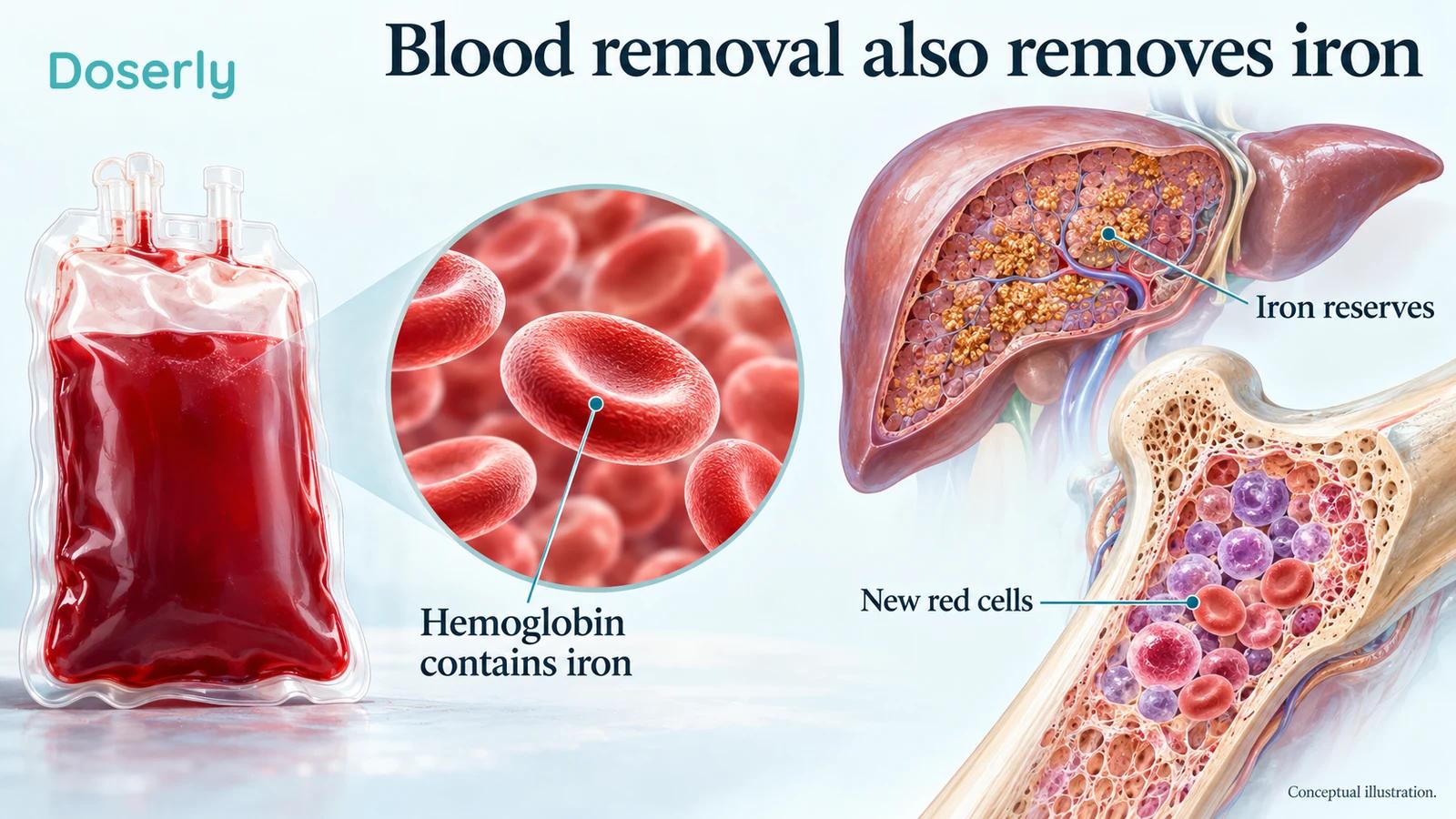
Donation does not reliably switch off the original stimulus
A small Canadian study reviewed 39 testosterone-treated donors. Among 27 who donated repeatedly, 12 had persistently high hemoglobin at subsequent visits. The authors concluded that repeat donation was not reliably maintaining counts below the guideline-related threshold they examined. Hematocrit was inferred from hemoglobin in this report, rather than directly measured at every donation. Chin-Yee and colleagues
This study was too small and too limited to quantify the frequency of iron deficiency on TRT. It also did not test whether donation prevented clots. Its contribution here is simpler: removing blood does not necessarily resolve the ongoing reason for excess production.
For someone repeatedly told to donate, that creates an important distinction between a temporary intervention and an indefinite workaround. If the same problem returns, the next appointment should include a review of the testosterone regimen and other contributors, alongside iron status. The donation history should be part of the prescribing record rather than a separate activity the patient manages alone.
Doserly's TRT and hematocrit guide covers the broader blood-count discussion. Here, the narrower issue is what can happen to iron reserves while that count is being managed.
How to read a low ferritin result without turning it into a target game
Ferritin thresholds depend on the clinical question and on inflammation. The World Health Organization's guidance uses different interpretive approaches for otherwise healthy people and those with infection or inflammation. A ferritin value that looks reassuring in isolation may be less reassuring in an inflammatory illness. WHO ferritin guideline
Clinicians may interpret ferritin with transferrin saturation, the complete blood count and relevant inflammatory information. Transferrin saturation describes how much of the blood's iron-transport capacity is occupied. Mean corpuscular volume, or MCV, describes average red-cell size. These measurements add context; none should be treated as a home-built replacement for clinical assessment.
The British Society of Gastroenterology identifies ferritin as a particularly useful marker and notes that transferrin saturation can help when a false-normal ferritin is suspected. It also distinguishes iron deficiency without anemia from iron-deficiency anemia. BSG guideline
Bring the original report, including units and reference intervals. Ferritin reported in ng/mL and micrograms/L has the same numerical value, but serum iron is a different measurement altogether. A message saying “my iron is 20” is difficult to interpret without the test name and units.
There is no established universal “optimal ferritin on TRT” number that overrides this context. The useful question is whether iron deficiency is present, why it developed, and what recovery should look like for you. A laboratory target copied from an athlete forum may be addressing a different population or no validated clinical endpoint at all.
What newer donor trials actually support
The 2025 FORTE trial enrolled 830 Dutch blood donors with ferritin at or below 30 micrograms/L. It compared several oral iron regimens with placebo over 56 days. At follow-up, iron deficiency was present in about half of assessed placebo participants, compared with 1–10% across the active-treatment groups. The trial was funded by Sanquin Blood Supply Foundation. FORTE randomized trial
This is useful evidence that low donor iron stores can be addressed. It is not evidence that supplementation makes unlimited blood removal safe, or that the same approach is appropriate while TRT is driving an excessive count. Its primary outcomes concerned iron deficiency, ferritin and hemoglobin. It did not establish a strategy for preventing thrombosis in testosterone-treated patients.
The earlier STRIDE trial randomized 692 frequent donors to iron, placebo, or information strategies over two years. Both iron provision and ferritin-informed letters helped mitigate deficiency among study completers; untreated control strategies performed worse. Only 393 participants completed the study, and withdrawal was more common in pill groups, an important limitation when interpreting effectiveness. STRIDE trial
The two trials support an organized approach to donor iron health, with testing or structured prevention and follow-up. They do not collapse the clinical decisions into “donate, then take a supplement.” For a TRT patient, the ongoing need for removal and the response to iron replacement must be considered together.
A better ferritin result does not guarantee better energy
Low iron stores deserve attention, but symptoms are not a simple ferritin meter. Fatigue, poor exercise tolerance, concentration problems and restless legs can have multiple contributors. A temporal relationship to donation is useful information, not a diagnosis by itself.
A placebo-controlled trial in 405 non-anemic, iron-deficient repeat donors tested intravenous iron. Ferritin and hemoglobin improved, but the primary fatigue outcome did not differ at six to eight weeks. Mean fatigue scores were 3.9 with iron and 4.0 with placebo on the study's scale. Prespecified subgroup analyses did not demonstrate a clear fatigue benefit either. Keller and colleagues
That negative result matters because it prevents a laboratory effect from becoming a promise about how someone will feel. It does not show that every symptomatic person with iron deficiency should go untreated. It shows that this trial's participants did not gain the expected average symptom benefit from that intervention.
A smaller double-blind trial in 79 iron-deficient donors likewise did not establish improved cognition or well-being with iron repletion. Its size and selected population limit generalization, but it reinforces the need to measure the outcome being promised rather than assume it follows from a corrected marker. Donor cognition and well-being trial
When following recovery, record symptoms separately from laboratory values. If ferritin improves but fatigue persists, that is a reason to reassess the remaining causes rather than indefinitely chase a higher ferritin number or increase testosterone exposure.
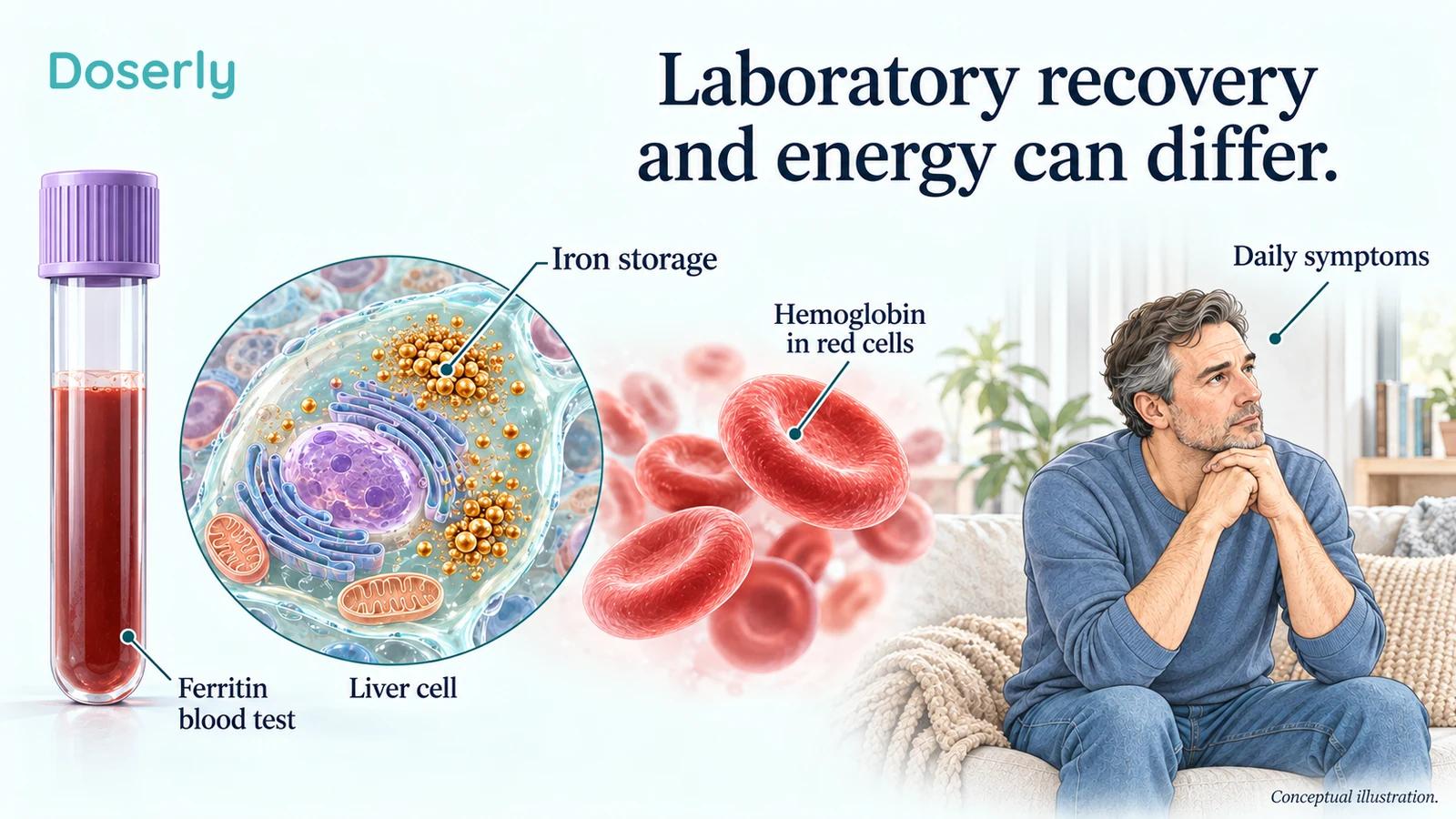
Why donation should not become the explanation for every low result
Repeated donation is a plausible source of iron loss, but plausibility is not exclusivity. A clinician should consider the amount and timing of removal, dietary intake, absorption problems and other blood loss. A ferritin decline that predates donations, continues after they stop, or seems disproportionate to the history deserves particular attention.
The BSG guideline notes that the threshold for investigating non-anemic iron deficiency should be lower in men, postmenopausal women and people with gastrointestinal symptoms or relevant family history. It does not recommend automatically sending every non-anemic person with low stores for invasive testing. The history and associated findings guide the decision. BSG investigation guidance
There is a practical reason to be specific about bleeding rather than simply answer “no” to a general question. Tell the clinician about visible blood, dark tarry stools, urinary bleeding or recurrent nosebleeds, and list medicines that affect bleeding. Do not assume a change is expected because you take testosterone or have donated recently.
If you have substantial bleeding, fainting, chest pain or severe new breathlessness, seek urgent assessment. Those symptoms need evaluation on their own merits; waiting for a routine ferritin recheck is not an adequate response.
What current donor guidance adds
AABB's donor-iron bulletin, updated in March 2026, describes several prevention approaches: iron replacement programs, evidence-based changes in donation frequency, and ferritin testing linked to follow-up action. The emphasis is on actively preventing depletion rather than relying on a passing hemoglobin result. AABB updated bulletin
Canadian Blood Services recommends a six-month pause from whole-blood donation for donors with low ferritin and advises discussion with a health professional. That is donor guidance, not an instruction to delay medically indicated therapeutic phlebotomy without contacting the treating team. The medical indication and the iron problem must be reconciled together. Canadian Blood Services
If one service advises a donation pause while another has prescribed blood removal, communicate that conflict directly. Neither team should have to infer the other team's plan from a laboratory value. Ask the prescriber to specify the purpose of any further removal, how iron status affects that decision, and what alternative changes are being considered.
Turn the next visit into a coordinated plan
A useful record has dates for testosterone changes, blood counts, ferritin results and every donation or therapeutic removal. Include the type of donation. Whole-blood donation, red-cell collection and plasma donation are not interchangeable entries in an iron-loss history.
Also record supplements already being taken, including the actual label and amount of elemental iron if listed. The name or total tablet weight alone may not describe the iron exposure. Do not hide supplementation because it was self-started; the clinician needs that information to interpret subsequent results and avoid contradictory instructions.
The plan should answer three separate questions: whether more blood needs to be removed, whether iron deficiency needs treatment, and whether the factor driving red-cell production can be changed. A decision about one does not automatically settle the others.
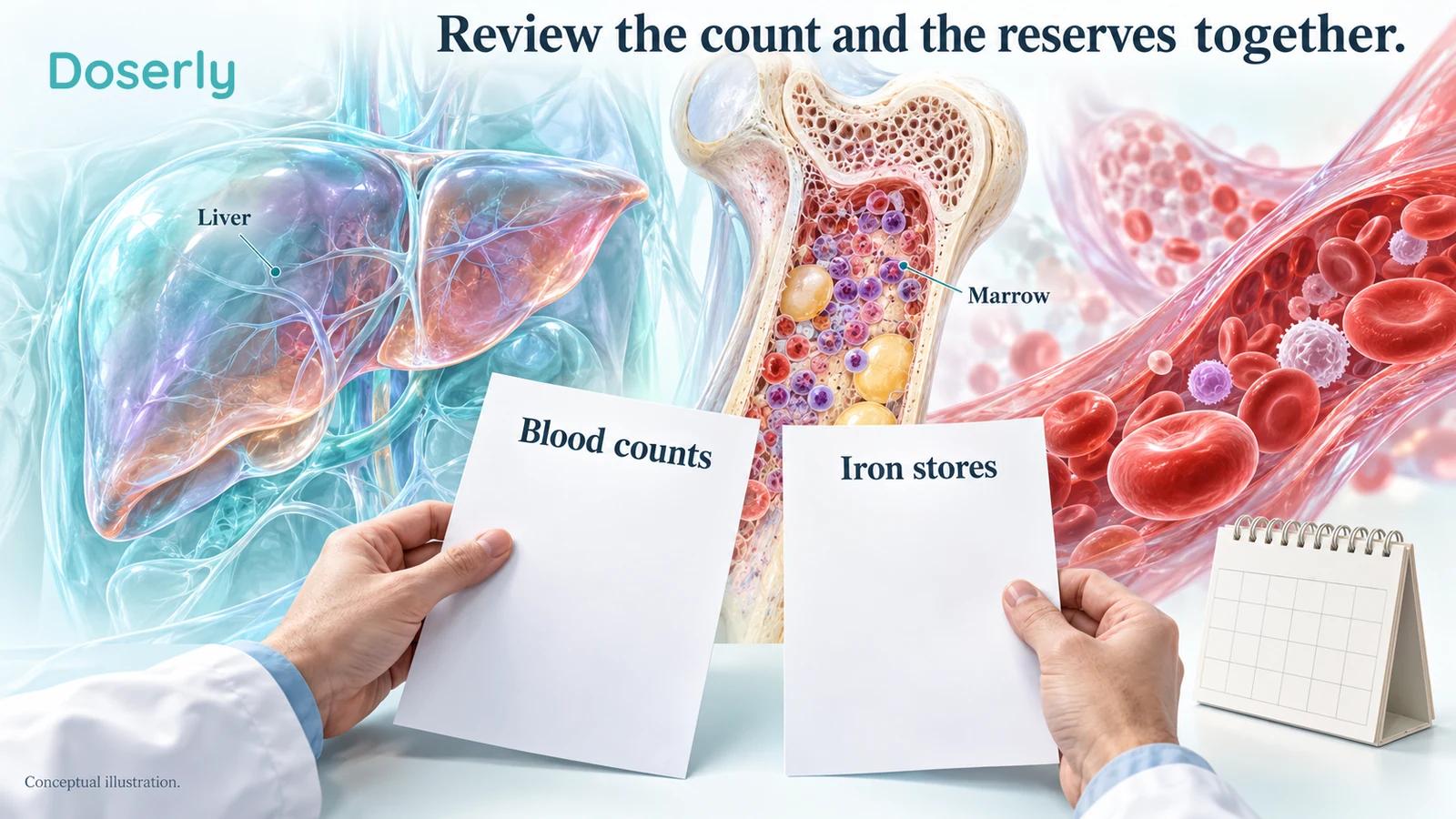
Useful questions to bring include:
- Does my ferritin indicate depleted reserves despite the current hemoglobin?
- Is donation enough to explain the pattern, or should another source of loss be investigated?
- Do we still need blood removal, and what is being done about the recurring high count?
- If iron is prescribed, which blood and iron measurements will guide follow-up?
- What will we reconsider if laboratory recovery and symptom recovery do not match?
Low ferritin after repeated donation is a reason to widen the follow-up beyond hematocrit. The most useful endpoint is a sustainable plan for the original hormone condition, the blood-count response and iron health together, with clear responsibility for reviewing what happens next.