
TRT
October 16, 2026
TRT and anemia: a real benefit with an important diagnostic catch
On this page
Testosterone does more than influence sexual function and muscle. It also affects the production of red blood cells, which carry oxygen around the body. In a man with both testosterone deficiency and anemia, that can create a treatment benefit that is measurable in a routine blood count.
The TRAVERSE anemia study found that testosterone gel corrected anemia more often than placebo in men with hypogonadism. But a low hemoglobin result still needs an explanation. Raising it does not prove that low testosterone was its only cause, and it does not replace investigation for bleeding, nutrient deficiency, kidney disease or another problem. TRAVERSE anemia report
Understanding both sides of that finding is especially useful if fatigue has prompted a hormone consultation. “Low energy” is a symptom; anemia is a blood finding; testosterone deficiency is a clinical diagnosis. They can overlap without being interchangeable.
What anemia means
Red cells contain hemoglobin, an iron-containing protein that carries oxygen. Anemia involves a lower-than-normal amount of healthy red cells or hemoglobin. It can develop because production is inadequate, cells are lost through bleeding, or cells are destroyed faster than they are replaced. Nutrients, inflammation and medical conditions can all be involved. NHLBI causes of anemia
A complete blood count, or CBC, measures several parts of the blood. Hemoglobin concentration and hematocrit, the fraction of blood volume occupied by red cells, are related but different results. The CBC also includes information about red-cell size, white cells and platelets. These details can help guide investigation rather than simply labeling every low count “low iron.” NHLBI diagnosis guidance
Anemia is therefore a starting point for a diagnostic conversation. Its severity, pattern, speed of development and accompanying symptoms affect what comes next. A gradual mild reduction in an otherwise stable person is a different situation from a rapid fall accompanied by breathlessness or evidence of bleeding.
If you have old blood counts, bring them. A trend can help establish whether the finding is new, longstanding or changing. A screenshot of the latest testosterone result alone leaves out much of that story.
How testosterone connects with red-cell production
Red cells develop in bone marrow. The kidneys help regulate production by releasing erythropoietin, often shortened to EPO, a hormone that signals the marrow. Kidney disease can reduce that signal and can contribute to anemia through several additional pathways. NIDDK explanation
A randomized mechanistic study in older men with mobility limitation found that testosterone-associated rises in hemoglobin and hematocrit were accompanied by changes in EPO and hepcidin, a hormone involved in iron regulation. The findings support effects on red-cell production and iron use, but they do not mean that every case of anemia can be treated by increasing testosterone. Bachman and colleagues
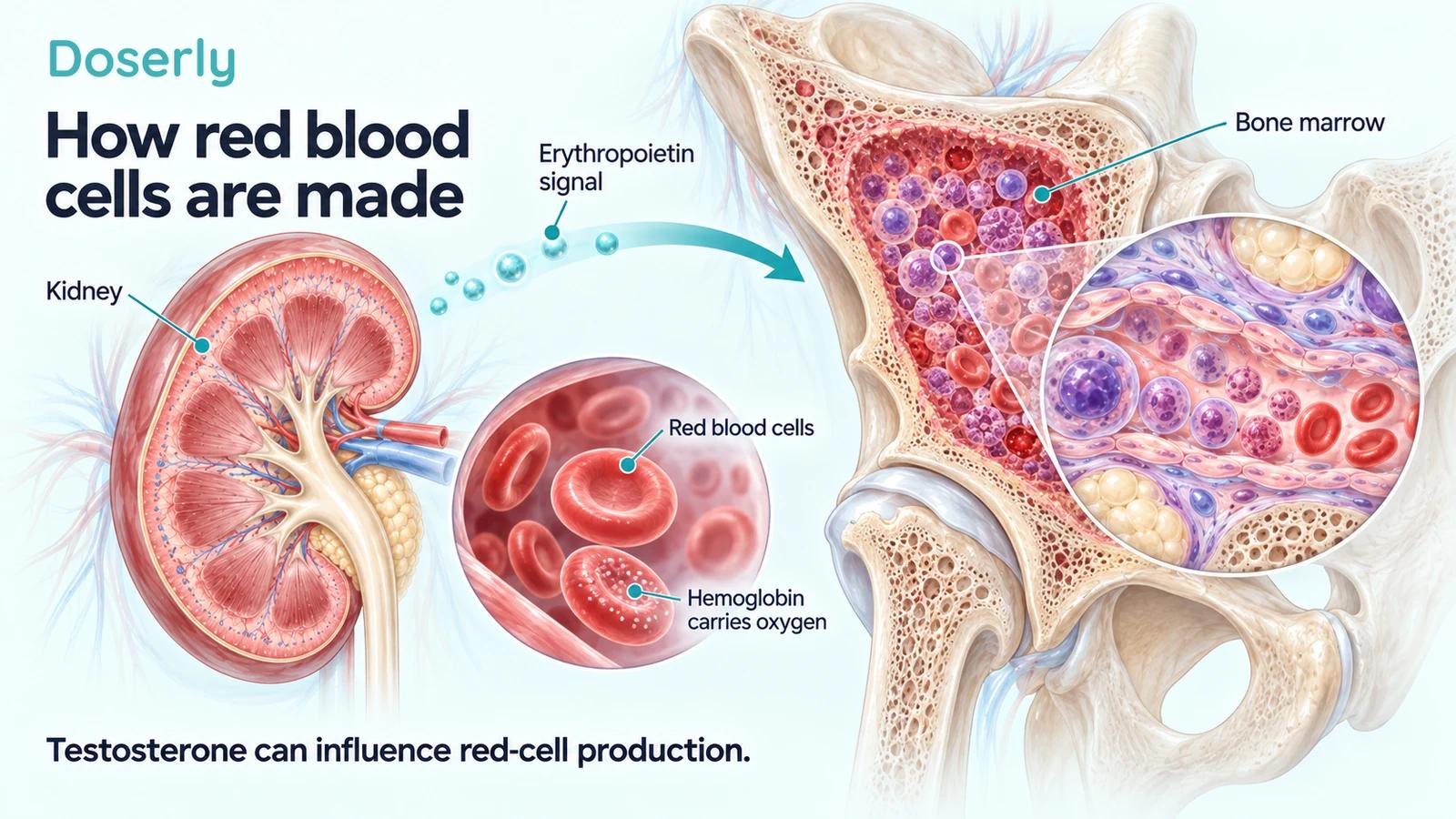
This biology also explains why a desired effect and an adverse effect can involve the same process. An increase may be helpful when hemoglobin is low. An excessive increase in someone whose count is already adequate can become a reason to reassess treatment. The goal is an appropriate clinical response, not the highest possible blood count.
What TRAVERSE studied
The anemia analysis included 5,204 men from TRAVERSE, of whom 815 had anemia at baseline and 4,379 did not. Participants were aged 45–80, had symptoms of hypogonadism and two testosterone measurements below 300 ng/dL, and had cardiovascular disease or increased cardiovascular risk. They were randomized to daily 1.62% testosterone gel or placebo. Primary anemia report
For this study, anemia meant hemoglobin below 12.7 g/dL, and correction meant reaching at least 12.7 g/dL. That was the trial's definition, not a universal diagnostic boundary for every laboratory or patient. The main analysis examined correction across repeated follow-up visits.
This was treatment of men who had established low-testosterone criteria, not a trial giving testosterone to everyone with anemia. It also tested a monitored gel regimen. The findings should not be expanded into an unsupervised dosing strategy or a claim that any formulation produces the same response.
How often was anemia corrected?
At six months, anemia was corrected in 143 of 349 assessed testosterone participants (41.0%), compared with 103 of 375 assessed placebo participants (27.5%). The difference in those observed proportions is 13.5 percentage points. At 12 months the corresponding proportions were 45.0% and 33.9%; the repeated-measures comparison favored testosterone. TRAVERSE results
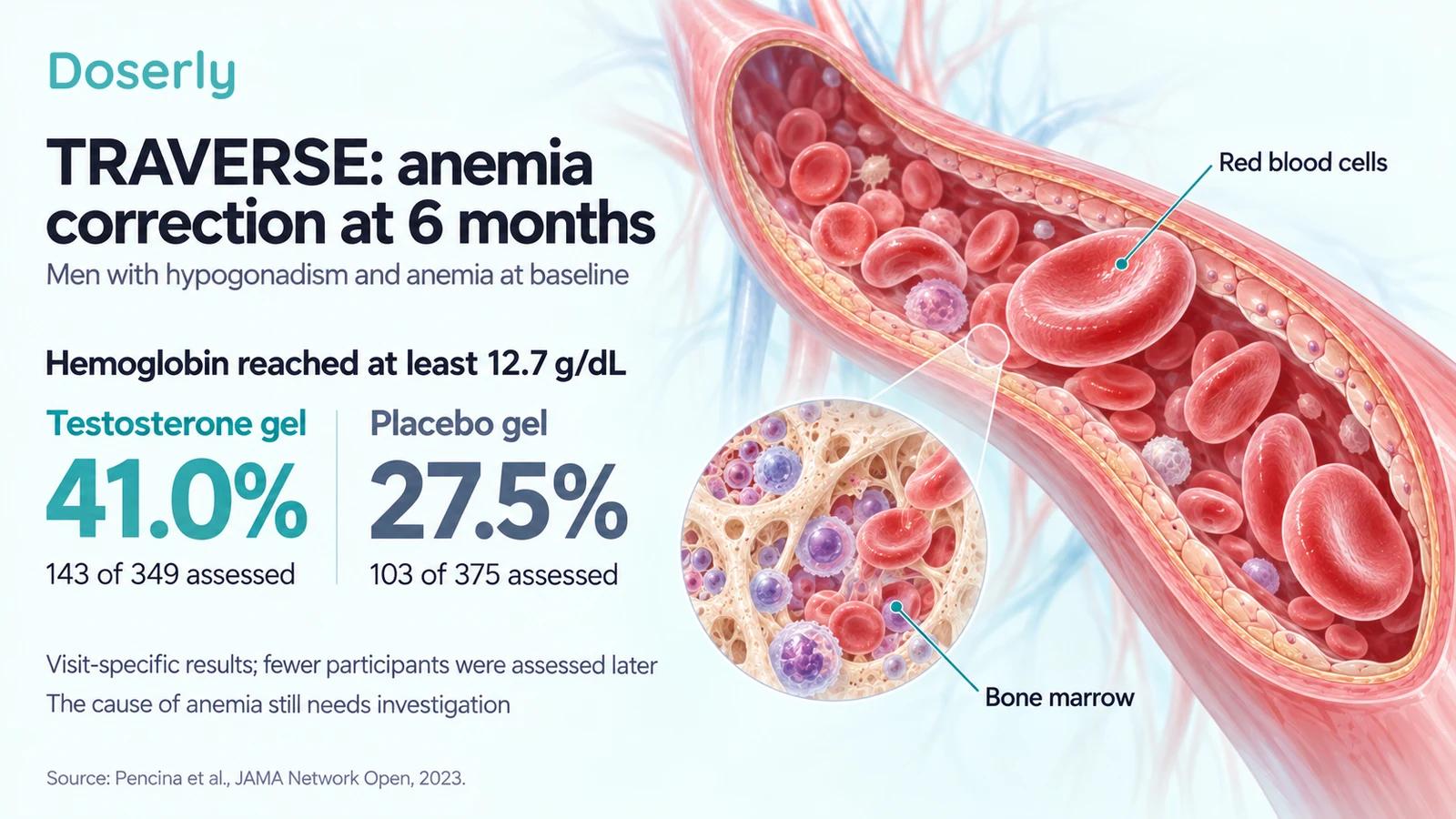
Image sources: primary anemia report
The denominator matters. Fewer participants contributed to later visits; at 48 months, the reported comparison involved 92 testosterone and 97 placebo participants. Those later percentages should not be presented as if all original participants had completed four years of observation. Follow-up data
The six-month difference gives a useful sense of scale: among roughly 100 similar men assessed at that time, about 41 versus 28 had crossed the study threshold. It is not a prediction that any particular man has a 41% chance of success, and it is not an estimate of how much his fatigue will improve.
What earlier research adds
An earlier Testosterone Trials analysis included 126 anemic older men, 62 of whom had no recognized cause of anemia after evaluation. Participants received testosterone or placebo gel for 12 months. Among those with unexplained anemia, 54% with testosterone versus 15% with placebo had a hemoglobin increase of at least 1 g/dL at month 12. The proportions no longer classified as anemic were 58.3% and 22.2%. Roy and colleagues
The small subgroup produced wide confidence intervals around adjusted estimates. It supported further investigation rather than a precise promise for every older man. Hemoglobin also rose in participants with identified anemia causes, reinforcing that a response to testosterone does not prove the cause was hormonal. Earlier trial report
Together, the trials establish that testosterone can affect this outcome in selected men with low testosterone. The larger TRAVERSE analysis gives the finding greater clinical substance, while the earlier study helps explain why the question was worth testing.
Does correction mean fatigue will disappear?
Not necessarily. TRAVERSE reported an association between changes in hemoglobin and changes in energy. That is relevant, but it does not prove that correcting the blood result explains every improvement or guarantees that fatigue will resolve. Anemia trial
Fatigue can be described in several ways: sleepiness, lack of motivation, reduced endurance, breathlessness or physical weakness. Those experiences can point toward different assessments. Telling the clinician which activities have become difficult is often more useful than giving fatigue a single number without context.
For example, “I need to stop halfway up stairs because I am short of breath” and “I cannot stay awake at my desk” are different descriptions. Both warrant attention, but a rise in hemoglobin would not automatically explain or resolve both. These are examples of how to communicate symptoms, not a way to diagnose yourself.
Follow-up should therefore include both the blood count and the problem that led to testing. If the count improves but daily function does not, that is useful information to bring back rather than a reason to assume the treatment needs escalation.
Why the cause of anemia must still be investigated
Blood loss, insufficient iron or vitamins, inflammation and other conditions can impair red-cell production or survival. Treatment depends on which process is present. Taking iron without evidence of deficiency, or attributing anemia to testosterone before reviewing the rest of the history, can miss the actual problem. NHLBI anemia causes
The workup may include the CBC pattern, iron studies and other tests selected from the history. Not everyone needs every test. A clinician may ask about diet, medicines, bleeding, bowel symptoms, previous results or family history, and may refer to a blood specialist when the explanation remains unclear. NHLBI diagnosis
In chronic kidney disease, more than one contributor can coexist: reduced EPO production, iron or vitamin deficiency, inflammation and blood loss are examples. NIDDK describes care directed at the underlying contributors and, when appropriate, specific anemia treatments. Testosterone is not a substitute for that kidney-focused evaluation. NIDDK anemia in kidney disease
The diagnostic catch is that a laboratory improvement can occur without removing the original cause. A satisfactory hemoglobin result after starting TRT should not be treated as evidence that a previously suspected source of bleeding or nutritional problem no longer needs attention.
When the same effect becomes a safety issue
The AndroGel prescribing information warns that hematocrit can rise and calls for assessment before treatment, after starting, and subsequently during therapy. If hematocrit becomes elevated, treatment may need to be stopped until it returns to an acceptable level. The prescriber interprets that result in context. AndroGel label
This is why “more red cells” should not be used as a general wellness goal. A patient who benefits from correction of anemia still needs monitoring for an excessive response. The same medication can move one person's result toward an appropriate range and another person's beyond it.
Do not assume that routine blood donation is the answer to an abnormal count. A raised result needs interpretation, including the treatment exposure and other possible contributors. An intervention that lowers a number can also change iron stores and obscure the trend. Discuss the actual result with the prescribing clinician rather than trying to manage it from a generic online threshold.
Our TRT blood-work guide explains how the blood count fits alongside hormone levels and other monitoring. Keep the date and the medication schedule with the result so the clinician can interpret the sequence accurately.
What to ask if you have both low testosterone and anemia
Start by separating diagnosis from treatment response. Ask what supports hypogonadism, what supports anemia, and which possible causes of anemia have been considered. The Endocrine Society recommends symptoms together with consistently low testosterone and evaluation of the cause before treatment decisions. Clinical guideline
Then agree on what success would look like. That might include correction of a low count, improvement in a particular symptom and no excessive hematocrit rise. Ask when those outcomes will be checked and who is responsible for following any unresolved anemia investigation.
Bring the full CBC rather than only the hemoglobin line, previous results if available, and a current medicine and supplement list. If several clinicians are involved, make sure each knows about TRT and any anemia treatment. That avoids interpreting a change as spontaneous when another treatment may have contributed.
New severe breathlessness, chest pain, fainting or significant bleeding needs prompt medical attention, not a routine wait for hormone follow-up. For less urgent symptoms, a clear dated description helps establish whether the person is improving alongside the laboratory result.
The benefit shown in the trials is worth discussing: testosterone can correct anemia in some men with hypogonadism. Its proper place is within a diagnosis and monitoring plan that continues to ask why the anemia occurred and whether the person is actually feeling and functioning better.
A record can also separate correction from explanation: note that hemoglobin improved, while keeping the original anemia evaluation and any unresolved cause visible. Otherwise, a favorable follow-up result can accidentally close a question that treatment never answered. Bring earlier reports to a new clinician so the reason for the initial investigation is not lost.
Sources
- Pencina and colleagues, TRAVERSE anemia trial, 2023.
- Roy and colleagues, Testosterone Trials anemia analysis, 2017.
- Bachman and colleagues, EPO and hepcidin mechanism study, 2014.
- NHLBI, anemia causes.
- NHLBI, anemia diagnosis.
- NIDDK, anemia in chronic kidney disease.
- AndroGel 1.62% prescribing information.
- Endocrine Society, testosterone clinical guideline.