
TRT
October 16, 2026
TRAVERSE's fracture surprise: what stronger bone measurements cannot tell us
On this page
Testosterone has an important relationship with bone health, and treatment can improve some bone measurements in men with low testosterone. That makes an intuitive promise attractive: if a scan suggests stronger bone, fewer fractures should follow. The large TRAVERSE fracture study did not support that promise.
Over a median 3.19 years, clinical fractures occurred more often among participants assigned to testosterone gel than among those assigned to placebo. The result does not mean a scan is useless or that testosterone necessarily weakens bone. It means that fracture prevention has to be measured directly, and TRT should not be assumed to provide it. TRAVERSE fracture report
For someone with low testosterone and concerns about osteoporosis, the useful question is how to address both conditions without letting treatment for one stand in for treatment of the other.
What makes a bone resistant to fracture?
Bone has a dense outer layer and an internal network of supporting tissue. The dense portion is called cortical bone; the inner lattice is trabecular bone. Bone-mineral density estimates how much mineral is present in the area or volume being examined. It provides valuable information about fracture risk, but it is not a complete description of the forces a person will encounter or their likelihood of falling. NIAMS explanation of bone-density testing
Fracture risk brings together the skeleton and the circumstances in which it is loaded. Balance, vision, muscle function, medicines and hazards in the home can affect falls. The location and force of an impact also matter. Osteoporosis care therefore includes both attention to bone and measures to reduce falls. NIAMS osteoporosis care
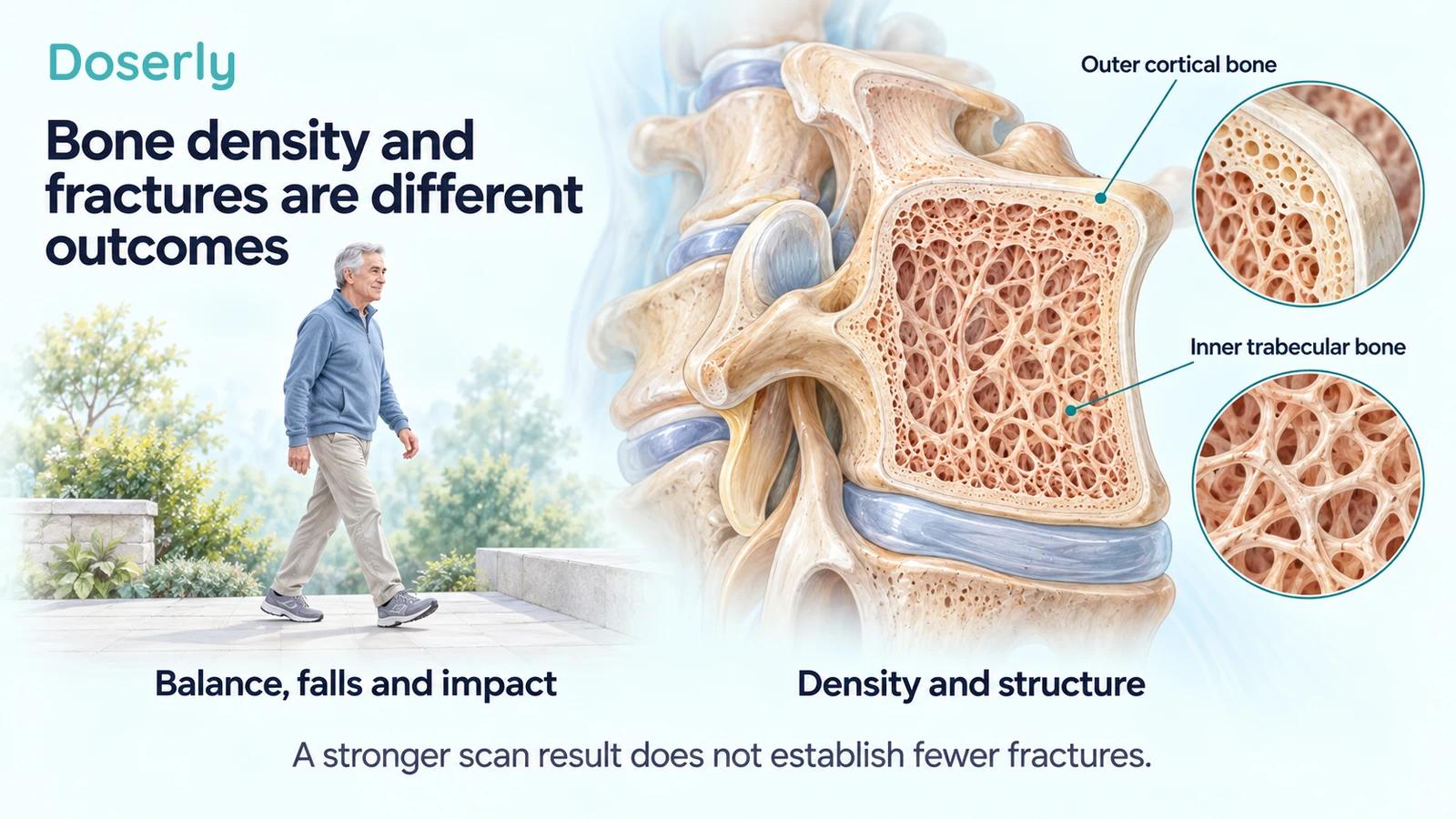
This is why two people with similar scan results may not have the same clinical risk. Their ages, previous fractures, medical histories and daily circumstances can differ. A scan informs the assessment; it does not replace it.
Why researchers expected testosterone might help
A 2017 trial within the Testosterone Trials studied 211 older men with low testosterone. Participants received testosterone or placebo gel for one year. Researchers used quantitative computed tomography, a three-dimensional imaging method, to measure bone density and calculate estimated strength from the scans. Bone Trial primary report
Spine trabecular volumetric density increased by 7.5% with testosterone and 0.8% with placebo. The reported treatment effect was 6.8%, with a 95% confidence interval of 4.8%–8.7%. Estimated trabecular spine strength also improved. The effects were greater in the spine than the hip and in trabecular than peripheral bone. Primary results
Those findings give a real biological reason for interest. They are not merely personal impressions of feeling stronger. But estimated strength is a calculation based on images; researchers did not apply force until participants' bones broke. The trial was also too small and short to establish a reduction in clinical fractures.
The question left open was consequential: would favorable measurements translate into fewer injuries over several years? A larger outcomes study was needed to answer it.
Even different bone measurements may respond differently
A later analysis of 197 men with repeat measurements from the same Bone Trial examined the trabecular bone score, an indirect image-derived measure associated with bone microarchitecture. After one year, the score did not change significantly differently between testosterone and placebo, despite changes in volumetric density. Trabecular bone score analysis
This is not a contradiction that makes all imaging meaningless. The measurements examine related but different features. “Bone quality” is often used loosely in public discussion, but no single number captures every aspect of strength, structure and clinical risk.
When reviewing a report, it helps to identify exactly what improved: density at which site, a calculated strength estimate, a texture-based score, or the number of fractures. Those descriptions carry more useful information than saying simply that testosterone “builds stronger bones.”
What the TRAVERSE fracture study tested
The fracture analysis was part of a randomized, blinded trial in middle-aged and older men with symptomatic low testosterone and cardiovascular disease or increased cardiovascular risk. Participants were assigned daily testosterone or placebo gel. They were asked about fractures at visits, and reported events were checked using medical records and adjudication. The full fracture-analysis population was 5,204 men. Study methods and results
This was not a trial enrolling only people with established osteoporosis, nor was it a comparison of testosterone against an osteoporosis medicine. It asked whether adding testosterone, under the study conditions, reduced clinical fractures compared with placebo in the selected hypogonadal population.
That distinction matters for someone already being treated for osteoporosis. The result does not tell you which bone medicine is best, and it does not test whether testosterone should replace one. It answers the narrower but important question of whether the testosterone strategy prevented fractures in these participants.
What the fracture numbers show
A clinical fracture occurred in 91 of 2,601 testosterone participants (3.50%) and 64 of 2,603 placebo participants (2.46%). The hazard ratio was 1.43, with a 95% confidence interval of 1.04–1.97. Median follow-up was 3.19 years. TRAVERSE fracture findings
Subtracting the observed proportions gives a difference of about 1.04 percentage points. This is roughly one additional person with a clinical fracture per 100 participants over the observed follow-up. It is an illustration of the trial counts, not an individual prediction or an annual rate.
The hazard ratio incorporates when events occurred. It is often described as a 43% higher relative hazard, but that does not mean 43 out of every 100 men fractured. Both the relative and absolute descriptions are needed to understand the scale without exaggerating or minimizing the finding.
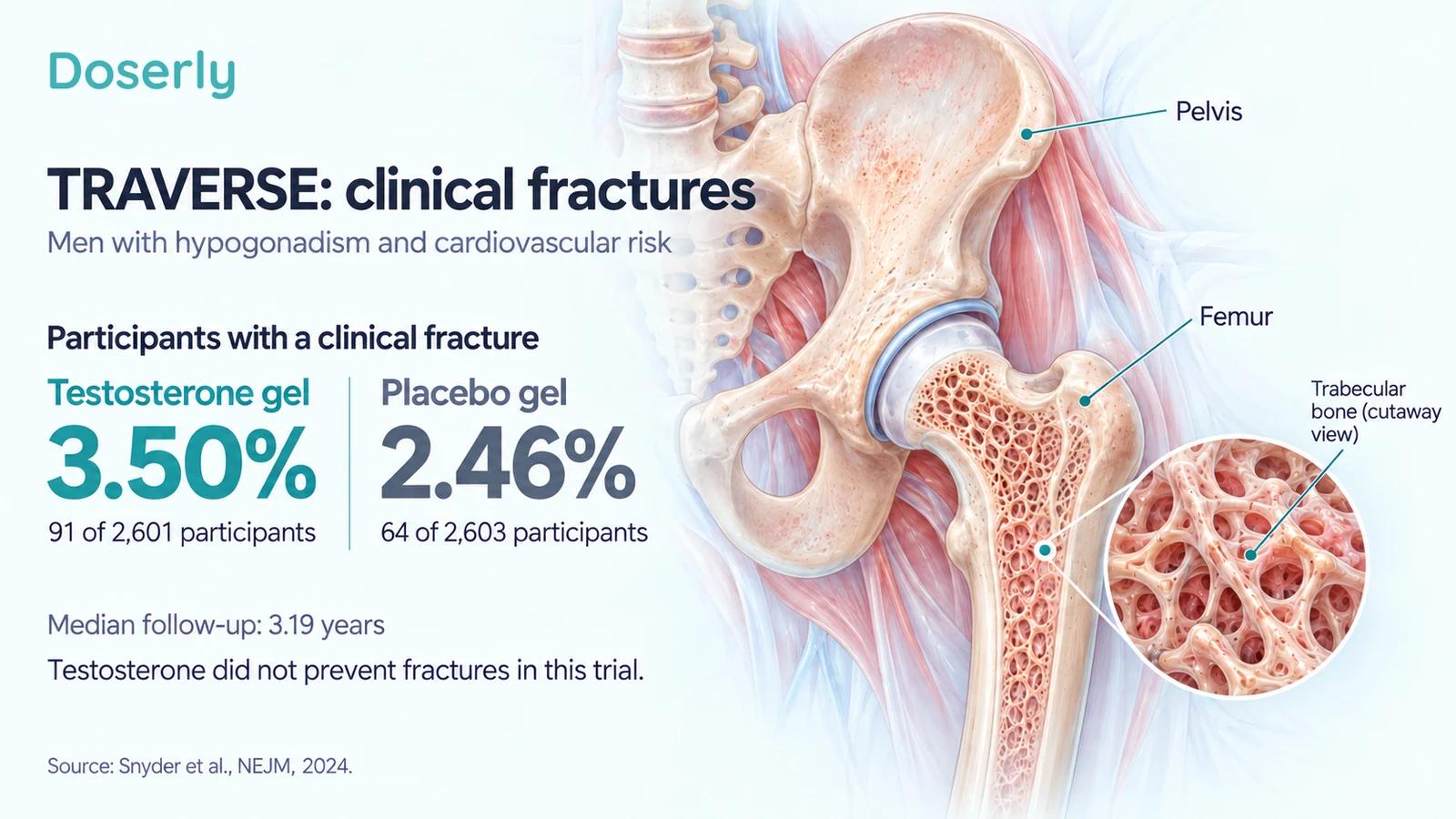
Image sources: primary fracture report
The appropriate conclusion is that testosterone did not prevent clinical fractures in this trial and that the observed incidence was higher with treatment. The result is not evidence that every treated man's bones became less dense.
Do we know why more fractures occurred?
The results do not establish a single explanation. Bone measurements, behavior, falls and injury exposure are different parts of the problem. It is possible to propose explanations involving activity or falls, but a plausible explanation is not a demonstrated mechanism.
In particular, it would be misleading to tell a patient that the fractures occurred because testosterone made men energetic enough to take more risks. That story can make a troubling finding sound reassuring without proving why it happened. The clinical result remains important even when its mechanism is uncertain.
It would be equally misleading to draw an image of testosterone dissolving bone. Earlier studies measured improvements in some skeletal properties. The useful response is to keep the measured outcomes separate and avoid inventing a unifying story that the trial did not test.
For a patient, this uncertainty does not prevent action. It means fracture risk should receive its own assessment rather than being inferred from the hormone response.
What osteoporosis treatment evidence looks like
A different randomized trial enrolled 1,199 men aged 50–85 with primary or hypogonadism-associated osteoporosis. It compared zoledronic acid with placebo over two years, with calcium and vitamin D given to participants. New morphometric vertebral fractures, identified through changes in vertebral shape on imaging, occurred in 1.6% versus 4.9%. The relative risk was 0.33, with a 95% confidence interval of 0.16–0.70. Boonen and colleagues
This is an example of evidence directly addressing a fracture outcome in men with osteoporosis. It is not a recommendation that every reader use that drug. The trial did not compare zoledronic acid with testosterone, and its imaging-defined vertebral outcome differs from TRAVERSE's clinical-fracture outcome.
The comparison teaches a more specific lesson: when the goal is preventing fractures, ask about therapies with evidence for the relevant fractures in an appropriate population. A treatment's ability to change a hormone level or scan does not answer that question by itself.
How to assess your own bone risk
The Endocrine Society's osteoporosis guideline recommends testing higher-risk men with central DXA, including men aged 70 or older and younger men with relevant risks. It also recommends investigating contributing causes. Its treatment recommendations consider prior hip or spine fracture, sufficiently low bone density and overall clinical risk. Osteoporosis in Men guideline resources
DXA, also written DEXA, is dual-energy X-ray absorptiometry. It is commonly used to assess density at the hip and spine. The result can support diagnosis and monitoring, but should be read with the rest of the history. NIAMS testing guidance
Bring a history of previous fractures, including how they happened. A fracture after a minor fall can have a different implication from one sustained in a major collision. Also describe falls or near-falls, changes in height or back symptoms, medicines and any existing bone treatment. The clinician decides which findings need investigation; you do not need to interpret the entire scan yourself before the visit.
If you already take TRT for a well-established deficiency, ask whether your bone assessment is complete. If the main reason for considering testosterone is osteoporosis, ask explicitly whether the proposed plan has evidence for fracture prevention and whether another treatment is needed.
What a better follow-up conversation includes
A useful plan separates three questions: whether testosterone treatment is helping its intended symptoms, whether bone risk requires dedicated treatment, and whether fall risk needs attention. Those questions may involve different measurements and different clinicians, but they should be discussed together.
For example, an improved density result can be encouraging while a new fall still calls for review. A normal testosterone result does not explain new back pain. Conversely, a stable scan does not necessarily mean a fracture-prevention medicine has failed; interpretation depends on the treatment and measurement context.
Our TRT introduction covers the broader decision to treat deficiency, while the blood-work guide explains routine laboratory follow-up. Neither substitutes for a bone-health evaluation when fracture risk is the concern.
The TRAVERSE finding changes the promise that can reasonably be made. Testosterone may improve some bone measurements, but it should not be offered as if fewer fractures were an established consequence. For someone worried about breaking a bone, a plan built around fracture risk, appropriate treatment and safer daily function is more useful than reassurance from one improved number.
Sources
- Snyder and colleagues, TRAVERSE fractures, 2024.
- Snyder and colleagues, volumetric bone density and estimated strength, 2017.
- Trabecular bone score analysis, 2021.
- Boonen and colleagues, zoledronic acid and fractures in men, 2012.
- Endocrine Society, Osteoporosis in Men, 2012.
- NIAMS, bone-mineral-density testing.
- NIAMS, osteoporosis diagnosis and care.