
TRT
October 16, 2026
Topical testosterone transfer: the household detail that deserves attention
On this page
Testosterone gel is designed to deliver medicine through the skin. Some testosterone can remain at the application surface, where contact may expose someone who has not been prescribed it. That is why household precautions belong in the treatment plan from the beginning.
The concern is especially important around children and people who are pregnant or could become pregnant. It is not a reason to assume gel is unusable in a household. It is a reason to understand the exact product’s application, drying, covering and washing instructions—and to choose a routine that makes those instructions realistic. AndroGel 1.62% prescribing information.
This article focuses on secondary exposure, meaning transfer to another person. It is different from the separate problem of contaminating a blood-test sample with gel residue. Our AndroGel guide covers the broader treatment and monitoring picture.
How can a medicine transfer after application?
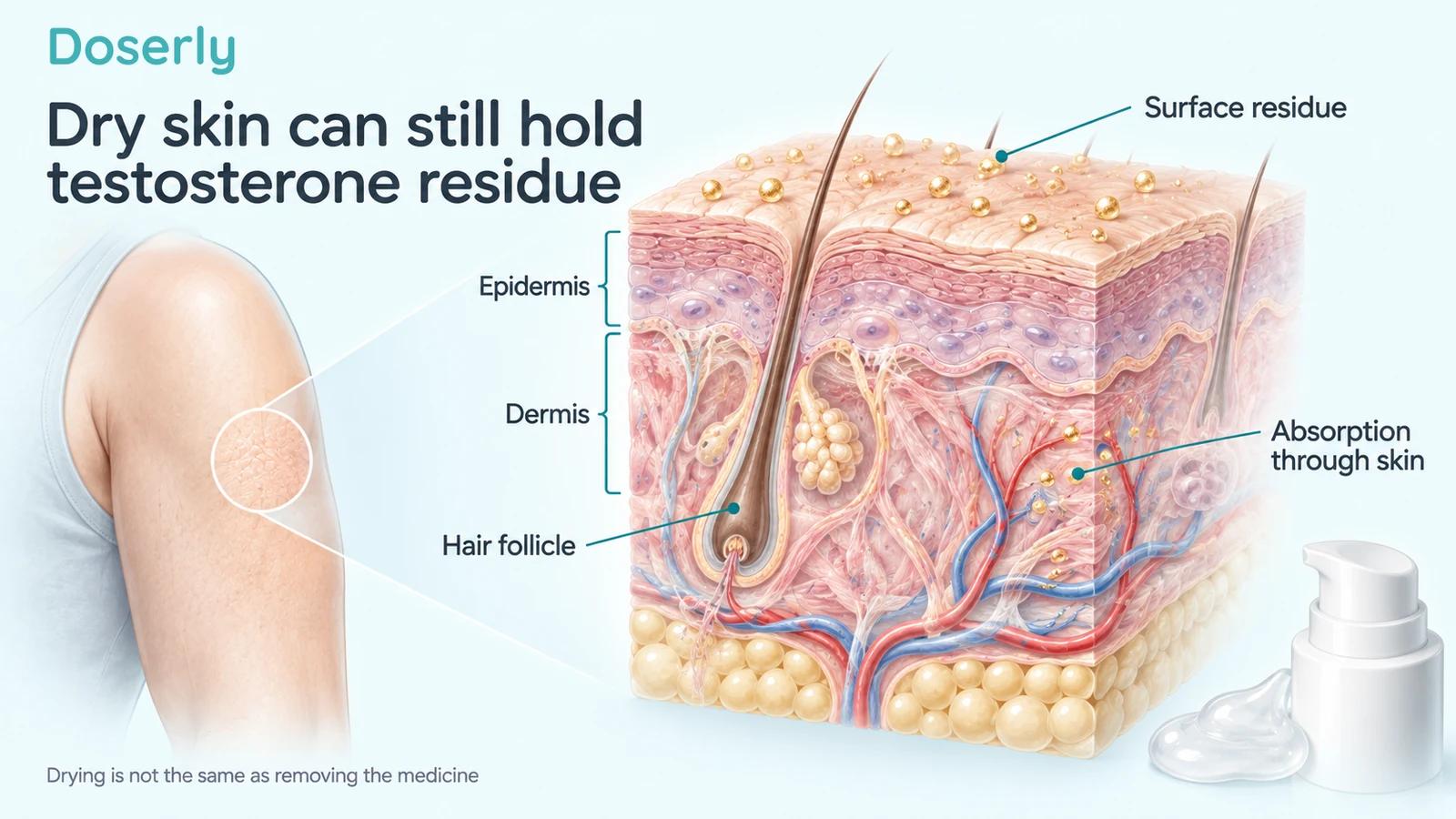
A gel’s vehicle can dry while active medicine remains on or within the outer skin layers. “It feels dry” and “there is no testosterone left to transfer” are therefore different statements.
A study of interpersonal transfer with a 1.62% gel found that contact with the application area could expose an untreated female partner even many hours after application. The authors concluded that transfer remained possible for at least 12 hours under the conditions studied. That is not a universal clock after which every gel becomes safe to touch; it is evidence against assuming that drying alone eliminates the issue. Clothing-barrier study.
Absorption into the treated person and removal of surface residue are also different processes. The therapeutic goal is appropriate delivery through the patient’s skin. The household goal is preventing another person’s skin from becoming an unintended application surface.
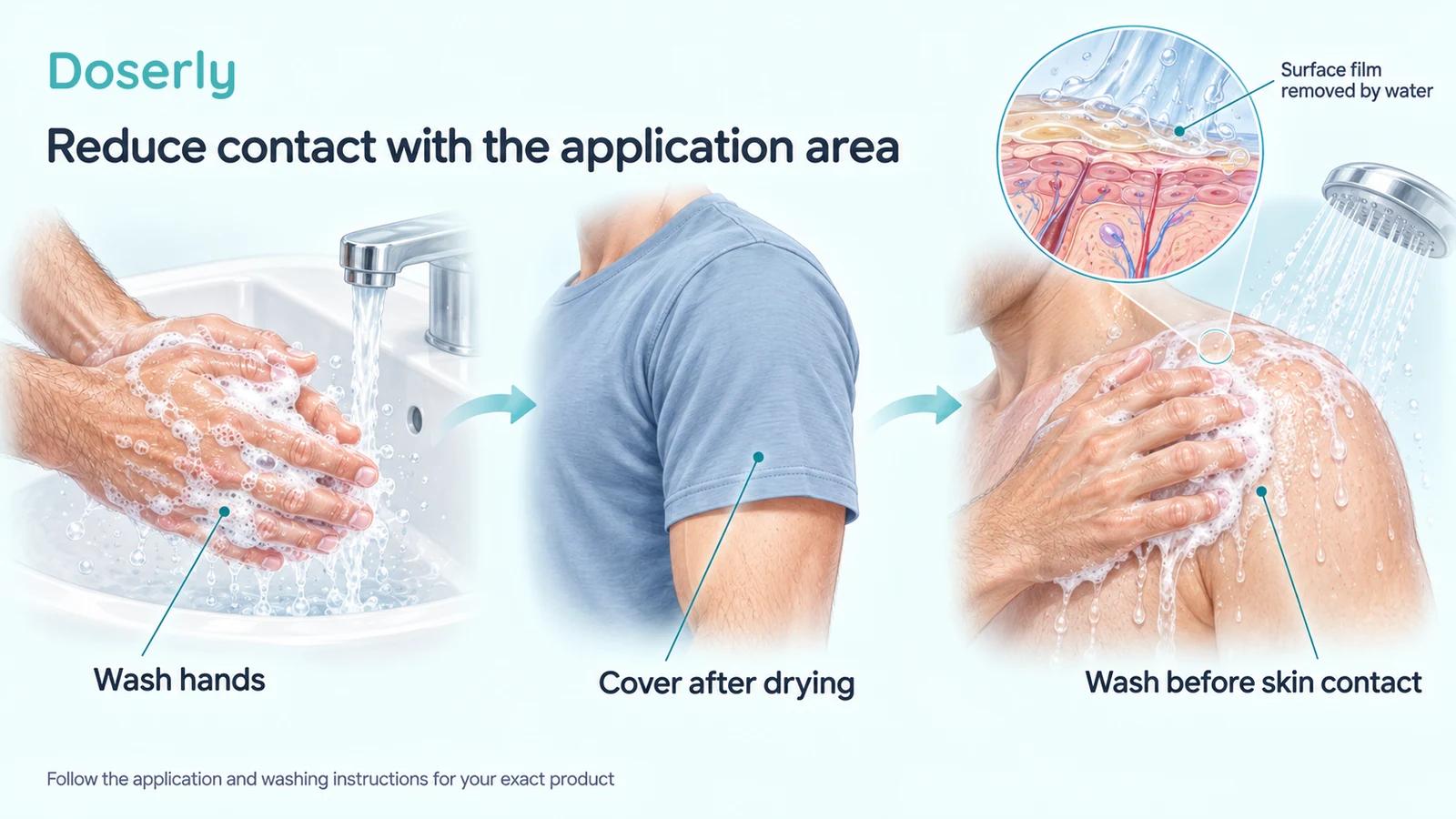
That distinction explains why product instructions combine several measures. Handwashing addresses medicine left on the hands. Clothing covers the treated area. Washing the application site before anticipated contact addresses remaining residue. No single step should quietly replace the others.
What have controlled contact studies shown?
One randomized, open-label crossover study involved 24 healthy male–female couples. Men applied a 1.62% testosterone gel, and partners had 15 minutes of supervised contact with the treated area two hours later. Researchers compared conditions involving clothing, washing and different application sites.
Testosterone exposure in the women increased after direct contact, with the magnitude depending on the conditions. Clothing and washing reduced transfer. These were carefully controlled experiments, useful for establishing that transfer can occur and that precautions can reduce it. Application-site and washing study.
The study did not estimate the probability that a child in an ordinary household would develop symptoms. Adult female participants, specified contact periods and supervised application do not reproduce every pattern of caregiving, sleeping or repeated exposure.
That limitation is important in both directions. A controlled adult study should not be used to promise zero household risk, but it should not be turned into a claim that ordinary brief contact inevitably causes harm. The useful finding is the mechanism and the value of following precautions.
Why children require particular care
Children normally have a different hormonal environment from adults. Unintended testosterone exposure can produce androgen-related physical changes, described clinically as virilization. The AndroGel label includes a boxed warning about secondary exposure and reports signs observed in exposed children. AndroGel label.
Published case reports make the concern concrete. A report of two prepubertal children described virilization associated with passive transfer from their fathers’ topical testosterone treatment. Testosterone concentrations returned to prepubertal levels after exposure stopped, with no further development of secondary sexual characteristics reported in those cases. Two-child case report.
Case reports cannot tell us how often this occurs. They also cannot guarantee that every change reverses fully after exposure ends. Their value is showing that the problem can be clinically meaningful and that the household medication history may explain findings that initially look like an endocrine disorder.
If a child develops unexpected pubic hair, genital changes or other unusual developmental signs, tell the child’s clinician about testosterone products used by anyone in close contact. Do not assume that only the person receiving a prescription needs to mention it in a medical history.
What about partners and pregnancy?
Secondary exposure can also matter for adults. A published report described a woman with hyperandrogenism—effects of excess androgen—considered likely to result from her partner’s testosterone gel. Such reports support asking about a household member’s topical medicine when unexplained androgen-related changes occur. Adult transfer case report.
Pregnancy makes prevention especially important because fetal development can be affected by androgen exposure. The product label warns against exposure in women who are pregnant or may become pregnant. That is a reason to discuss the routine with the prescriber before treatment, not to wait until a transfer episode occurs.
A partner does not need to memorize a pharmacology lecture. They do need to know which area is treated, that uncovered application skin should be avoided and what to do after accidental contact. Agreeing on a clear routine can reduce uncertainty without turning ordinary affection into constant alarm.
If unexpected adult symptoms develop, report both the symptom and the possible exposure. A clinician can decide what assessment is needed; a home hormone test or a guess about the amount transferred cannot establish the effect.
The product name and concentration matter
Application sites and washing intervals differ between formulations. Advice for a 1% gel should not automatically be copied to a 1.62% product, and advice for one brand should not be assumed to fit a compounded cream.
For example, AndroGel 1.62% is applied to specified upper-arm and shoulder areas and has a labeled interval before showering or swimming. Its instructions also describe washing before anticipated skin contact. These details need to be reconciled with the person’s day, rather than shortened into a universal rule such as “shower immediately after gel.” AndroGel 1.62% instructions.
A skin-washing study in 24 hypogonadal men examined how washing affected both systemic exposure and residual testosterone. It supports the principle that washing time can matter for delivery as well as transfer prevention. Its findings apply to the product and conditions studied, not every topical hormone. Skin-washing study.
If the instructions seem difficult to combine with caregiving or exercise, ask the pharmacist to walk through a typical day. Do not solve the problem by moving the application to an unapproved body site or changing the prescribed amount.
Build the precautions into ordinary routines
The AndroGel instructions emphasize washing hands with soap and water after applying the gel, allowing the site to dry, covering it with clothing and washing the site before anticipated direct skin contact. Follow the directions for your exact product rather than treating this list as a substitute for its medication guide. Product instructions.
Consider the moments that are easy to overlook: dressing a child, helping someone bathe, changing clothes before bed or skin contact during intimacy. The relevant question is whether the treated area may become exposed. Choosing an application routine that consistently allows covering and planned washing is more dependable than relying on memory at each encounter.
Keep the medicine and used packaging out of children’s reach according to the product instructions. If another adult helps with medication administration or caregiving, make sure they understand the precautions too.
A treatment plan is more workable when responsibility is clear. Who applies the gel, where is it stored, what clothing covers the area and what happens when plans change? These practical questions deserve space in the prescribing conversation.
What should happen after accidental contact?
The AndroGel label instructs someone who contacts unwashed or uncovered application skin to wash the contact area with soap and water as soon as possible. If a child or pregnant person may have been exposed, contact a healthcare professional for advice and identify the exact product. AndroGel medication guide.
Describe what happened without trying to estimate a precise absorbed dose. Useful details include the treated area, whether it had been washed or covered, when the gel was applied and whether contact was repeated. If there are symptoms, mention them directly.
Do not assume that the absence of immediate symptoms proves that no exposure occurred. Hormonal effects are not necessarily noticeable at the moment of contact. Conversely, a single contact does not establish that a harmful amount was absorbed.
The clinician can advise whether observation, examination or testing is appropriate. Changes to the patient’s prescribed testosterone should also be discussed with the prescriber, especially if the household routine cannot reliably prevent further exposure.
What do studies of other gels add?
Researchers have also studied a combined testosterone–Nestorone gel being developed for male contraception. In that study, covering or washing the application area markedly reduced transfer to female partners compared with unprotected contact. Combined-gel transfer study.
This supports the broader physical principle that barriers and washing can reduce secondary exposure. It does not make the contraceptive formulation interchangeable with a TRT gel, and it does not supply dosing or washing instructions for a different product.
The distinction is worth preserving because online discussions often combine all “testosterone gel studies” into one set of instructions. Product composition, application site and study conditions matter. Use research to understand why precautions exist, then use the actual label to determine what to do.
The same restraint applies to percentages. A large reduction measured during a supervised experiment is not a guarantee that every real-world contact through every type of clothing is harmless.
When the household routine and the formulation do not fit
Some people can follow topical precautions consistently and prefer gel. Others may find the application areas difficult to keep covered or may have frequent close caregiving contact that makes the routine impractical. That is a legitimate reason to discuss alternatives.
The decision should include the benefits and burdens of the entire treatment plan. Switching to another route removes the particular issue of topical residue, but introduces different requirements and does not remove testosterone’s systemic monitoring needs.
Bring a concrete description of the difficulty. “I care for a toddler immediately after applying the gel, and the treated area is often uncovered” is more actionable than “I am worried about transfer.” The clinician can help determine whether the routine can be changed safely or whether another formulation is more appropriate.
Topical testosterone transfer is preventable enough to warrant clear precautions and real enough to deserve attention. Knowing the product, planning around contact and sharing possible exposure with the relevant clinician make the treatment safer for the household as well as the person using it.
Sources
- AndroGel 1.62% US Prescribing Information
- Serum Testosterone Levels in Non-Dosed Females after Secondary Exposure to 1.62% Testosterone Gel: Effects of Clothing Barrier on Testosterone Absorption
- Effect of Application Site, Clothing Barrier, and Application Site Washing on Testosterone Transfer with a 1.62% Testosterone Gel
- Virilization in Two Pre-Pubertal Children Exposed to Topical Androgen
- Hyperandrogenism after Transfer of Topical Testosterone Gel: Case Report and Review of Published and Unpublished Studies
- Effects of Skin Washing on Systemic Absorption of Testosterone in Hypogonadal Males after Administration of 1.62% Testosterone Gel
- Preventing Secondary Exposure to Women from Men Applying a Novel Nestorone/Testosterone Contraceptive Gel