
Peptides
October 16, 2026
Tirzepatide for sleep apnea: why a lower AHI is only part of the story
On this page
Tirzepatide changed the treatment conversation for adults who have both obesity and obstructive sleep apnea. The SURMOUNT-OSA trials found fewer breathing interruptions during sleep, alongside improvements in weight and other measurements. In December 2024, FDA approved Zepbound for moderate to severe obstructive sleep apnea in adults with obesity, used with reduced-calorie eating and increased physical activity. FDA approval
That is a meaningful advance. It does not mean every person's sleep apnea disappears, or that a lower number on a sleep study automatically makes positive airway pressure unnecessary.
The main trial measure was the apnea-hypopnea index, usually shortened to AHI. Understanding what that number counts, what it leaves out and how it was measured makes the findings much easier to use.
What is obstructive sleep apnea?
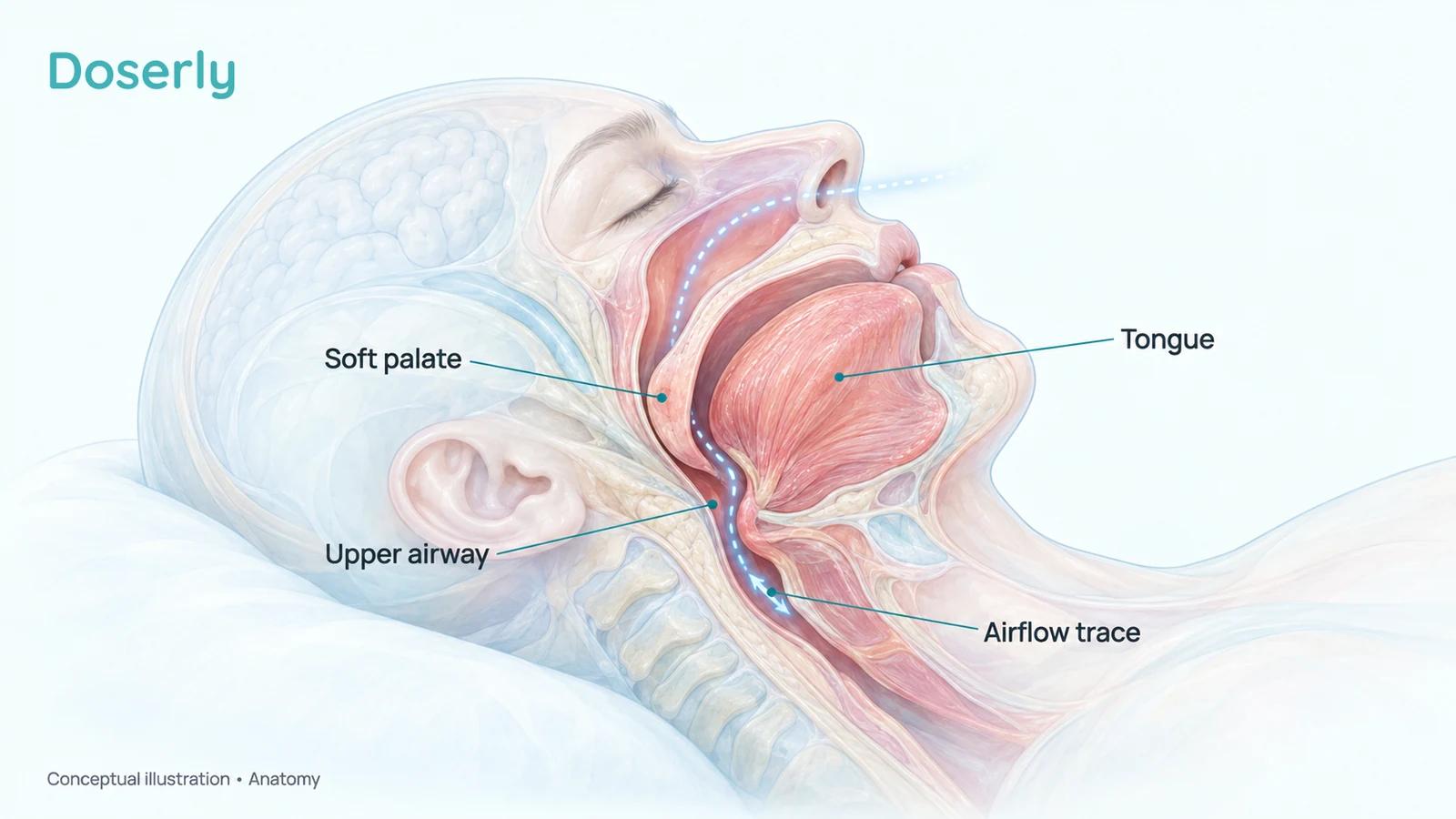
In obstructive sleep apnea, airflow through the upper airway is repeatedly blocked during sleep. The tongue, soft palate and other structures can contribute to narrowing or collapse. Obesity is an important risk factor, but anatomy, age and other influences also matter. Central sleep apnea is a different problem involving the control of breathing. NHLBI explanation
This distinction matters because the tirzepatide studies were about obstructive sleep apnea in adults with obesity. They were not a trial of every sleep-related breathing disorder, and they do not establish the same benefit in people without obesity.
A person's experience can include snoring, disrupted sleep or daytime symptoms, but symptoms alone do not describe the full disorder. Someone may notice an improvement and still have clinically relevant breathing events. That is why an assessment uses more than an impression of how the night went.
What does AHI measure?
AHI counts apneas and hypopneas per hour of sleep. Apneas are episodes of stopped or nearly stopped airflow under scoring rules; hypopneas are partial reductions that meet specified criteria. The index summarizes how often qualifying events occur. SURMOUNT-OSA outcome definition
Its units are events per hour, not events per night. A reduction of 25 events per hour should not be retold as 25 fewer interruptions across an entire night. The time denominator is part of the result.
AHI is useful, but two people with similar event counts may differ in oxygen consequences, symptoms and other clinical features. An index that counts events is not a complete description of how deep or prolonged the associated oxygen drops are, or how sleepy someone feels during the day.
This is why a treatment evaluation can include oxygen-related measures and patient-reported sleep impairment alongside AHI. They describe related aspects of the condition without being interchangeable.
Why were there two SURMOUNT-OSA trials?
Both trials enrolled adults with obesity and moderate to severe obstructive sleep apnea. Trial 1 included people who were not using positive airway pressure, or PAP, at baseline. Trial 2 included people already using PAP. Participants were randomized to tirzepatide or placebo for 52 weeks, with a maximum tolerated weekly tirzepatide dose of 10 or 15 mg. Original trial report
The two studies enrolled 469 adults in total. Participants with type 2 diabetes were excluded, and both groups received dietary and physical-activity counseling. The average starting AHI was about 50 events per hour, indicating substantial disease burden in the enrolled population. Zepbound clinical-study description
Separating the trials addressed two practical situations: people not using PAP and people already using it. It did not randomize people to “tirzepatide versus PAP.” Both studies compared medication with placebo within their own treatment context.
That distinction prevents a common misreading. A positive medication result does not establish that it outperformed properly used PAP or that all existing PAP treatment can be replaced.
How large was the AHI improvement?
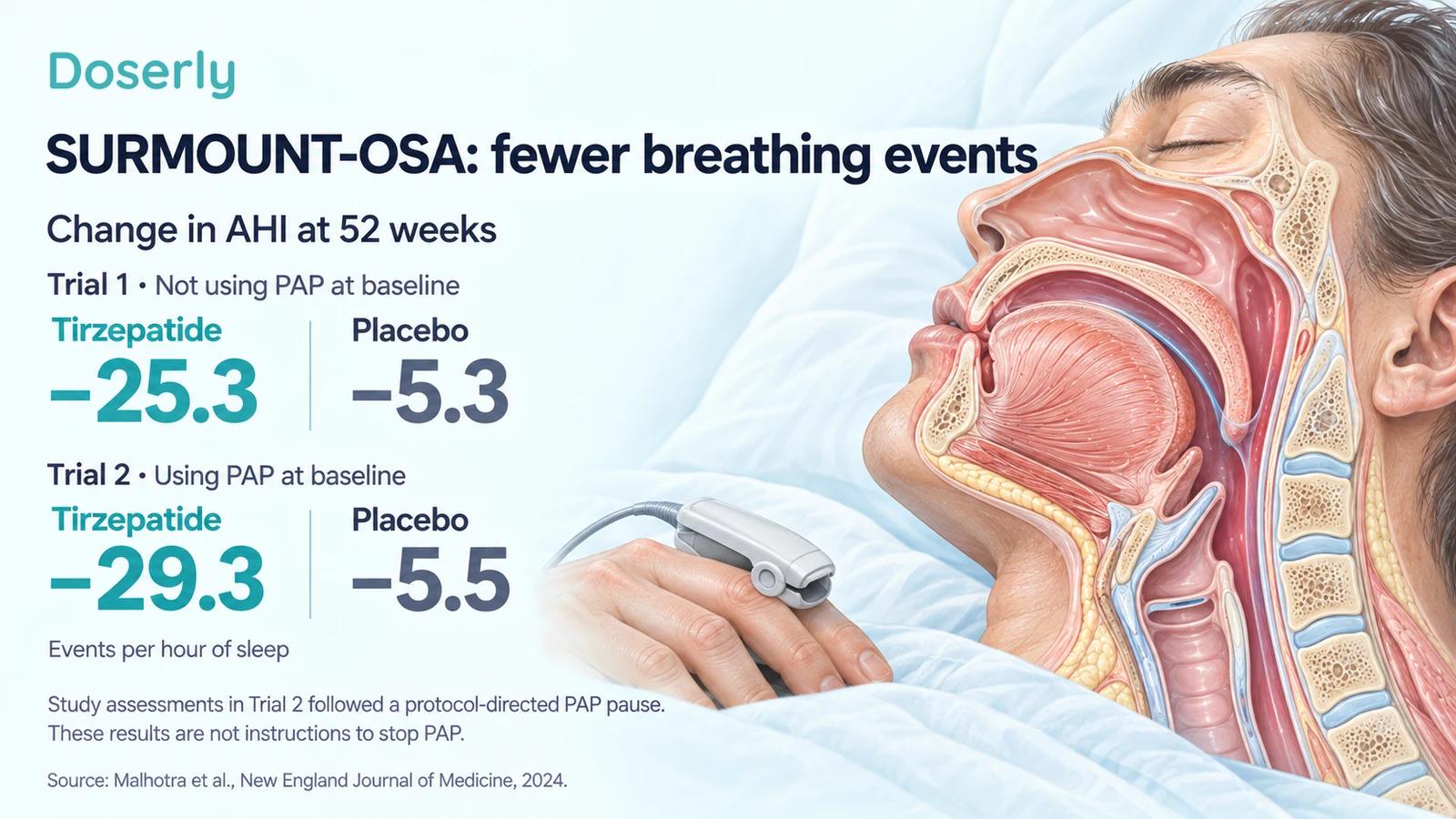
In Trial 1, average AHI change at 52 weeks was −25.3 events per hour with tirzepatide and −5.3 with placebo. The estimated difference between groups was −20.0 events per hour. In Trial 2, the corresponding changes were −29.3 and −5.5, with a difference of −23.8 events per hour. Primary results
Those are substantial average reductions. They are changes from baseline, not the final AHI values. They also are not percentage reductions, even though percentages are reported elsewhere in the study.
To illustrate the distinction, an imaginary person whose AHI falls from 50 to 25 has improved by 25 events per hour but still has 25 events per hour. That arithmetic example is not a trial participant or a prediction. It shows why “a large reduction” and “no remaining sleep apnea” are different statements.
The placebo comparison matters too. Some improvement occurred in the comparison groups. The between-group difference estimates what tirzepatide added under the study conditions, rather than attributing every within-group change to the medicine alone.
How was PAP handled during assessment?
Participants using PAP were instructed to pause it for seven days before assessment of the primary endpoint. This was a protocol-directed research procedure intended to assess the underlying sleep-apnea outcome outside the immediate effect of PAP. It was not a general recommendation for patients to interrupt treatment at home. Prescribing-information study details
The label explicitly states that these studies did not evaluate the timing or appropriateness of PAP discontinuation in people previously compliant with PAP therapy. That is a central limit, not a minor footnote.
A clinician interpreting follow-up needs to know the circumstances of measurement. An AHI measured while PAP is actively treating the airway and an AHI measured off PAP are not answering exactly the same question. The conditions should remain attached to the result.
If treatment changes are being considered, the sleep clinician should decide how to reassess and what the findings mean. A research washout procedure should not be copied as a personal test of whether PAP is still needed.
What does “remission or mild nonsymptomatic OSA” mean?
One reported endpoint combined two possibilities: an AHI below 5, or an AHI from 5 to 14 together with an Epworth Sleepiness Scale score of 10 or lower. More tirzepatide participants reached that combined endpoint than placebo participants. Endpoint definition
The wording matters. Some people meeting the combined endpoint still had measurable mild sleep apnea. It would be inaccurate to describe the entire group as cured or as having no breathing events.
A combined endpoint can be clinically helpful because it incorporates both event frequency and symptoms. But it should be reported with its components visible. Otherwise, the most reassuring component can accidentally stand in for everyone included.
This principle applies beyond sleep medicine: whenever a result joins outcomes with “or,” ask what each alternative means. A percentage attached to a composite is not automatically the percentage reaching its strongest possible outcome.
Why oxygen and daytime function still matter
The trials assessed sleep-apnea-related hypoxic burden and patient-reported sleep disturbance or impairment, as well as AHI. Tirzepatide improved these measures compared with placebo. Hypoxic burden captures aspects of oxygen reduction associated with breathing events, adding information beyond event frequency. Trial secondary outcomes
For everyday care, how someone functions matters alongside the study numbers. Better sleep may mean feeling more alert or having less interference with daytime activities. Those outcomes deserve their own assessment; a reduced AHI should not be used to assume that every symptom has resolved.
The converse matters too. Feeling better does not provide a complete measurement of breathing or oxygen levels. Subjective improvement and objective reassessment can support one another, especially when deciding whether an existing treatment remains appropriate.
A useful follow-up conversation therefore connects three observations: what the sleep study shows, what the person experiences and what treatment they were using when each observation was made.
Is the effect simply weight loss?
Weight reduction is likely an important contributor. FDA's approval announcement described the sleep-apnea improvement as likely related to body-weight reduction. But the trial did not compare tirzepatide with a separate intervention engineered to produce exactly the same weight loss. It cannot cleanly identify every weight-dependent and weight-independent contribution. FDA interpretation
This is a good place to resist overly detailed mechanism stories. The clinical result is more secure than a claim that the medicine directly repairs throat tissue, permanently changes airway anatomy or treats every underlying cause of obstruction.
Because obesity is not the only contributor to sleep apnea, losing weight does not guarantee resolution. The relevant question is what happens to the individual's breathing and symptoms after treatment, not whether a plausible mechanism sounds complete.
What does this mean for PAP and other treatments?
PAP supplies pressure that helps keep the airway open during sleep. Depending on the person, care may also involve an oral appliance, positional approaches, surgery or other interventions. These options address different aspects of the disorder and require individual assessment. NHLBI treatment overview
The American Academy of Sleep Medicine describes tirzepatide as an additional option for appropriate patients, with attention to established treatments and ongoing follow-up. It should be considered within sleep-apnea care rather than treated as an automatic replacement for that care. AASM clinical discussion
If PAP has become uncomfortable or difficult to use, that is a reason to discuss the problem with the treating team. It is not evidence that the underlying condition has disappeared. Conversely, an effective PAP regimen does not make management of obesity irrelevant; the two treatment goals can coexist.
What about safety and longer-term health?
Gastrointestinal symptoms were the most common adverse events in the trials. The current Zepbound label also describes contraindications and risks that require clinical review, including severe gastrointestinal reactions, pancreatitis and volume-depletion-related kidney injury. Its approved sleep-apnea use is limited to adults with obesity and moderate to severe OSA. Current prescribing information
The study's improvements in blood pressure and other risk-related measurements should not be translated into a proven reduction in heart attacks or cardiovascular death from this trial. Those are different outcomes requiring suitable event-based studies and follow-up.
A 2026 secondary analysis examined cardiometabolic risk measures and used post hoc mediation analyses to explore contributions from weight change and sleep-apnea measurements. Such analyses can suggest how changes relate, but they depend on modeling assumptions and do not randomize the proposed mediators themselves. They also do not turn a risk-factor improvement into an observed reduction in heart attacks. 2026 secondary analysis
The same caution applies to permanence. A favorable result at one year does not show that benefit persists unchanged after medication withdrawal or that follow-up can stop. Both treatment response and circumstances can change.
What should a follow-up conversation cover?
Bring the actual sleep-study result, including when it was obtained and whether PAP was used. Note changes in daytime sleepiness, treatment comfort and medication tolerability. Weight change is useful context, but it should not be the only information used to judge sleep-apnea control.
Ask what would justify repeat testing and how existing treatment will be reviewed. The answer depends on the clinical situation; it should not be inferred from a study average or an online account of someone who stopped using a device.
Doserly's tirzepatide guide provides broader treatment context. SURMOUNT-OSA supports a clear conclusion: tirzepatide can substantially improve measured sleep apnea in the population studied. The next clinical task is to establish how much disease remains, how the person is doing and what care they still need.