
Peptides
October 16, 2026
Tirzepatide and heart failure: look beyond the bathroom scale
On this page
For someone with heart failure, treatment success can mean being less breathless while getting dressed, walking farther or avoiding an urgent visit. Weight may matter, but it isn't the only outcome worth measuring. The SUMMIT trial studied whether tirzepatide could help people with obesity and heart failure with preserved ejection fraction, often shortened to HFpEF.
The findings were encouraging: fewer participants experienced the combined outcome of cardiovascular death or worsening heart failure, and reported health status improved. The result needs its population and components attached. It doesn't establish that tirzepatide treats every form of heart failure or prolongs life on its own. SUMMIT primary report
Our tirzepatide guide explains the medicine more broadly. Here we'll look at what heart-failure patients might gain from the research and which questions remain open.
How can someone have heart failure with a preserved ejection fraction?
Ejection fraction is the proportion of blood in the left ventricle that is pumped out with a contraction. It is a fraction, not a complete assessment of heart health. Someone can have a preserved fraction while the heart has difficulty relaxing and filling, with pressures that contribute to symptoms. American Heart Association explanation
This can seem contradictory when a report describes pumping function as normal. The number answers a particular question about contraction. It doesn't establish that filling, pressure, exercise response and the circulation are all normal.
HFpEF is therefore a clinical diagnosis, not simply a preserved number on an echocardiogram. Symptoms and other findings matter. Breathlessness, fatigue and swelling can occur, but they also have other possible causes. The diagnosis belongs in a clinical assessment rather than a self-diagnosis based on a symptom list. AHA symptoms
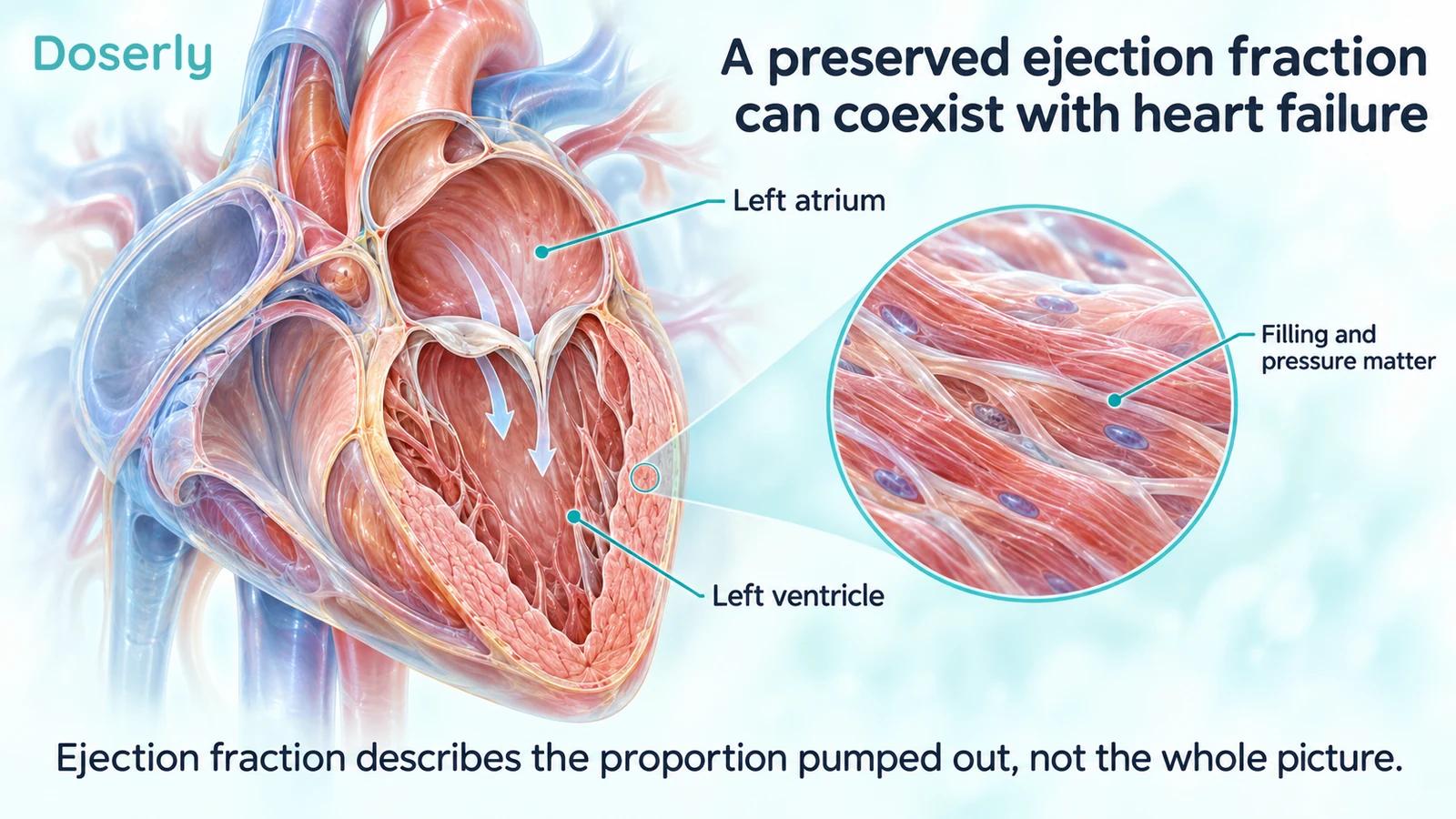
The illustration explains filling anatomy. It doesn't depict a participant, a measured pressure or a treatment effect.
Who took part in SUMMIT?
The trial enrolled 731 people with heart failure, an ejection fraction of at least 50% and a body-mass index of at least 30. Participants were randomly assigned to tirzepatide, titrated up to 15 mg weekly, or placebo. It was double-blind, and median follow-up was 104 weeks. SUMMIT
These details identify an obesity-related HFpEF population. They don't describe all people with obesity, all people with breathlessness or those whose ejection fraction is reduced. If you are considering how the result relates to you, the first question is whether your clinical condition resembles the one studied.
The trial also tested a treatment strategy against placebo within clinical care. It wasn't a comparison with stopping all other heart medicines. Treating obesity and managing heart failure are connected, but a study of an additional medicine doesn't establish that established care can be withdrawn.
The weekly target dose describes the research. It isn't a reason to escalate a prescription independently, especially if symptoms, blood pressure, kidney function or tolerability are changing.
What happened to worsening heart-failure events?
The primary clinical composite occurred in 36 of 364 tirzepatide participants, or 9.9%, versus 56 of 367 placebo participants, or 15.3%. The hazard ratio was 0.62, with a 95% confidence interval of 0.41–0.95. This is commonly described as a 38% lower relative hazard. Primary results
Subtracting the observed proportions gives about 5.4 percentage points. That describes the scale of the counts during follow-up. It isn't the same calculation as the hazard ratio, which incorporates the timing of events.
Neither expression means that 38 of every 100 people avoided a hospitalization or that heart function improved by 38%. A person interpreting the headline needs to know what counted as an event and how often it occurred in the comparison group.
The trial's combined outcome included worsening heart failure as well as cardiovascular death. The positive finding was driven by fewer worsening events. Keeping that distinction visible is more useful than turning every cardiac endpoint into a survival claim.
Did tirzepatide reduce cardiovascular deaths?
The death component alone did not establish a benefit. Cardiovascular deaths occurred in eight tirzepatide participants and five placebo participants; the estimate was imprecise. SUMMIT
Those small numbers should not be used to claim either a proven survival advantage or a proven increase in death. The point estimate and its uncertainty matter together. A trial can show a benefit for a combined endpoint while remaining unable to settle one less frequent component.
For someone living with heart failure, avoiding worsening episodes is itself meaningful. It doesn't need to be relabeled as living longer to matter. At the same time, a patient who asks specifically about survival deserves a direct answer about the limitations.
This distinction also explains why counting all events together can be useful for research while requiring careful explanation in public summaries. The components may differ in frequency, severity and response to treatment.
Did people feel better?
The other primary endpoint was the Kansas City Cardiomyopathy Questionnaire clinical summary score, or KCCQ-CSS. It captures heart-failure symptoms and physical limitations on a scale where higher scores represent better status. At 52 weeks, the between-group improvement favored tirzepatide by 6.9 points. Clinical trajectory analysis
A questionnaire is not merely an inferior substitute for a scan. If the question is whether someone feels less limited in daily life, asking systematically about that experience is relevant. It measures something different from anatomy or a blood marker.
The companion report also examined walking performance and other patient health assessments. These offer a broader view of function. They remain analyses from the same study, rather than independent trials that multiply the amount of evidence.
Group averages don't mean everyone felt the same improvement. Someone might improve substantially, slightly or not at all. In clinical care, it helps to choose concrete activities to discuss alongside formal scores: walking to a nearby shop, climbing a flight of stairs or completing ordinary household tasks.
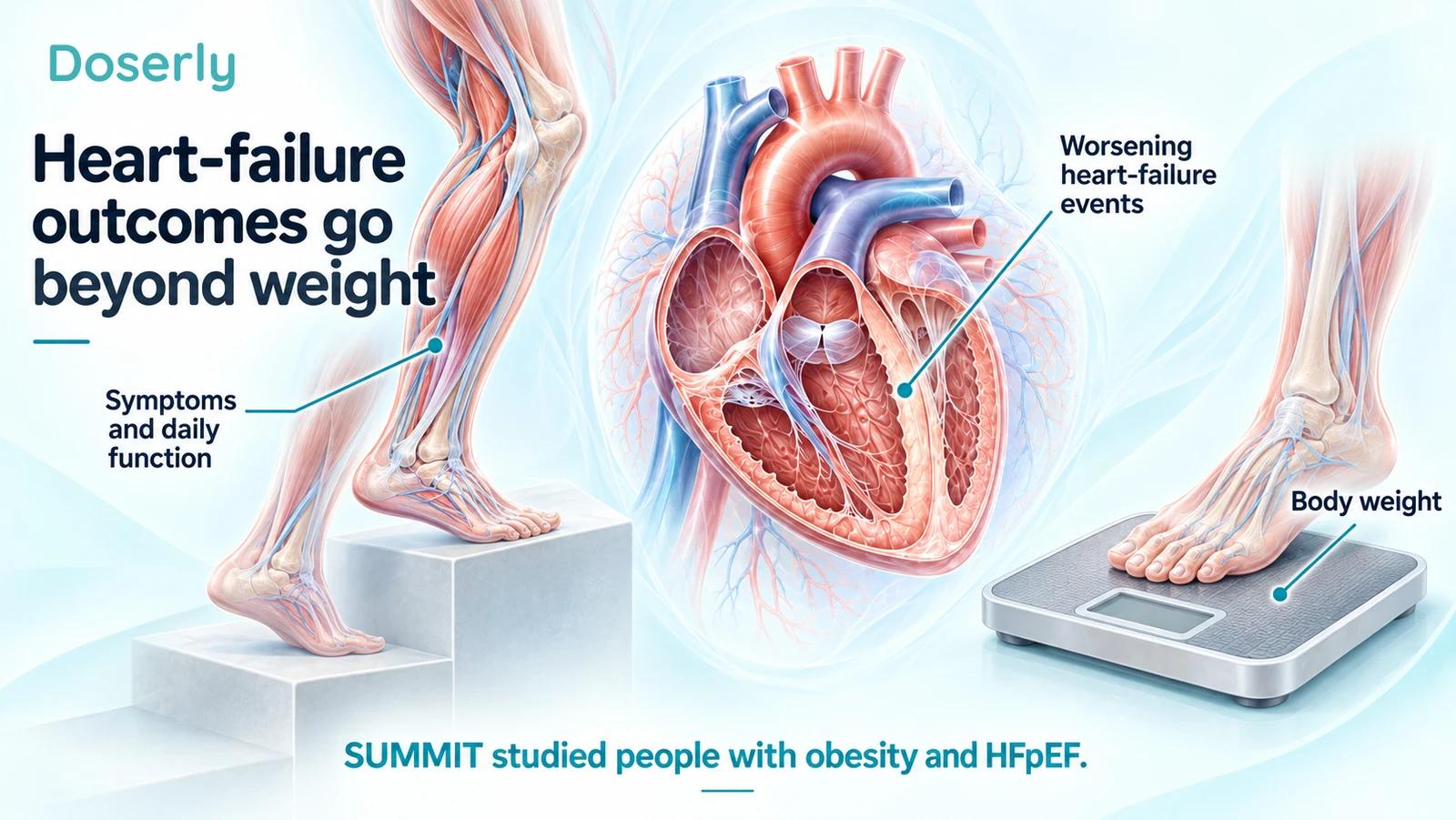
Symptoms, daily function and worsening heart-failure events are distinct from weight. These are conceptual scenes, not trial participants or before-and-after results.
Is the benefit entirely explained by weight loss?
Weight reduction is a plausible contributor, but the trial didn't isolate every pathway. A secondary SUMMIT analysis found that greater weight loss was associated with larger improvements in walking distance and reported symptoms. That supports a relationship; it doesn't establish that weight change explains every treatment effect. Weight and central adiposity analysis
The distinction matters because people who lose more weight may also differ in adherence, illness, activity or other characteristics. Random assignment to a drug doesn't randomly assign each person to a particular amount of weight loss.
This is a reason to avoid two opposite oversimplifications. One is that the medicine directly repairs the heart independently of everything else. The other is that patient-reported and clinical-event improvements are unimportant because weight also changed. The study can demonstrate useful clinical effects while the mechanism remains incompletely separated.
For an individual, a better approach is to follow several relevant measures together. Changes in symptoms, function, fluid status and treatment tolerance provide context for the number on the scale.
What did the heart scans show?
A cardiac magnetic resonance substudy examined structure. Of 175 participants scanned initially, 106 had usable paired scans at baseline and 52 weeks. Compared with placebo, tirzepatide was associated with an 11-gram reduction in left-ventricular mass and a 45-mL reduction in fat around the heart. SUMMIT imaging substudy
Left-ventricular mass estimates the amount of muscle forming the chamber. Paracardiac fat includes fat around the heart. These are anatomical measurements, not direct measurements of how someone feels or whether they will survive.
The paired-scan sample was smaller than the full trial. Its findings can suggest biological changes associated with treatment, but they don't independently prove that a particular structural change caused fewer clinical events.
A diagram showing a visibly damaged heart becoming normal would therefore overstate the research. The useful message is that measurable structural changes accompanied treatment in the imaging subset, with their contribution to outcomes still being investigated.
Does SUMMIT tell us which incretin medicine is best for HFpEF?
No. SUMMIT compared tirzepatide with placebo. A separate STEP-HFpEF trial studied semaglutide and found improvements in symptoms, physical limitations and exercise function in people with obesity and HFpEF. It was also placebo-controlled, rather than a direct comparison with tirzepatide. STEP-HFpEF primary report
Putting percentages from these trials next to each other cannot recreate a randomized head-to-head study. Differences in eligibility, follow-up, endpoints and analysis can influence the apparent size of benefit.
This doesn't make separate trials useless. They show that obesity-related HFpEF is a clinically important setting for incretin research. They also help clinicians discuss treatment options. They just don't establish a universal ranking by themselves.
A choice for a particular patient must also account for the treatment's authorized uses, other medical conditions, access and tolerability. A promising heart-failure publication and a product's approved indication are separate pieces of information.
What monitoring questions matter in practice?
Weight has a special complication in heart failure: changes may reflect fluid as well as body tissue. A rapid change accompanied by swelling or breathlessness shouldn't simply be celebrated or dismissed as weight-management progress. Follow the symptom and weight-monitoring plan agreed with your heart-failure team. AHA symptom guidance
Gastrointestinal adverse effects matter too. Vomiting and diarrhea can lead to dehydration, and tirzepatide's label warns about kidney injury related to volume depletion. A person taking diuretics or other cardiovascular medicines needs coordinated review if intake, symptoms or blood pressure change. Don't adjust those medicines solely because the scale changes. Prescribing information
Useful questions include whether your diagnosis matches SUMMIT, which benefit treatment is intended to provide, and how the team will assess improvement. Ask how worsening breathlessness, dizziness, persistent vomiting or difficulty maintaining intake should be handled.
For sudden severe breathing difficulty, chest pain or fainting, seek urgent medical care rather than waiting to see whether a medication record reveals a pattern. Routine tracking helps describe a course of events; it is not a substitute for assessing an acute problem.
SUMMIT makes the strongest case when described in terms patients recognize: fewer worsening episodes and better reported health status in a defined group with obesity and HFpEF. The scale contributes information, but the person's ability to function and the course of heart failure remain central.
Sources
- SUMMIT primary report, online 2024.
- AHA ejection fraction explanation.
- AHA heart-failure symptoms.
- SUMMIT clinical trajectory analysis.
- SUMMIT cardiac imaging substudy.
- SUMMIT weight and adiposity analysis.
- STEP-HFpEF semaglutide trial.
- Zepbound prescribing information.