
Peptides
October 16, 2026
Tirzepatide and fatty liver: what a biopsy result means
On this page
Fat in the liver can accompany insulin resistance, type 2 diabetes and obesity. For some people, the concern extends beyond fat itself: liver cells become injured, inflammation develops and scar tissue accumulates. That is why a treatment study looking at biopsies can tell us something different from a headline about weight loss or a better blood test.
Tirzepatide has produced encouraging biopsy findings in people with metabolic dysfunction-associated steatohepatitis, or MASH, and established fibrosis. But “MASH resolution” doesn't mean every participant's liver became normal. Understanding the two biopsy questions makes the result more useful when discussing your own liver health.
This article focuses on the phase 2 SYNERGY-NASH trial. Our tirzepatide guide covers the medicine's broader effects on glucose, appetite, weight and safety.
Fatty liver, MASH and fibrosis describe different things
Metabolic dysfunction-associated steatotic liver disease, or MASLD, is the broader condition involving excess liver fat in a metabolic setting. You may still see the older term NAFLD. MASH, formerly called NASH, identifies the form with inflammation and liver-cell injury as well as fat. Fibrosis means scar tissue; cirrhosis describes advanced scarring that disrupts the liver's structure. These words describe related features, rather than interchangeable diagnoses. NIDDK definitions
Keep the questions separate by asking what a test looks for. Is it estimating fat content? Detecting tissue injury? Assessing scarring? Or counting serious complications? A result can improve on one measure without answering the others.
Feeling well doesn't settle the question either. MASLD often produces few symptoms. Assessment can therefore depend on blood tests, imaging and, in selected circumstances, tissue examination rather than how much discomfort someone feels. NIH overview
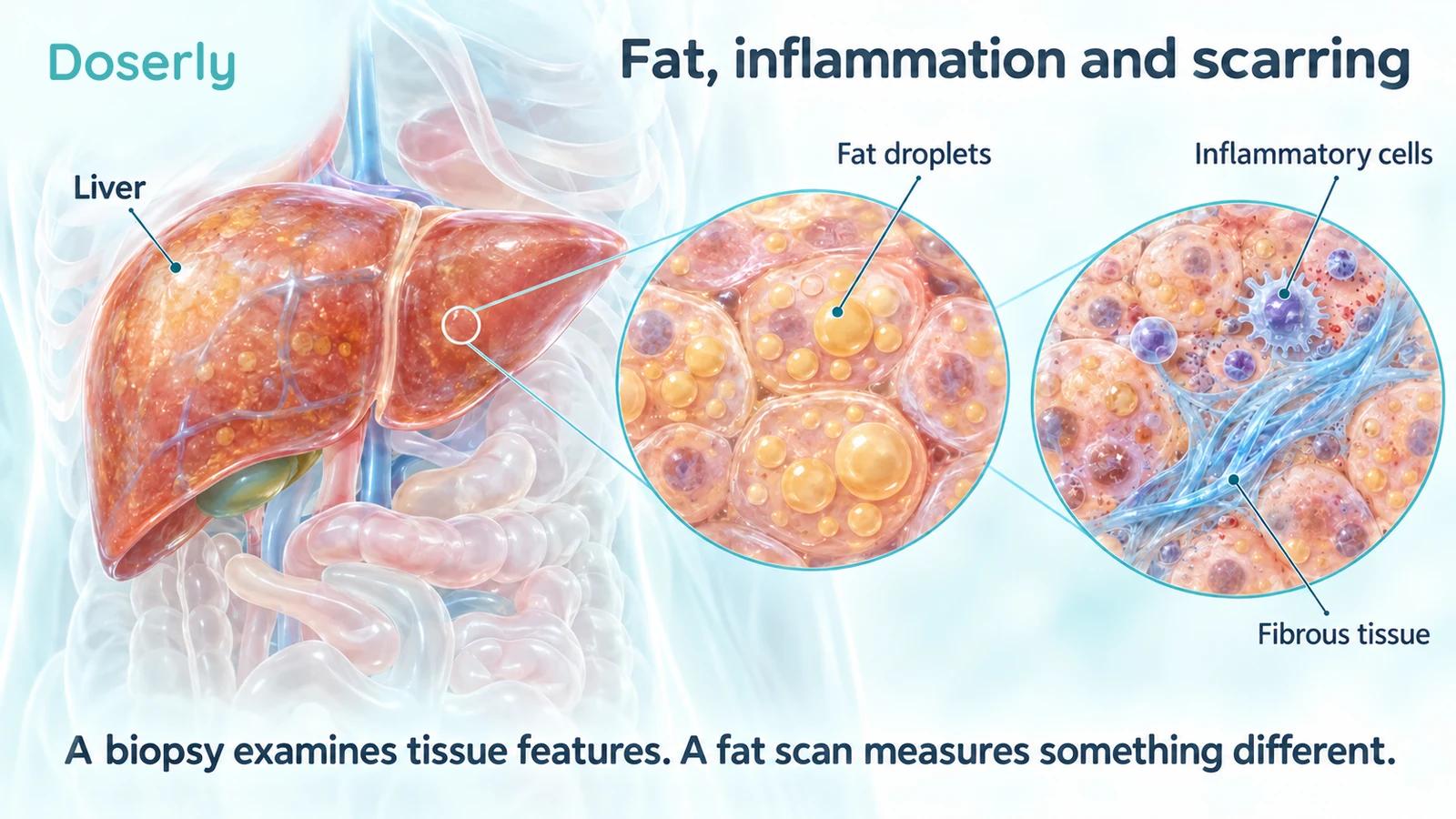
Fat accumulation, inflammatory injury and scarring are distinct features. The microscopic details are conceptual, not a patient's biopsy or evidence of treatment benefit.
What does a liver biopsy add?
A biopsy removes a small sample that a pathologist examines under a microscope. Unlike a scan estimating fat, it allows direct examination of features used to diagnose steatohepatitis and grade scarring. It is invasive, so clinicians don't recommend it for everyone with fatty liver. Medical history, blood tests and noninvasive imaging help determine when additional information would change care. NIDDK diagnosis guidance
A lower liver-fat measurement is useful, but doesn't provide the same information as tissue. Conversely, a biopsy doesn't continuously measure the whole liver or follow someone's health between visits. It provides a structured assessment at a particular time.
For a reader receiving a biopsy report, the practical task is to understand both disease activity and fibrosis stage. “Less inflammation” and “less scarring” are different improvements. Ask your clinician to explain each part rather than compressing the report into a single label such as better or worse.
Who was studied in SYNERGY-NASH?
SYNERGY-NASH enrolled 190 adults with biopsy-confirmed MASH and F2 or F3 fibrosis. Participants could have or not have type 2 diabetes. Researchers compared weekly subcutaneous tirzepatide at target doses of 5, 10 or 15 mg with placebo over 52 weeks. Original trial report
This was a randomized, double-blind study: allocation was determined by chance, and participants and investigators did not know the assigned treatment. These features help reduce differences in expectations and care between groups. The registry identifies a phase 2 investigation, an important development stage rather than a final demonstration of every clinical benefit. Study registration
The sponsor's trial page lists an age range of 18–80 and eligibility involving overweight or obesity. Those boundaries matter. Someone with cirrhosis, a different cause of liver disease or a substantially different clinical profile should not assume that this study provides an equally precise answer for them. The doses describe research groups; they aren't a recommendation to choose a dose based on a liver report. Sponsor trial description
What did the main result show?
At week 52, the reported proportions meeting the main biopsy endpoint were 44%, 56% and 62% in the 5-, 10- and 15-mg groups, respectively, compared with 10% with placebo. The endpoint required resolution of MASH without worsening fibrosis. Each tirzepatide comparison was statistically significant. SYNERGY-NASH publication
The final phrase is essential. Someone could meet this endpoint while still having scar tissue. The requirement was that scarring not worsen, not that it disappear. Calling this a normal liver, a cure or complete reversal would change the finding's meaning.
Imagine a biopsy assessment with two separate entries: inflammatory disease activity and fibrosis stage. A response on the first entry, with the second unchanged, could satisfy this endpoint. That hypothetical example explains the rule; it isn't a reconstruction of an actual participant's report.
The result is encouraging because researchers examined disease in tissue rather than relying only on weight. It gives clinicians a reason to take the liver effects seriously. The useful claim remains specific: a higher proportion met this defined endpoint during the study.
Was there an improvement in scarring too?
A separate secondary endpoint required improvement by at least one fibrosis stage without worsening MASH. Reported proportions were 55%, 51% and 51% with tirzepatide, versus 30% with placebo. Primary publication
This is a different response definition. The same people need not account for both percentages, and the percentages cannot be added together. Moving down one fibrosis category and reaching the category with no fibrosis are also different achievements.
The sponsor's detailed report notes that tests for this secondary endpoint were nominal and not adjusted for multiple comparisons. That limits how confidently individual secondary findings should be treated as independently confirmed. These data support further investigation; they don't establish how much scarring will improve in a particular person. Detailed sponsor results
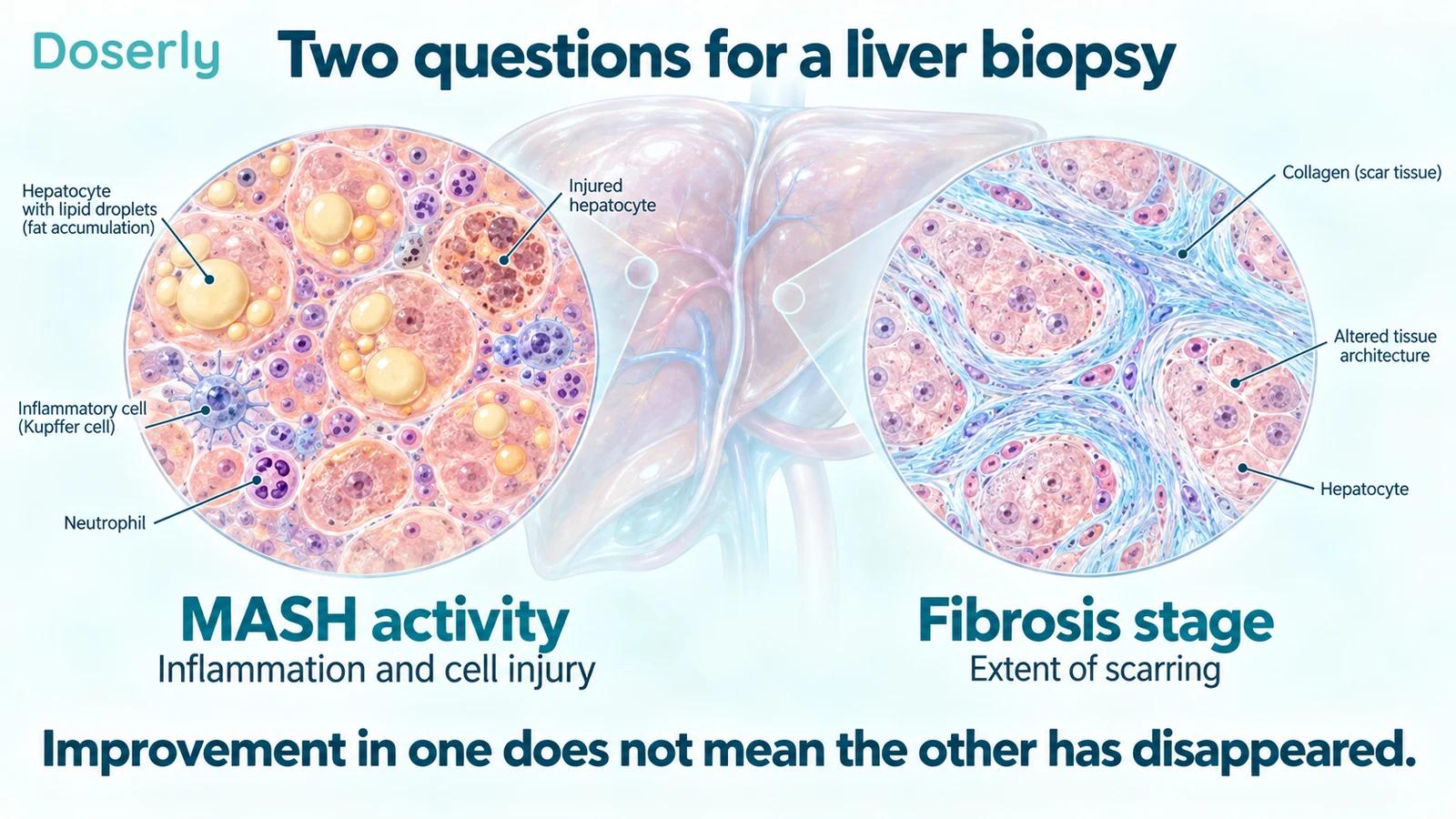
The main endpoint and fibrosis endpoint ask different questions. These conceptual illustrations explain tissue features, not the appearance of paired biopsies from the trial.
Why do some reports give higher response percentages?
You may encounter a headline saying roughly three quarters responded at the highest dose. Lilly's announcement also reports an efficacy estimand, with MASH-resolution estimates of 51.8%, 62.8% and 73.3%, compared with 13.2% for placebo. An estimand defines the treatment question being estimated, including how events such as stopping treatment are handled. These aren't the same figures as the publication's main reported analysis. Lilly announcement
A reader doesn't need to conclude that one number is dishonest because another is lower. First identify whether they answer the same statistical question. An estimate under assumptions about continued use can differ from one taking a broader view of what happens after assignment.
It would be misleading to take the most favorable treatment percentage from one analysis and the placebo percentage from another. Keep treatment and comparator together and identify the analysis. This is particularly useful when discussing a screenshot that leaves those details out.
Does this show that tirzepatide prevents liver failure?
No. A tissue response is an encouraging intermediate finding, but liver failure, transplantation and liver-related death are different outcomes. Establishing effects on those events requires studies designed to measure them, with adequate follow-up and enough events.
The distinction isn't a reason to dismiss biopsy research. It explains why drug development can use tissue endpoints while longer studies continue. FDA's accelerated approval of resmetirom for selected adults with noncirrhotic disease relied on intermediate evidence, with continued research needed to confirm clinical benefit. FDA resmetirom approval
Semaglutide's MASH approval also uses accelerated approval. That decision concerns a particular medicine and population; it doesn't transfer to tirzepatide because both affect incretin signaling. A shared mechanism isn't a shared authorization or proof of equal outcomes. FDA semaglutide announcement
These examples also explain why an older webpage saying no medicines are approved for MASH can be misleading today. The publication date matters for treatment availability, even when the same page remains useful for basic anatomy. For decisions about which treatment is available locally, use current product information and clinical advice.
Where do weight loss and glucose control fit?
Tirzepatide activates GIP and GLP-1 receptors and affects appetite, weight and glucose regulation. These effects provide a biological reason to study metabolic liver disease. The product's pharmacology doesn't identify exactly how much of a tissue response comes from weight loss, altered metabolism or another pathway. Zepbound prescribing information
For someone receiving treatment for diabetes or obesity, improving liver-related tests may be welcome. It still helps to define what is being monitored. Falling weight, lower liver enzymes and improved fat measurements should retain their own names. None alone documents the paired-biopsy endpoint used in SYNERGY-NASH.
That doesn't mean everyone needs repeat biopsies. The appropriate monitoring plan depends on the clinical question and each test's value and risks. Is the goal assessing metabolic response, estimating fibrosis risk or investigating a new concern? The answer helps determine which measurement is informative.
Our tirzepatide human evidence section places the liver research alongside studies of other conditions. Those studies can help explain the broader treatment picture, but an outcome in one organ should not stand in for an outcome in another.
What should someone with liver disease discuss before treatment?
Start with your diagnosis and stage. Ask whether you have excess fat alone, suspected MASH, established fibrosis or cirrhosis, and how that conclusion was reached. Then ask which problem a proposed medicine is intended to treat and what evidence applies to people with similar findings.
Tolerability matters too. The current Zepbound information discusses gastrointestinal adverse effects, dehydration-related kidney injury, gallbladder disease and pancreatitis warnings. It includes contraindications concerning medullary thyroid carcinoma and multiple endocrine neoplasia type 2. Your other medicines and conditions belong in the discussion, even when the appointment concerns liver health. Prescribing information
Agree on what follow-up will mean before interpreting a single change. Which tests will be repeated? What symptoms should prompt contact? What finding would change the plan? Keeping a dated record of treatment changes, symptoms and laboratory results can make the conversation more concrete. A record cannot prove causation, but it helps establish what happened and when.
It is also reasonable to ask how liver-specific care fits with management of diabetes, weight, blood pressure and other health concerns. A promising biopsy result doesn't make those priorities disappear. Your care plan should explain how the different goals fit together and who will review them.
SYNERGY-NASH gives people with biopsy-confirmed MASH and F2–F3 fibrosis a meaningful result to discuss. Keep its two questions intact: improvement in inflammatory disease activity and, separately, improvement in scarring. Those findings deserve careful explanation without becoming a promise of a normal liver or freedom from future complications.
Sources
- SYNERGY-NASH primary publication, 2024: randomized phase 2 biopsy findings.
- ClinicalTrials.gov NCT04166773 and Lilly trial page: registration and eligibility.
- Lilly detailed results, 2024: alternative estimand and statistical qualification.
- NIDDK definitions, diagnosis and NIH overview: disease context and test roles.
- FDA resmetirom approval and semaglutide approval: regulatory context.
- Zepbound prescribing information: pharmacology and safety.