
Peptides
October 16, 2026
Tirzepatide and birth-control pills: why absorption matters
On this page
Tirzepatide can change how quickly the stomach empties. That matters for medicines swallowed as tablets, including birth-control pills. The concern is not that an injection directly switches off contraception; it is that the amount and timing of contraceptive hormone reaching the bloodstream can change.
The practical advice is clear: people using oral hormonal contraception should switch to a non-oral method or add a barrier method for four weeks after starting tirzepatide and for four weeks after each dose increase. This is the precaution in current product information and professional guidance. Mounjaro prescribing information
Understanding the reason helps you plan before starting or increasing treatment. It also helps separate three questions often mixed together: the drug interaction, vomiting or diarrhea that can interfere with pill use, and pregnancy planning. Our tirzepatide guide covers the wider treatment background.
Why an injected medicine can affect a swallowed pill
A tablet must dissolve and its ingredients must be absorbed before they can act throughout the body. Gastric emptying is the movement of stomach contents into the small intestine. Slowing that process can change when a drug reaches its main absorption site and the concentration measured in blood.
Tirzepatide's effect on gastric emptying is greatest early in treatment and diminishes with repeated dosing. The label nevertheless specifies renewed contraception precautions after dose increases. Feeling no nausea doesn't remove this interaction: symptoms and drug absorption aren't the same measurement. Prescribing information
This distinction explains why taking the pill faithfully isn't the only issue. Someone can remember every tablet and still need temporary additional protection because of a medicine interaction. It also explains why changing the time of day you take the pill is not the recommended substitute for the four-week precaution.
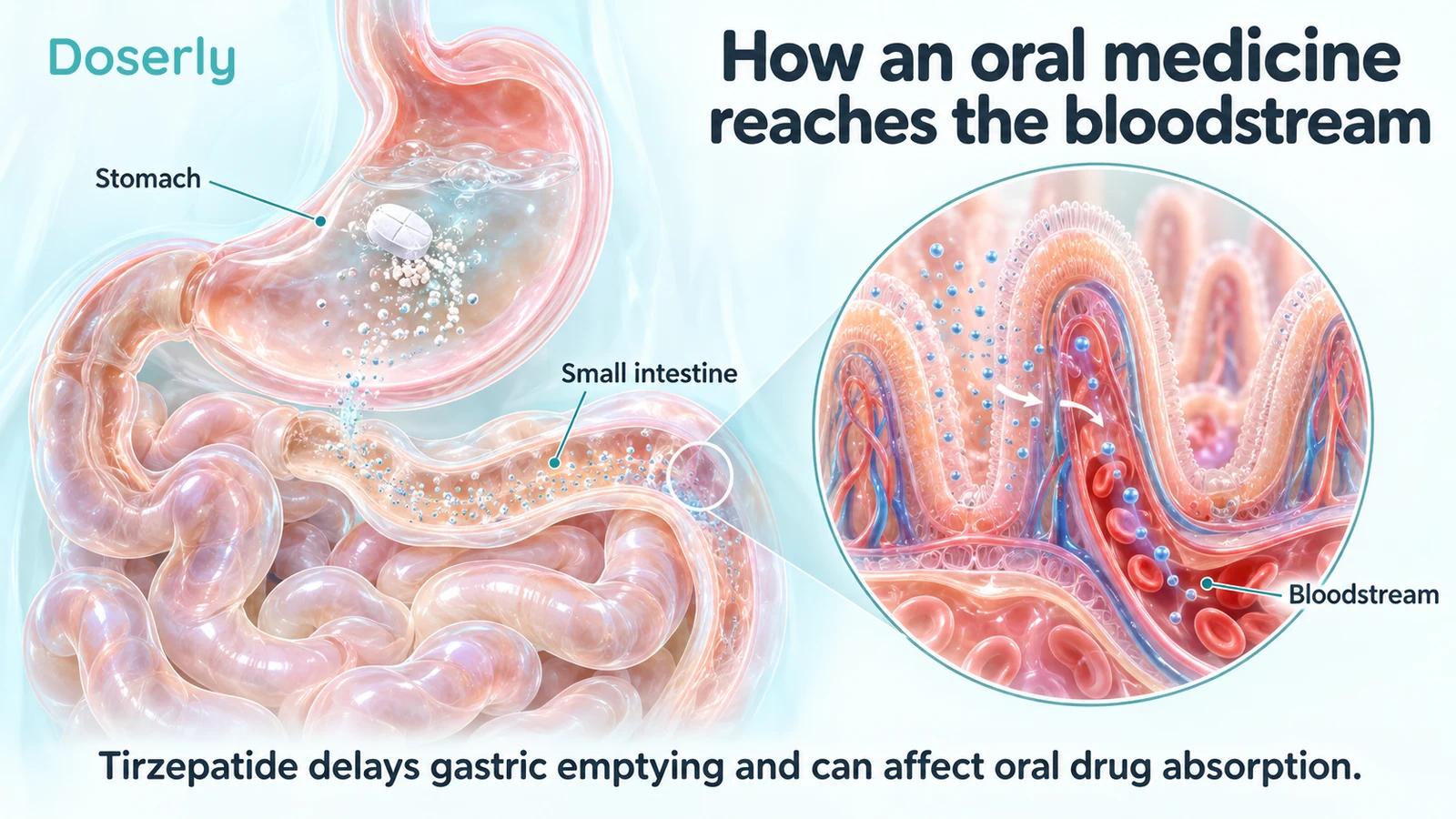
This conceptual illustration shows absorption through the intestine. It is not a concentration graph or a claim that every oral drug is affected to the same degree.
What did the interaction study measure?
The US label describes a combined contraceptive containing 0.035 mg ethinyl estradiol and 0.25 mg norgestimate given with a single 5-mg tirzepatide dose. Peak concentrations of ethinyl estradiol, norgestimate and norelgestromin fell by 59%, 66% and 55%, respectively. Overall exposure fell by 20%, 21% and 23%, and the time to peak concentration was delayed by 2.5–4.5 hours. Label pharmacokinetics
The two sets of percentages describe different things. Peak concentration is the highest measured level. Overall exposure, often called area under the curve or AUC, summarizes concentration across time. A lower peak is not the same as the same percentage reduction in contraceptive protection.
For example, a 59% lower peak does not mean a 59% chance of pregnancy, or that the pill becomes 59% less effective. Those conclusions would require evidence about contraceptive failures, not just hormone measurements.
The study also used a particular combined pill under particular conditions. Professional recommendations extend to oral contraception more broadly, rather than asking patients to calculate risk from the ingredients in that single experiment.
Do we know how often pregnancy occurs because of this?
The available interaction evidence doesn't provide a reliable personal failure rate. The Faculty of Sexual and Reproductive Healthcare statement identifies pharmacokinetic studies as the evidence base. Its recommendation is precautionary: use a non-oral method or add a barrier during the specified periods. FSRH statement
Australia's Therapeutic Goods Administration updated its advice in December 2025 after concluding that reduced oral-contraceptive effectiveness could not be ruled out. Its report also discusses spontaneous pregnancy reports. Such reports can identify concerns, but they don't establish how often an interaction occurs or prove the cause of an individual pregnancy. TGA safety update
This uncertainty doesn't make the advice optional. It explains why a protective action can be recommended before the exact size of a risk is known. There is a meaningful difference between “we cannot calculate the risk precisely” and “there is no reason to take precautions.”
How do the four-week windows work?
There are two triggers: starting tirzepatide and increasing its dose. Each starts a four-week precaution period. If dose increases occur while another window is ending, additional protection may be needed continuously through that part of treatment.
The practical task is to record the actual start and increase dates, not just the weekday of the injection. Ask the prescribing clinician or pharmacist to confirm when additional protection can end for your situation. The NHS repeats the four-week advice for initiation and each increase. NHS tirzepatide information
Do not assume the protection window ends simply because nausea settles or because you've taken several pills on time. Those observations don't replace the specified interval. Equally, the advice should not be presented as proof that oral contraception never works during stable long-term treatment.
If treatment has been interrupted and restarted, ask for advice that addresses the interruption rather than guessing whether it counts as a new start. A generic diagram cannot account for every restart, missed pill or change in medication.
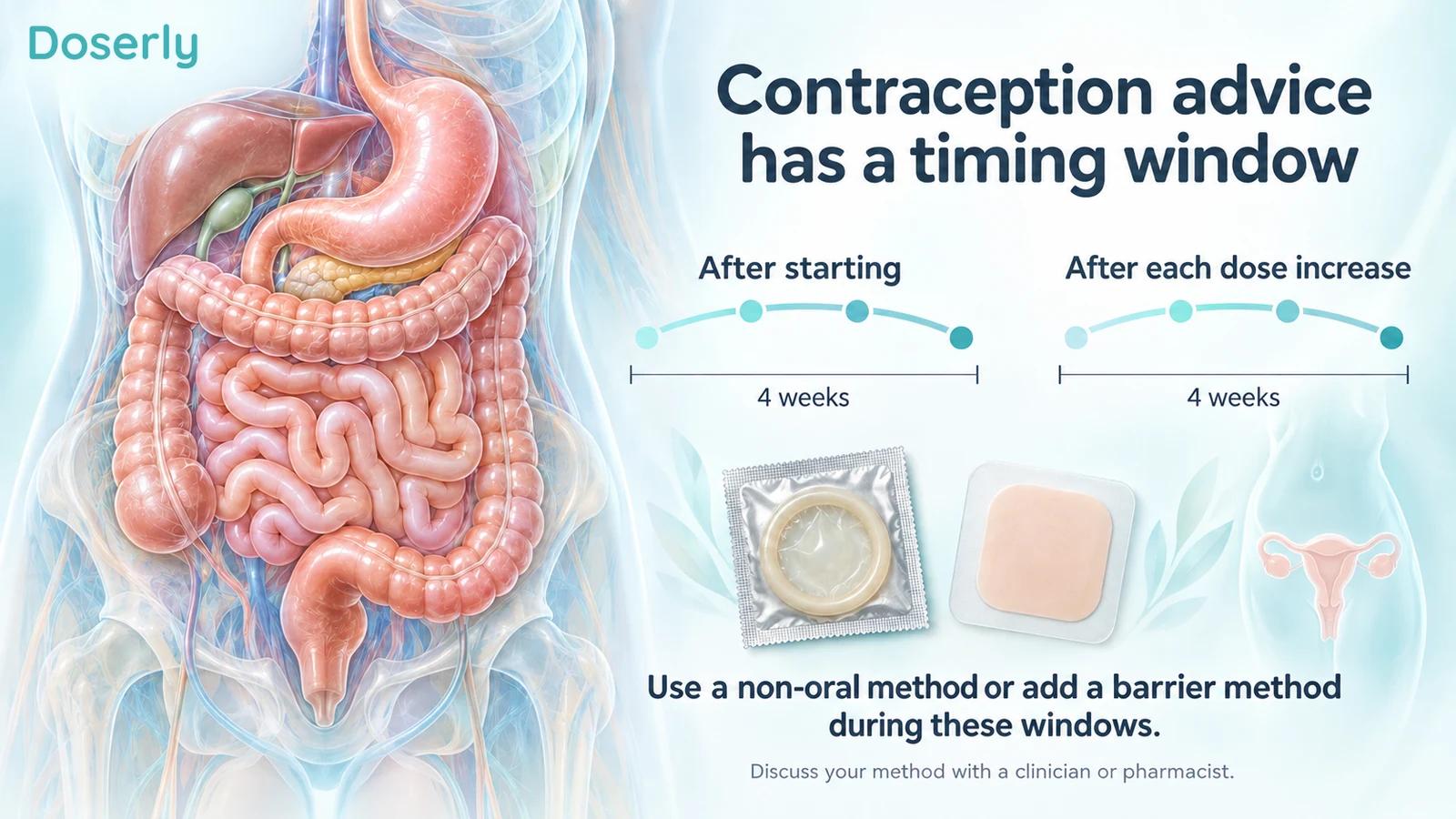
These windows apply to people using oral contraception. A non-oral method or an added barrier method should be selected with appropriate clinical advice; the pictured methods are examples, not individual recommendations.
What counts as a non-oral method?
Non-oral methods do not rely on swallowing a contraceptive tablet. Options can include intrauterine contraception, an implant, an injection, a vaginal ring or a patch, depending on suitability and local availability. Their individual risks, benefits and instructions still matter. “Non-oral” doesn't mean every option is appropriate for every person. MHRA contraception guidance
An added barrier method means adding protection while continuing the pill according to its instructions, rather than simply stopping contraception. If you prefer a longer-term change, plan the transition so that the new method is effective when needed. The timing of a contraceptive switch is a separate question from the tirzepatide dosing calendar.
Bring the exact name of your pill to the conversation. Combined pills and progestogen-only pills aren't interchangeable, and details such as missed-pill instructions depend on the product. A photograph of the box or a medication list can prevent unnecessary guesswork.
What if vomiting or diarrhea occurs?
Vomiting or severe diarrhea can create an additional problem for oral contraception, including outside the four-week interaction windows. The advice depends on the pill, when symptoms occurred relative to taking it and how long the illness lasted.
For combined pills, NHS guidance provides instructions for sickness, persistent diarrhea and situations near the pill-free interval. It may call for additional protection and changes to how a pack is continued. Use the instructions for your actual product rather than applying a generic rule from an online discussion. NHS combined-pill guidance
Progestogen-only pills have their own instructions. NHS guidance recommends contacting a pharmacist, sexual-health service or clinician when protection is uncertain, including when emergency contraception may be needed. The pill already being used can also affect which emergency option is appropriate. NHS progestogen-only-pill guidance
If sex has already occurred during a period of uncertain protection, seek prompt advice. Starting a barrier method today doesn't address an earlier exposure. Tell the professional which pill you use, tirzepatide start or increase dates, missed tablets, symptom timing and when sex occurred.
Is this the same for semaglutide and other GLP-1 medicines?
No blanket assumption is appropriate. The FSRH statement distinguishes tirzepatide from semaglutide, dulaglutide, exenatide, lixisenatide and liraglutide, for which it did not identify a clinically relevant reduction in oral-contraceptive bioavailability requiring the same added-barrier recommendation. FSRH statement
Vomiting and diarrhea can still affect pill use regardless of which medicine caused them. That is why there are two overlapping discussions: a medicine-specific absorption precaution and the usual illness instructions for an oral contraceptive.
If switching between weight-management medicines, make sure the advice is updated for the new product. A plan appropriate for one drug may not automatically cover another, even when people describe both simply as GLP-1 treatment.
What if pregnancy is planned or suspected?
Regulators advise against using these medicines during pregnancy and emphasize effective contraception during treatment. Pregnancy planning requires a medication review before trying to conceive, including enough time for the relevant medicine to clear and an alternative plan for any condition it treats. MHRA guidance
If pregnancy is suspected or a test is positive, contact the prescriber promptly for individualized advice. Someone using tirzepatide for diabetes also needs a plan for glucose management. Avoid interpreting online pregnancy anecdotes as proof either of safety or inevitable harm.
The most useful preparation is a clear, dated plan: your contraceptive method, the tirzepatide start or increase date, how long extra protection is needed, and who to contact after missed pills or illness. That turns a potentially confusing interaction into a manageable conversation.
Sources
- Mounjaro prescribing information: interaction measurements and precautions.
- FSRH statement, 2025: method and drug distinctions.
- TGA safety update, 2025: precautionary regulatory reasoning.
- MHRA guidance, 2025: contraception and pregnancy.
- NHS combined-pill illness guidance and progestogen-only guidance: product-specific next steps.
- NHS tirzepatide information: treatment and contraception overview.