
Peptides
October 16, 2026
Thymosin beta-4 skin-wound trials: why wound type changes the answer
On this page
A wound that stays open is more than a break in the skin. It can make walking painful, interrupt sleep and require repeated dressings long after someone expected to recover. When thymosin beta-4 is described as a healing peptide, the appealing question is whether it could help that wound finally close.
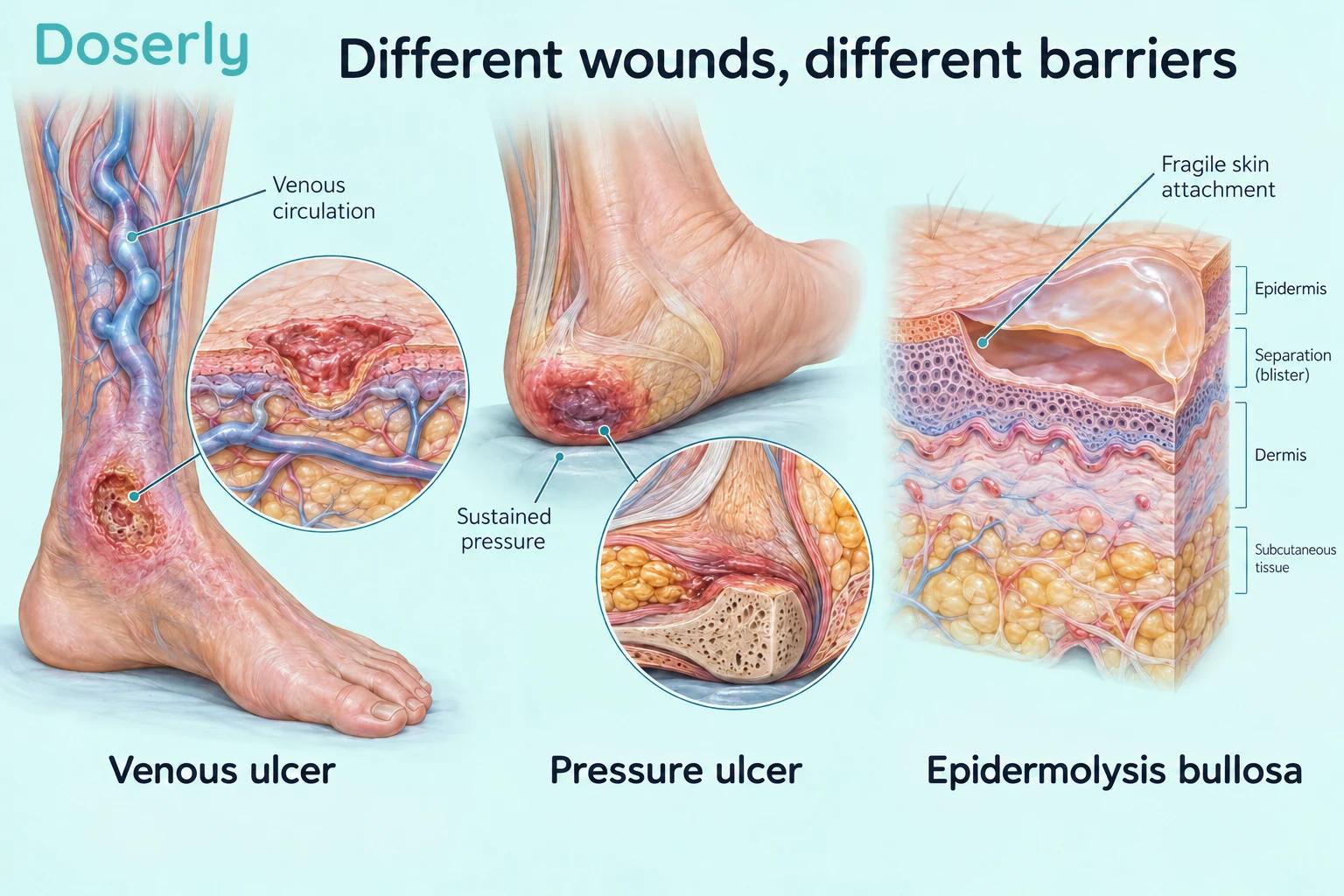
There have been human trials of topical thymosin beta-4 in skin wounds. They are worth reading carefully because they tested people with actual ulcers, rather than relying entirely on cell experiments. But their findings do not support a single claim that the peptide heals all kinds of damaged skin. Venous ulcers, pressure ulcers and the blistering disorder epidermolysis bullosa pose different problems, and their trials produced different kinds of evidence.
The most useful question is therefore specific: what wound was treated, what else did the person receive, and how did healing compare with the control group? Answering it reveals a tentative venous-ulcer signal alongside less encouraging posted results in two other conditions. It also explains why these studies cannot establish the usefulness of an injected product for a sports injury.
A venous ulcer has a circulation problem behind it
Venous leg ulcers are associated with problems returning blood from the legs toward the heart. Pressure builds in the leg veins and affects the surrounding skin. The open area may be the most visible part of the condition, but treating the surface alone does not explain or address everything that keeps it open. The NHS describes compression as a central part of treatment, following assessment of the circulation. NHS venous leg ulcer overview
This matters when reading an experimental gel study. If participants also receive consistent dressings, compression and wound care, some ulcers may improve regardless of the gel's active ingredient. That improvement is clinically valuable. It just cannot all be credited to thymosin beta-4.
The earlier report of the European thymosin beta-4 program described a randomized, placebo-controlled study in which compression stockings and wound debridement were part of care. Debridement means removing material, including dead tissue, that can interfere with assessment and healing. This was an ongoing-study account, not a separate completed demonstration of efficacy. Venous-ulcer study design, 2007
The subsequent publication reported 73 participants at eight European sites. Its abstract described comparable tolerability and suggested that the 0.03% topical formulation might accelerate healing, particularly in small to moderately sized ulcers. It also described complete healing within three months in about one-quarter of patients. Those observations justify interest in the approach, but the accessible abstract does not supply the arm-by-arm data needed to calculate a reliable treatment benefit ourselves. Completed venous-ulcer report, 2010
That is a narrower conclusion than either “it works” or “every wound trial was negative.” The authors reported a possible signal. Without the complete comparative results, we should not turn that signal into a precise extra chance of healing, a number needed to treat or a recommendation for an individual ulcer. Nor should the approximate one-quarter figure be presented as an improvement over placebo; a healing proportion and a treatment difference are different quantities.
Pressure ulcers ask a different question
A pressure ulcer develops when pressure or rubbing damages skin and underlying tissue, often over a bony area such as the heel or tailbone. Limited movement can leave the same area exposed for prolonged periods. Repositioning, suitable support surfaces and an individualized wound-care plan are therefore relevant to the cause, not just the appearance of the wound. NHS pressure ulcer guidance
A surface treatment could still be worth studying in this setting. But even a promising biological action would have to show benefit while the pressure problem was being managed. A person whose heel remains loaded and a person whose leg ulcer receives appropriate compression are not interchangeable examples of “slow healing.”
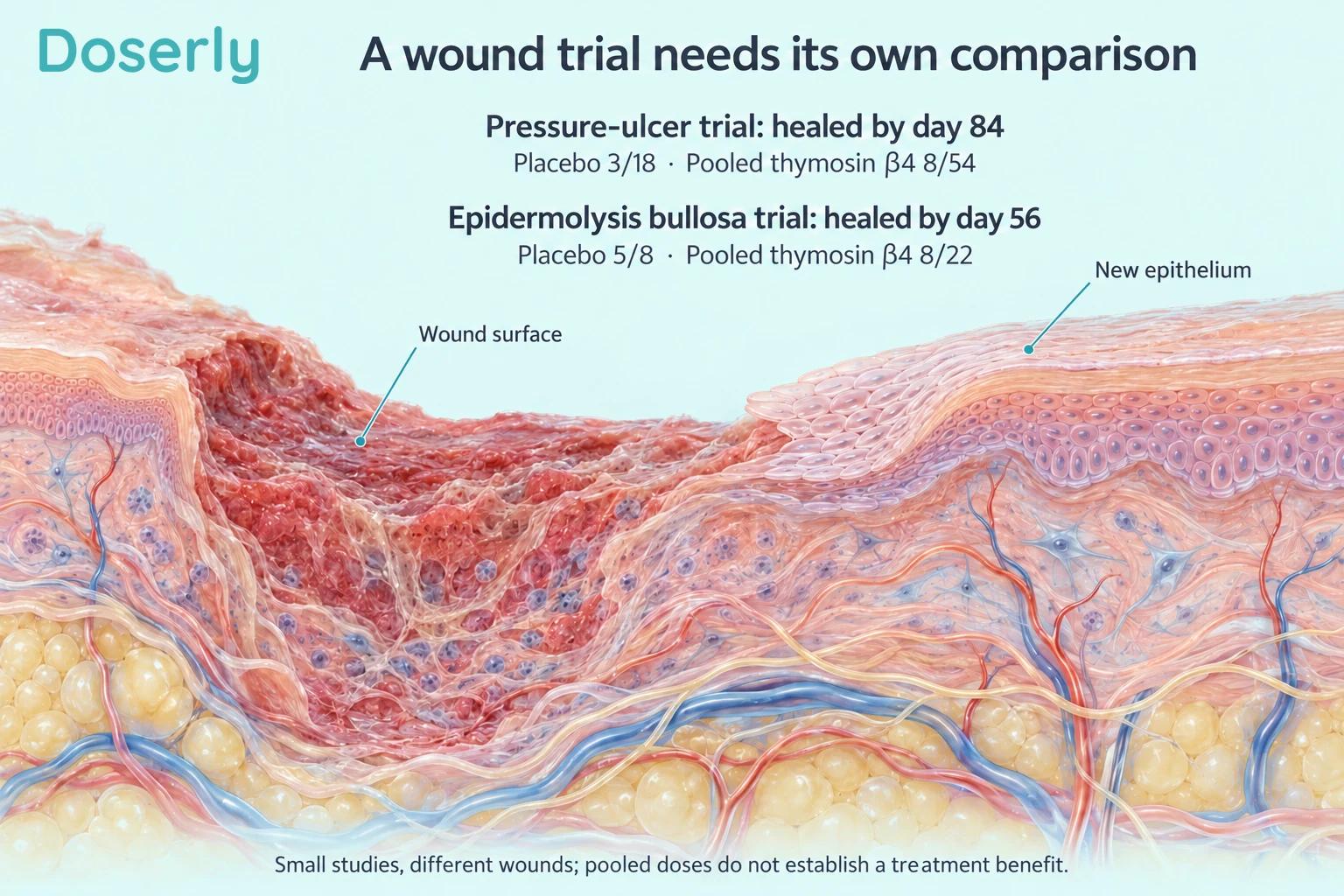
The posted results for the thymosin beta-4 pressure-ulcer study are particularly informative. It randomized 72 participants: 18 to placebo gel and 54 across three active concentrations. Treatment could continue for up to 84 days. Safety and tolerability were the primary objective; the incidence of wound healing by day 84 was a secondary outcome. The registry pools the active groups in its reported comparison. Pressure-ulcer trial results
At that endpoint, healing was reported in 3 of 18 placebo participants and 8 of 54 participants assigned to the pooled active groups. Those fractions are approximately 17% and 15%, respectively. They do not show an obvious advantage for active treatment. The unequal denominators are important: eight healed wounds can sound better than three until the number of people in each comparison is included.
These small, pooled results do not establish that thymosin beta-4 makes pressure ulcers worse. They also do not establish equivalence between the treatments. A small trial can be uncertain about modest differences, and combining concentrations obscures what happened at each dose. The useful finding is more restrained: these posted healing results do not demonstrate superior healing from the tested treatment.
Epidermolysis bullosa is a skin-fragility disorder
Epidermolysis bullosa, often abbreviated EB, refers to conditions in which the skin is unusually fragile and can blister with relatively minor friction or injury. In inherited forms, changes in genes affecting skin structure disrupt the attachment and resilience of skin layers. Closing one wound does not mean that the underlying tendency to blister has disappeared. NIAMS overview of epidermolysis bullosa
That distinction changes what a treatment needs to accomplish. A selected wound may close while other wounds form. A useful treatment might reduce the burden of a particular wound without correcting the genetic condition. Conversely, a claim that a product “repairs skin” can imply a much broader biological correction than a short trial actually measured.
The thymosin beta-4 EB study enrolled 30 people rather than the originally intended 36. Eight received placebo and 22 received one of three active concentrations, again pooled in the posted results. Treatment was topical and could continue for up to 56 days. The study was terminated because of difficulty obtaining patients and expiration of study drug, rather than because the registry recorded a proven treatment benefit. EB trial results and study history
The reported healing outcome was closure without drainage. Five of eight participants in the placebo group and eight of 22 in the pooled active group were reported with healed wounds. These correspond to about 63% and 36%. The numerical result does not support a claim that active treatment improved healing in this study.
Here too, small numbers and pooled doses limit interpretation. One person's outcome changes a percentage substantially when the denominator is eight. Early termination also restricts how much can be learned. Those limitations are reasons to avoid overstating either benefit or harm; they are not reasons to erase the comparison and describe the study simply as successful human research.
Why placebo healing is real healing
In both posted trials, people assigned to placebo experienced wound closure. That can seem surprising if “placebo” is understood as receiving no help. In wound research, a control gel can be used alongside the clinical attention and wound care that participants need. The comparator helps distinguish the additional contribution of the active ingredient from the recovery occurring with the rest of the study care.
The venous-ulcer design report makes that context concrete by describing compression and debridement. A study visit can also improve consistency: someone receives a more regular assessment, a dressing schedule or reinforcement of an existing care plan. The correct comparison is between groups experiencing the trial, rather than between a treatment group's end result and an assumption that none of their wounds would otherwise improve.
For a reader, this changes how testimonials and photographs should be interpreted. A wound that looks smaller after a new product was introduced may truly have improved. The photograph does not establish which part of the person's care caused it. Without a concurrent comparison, changes in pressure, circulation management, dressings and the passage of time remain possible contributors.
This is also why counting publications is less useful than identifying independent studies. The 2007 venous-ulcer design account and the 2010 results publication belong to the same development program. Calling them two successful trials would make the evidence appear more extensive than it is.
Safety needs its own reading
A study can provide useful tolerability information without proving efficacy. The venous-ulcer abstract described tolerability as acceptable and comparable with placebo. That observation concerns the formulation, exposure and patients actually studied; it does not validate every product using the same peptide name.
The pressure-ulcer registry separately reports a safety population of 18 placebo recipients and 53 active recipients, one fewer active participant than was randomized. Serious adverse events affected people in both groups. A registry event listing records what occurred during the observation period; it does not, by itself, establish which events the gel caused. These medically vulnerable participants also had health risks beyond the study wound. Pressure-ulcer safety results
In the EB trial, no serious adverse events were reported in either group. That is useful descriptive information from a small study, rather than proof that rare problems cannot occur. The same trial's limited healing results must remain visible alongside its safety findings. EB safety results
For patients, “tolerated in a small trial” and “likely to help my wound” answer separate questions. Neither should be used as a substitute for the other when weighing a proposed treatment.
These gel trials do not validate an injection
Every wound study discussed here tested topical treatment in a defined disease setting. Applying a formulation to a wound creates a different exposure from administering a peptide by injection. The clinical question also changes when someone moves from a chronic skin ulcer to a tendon, muscle or joint injury.
The FDA's wound-product guidance explains why wound type and route deserve attention: different wound causes can require separate clinical studies, and preclinical work should reflect the intended clinical exposure. An argument that a substance influences cell migration does not remove the need to test the actual formulation and outcome in people. FDA wound-product development guidance
Names add another source of confusion. A product sold as TB-500 should not automatically inherit the evidence for full-length thymosin beta-4. Doserly's thymosin beta-4 guide explains that distinction. Even an accurately identified molecule would still need appropriate evidence for its route and proposed use.
What to take to a wound-care appointment
A practical conversation starts with the wound diagnosis. Ask what is keeping the area open, how circulation and pressure have been assessed, and what the current plan is intended to change. If an experimental topical treatment is proposed, ask which trial matches your wound type and whether its benefit was measured against the care you are already receiving.
It is also reasonable to ask what counts as success: complete closure, less drainage, less pain, fewer dressings or durable healing without reopening. Those outcomes can matter differently to someone trying to walk comfortably or manage care at home. A study's chosen endpoint should be clear before its findings are used to support a personal decision.
Worsening pain, hot or swollen surrounding skin, pus or fever warrant prompt clinical assessment; they are not a reason to wait for an experimental product to start working. The NHS identifies these as concerning features in pressure ulcers. When pressure ulcers need urgent help
Thymosin beta-4's skin-wound research is a small and mixed body of evidence. The venous-ulcer publication suggests a possibility worth investigating, while the posted pressure-ulcer and EB comparisons do not demonstrate improved healing. Keeping those findings attached to their original wound types gives patients a more useful answer than a broad promise of skin repair.
Sources
- The effect of thymosin treatment of venous ulcers, 2010
- Venous-ulcer prospective study design, 2007
- Thymosin beta-4 pressure-ulcer study: posted results
- Thymosin beta-4 epidermolysis bullosa study: posted results
- NIAMS: epidermolysis bullosa
- NHS: venous leg ulcer
- NHS: pressure ulcers
- FDA: developing chronic ulcer and burn-wound treatments